Digital Amphitheatre
Building the User Interface
A key aspect of the digital amphitheatre is its innovative user
interface. This is implemented based on the vic video
conferencing application from Lawrence Berkeley National Laboratory
working in conjunction with the UCL
Robust-Audio Tool.
The user interface of vic has been augmented with an
additional mode, which displays the speaker, four panelists, and a
number of audience segments (in our present implmentation, six segments
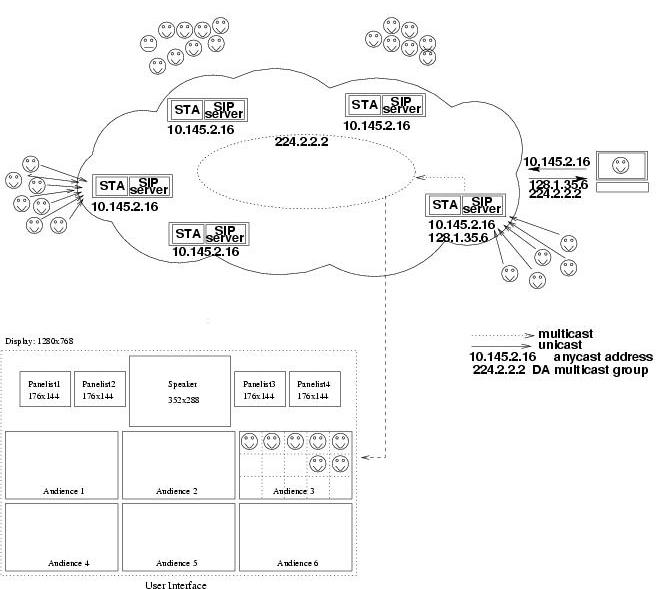
are used) in a full-screen configuration. Due to the use of spatial
tiling agents, it is only necessary to display a small number of video
streams for the audience: each stream contains a 5x3 block of 80x64
pixel frames. The result is an interface that displays hundreds of
video clips, while only receiving a small number of RTP streams (our
present implementation receivers 11 streams in total, yet displays 95
video sources). The figure below shows the combination of streams via
the spatial tiling agents, and their composition in the user interface.
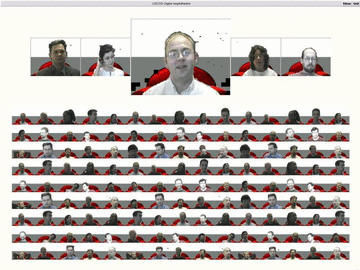
Due to the use of background substitution, the interface is clean and
simple. It displays no information about each source by default: a tool
tip popup is used to highlight participant names and other information
(the mixer functionality included in RTP allows for this to be conveyed
along with a tiled video stream).
In present implementation, those participants which appear in the panel
and as the speaker are selected command-line parameter, referenced by
RTP CNAME. This provides for static selection of panelist and speaker.
We plan to add the ability to dynamically chose panelists in a future
version.
Audio is provided by a separate instance of the UCL Robust-Audio Tool,
running on a local host. All communication and coordination between
audio and video - including lip-sync - is achieved via a
message bus interface.