An IRTF Retrospective
15 June 2025
It’s been a few months since I completed my term as Chair of the
Internet Research Task Force
(IRTF) and handed over to
Dirk Kutscher. With a little distance, I wanted to reflect
on the organisation, the experience, and what I learned.
The IRTF plays a unique role as a point of contact between the Internet
research and standards development communities. It provides a venue
where researchers, implementers, standards developers, network
operators, and policy makers can come together to exchange knowledge
and experiences to help shape the future of the network. This allows
new ideas from the research community to find their way into the
standards world, helping ensure the standards evolve and stay relevant,
while also providing a forum where standards developers can seek input
from broader researcher community on questions that may have arisen
during the standardisation process.
The period while I was Chair of the IRTF (March 2019 – March 2025) saw
some challenges, due to the pandemic, but also some progress. I’m
pleased that IRTF remains a vibrant and growing community, and
continues to play a key role in connecting the Internet research and
standards communities.
Research Groups
As the pandemic receded, I worked with the IRTF community to charter
three new research groups, and significantly re-charter
a fourth, broadening the scope of the research undertaken.
-
The Usable
Formal Methods Research Group was created to promote the use of
formal methods for specification of Internet protocols.
There’s a tension, when writing standards documents, between
inclusivity and precision. A standards development organisation
wants to facilitate discussion and consensus building, and to take
wide input on the form and scope of the standards it develops, to
ensure its outputs are both useful and perceived to
have legitimacy. This requires an open and inclusive process, and
for the standards documents to be written in a manner that is
widely accessible, including to people that are new to the process
or not experts in standards development. This usual result is that
standards are written in a natural language, such as English, and
make careful use of well-defined terms and diagrams to ensure
precision with only limited use of formal languages and methods.
The resulting standards suffer from the inherent ambiguity of
natural language and the inability to use automated tools to reason
about, and validate, their contents. Formal methods can remove that
ambiguity, and make it possible to check standards for correctness,
but they’re not widely understood by standards developers or
necessarily easy to use. The Usable Formal Methods Research Group
is trying to help bridge this gap, by connecting those who are
developing formal methods for network protocol specification with
those who write network protocol standards, to explore how the
benefits of formalisms can be incorporated into the standards
process while maintaining the open debate and low barriers to
entry that are essential for effective standards development.
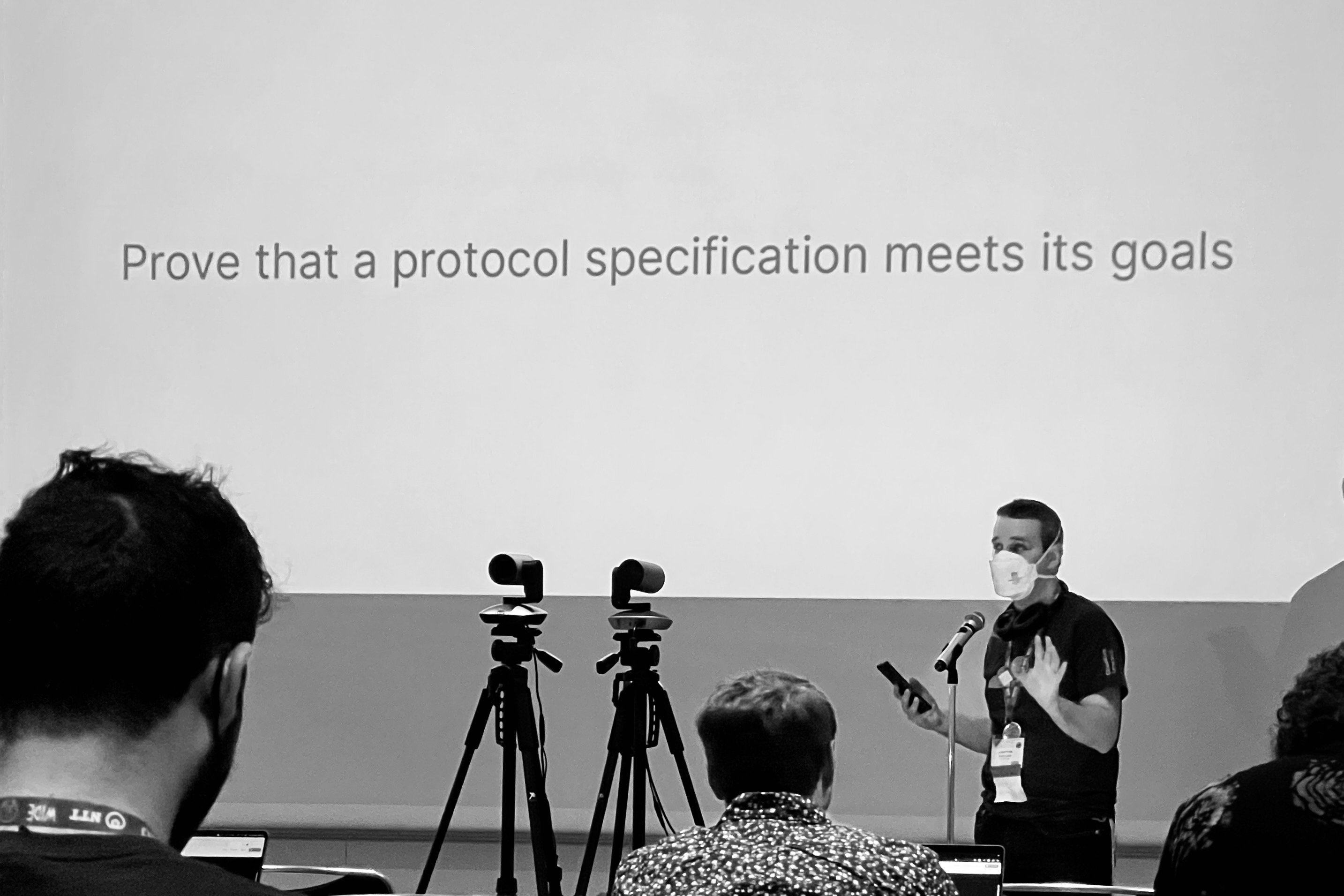
This is not a problem that will be solved quickly, but the research
group chairs,
Jonathan Hoyland and
Stephen Farrell, are doing a great job bringing formal methods
researchers to the standards meetings, moving the discussion
forwards, and running training to help raise awareness of what
tools and techniques exist today and how they can be used –
especially in terms of cybersecurity and cryptography, where there
is existing practice to build upon, but also in trying to draw
lessons that are applicable to the wider network standards
development community.
-
The
Research and Analysis of Standard-Setting Processes research
group (RASPRG) aims to understand how Internet standards are
developed, and by whom, and to connect those studying Internet
governance with those developing technical standards for the
operation of the Internet.
The Internet standards development organisations, including the
Internet Engineering Task Force (IETF), have procedures in place to
ensure standards are developed in an open, transparent, and fair
manner, taking input from multiple stakeholders. To ensure trust in
those standards, and in the Internet governance process more
broadly, however, it’s important understand the makeup of the
standards development community and how it changes over time; which
people, organisations, and countries are successful at influencing
standards, and which are not; and what factors lead to success in
standards development.
RASPRG aims to connect those studying Internet governance, and the
economic, legal, sociological, and political factors that affect
standards-setting, development, and uptake, with those actively
involved in the development of those standards, to ensure the
research is grounded in the reality of the process and to apply
research insights to improve the process.
The group grew out of an
IAB workshop on analysing IETF data, that I co-organised with
Niels ten Oever,
Corinne Cath, and
Mirja Kühlewind. The current chairs,
Ignacio Castro and
Alvaro Retana, with Niels ten Oever as a former
chair, have done a great job connecting with researchers in the law,
economics, and social science communities, and with
researchers studying Internet governance more broadly – work that’s
especially important to help build trust in the process given
political factors pushing to splinter the global Internet and the
upcoming
WSIS+20 Internet governance review.
-
The
Sustainability and the Internet Research Group is most recently
chartered, completing
its first meeting at IETF 122 in March 2025, and is considering
the challenges in developing and operating an environmentally,
socially and economically sustainable Internet.
This research group, led by chairs
Ali Rezaki, Eve Schooler,
and Michael Welzl, is exploring
how to better characterise the carbon footprint of the Internet, to
ensure it is environmentally, socially, and economically sustainable,
while fostering an appreciation of the use of the Internet to enhance
Sustainability – the handprint of the network. The plan is for it
to take a holistic, longer-term, approach to understanding the
environmental impacts of the network, to complement the focussed
standards development work of the
IETF GREEN
Working Group and elsewhere.
I also worked with Dirk Kutscher
and Lixia Zhang, chairs of
the Decentralisation
of the Internet Research Group, to expand the scope of that group
to more broadly investigate the causes of Internet centralisation, and
to articulate of the impact of economic, regulatory, and social dynamics,
in addition to protocol design, on centralisation and consolidation of the
Internet. Two highly successful workshops
(online
during the pandemic and at the
ACM CoNEXT 2024
conference) explored these topics – with ongoing work relating to
Internet governance and the debate about federated social media, such
as Bluesky, Mastodon, and the Fediverse.
The key strand that runs through all of these research groups has been to
broaden the scope of the IRTF, moving beyond the technological to
consider also broader economic, social, regulatory, and societal
concerns and building on preexisting activities in research groups
such as those on Human
Rights Protocol Considerations and
Privacy Enhancements
and Assessments. The IRTF is certainly not abandoning technical work,
the Crypto Forum
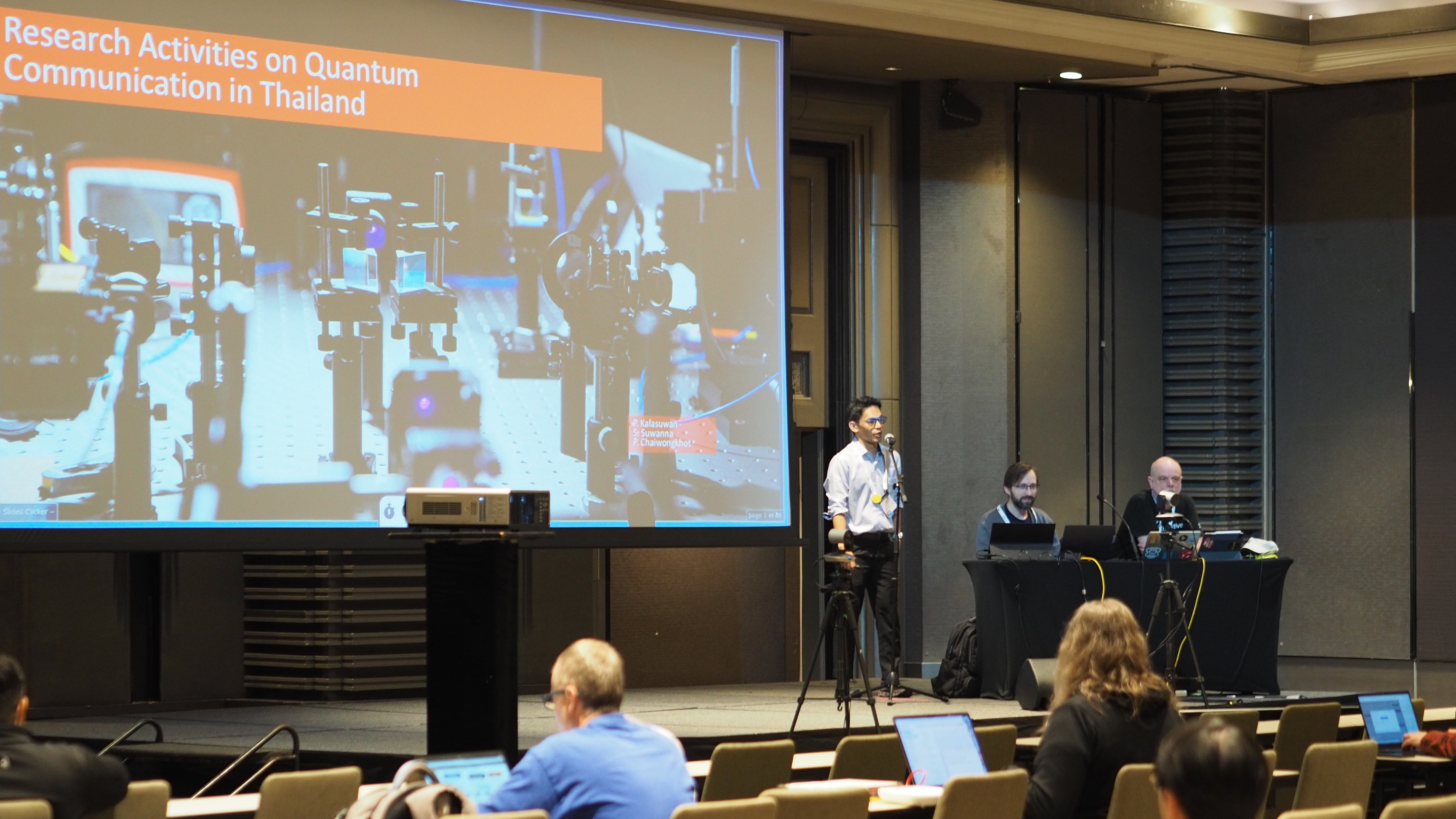
and Quantum Internet
research groups, amongst many others, are still active and doing great
work focussed on core Internet technologies, but it’s increasingly clear
that Internet research and standards must consider the broader societal
context if they’re to be effective, and the IRTF is well-placed to help
make connections and consider these issues in addition to its
focus on improving core Internet technologies.
Applied Networking Research Workshops and Prizes
Aside from the research groups, the IRTF organises the Applied
Networking Research Workshop, co-sponsored by
ACM SIGCOMM, and
administers the Applied Networking Research Prize on
behalf of the Internet Society.
The Applied Networking Research
Workshop (ANRW) is an academic conference, with peer-reviewed
proceedings published in the ACM Digital Library, that allows
researchers, vendors, operators and the Internet standards community
to present and discuss new results in applied networking research.
By co-locating with the IETF meeting each July it aims to foster
cross-community collaboration, helping ensure that new research has a
pathway into the standards community, and industry more broadly, and
providing an opportunity for the standards developers to raise
awareness of issues that might benefit from research input. The ANRW
has grown in scope over the years – thanks to the efforts of a
fantastic set of programme chairs and reviewers – and has received a
range of increasingly high-quality submissions that reflect a growing
awareness of the benefits to researchers in engaging with the standards
community.
The Applied Networking Research
Prize recognises high quality applied networking research,
interesting new ideas of relevance to the Internet standards community,
and upcoming people that are likely to have an impact on Internet
standards and technologies, with a focus on cases where these people or
ideas would not otherwise get much exposure or be able to participate
in the discussion. It’s been a huge privilege to chair the award
committee, and I've been impressed by the range and quality of the work
submitted over the years – making the awards has been a huge challenge
because there were so many deserving submissions. The award talks, that
take place during IETF meetings, have been outstanding – people
regularly tell me they’re one of the highlights of the meeting – and
have led to a number of ongoing collaborations between researchers and
the IETF and IRTF communities. My sincere thanks go to everyone who
helped review submissions and to everyone who was willing to submit
their work.

Equality, Diversity, and Inclusion
The ANRW and ANRP have also helped widen the appeal of the IRTF and
bring in an increased range of participants. These complement the
diversity travel grant
programme that IRTF has been administering since the return to
in-person meetings as the pandemic receded, and the range of in-person
and remote fee waivers we've been able to offer to bring in people who
wouldn't otherwise be able to attend the meetings.
There is clearly more to do, and the grants and fee waivers we've been
able to offer make only a limited contribution to improving diversity,
but I’m proud that we have supported more than 50 people, including a
significant fraction (55%) from the Global South, to attend IRTF events
co-located with IETF meetings, with 42% of awardees being female, non-binary,
or transgender, and that we've supported repeat attendance for a number of
people to help them to make connections and develop their participation
in the community as more than a one-off activity.
The recently completed
IRTF Code of Conduct further makes clear the value the IRTF places
providing and open and inclusive forum that encourages diversity of
ideas and participation, and should help maintain an environment that
encourages broad participation, and one in which people are treated
with dignity, decency, and respect.
Challenges
A key challenge over the past six years was, of course, the ongoing
COVID-19 pandemic.
As part of the IETF leadership team, along with the IESG and IAB, the
IETF LLC staff, and the Secretariat, I was involved making the decision
to cancel the IETF 107 meeting, planned for Vancouver in March 2020,
and move to an online meeting, and in planning how to run the IETF and
IRTF as online events for the following two years before a gradual
return to in-person events.
There was the expected drop-off in activity during this period – there
was a pandemic, after all, and many people, or their family and friends
got seriously ill – but both the IETF and IRTF continued their
activities during this time. Indeed, as we highlighted at the time in
Evolving the Internet Through
COVID-19 and Beyond, which I co-authored with
Jari Arkko,
Alissa Cooper, and
Tommy Pauly,
and as discussed in the
IAB COVID-19 Impacts Workshop
that I helped organise, one thing the pandemic showed was how essential
the Internet is in supporting collaboration.
It’s important, going forward, that we retain the flexibility inherent
in the current design of the Internet, that made it possible for us all
to switch to home working on minimal notice. We must remember that this
flexibility is the result of a deliberate set of design choices,
relating to both the technology and governance of the Internet, that
supported the development of an open, technology neutral, general
purpose network, operated and managed in a decentralised manner, that
could be repurposed at such short notice to support a new way
of working.
We must not give in to the engineering desire to hyper-optimise the
network, or to the business and political pressures to centralise,
consolidate, and constrain the network, to support only particular
applications or uses. The pandemic showed us that
the Internet way of networking is an essential choice if we are
to provide a robust and flexible Internet that can itself support the
needs of society – and a choice that I'm proud to have been able to
help the IRTF support over these past years.