Lecture 1 provides an introduction to the course. It reviews the course
aims and objectives, intended learning outcomes, and timetable; and it
outlines the means by which the course will be assessed. This lecture
is comprised on one part.

00:00:00.333
Welcome to Advanced Systems Programming.
00:00:02.800
For those who don’t know me, my name is Colin Perkins
00:00:06.100
and I’m the lecturer and coordinator for this course.
00:00:08.633
In this first lecture I’ll introduce the course materials,
00:00:12.600
and review the aims, objectives, and administration
00:00:15.400
of the course.

00:00:18.933
As I said, I'm Colin Perkins.
00:00:21.300
I'll be the lecturer for this course.
00:00:23.133
My contact details are on the slide
00:00:25.533
and if you have questions about the material
00:00:27.466
covered in the course I'm happy to answer them via email.
00:00:30.533
We also have office hours and discussion
00:00:33.033
sessions throughout the course,
00:00:34.533
and a chat room in Microsoft teams.
00:00:36.866
And in normal times
00:00:38.500
you can also find my office in Lilybank Gardens.
00:00:42.900
The lecture slides, recordings, transcripts, lab
00:00:45.833
exercises, and other course material are on Moodle.
00:00:48.700
And the material is also on my website at csperkins.org/teaching.
00:00:53.333
The version on my website also has lecture transcripts
00:00:56.433
that are difficult upload to Moodle.

00:01:00.066
So what’s this course, about?
00:01:04.000
Well, over the last 10 to 15 years or so
00:01:07.300
we’ve seen a significant shift in the technology landscape.
00:01:11.466
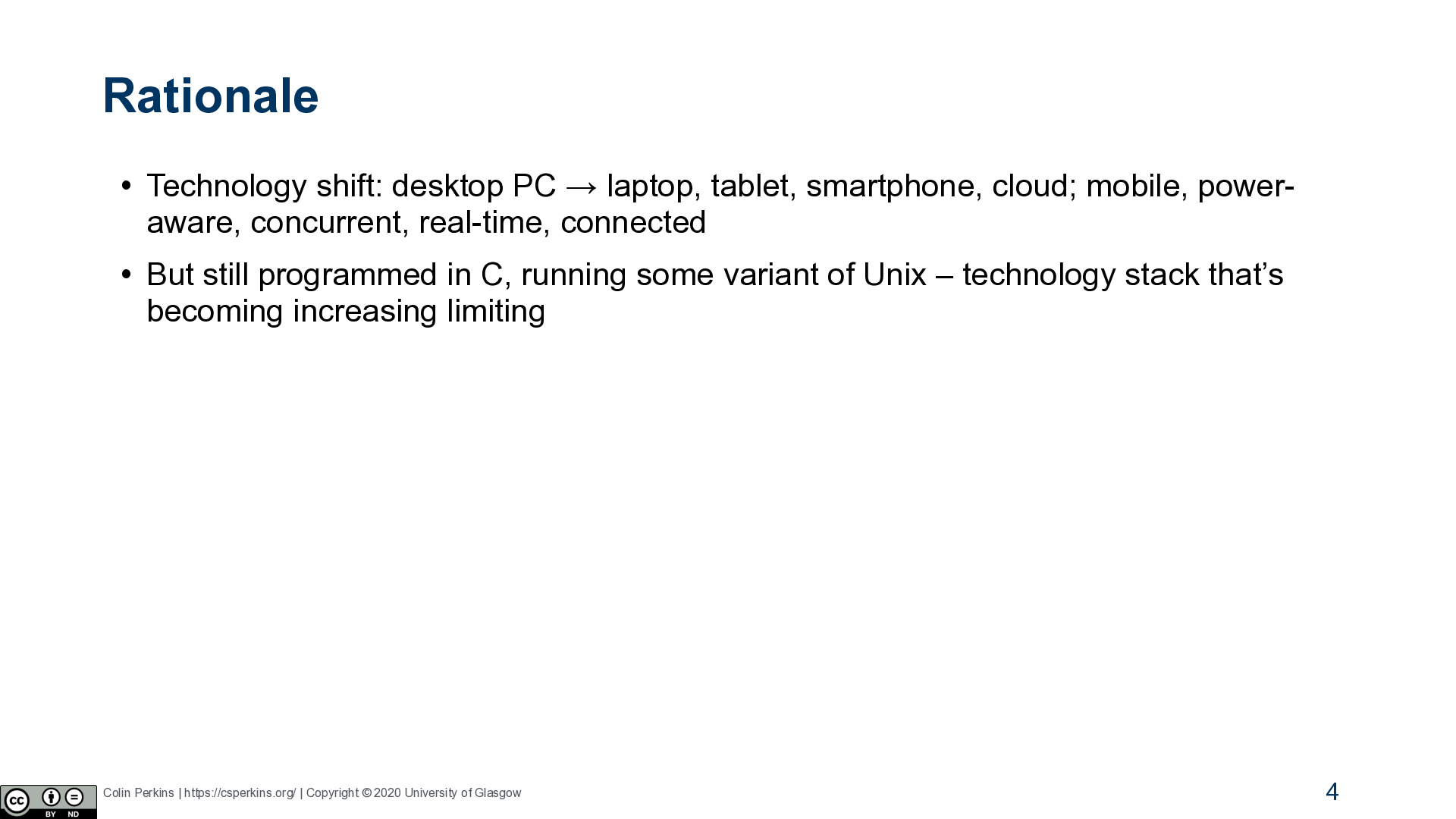
We’ve gone from a world dominated by desktop PCs running Windows,
00:01:16.100
with a relatively small number of servers, often located on site,
00:01:19.766
which support those PCs,
00:01:22.133
to a world dominated by smartphones and cloud computing.
00:01:27.166
Devices are now much more likely to be mobile and battery powered,
00:01:30.600
and connected to a network
00:01:33.400
that lets them offload computation and data
00:01:35.566
to remote cloud computing resources
00:01:38.100
running in dedicated data centers.
00:01:40.966
This changes the way we use those devices,
00:01:44.233
and the type of applications we can use.
00:01:46.900
And part of that shift is that we’re increasingly
00:01:49.900
using real time applications like telephony,
00:01:53.200
video conferencing, or streaming video,
00:01:55.800
on our smartphones, tablets,
00:01:57.666
and other general purpose computing devices.
00:02:00.833
And these applications are powered
00:02:03.266
by an increasing number of servers.
00:02:06.133
These servers are not battery powered or mobile,
00:02:09.166
but are also, increasingly, power aware as data centre
00:02:12.800
operators strive to reduce the electricity
00:02:15.100
and air conditioning costs of operating
00:02:16.800
their services, and to reduce their environmental impact.
00:02:22.033
And the devices, we use her also increasingly concurrent.
00:02:26.166
In part, this is because a data centre is a
00:02:29.266
natural home for concurrency.
00:02:30.833
Running millions of instances of the same service
00:02:33.666
to meet the needs of different users.
00:02:35.900
But it's also, in part, because of the
00:02:37.933
need to control power consumption
00:02:39.900
has pushed mobile CPUs in the
00:02:42.000
direction of multi-core support.
00:02:44.233
These days, everything is a multi-core system.
00:02:49.566
Despite these massive shifts,
00:02:52.133
the underlying operating system and software stack
00:02:54.800
has changed relatively little.
00:02:57.333
The operating system on my smartphone
00:03:00.133
runs the same underlying software stack
00:03:02.633
as the desktop workstation I used in 1992,
00:03:05.900
for example.
00:03:07.300
It uses the same operating system kernel,
00:03:10.166
it's programmed using the same programming language
00:03:13.133
and shares many of the same software libraries,
00:03:16.166
API's and features.
00:03:18.366
The Code has evolved and changed, of course,
00:03:21.300
but the organization, architecture, and underlying approaches
00:03:25.033
to writing the system remain surprisingly similar.
00:03:29.400
The technology, and programming model,
00:03:32.066
is increasingly limiting.

00:03:37.366
In this course we'll explore some new techniques
00:03:40.466
and approaches that aim to support safer,
00:03:42.766
and more effective, systems programming.
00:03:46.100
We'll talk about advances in programming languages
00:03:49.100
that allow us to retain the advantages of systems
00:03:51.866
programming languages, such as C,
00:03:54.100
in terms of control over data
00:03:56.033
representations and high performance,
00:03:58.133
while being much safer and easier to program.
00:04:02.333
And we'll talk about how operating systems
00:04:04.300
might change, to better support writers of
00:04:06.633
device drivers, level networking code,
00:04:09.333
and so on,
00:04:10.633
with the goal of improving the safety
00:04:12.300
and security of the overall system.

00:04:18.533
The aims of the course are to explore the features
00:04:21.200
of modern programming languages and operating systems
00:04:23.966
that can ease the challenges of systems programming,
00:04:26.866
focusing on type systems and runtime support.
00:04:30.733
We'll review the literature on systems programming
00:04:34.033
and operating systems design.
00:04:35.700
discuss limitations of deployed systems,
00:04:38.866
and consider how systems programming might evolve
00:04:41.400
to address the challenges of supporting
00:04:43.133
modern computing systems.
00:04:46.133
In particular, the course will aim to highlight
00:04:48.933
how modern programming languages
00:04:50.766
and new approaches to software development
00:04:53.133
can help ensure system correctness and security.
00:04:57.866
Fundamentally, we'll be looking at how systems programming is
00:05:00.900
changing to support new applications and new use cases.

00:05:06.600
What are the expected learning outcomes?
00:05:11.333
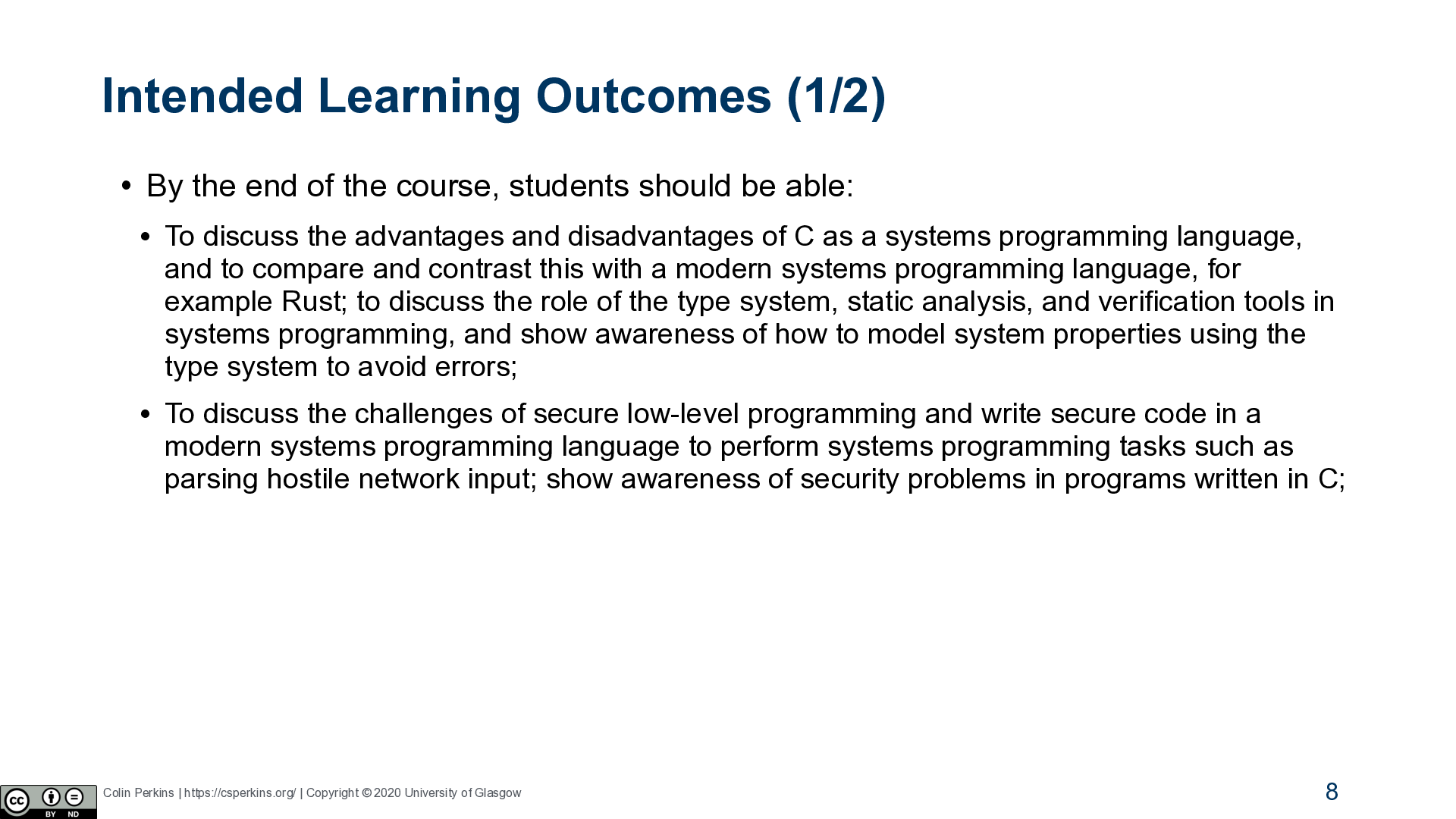
Well, first and most importantly,
00:05:14.466
by the end of the course, you should understand
00:05:16.800
the advantages and disadvantages of using C
00:05:19.666
as a systems programming language.
00:05:22.300
You should be able to discuss the benefits of using a modern,
00:05:25.900
strongly typed, systems programming language
00:05:28.100
as an alternative.
00:05:29.666
And you should have an understanding of the concepts
00:05:32.466
behind type-driven development,
00:05:34.300
and the role of the type system in ensuring code correctness.
00:05:40.333
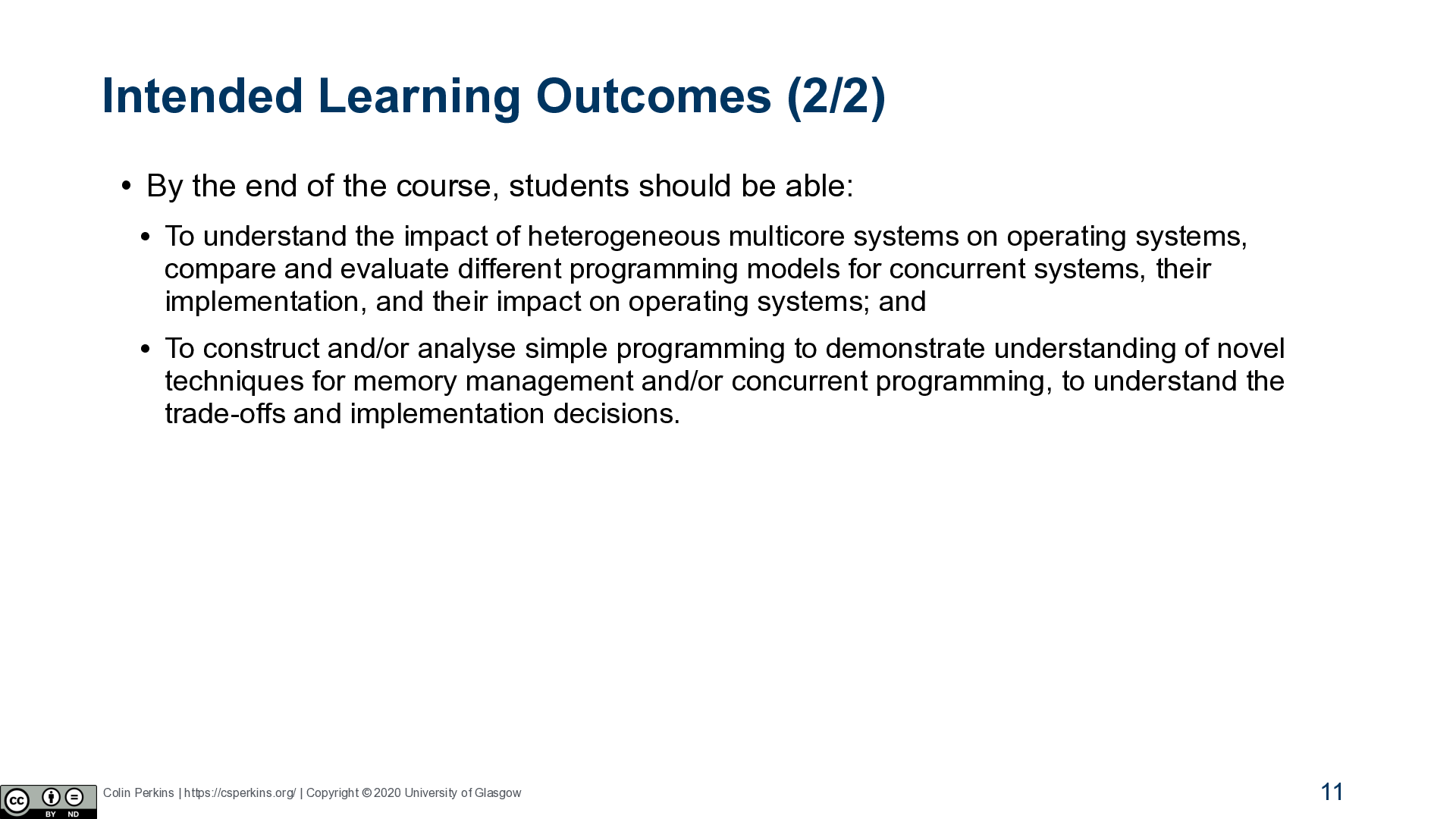
Second, you should have some understanding of
00:05:42.866
the challenges in writing secure systems code.
00:05:46.233
In particular, you should understand some of the
00:05:48.966
issues around memory safety and parsing
00:05:51.300
untrusted network input.
00:05:53.300
And you should understand why these tasks are difficult in C.

00:05:59.533
Third, you should have some understanding
00:06:03.266
of the basics of how garbage collection,
00:06:05.300
reference counting, region based memory management,
00:06:08.866
and manual memory management work.
00:06:10.900
And you should have some idea when it's appropriate
00:06:13.566
to use each approach,
00:06:14.766
and what are the trade offs
00:06:16.200
between them.

00:06:19.100
You should understand why multi-core systems
00:06:22.266
have become popular, and the hardware trends
00:06:24.766
that are driving this.
00:06:26.400
And you should have an understanding of different
00:06:28.633
approaches to concurrent programming,
00:06:30.633
including multi threading,
00:06:32.533
actor based systems,
00:06:34.033
concurrent transactions,
00:06:35.533
and coroutines.
00:06:37.166
And understand a little of what are the trade-offs
00:06:39.866
between these different approaches to concurrent programming.
00:06:44.000
And finally, you should be able to write simple programs
00:06:47.333
in a modern systems programming language
00:06:49.466
to demonstrate your understanding.

00:06:54.566
There are a number of prerequisites for this course.
00:06:57.966
Firstly, you're expected to be familiar with the C programming language.
00:07:03.033
You won't need to write any C programs in this course,
00:07:07.333
but you will need to read and understand C code.
00:07:11.400
One of the aims of this course
00:07:13.633
is to make you aware of the strengths,
00:07:15.366
and weaknesses of C as a programming language,
00:07:17.900
and to compare C to other languages.
00:07:21.366
To do this, you need to understand C programming.
00:07:26.333
You also need to understand the basics
00:07:27.966
of operating systems and networking.
00:07:30.833
This is a systems programming course,
00:07:33.233
and operating systems and networks
00:07:35.033
are two of the main areas where systems programming is used.
00:07:40.300
And you need a conceptual understanding of functional programming.
00:07:44.100
You won’t need to read more than a few lines of Haskell code,
00:07:48.033
and you certainly wouldn't need to write Haskell programs.
00:07:52.233
But the ideas behind Haskell, and functional programming, are important.
00:07:57.233
We’ll be talking a lot about how functional programming concepts,
00:08:01.366
and some of the ideas around modern type systems,
00:08:04.133
both of which were pioneered in Haskell,
00:08:06.466
can be used in more mainstream systems programming tasks.
00:08:12.600
These prerequisites broadly match the systems programming,
00:08:16.033
operating systems, network systems,
00:08:18.666
and functional programming programming courses
00:08:21.300
in the Glasgow computing science degree.
00:08:24.400
You can take this course, if you haven't done those courses,
00:08:27.233
but you might need to do some catching up in your own time.
00:08:33.466
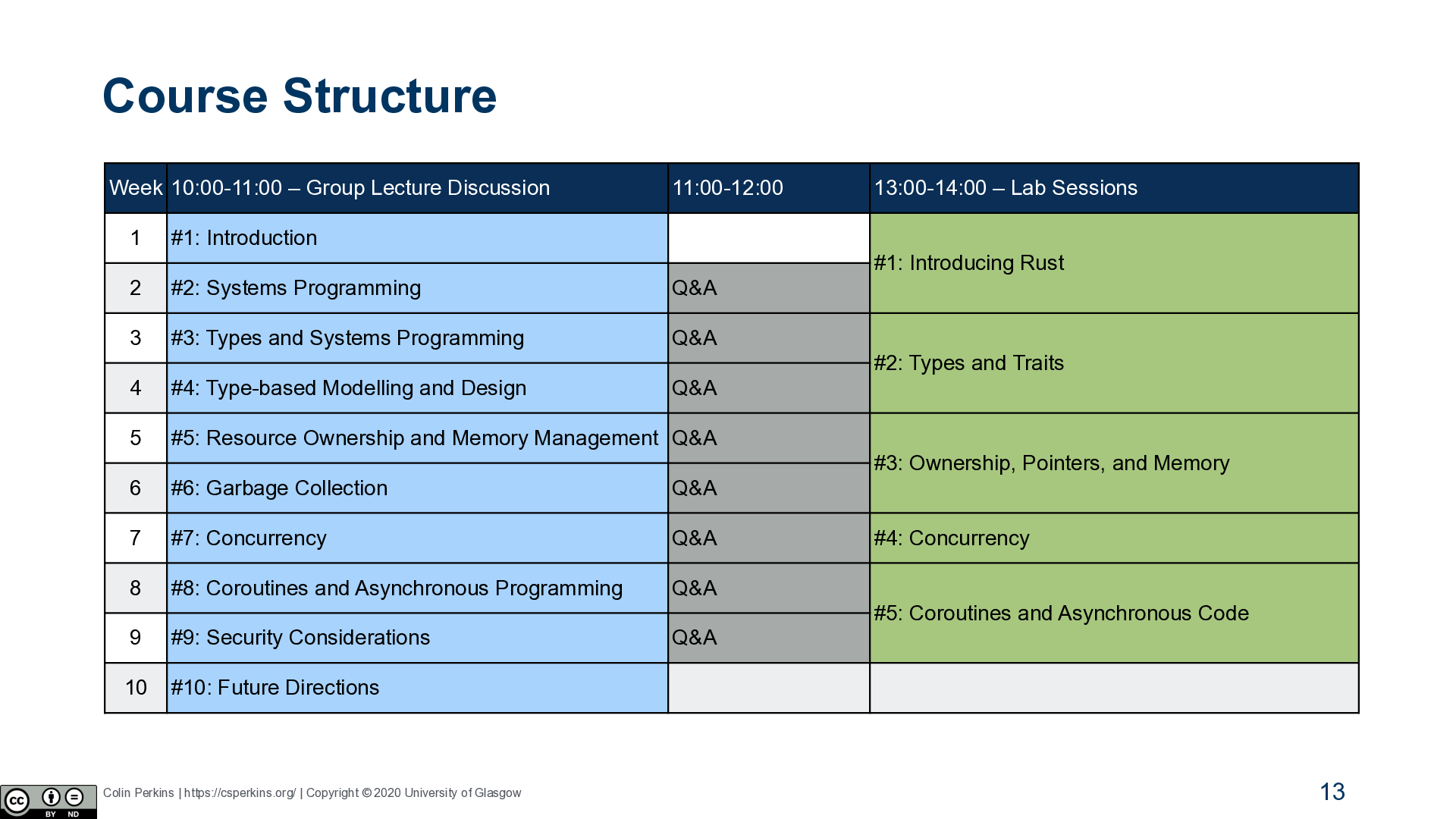
This course is structured as 10 lectures
00:08:35.866
and five lab exercises.
00:08:38.300
The lectures run weekly,
00:08:40.366
with a new topic each week for 10 weeks.
00:08:42.733
The lectures are pre-recorded,
00:08:44.900
and there’s a group discussion slot
00:08:46.500
and a Q-and-A slot each week.
00:08:49.633
The labs are also organized weekly,
00:08:51.666
but some exercises are expected
00:08:53.600
to take one week to complete,
00:08:55.366
while others will take two weeks.
00:08:57.333
The labs finish after nine weeks.

00:09:03.533
Lecture recordings will be made available ahead of time,
00:09:06.733
and will comprise one-to-two hours worth
00:09:08.800
of material each week
00:09:10.166
split into several shorter parts.
00:09:13.866
Each lecture will be accompanied
00:09:15.366
by a set of discussion questions
00:09:17.133
that'll be available on moodle and on the course website.
00:09:20.500
These discussion questions are not assessed,
00:09:23.766
and intended rather to help you understand the material.
00:09:28.800
We have a live session on zoom,
00:09:30.966
scheduled from 10 to 11 on Monday mornings.
00:09:33.633
The sessions are intended for discussion
00:09:36.400
of the lecture material and questions.
00:09:38.566
You should watch the lecture videos,
00:09:40.700
and think about the discussion questions,
00:09:42.766
before those timetable sessions.
00:09:46.033
This discussion slot is your main opportunity to ask
00:09:49.166
questions about the material,
00:09:50.666
and I would encourage you to come prepared
00:09:52.866
to use the slot for discussion.
00:09:55.266
The more questions and discussion we have,
00:09:58.200
the more useful, it will be to everybody.

00:10:03.733
Immediately following that discussion slot,
00:10:06.300
from 11-12 on Monday mornings,
00:10:08.933
is a scheduled question-and-answer drop-in session.
00:10:12.800
This is your time to ask questions
00:10:14.866
and discuss the materials with me
00:10:16.800
in a one-to-one zoom call.
00:10:18.700
And to ask any questions you don't want to
00:10:20.466
ask in the open discussion session.
00:10:26.033
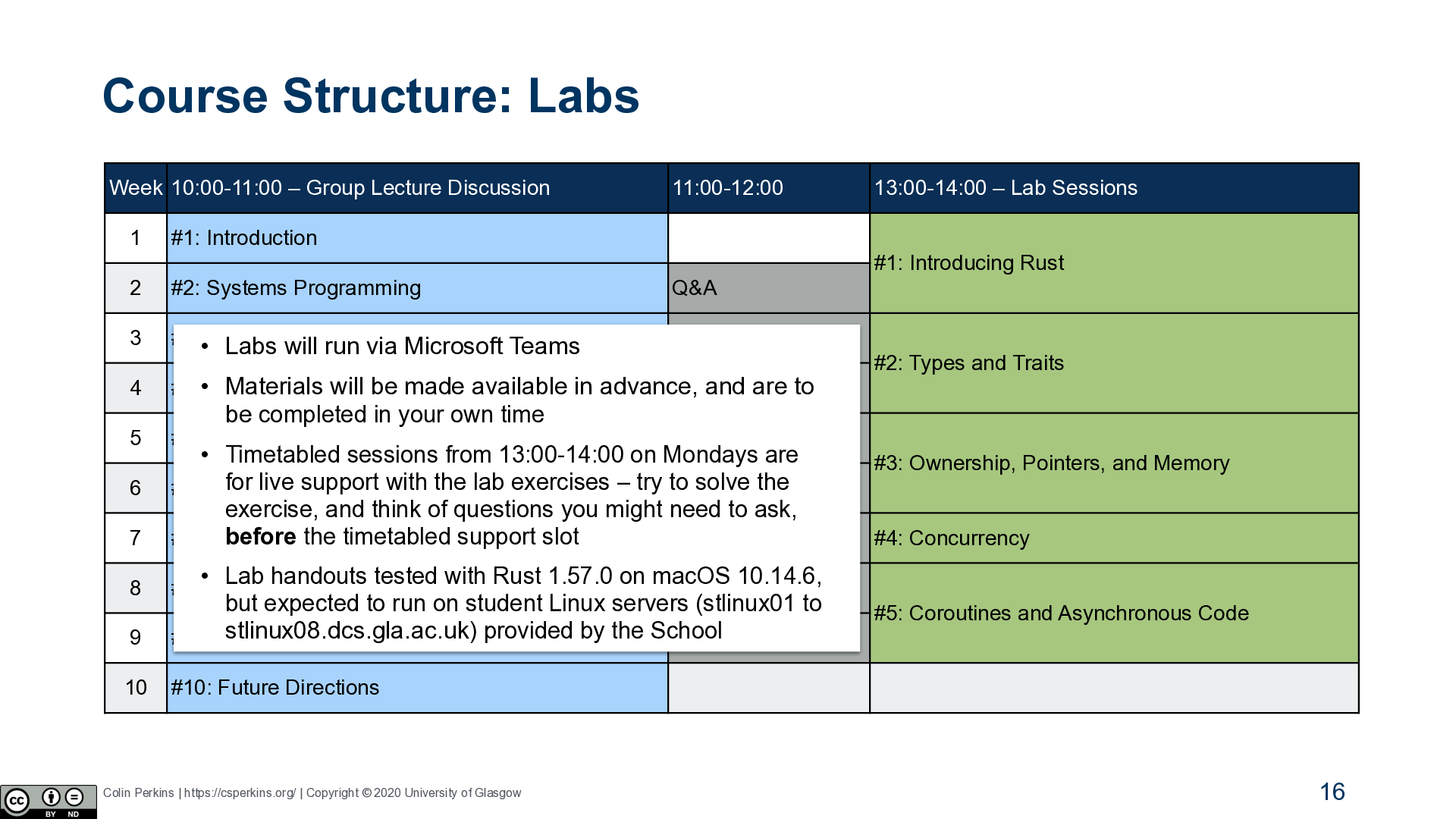
Finally, there'll be weekly labs during the first nine weeks
00:10:29.400
of the course.
00:10:31.700
As with the lectures,
00:10:33.033
the lab materials will be made available in advance
00:10:35.100
of the timetabled sessions
00:10:36.866
And the exercises are to be completed in your own time.
00:10:41.933
The timetabled sessions, from 1-2 on Mondays,
00:10:45.333
are for live support with the lab exercises.
00:10:48.533
You should try to solve the exercises,
00:10:51.066
and think of questions you might need to ask,
00:10:53.100
before the timetabled slots,
00:10:54.966
so we can effectively help you.
00:10:57.500
There’ll be groups set up on Microsoft teams
00:11:00.266
for discussion of the labs.
00:11:06.133
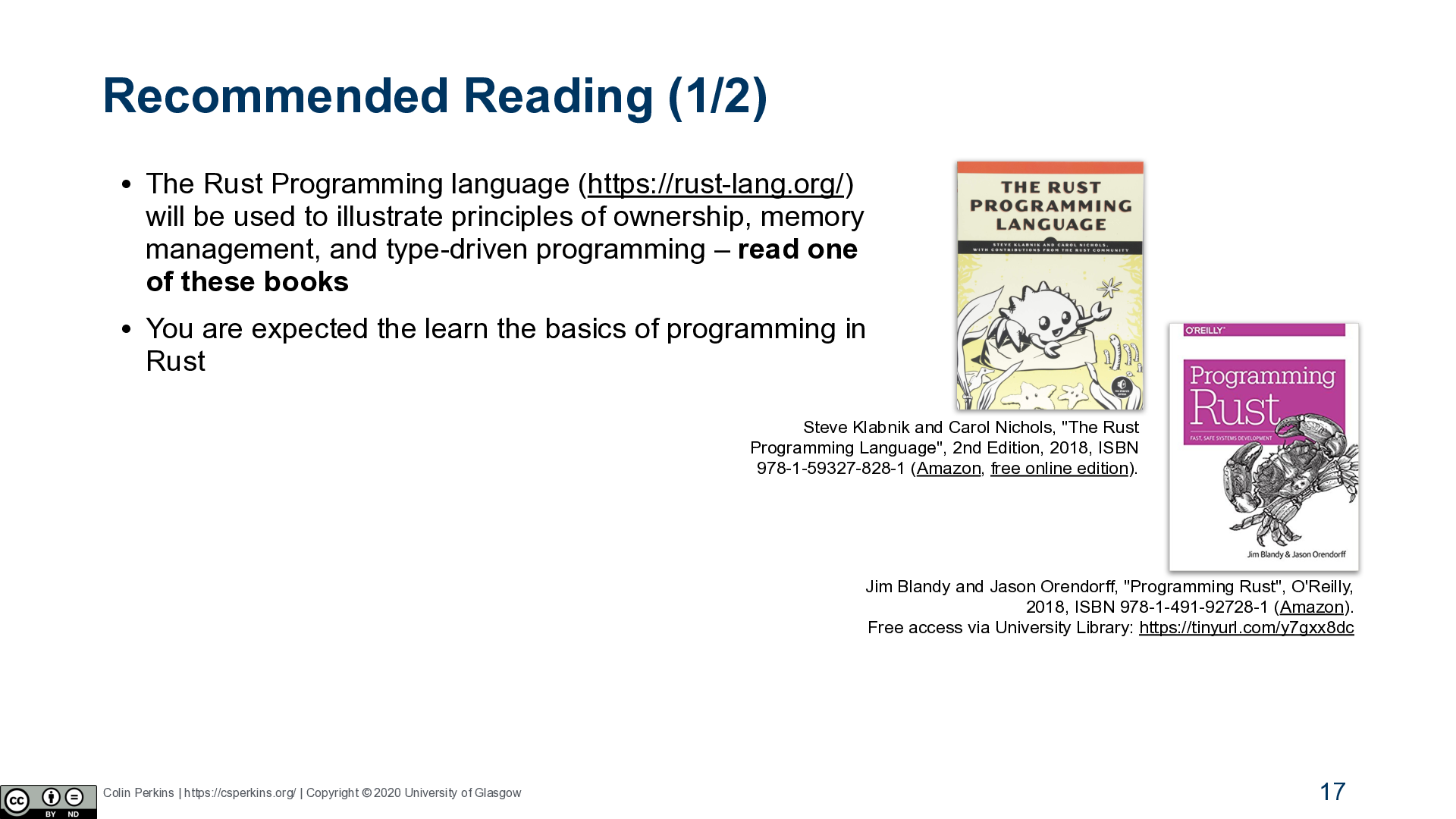
This course will use the Rust programming language
00:11:09.233
to illustrate type-driven design
00:11:10.900
and ownership tracking for systems programming.
00:11:13.733
You're expected to learn the basics of how to
00:11:16.700
program in Rust as part of this course.
00:11:20.766
The two books listed on the slide
00:11:23.033
provide good introductions to Rust
00:11:24.866
to complement the material we’ll cover in the lectures.
00:11:28.100
The first book, The Rust Programming Language,
00:11:31.800
by Steve Klabnick and Carol Nichols,
00:11:34.033
is the standard tutorial introduction to Rust.
00:11:37.333
It’s available for free on the Rust language website,
00:11:40.966
or you can buy it as a bound paper book, if you like.
00:11:46.900
The second book, Programming Rust,
00:11:49.366
by Jim Blandy and Jason Orendorff,
00:11:51.933
is more expensive to buy,
00:11:53.933
but I think it has the better explanations
00:11:56.133
of many of the concepts.
00:11:57.800
The link on the slides offers free access to this
00:12:01.100
book online via the University library.
00:12:05.000
I strongly recommend you read one of these books
00:12:07.700
to build on the lectures and lab exercises.

00:12:11.533
In addition to the two books
00:12:13.666
on the Rust programming language,
00:12:15.600
lectures will also refer to various research
00:12:18.133
papers and blog posts.
00:12:20.133
You're expected to read this material.
00:12:24.166
For all the research papers, either a URL
00:12:28.133
or a digital object identifier, a DOI,
00:12:30.933
will be provided.
00:12:32.300
If a DOI is given, go to dx.doi.org
00:12:37.166
enter the DOI, and it will redirect you to the paper.
00:12:41.100
All the papers mentioned in the course
00:12:44.300
are accessible at no cost from the campus network
00:12:46.933
or via the university’s VPN service.
00:12:49.933
In most cases, you should also be able to get access
00:12:53.666
by following the institutional login
00:12:55.600
option on the publisher's website
00:12:57.566
from your home network.
00:13:00.600
Under no circumstances should you
00:13:02.766
pay to access any of these papers.
00:13:04.866
You can't get access for free,
00:13:07.400
ask me, and I'll send you a copy.
00:13:10.600
Indeed, as a general principle
00:13:13.400
don't pay for access to any research papers.
00:13:16.433
The authors of the research papers
00:13:19.433
do not get paid if you buy
00:13:21.566
a copy of their paper from the publisher.
00:13:24.000
In fact, most research paper authors
00:13:26.700
actually pay to publish their papers.
00:13:29.600
If you want a copy of a research paper,
00:13:32.700
and you can't find it for free online,
00:13:34.733
then email the author and ask.
00:13:36.933
They'll always almost always just send you a copy by return.
00:13:41.833
Now, as I said earlier,
00:13:43.666
you're expected to read these papers.
00:13:46.100
When you do, read them to understand the concepts and ideas,
00:13:50.133
not the details.
00:13:51.633
Don't worry if you don't understand
00:13:53.800
everything in these papers.
00:13:55.300
Skip over details and parts you don't understand.
00:13:58.633
You're looking to get a feel for the ideas,
00:14:01.700
not to understand every detail.
00:14:04.000
Some of the ideas mentioned in the papers will be good;
00:14:07.700
some less so.
00:14:09.266
Some will be interesting, but perhaps impractical.
00:14:12.566
And what's impractical today might become important tomorrow
00:14:16.633
due to changes in technology and/or society.
00:14:20.700
The goal of the papers, is to help you think
00:14:23.900
more deeply about the subject
00:14:25.700
They're not necessarily there to suggest
00:14:28.133
particular desirable outcomes,
00:14:30.000
they're there to suggest interesting ideas.
00:14:33.533
If you've not read many research papers before
00:14:37.300
the link on the page,
00:14:40.133
on how to how to read a research paper, might be useful.
00:14:48.366
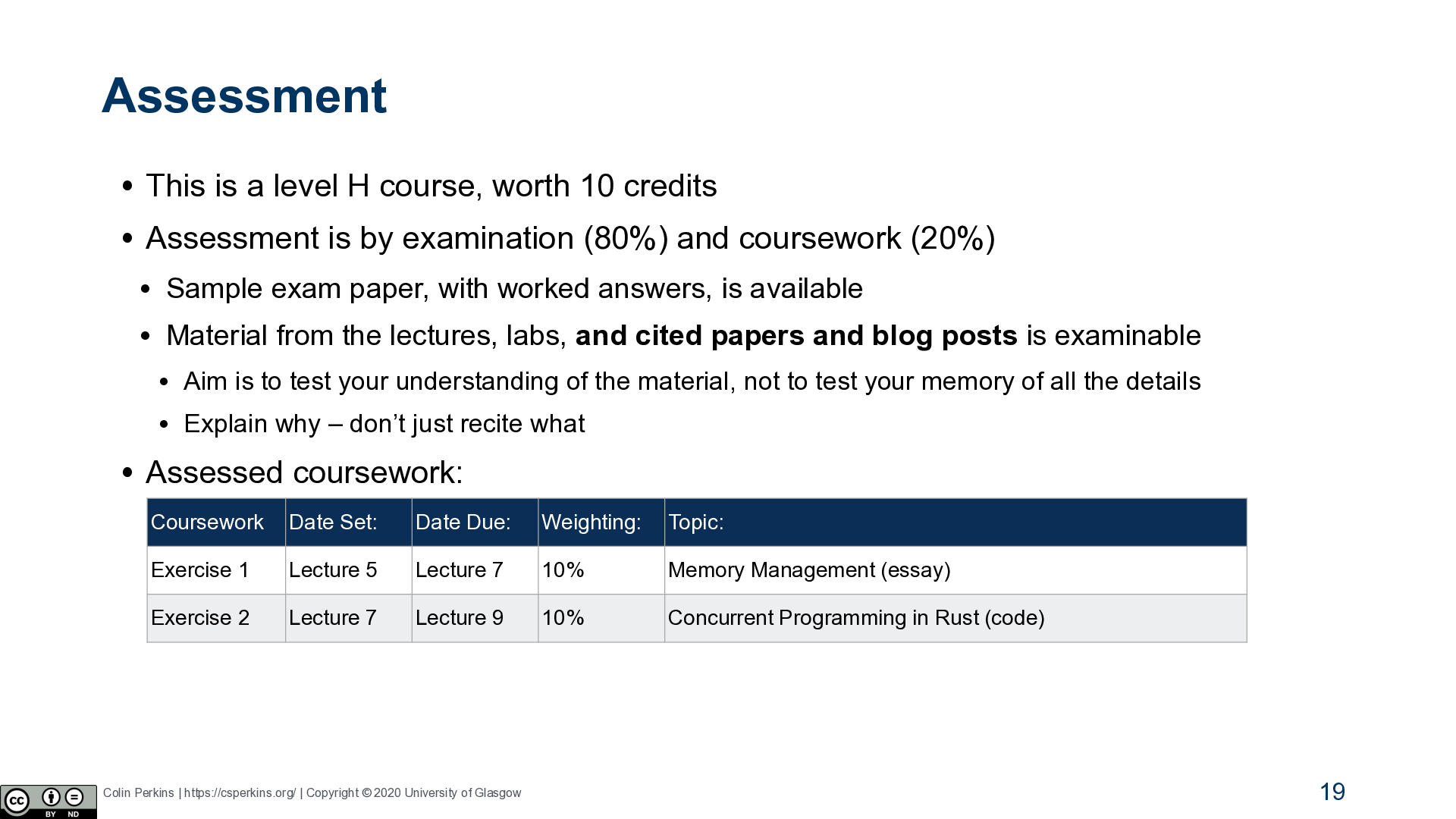
The course follows the usual model
00:14:50.600
with an exam worth 80% of the marks
00:14:52.866
and the coursework being worth the remaining 20%.
00:14:56.066
The assessed coursework will comprise two exercises,
00:14:59.966
each of which is worth 10% of the marks.
00:15:03.800
The first assessed exercise will be an essay question
00:15:06.866
about memory management.
00:15:08.733
It will be made available at the start of lecture five,
00:15:11.433
and will be due at the start of lecture seven.
00:15:14.766
The second assessed exercise
00:15:16.766
will be concurrent programming exercise
00:15:18.733
using the Rust programming language.
00:15:20.866
It will be made available at the start of lecture seven,
00:15:24.100
and will be due at the start of lecture nine.
00:15:27.300
There'll also be an exam
00:15:29.533
worth 80% of the marks for the course,
00:15:32.033
sometime in April or May.
00:15:35.000
Past papers, and a sample exam paper with worked answers,
00:15:38.566
are available on moodle.
00:15:41.033
The material covered in the lectures and labs is examinable.
00:15:45.466
Importantly, though, so too are the ideas discussed
00:15:49.000
in the cited to the research papers and blog posts.
00:15:52.433
The goal is to test your understanding of the concepts,
00:15:56.166
not to test your memory of the details.
00:15:58.466
Reading widely, and broadly understanding
00:16:01.333
the material, is important.
00:16:03.733
If you only watch the lectures, and skip the reading,
00:16:07.066
you'll miss important ideas.

00:16:11.333
That concludes these introductory remarks.
00:16:14.600
The main lecture content starts in week two.
00:16:17.500
Please make sure you watch lecture two
00:16:20.266
and think about the discussion questions before then
00:16:22.733
and come prepared to discuss.
00:16:25.566
The labs start in week one of the semester.
00:16:29.000
Please review the lab one hand out,
00:16:31.500
and start on the exercises.
The discussion session in week 1 will review the course structure,
goals, and logistics. There will be time to answer ask any questions
about the course, lectures, and labs.