The final lecture concludes by reviewing the course material, and
discussing some possible future directions for systems programming.
The final part of the course talks about future directions and open
issues. It notes that there are still open questions around how best
to support concurrent programming, data centre-scale computing, and
large-scale distributed operating systems. It also highlights the benefits
of modern programming languages for developing programs that run within
a single system, and notes the challenges in scaling out to massively
distributed systems.
00:00:00.200
In this last lecture, I’d like to
00:00:01.866
talk about some open issues and future
00:00:03.700
directions for systems programming.
00:00:08.466
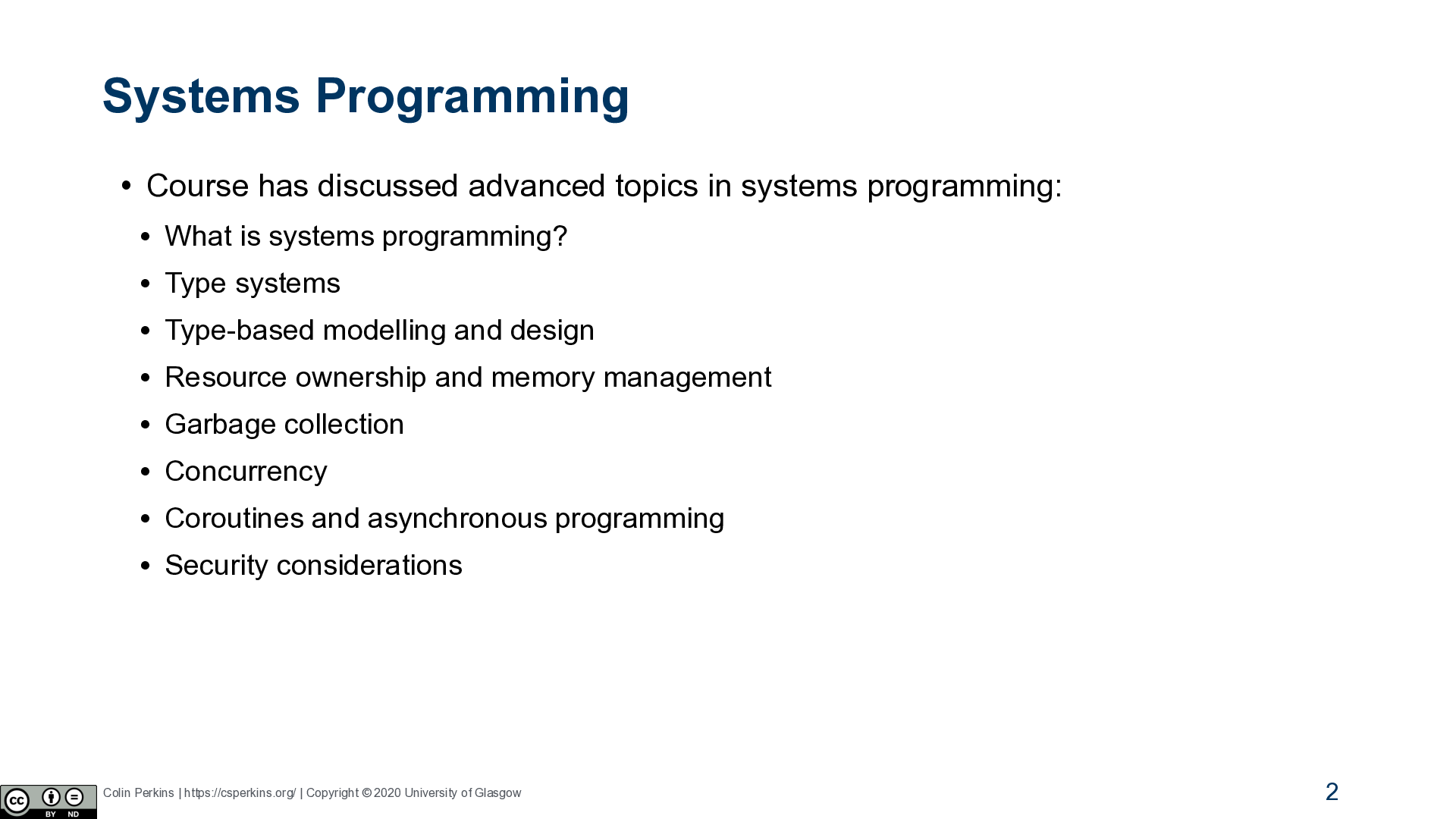
So, in this course we've discussed a
00:00:11.200
number of advanced topics in the systems
00:00:13.733
programming space.
00:00:15.900
We spent some time talking about what
00:00:18.300
is systems programming, and what distinguishes a
00:00:21.000
systems program from an applications program,
00:00:24.966
focusing on control over memory layout,
00:00:29.633
and performance needs, and so on
00:00:33.533
We spent a fair amount of time
00:00:34.866
talking about type systems, and type based
00:00:37.333
modelling and design, and thinking about the
00:00:41.233
benefits of advanced type systems for building
00:00:44.933
systems programs.
00:00:46.766
Thinking about some of the constraints and
00:00:48.600
issues around modelling the problem space using
00:00:52.800
types, and using that to help robustness
00:00:55.433
and security of programs.
00:00:59.133
We focused a lot on resource ownership
00:01:02.200
and memory management, and tracking how the
00:01:06.166
program works with, controls, and owns resources,
00:01:10.833
including memory, but also including state machines,
00:01:14.833
and the state variables in state machines.
00:01:17.600
And we spoke about different approaches to
00:01:19.400
memory management, the reference counting approaches,
00:01:23.666
garbage collection, and region-based memory management.
00:01:28.566
And we spent a fair amount of
00:01:29.866
time talking about concurrency.
00:01:32.633
Talking about message passing approaches to concurrency.
00:01:37.200
Talking about transactions, talking about co-routines and
00:01:40.333
asynchronous programming. And we spent some time
00:01:44.000
discussing why the common approach of using multithreading,
00:01:48.166
locks, and shared mutable state, is not
00:01:52.400
an effective approach, and doesn't scale out
00:01:55.866
to larger systems, and is very hard to get right.
00:02:00.900
And, we just finished up by talking
00:02:03.033
about some of the security considerations in
00:02:05.166
these systems, and thinking about
00:02:08.733
how we can use advanced type systems
00:02:12.500
to make explicit the assumptions in the
00:02:15.766
code, and reduce the risk of inconsistencies
00:02:21.033
which lead to security breaches. And we
00:02:24.233
spent some time talking about how memory
00:02:26.666
unsafety is the primary cause of security vulnerabilities.
00:02:32.600
What did we learn from this?
00:02:36.700
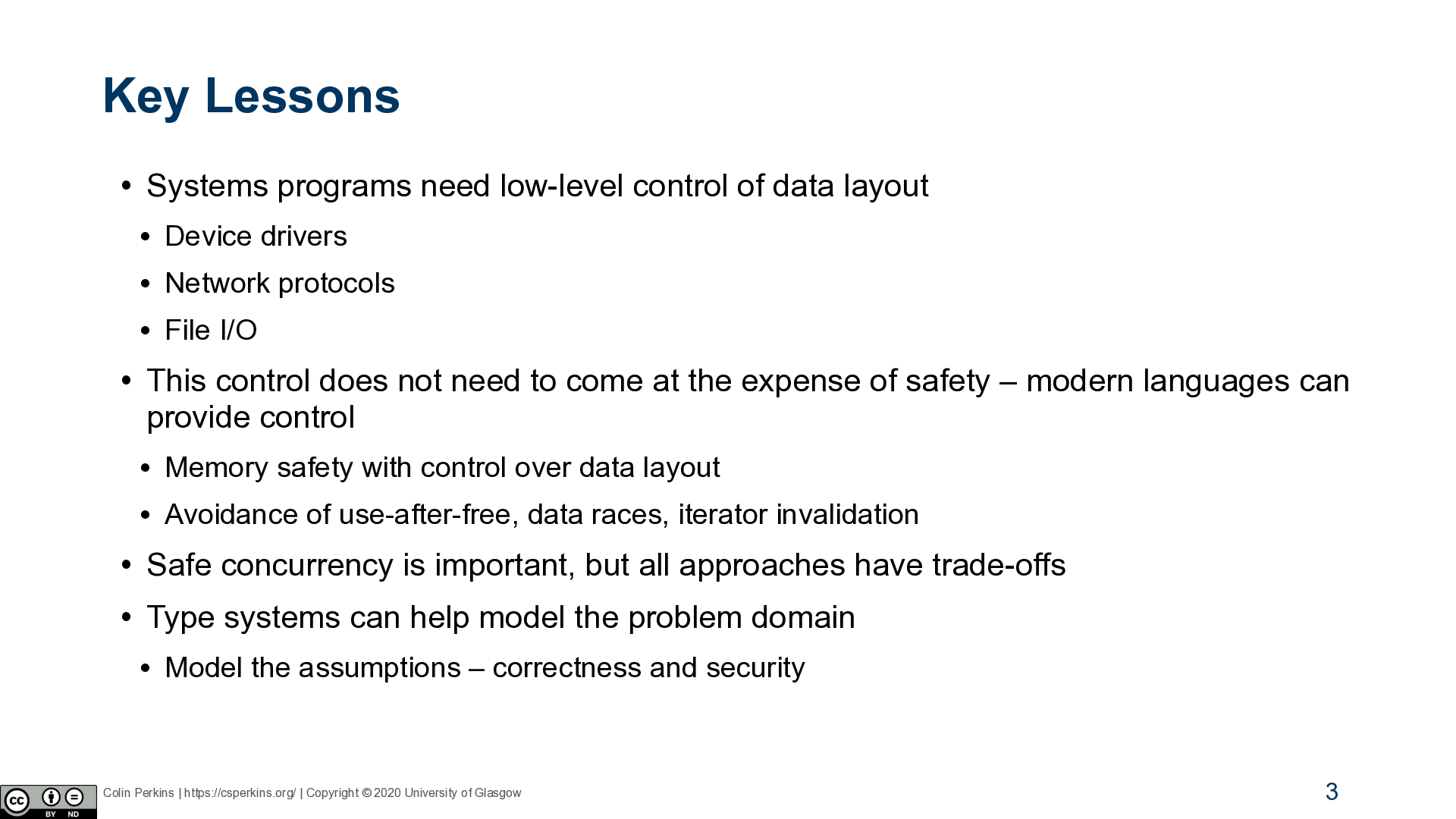
Well, I think one of the key
00:02:39.500
distinguishing features with systems programs, is that
00:02:42.833
they need low-level control over the data layout.
00:02:47.266
In order to effectively write device drivers,
00:02:50.133
in order to effectively write network protocols,
00:02:52.866
or file I/O,
00:02:55.766
and in order to make effective use
00:02:58.000
of memory, and fit within the cache,
00:03:00.933
and optimise the layout of data structures
00:03:04.666
to fit within the cache,
00:03:07.533
we need to be able to control
00:03:09.400
the way data is laid out in memory.
00:03:12.833
One of the key features of systems
00:03:15.266
programs, is that they give that control.
00:03:18.233
And going forward, I expect systems programming
00:03:20.466
languages to continue to do that.
00:03:23.300
We need to be able to specify
00:03:25.633
exactly how a data structure is laid
00:03:28.000
out in memory, and to be able
00:03:29.800
to control whether it is allocated on
00:03:31.533
the stack or on the heap.
00:03:33.933
And to be able to box,
00:03:35.533
or unbox, data structures as we need
00:03:37.766
to, to get good performance.
00:03:43.066
In traditional systems programming languages,
00:03:46.000
that control has
00:03:49.400
come at the expense a lot of safety.
00:03:54.433
C provides you with a tremendous amount
00:03:57.833
of control over the way data is
00:03:59.866
laid out in memory, with tremendous amount
00:04:02.700
of control over representations, and pointer use,
00:04:06.266
and so on, but in a way
00:04:08.033
that's quite unsafe, and quite hard to get right.
00:04:12.100
More modern languages,
00:04:14.500
Rust being the example we’re using in
00:04:17.633
this course, but certainly not the only
00:04:20.166
language in the space,
00:04:22.433
provide this type of behaviour in a much
00:04:28.100
safer way. They give you control over data layout,
00:04:31.800
but they also provide memory safety,
00:04:34.366
they check it array bounds they check
00:04:36.033
pointers are used correctly, and they can
00:04:39.100
avoid problems like use-after-free bugs, data races,
00:04:42.866
iterator invalidation, and so on, and get
00:04:46.166
the control over data layout whilst maintaining
00:04:48.933
a lot more safety,
00:04:51.400
a lot more robust behaviours.
00:04:56.566
I think it's clear that concurrency is
00:04:59.366
important, especially as Moore's law and Dennard
00:05:03.300
scaling break down, and we get increasingly
00:05:07.033
concurrent systems.
00:05:12.166
And we spoke about several different approaches
00:05:14.100
to concurrency, but I think it's clear
00:05:16.166
they've all got trade-offs, and none of
00:05:18.200
them are a one size fits all
00:05:20.800
approach to building concurrent systems.
00:05:26.500
The transactional memory approach, I think,
00:05:28.833
works wonderfully in Haskell, but it's not
00:05:32.366
clear it scales out to other languages.
00:05:35.533
The message passing approach works wonderfully in Erlang,
00:05:41.100
but fits less well, less naturally,
00:05:44.566
into many other languages, and has some
00:05:47.733
difficult safety issues in some cases.
00:05:52.200
And the asynchronous coroutine based approach
00:05:56.033
leads to strange behaviours with starvation and blocking.
00:05:59.966
There’s constraints, and it’s not clear
00:06:02.666
we have the right answer.
00:06:06.166
And we’ve shown that type systems,
00:06:07.900
I think, can help model the problem domain.
00:06:09.833
I think that's one of the key takeaways.
00:06:12.400
We can model the assumptions, we can
00:06:14.933
help ensure the system is safe and correct.
00:06:21.366
And we can make the systems much
00:06:24.233
safer, and avoid a lot of common
00:06:26.166
problems, by encoding more information into the
00:06:28.400
types, and letting the compiler help us
00:06:30.666
check the systems for correctness.

00:06:37.200
So that's where we are at today.
00:06:39.633
That, I think, is the current state-of-the-art,
00:06:41.933
and what we have learned from building
00:06:44.166
systems programs today.
00:06:47.333
Where we going in the future?
00:06:51.166
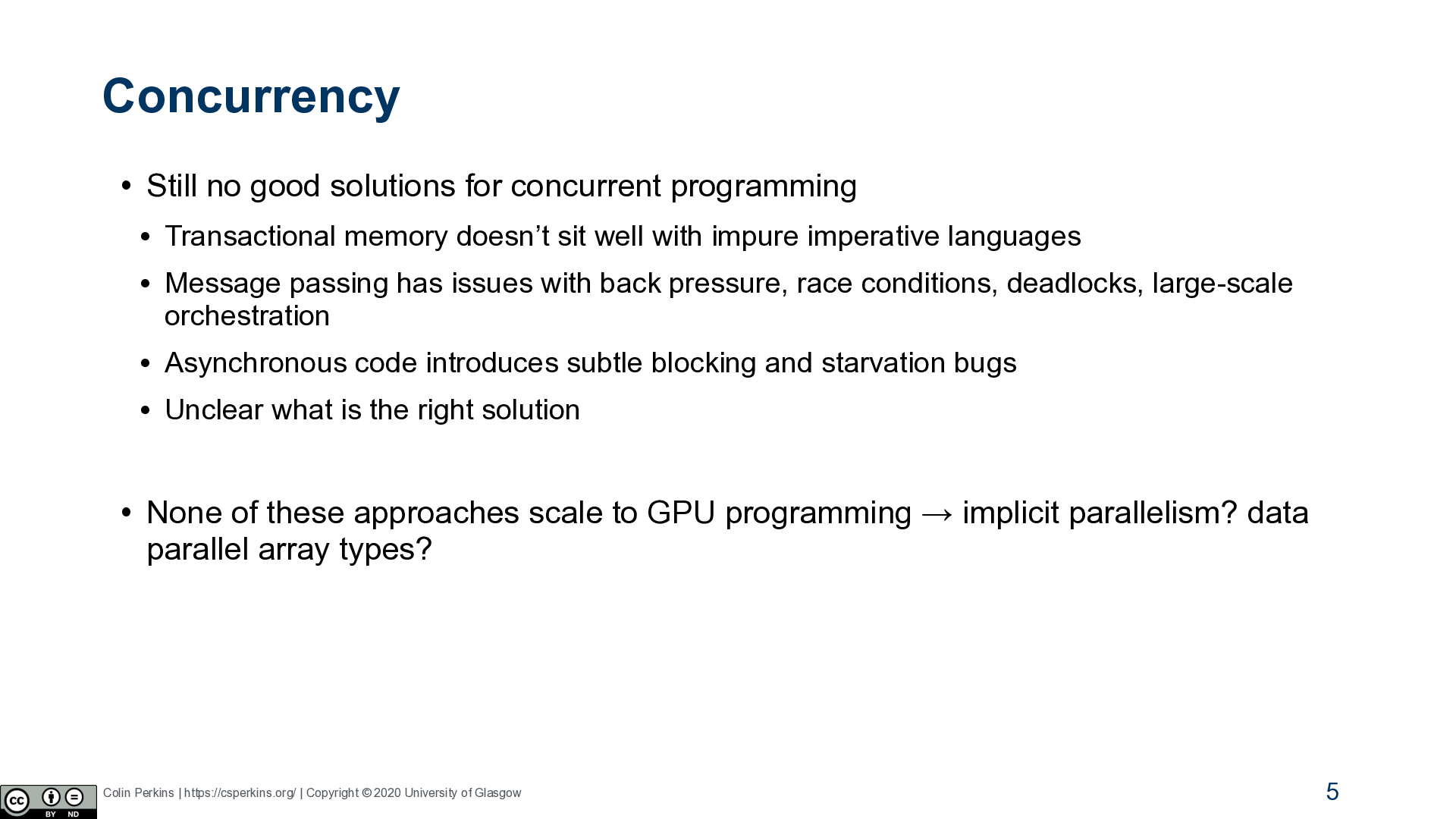
Well, as I mentioned, I think we
00:06:53.000
still don't have good solutions for concurrent programming.
00:06:57.733
Transactional memory, I think, is very promising,
00:07:00.833
but doesn't fit well with impure imperative
00:07:05.033
languages, and most of the programs we
00:07:07.966
write today are written in impure imperative languages.
00:07:13.500
Message passing is quite a natural approach,
00:07:18.500
and fits nicely into mainstream languages,
00:07:23.100
and solves some of the problems with
00:07:26.233
shared mutable state, and threads and locks,
00:07:29.300
but it's got problems with providing back
00:07:32.133
pressure, it can have race conditions and
00:07:34.933
deadlocks, and it's difficult to structure programs,
00:07:39.366
structure large message passing systems, without losing
00:07:42.333
track of the message flows.
00:07:45.800
And asynchronous code introduces subtle
00:07:48.800
blocking and starvation bugs.
00:07:52.433
And it's not really clear what's the right solution.
00:07:55.666
It’s not clear if the problem domain
00:07:58.533
is sufficiently broad that we need different
00:08:01.533
types of solution for different problem domains,
00:08:04.800
and we are just going to end
00:08:06.400
up with three-or-four different ways of doing
00:08:08.566
concurrency, and you pick the appropriate one
00:08:11.066
for your domain.
00:08:12.700
Or if there's a more general solution
00:08:15.666
waiting to be discovered.
00:08:18.766
And I think none of these approaches
00:08:20.366
scale out to GPU programming, where you're
00:08:23.100
doing the same operation on 10s,
00:08:26.133
or 100s, of thousands of cores simultaneously.
00:08:30.200
And, maybe, there are approaches with implicit
00:08:32.300
parallelism. Maybe there are data parallel array
00:08:35.800
types that can solve this problem.
00:08:38.000
We haven't really spoken about GPU programming
00:08:40.400
in this course. But, again, there’s a
00:08:43.500
different type of concurrency, which again seems
00:08:45.866
to need different solutions.
00:08:54.100
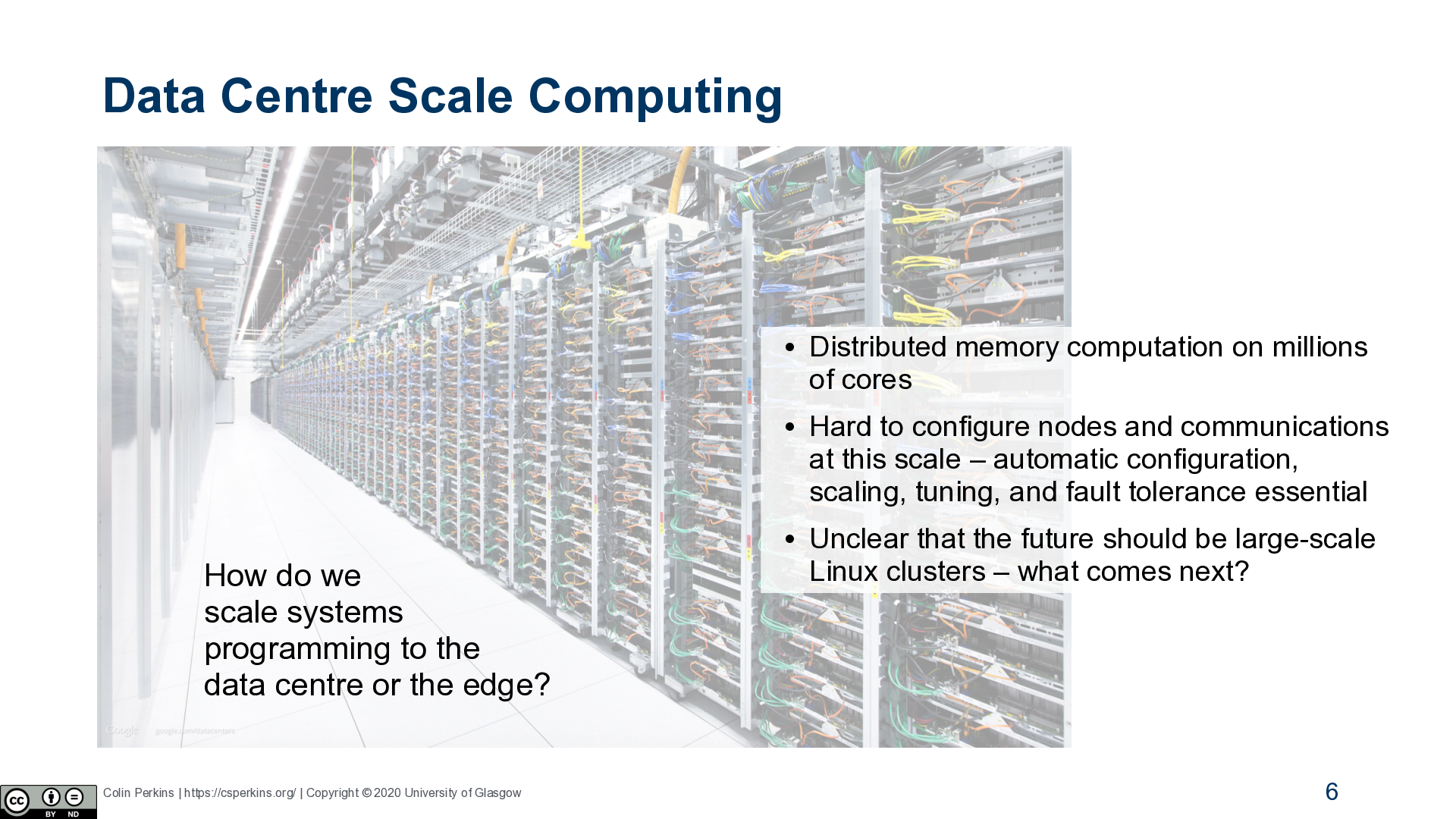
It's not clear that we have good
00:08:56.866
approaches to making use of data centre
00:08:59.800
scale computing.
00:09:02.200
It’s not clear that we know how
00:09:03.766
to scale systems programming
00:09:06.200
to massive data centres, or to large
00:09:09.366
scale distributed edge compute data centres.
00:09:13.800
It’s not clear that we know how
00:09:16.366
to do distributed computations across millions of cores.
00:09:25.266
We do know how to build large-scale
00:09:28.500
Linux clusters, but we do this by
00:09:33.666
assuming a reliable, robust, homogeneous system.
00:09:38.566
And we do this by essentially automating
00:09:40.600
traditional systems administration.
00:09:44.133
We have DevOps tools, like Ansible,
00:09:48.100
and Salt Stack, and the like,
00:09:51.666
but all they’re doing is shell scripting
00:09:54.333
and editing config files.
00:09:56.566
It's the same type of approach,
00:09:58.833
just automating the ssh into a bunch
00:10:02.033
of machines and edit some config files.
00:10:04.200
And there has to be a better
00:10:05.966
way of doing that, a better way
00:10:08.033
of structuring the system.
00:10:10.900
And we know how to use these
00:10:12.666
data centres, but we know how to
00:10:14.033
use them to run millions of instances of the same thing.
00:10:19.866
It's not clear that we are good at
00:10:25.200
distributing code into these environments.
00:10:31.166
We can make it work
00:10:33.533
for restricted tasks and in homogenous data centres.
00:10:38.700
But as compute becomes more ubiquitous,
00:10:41.266
as it moves out of the controlled
00:10:42.966
data centre and towards the edges of the network,
00:10:46.433
where we need to run millions of
00:10:48.733
tasks over a ubiquitous computing environment that
00:10:51.600
spreads around the world, and is much
00:10:54.400
more heterogeneous, and much more variable,
00:10:57.200
in its configuration, it's not clear we
00:10:59.900
know how to do that that.
00:11:01.433
It’s not clear we have good approaches to doing that.
00:11:09.366
It’s not clear that we necessarily have
00:11:13.266
the right operating systems abstraction for data
00:11:16.833
centres, or for ubiquitous computing,
00:11:20.500
edge computing, environments.
00:11:23.466
But I think are some interesting ideas in this space.
00:11:29.133
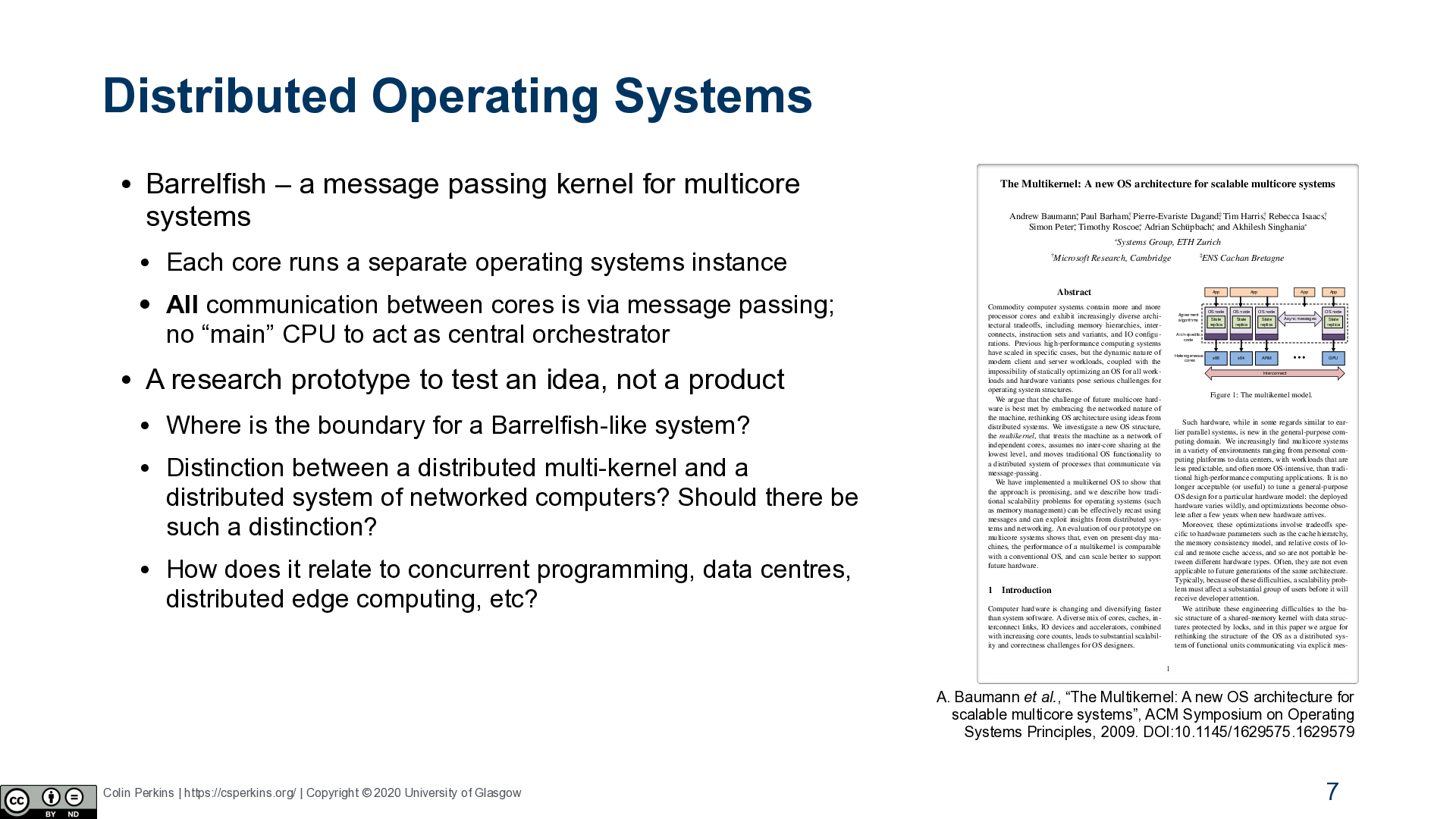
The system known as BarrelFish, for example,
00:11:33.033
and the paper on the slide talks about this,
00:11:36.866
has a goal of building a message-passing
00:11:40.533
operating system kernel for multi core systems.
00:11:45.000
And the idea here, is if you
00:11:46.833
have a system with multiple processors in
00:11:49.233
it, each processor core runs its own
00:11:52.066
instance of the operating system, and they
00:11:54.733
communicate with each other via message passing.
00:11:58.200
And there's no use of shared memory,
00:12:00.900
other than to implement the message passing
00:12:02.966
system as an optimisation, and there's no
00:12:05.666
main CPU in a system to act
00:12:07.600
as a central coordinator.
00:12:09.966
So if you have a quad core
00:12:13.300
phone, for example, then each of the
00:12:16.366
cores on the phone would be running
00:12:17.966
a separate instance of this operating system,
00:12:19.900
communicating internally via message passing.
00:12:25.466
And it's taking message passing as the
00:12:28.066
fundamental primitive. It's taking this idea to
00:12:30.166
its extreme, to separate every CPU into
00:12:33.500
its own message passing core.
00:12:36.566
And it's very much a research prototype,
00:12:38.866
to test an idea. It's not something
00:12:41.133
that you could currently make a robust
00:12:42.833
product out. But I think it's an
00:12:44.833
interesting approach, and I think it leads
00:12:47.033
to an interesting discussion about what's the
00:12:49.733
boundary of an operating system?
00:12:53.133
What's the distinction between a distributed multi-kernel,
00:12:57.300
multiple operating system kernels running on a
00:13:00.666
single machine exchanging messages with threads,
00:13:03.566
and one running across the network?
00:13:06.666
And should there, or does there even
00:13:09.266
need to be, such an assumption,
00:13:13.366
such a distinction?
00:13:17.100
Can we just run this type of
00:13:20.100
multi kernel across a data centre,
00:13:22.233
across an edge computing environment, for example?
00:13:26.033
Where are the boundaries between systems?
00:13:28.566
And what should be the boundary between systems?
00:13:31.700
So I think there's a bunch of
00:13:32.866
interesting questions in this space, that have
00:13:34.966
not yet been fully explored. And I
00:13:37.933
hope we’ll see some innovation in the
00:13:39.633
way we build operating systems going forward.
00:13:46.366
And we're increasingly seeing innovation in programming
00:13:50.733
languages. We spent a long time stuck
00:13:56.400
with C and C++, as a sort of local maxima.
00:14:02.000
But we're starting to see more research
00:14:05.400
ideas coming into mainstream languages.
00:14:10.133
And in Rust, as we've spoken about
00:14:12.666
in most of this course, and in
00:14:15.533
Swift, we're beginning to see abstraction,
00:14:18.333
and resource management, and
00:14:20.733
more expressive type systems, coupled with low-level
00:14:25.100
control, giving more powerful, safer,
00:14:31.200
low-level programming environments.
00:14:33.733
And languages like Erlang and Go,
00:14:36.100
are exploring the concurrency and fault tolerance
00:14:39.100
and communication space. And there are others
00:14:41.900
which are bubbling up, and people are
00:14:43.833
starting to explore how things can work.
00:14:48.166
And I think it’s long overdue that
00:14:50.700
we're seeing this development in the underlying
00:14:54.133
languages, and we're beginning to have more
00:14:57.266
expressive ways of describing what our program should do.
00:15:04.066
We should clearly, I think, going forward
00:15:06.766
choose the language for our systems based
00:15:09.733
on the problem domain, based on the
00:15:11.733
tooling based, based on our expertise.
00:15:14.300
And it's not clear that single language
00:15:17.066
fits the entire space.
00:15:20.200
Rust, for example, works extraordinarily well for
00:15:24.166
building operating systems.
00:15:26.200
But languages like Erlang or Go are
00:15:29.600
possibly better suited to
00:15:34.066
large-scale web application development running in a
00:15:39.866
data centre, for example.
00:15:43.533
We've got good solutions for programming single
00:15:46.600
systems. I think Rust is great for
00:15:49.466
programming within a single system.
00:15:52.033
We're starting to learn about how to
00:15:54.933
scale to large clusters, to ubiquitous computing,
00:15:58.600
to edge computing environments, and I think
00:16:00.800
Erlang and Go are starting to have
00:16:02.533
some good ideas in this space,
00:16:04.300
but we don't have a language that
00:16:05.700
fills all of these spaces yet.
00:16:12.833
The systems we use, Unix and C,
00:16:16.533
made sense when we were programming simple
00:16:20.200
single core systems.
00:16:22.966
And they form on the basis of
00:16:24.400
pretty-much every computing system we use today.
00:16:30.133
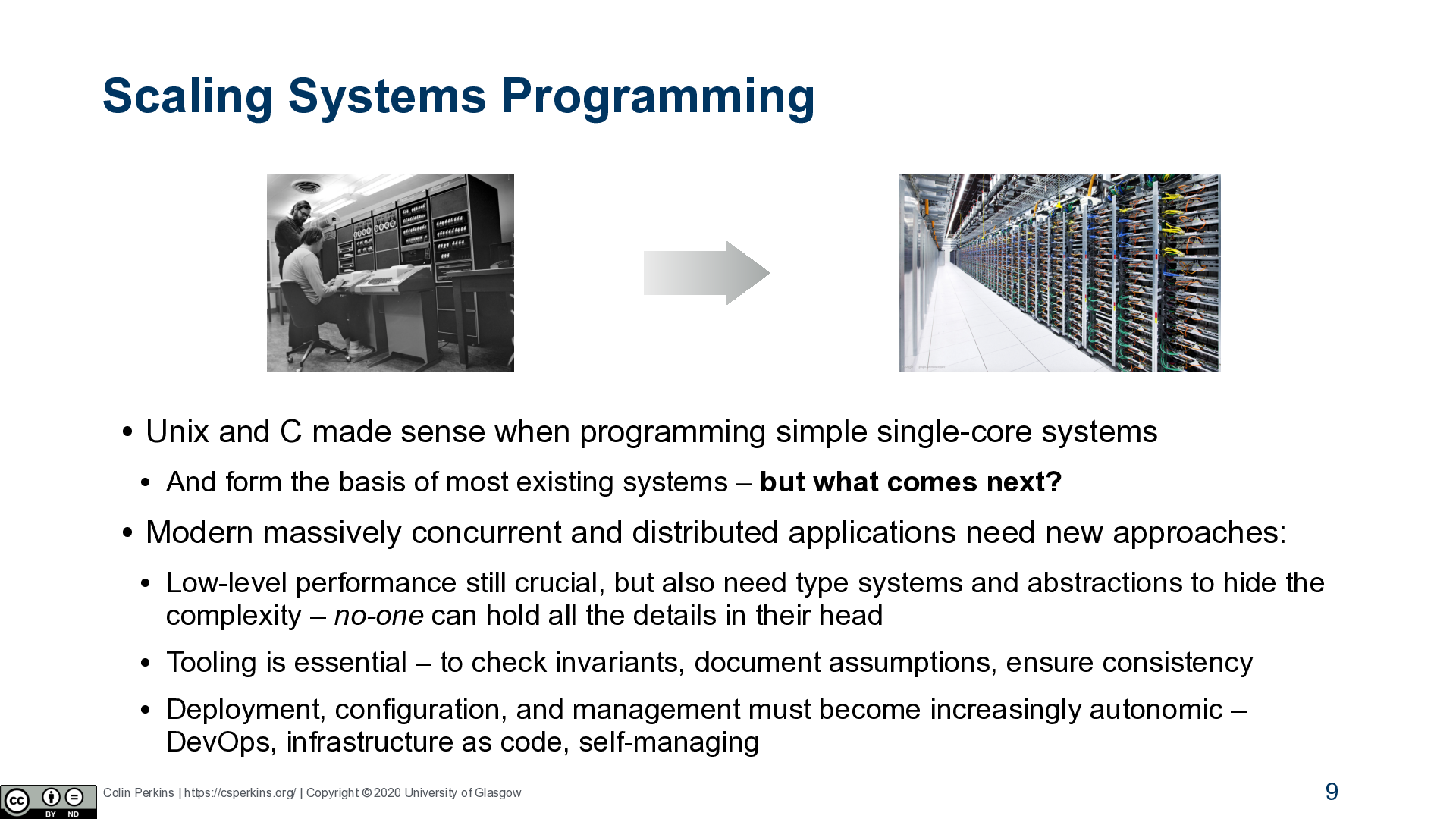
But the system we see on the left,
00:16:34.166
programmers at a PDP 10 with a
00:16:37.133
teletype, is not the data centre environment
00:16:40.133
we see on the right, where a
00:16:41.366
lot of modern software lives.
00:16:45.500
And I do think we need new
00:16:49.600
approaches to build software that is massively
00:16:51.933
concurrent and massively distributed.
00:16:55.733
Languages like Rust solve part of this
00:16:57.966
problem space, and give us low-level performance,
00:17:01.333
they give us an effective type system,
00:17:03.566
they give us abstractions for writing the
00:17:05.666
low-level code running on a single machine.
00:17:08.866
And that's essential, because no-one can hold
00:17:11.366
all those details in their head,
00:17:13.933
and we need this abstraction, we need
00:17:15.866
the compiler help to write this sort of code correctly.
00:17:19.833
We need the tooling to check our
00:17:22.200
invariants, document our assumptions, ensure consistency.
00:17:27.533
But once we start scaling out to
00:17:30.000
data centres, and to the sort of
00:17:32.866
future ubiquitous computing, edge computing, world it
00:17:35.866
seems we are likely to get,
00:17:38.233
it's not clear that we have the
00:17:39.933
right DevOps, infrastructure as code, self-managing,
00:17:44.033
autonomic management systems, and the right approaches
00:17:47.366
for programming at such large scales.

00:17:55.033
And that is, essentially, all I want to say.
00:18:00.900
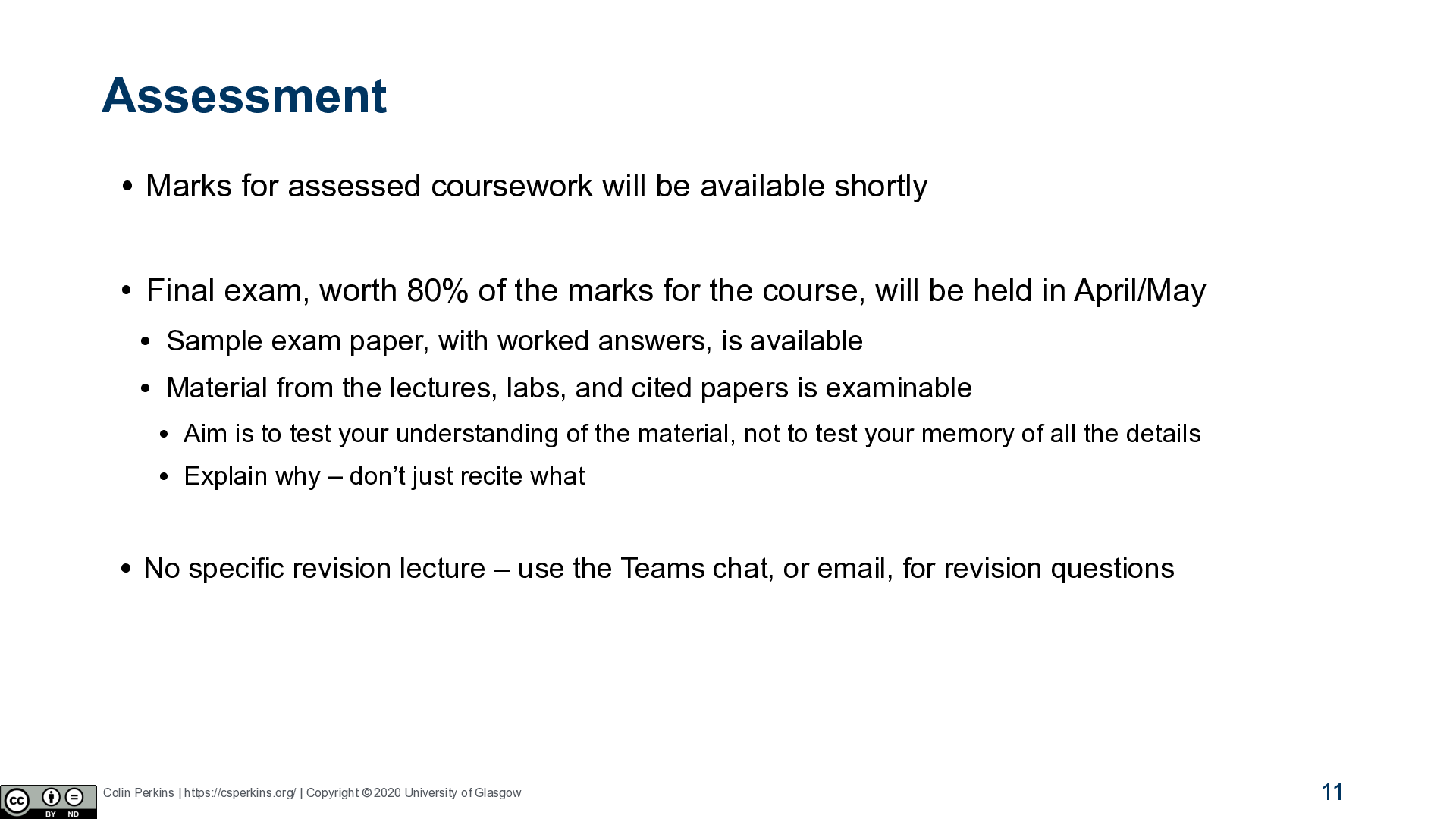
The course, obviously, will have some assessment at the end.
00:18:06.566
There will be a final exam,
00:18:08.866
worth 80% of the marks, which will
00:18:11.700
happen in the April/May time frame.
00:18:15.000
There is a sample exam paper,
00:18:17.400
with some worked answers, available on Moodle,
00:18:21.000
to give you an idea for the
00:18:22.633
feel of the questions.
00:18:26.633
The idea is very much to test
00:18:30.033
your understanding, rather than testing your memory.
00:18:34.133
Especially with the type of open-book exam,
00:18:38.466
which it’s necessary to offer with online
00:18:41.800
assessment, there's no point asking questions that
00:18:45.300
you can just Google the answer for,
00:18:47.233
and you can just look up in the notes.
00:18:49.433
We're looking to test your
00:18:50.666
deeper understanding of the material.
00:18:53.266
So think read-over the material, watch the
00:18:57.300
lectures, look at the material from the
00:19:00.166
papers, and the labs, and so on,
00:19:02.866
and think about it, learn about and
00:19:05.266
understand the material deeply.
00:19:08.300
And look out for questions
00:19:10.200
testing that deeper understanding.
00:19:13.266
There’s no specific revision lecture scheduled,
00:19:15.633
but we do have the Teams chat and email,
00:19:17.400
if you have questions about the material.
00:19:21.166
And that's it.
00:19:23.566
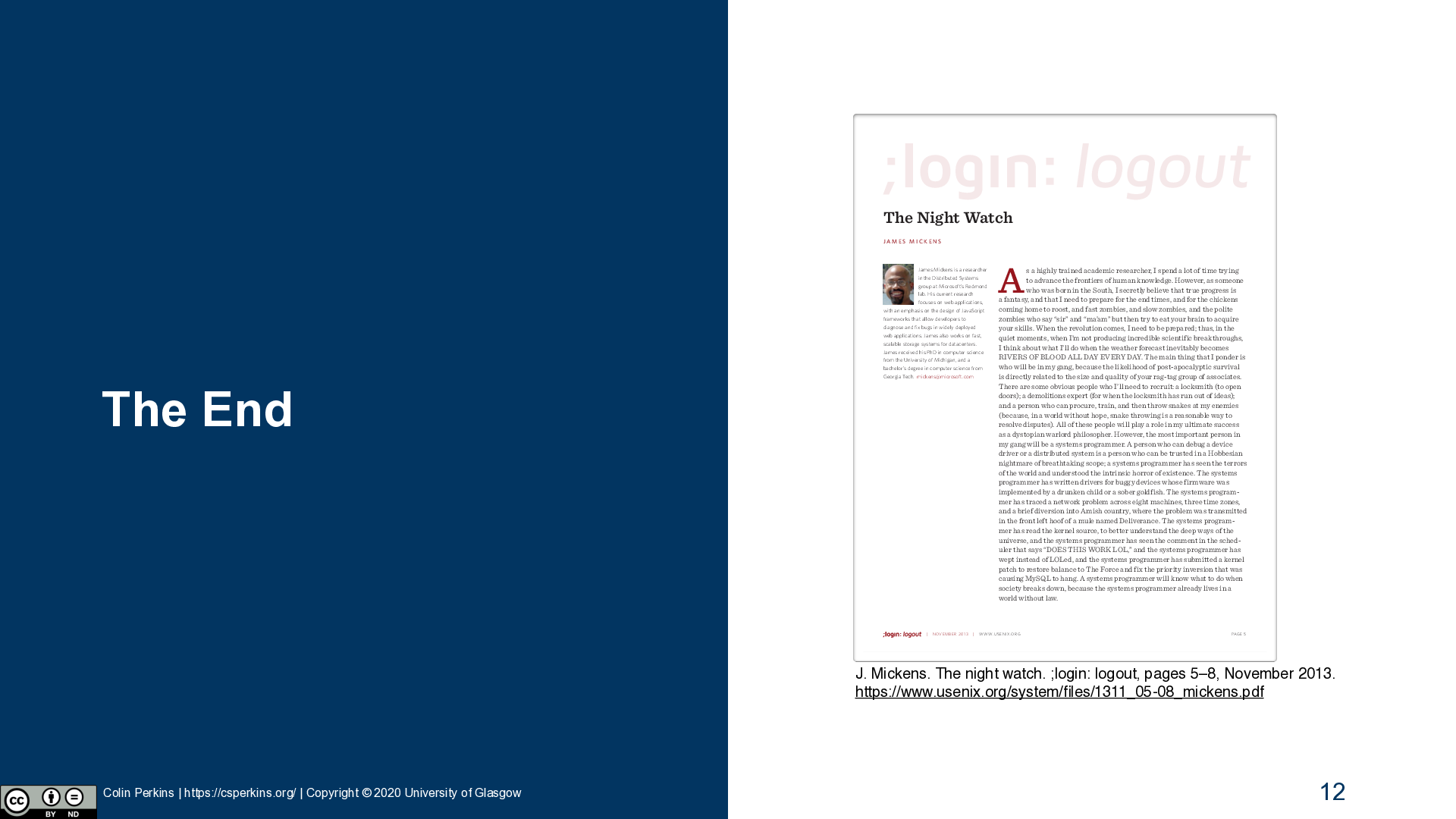
A final paper to highlight some of the
00:19:25.300
issues around systems programming,
00:19:27.100
which you'll hopefully find interesting.
00:19:29.766
I hope you found some of the material
00:19:31.633
in the course interesting.
00:19:33.233
Thank you for your attention.
00:19:35.166
And if there are any further questions,
00:19:37.000
please do get in touch.
00:19:38.266
Thank you.
Lecture 10 summarised the course content and briefly discussed future
directions for systems programming. It noted that there are still no
good, general purpose, solutions for concurrent programming, and
highlighted some issues with programming large scale systems in data
centres and edge computing environments.