Lecture 2: Systems Programming
Lecture 2 is an introduction to systems programming. It discusses what
is meant by systems programming, what is the state of the art, and how
changes in the environment are driving changes in systems and the way
we write systems programs. It concludes with a discussion of how systems
programming might evolve, to set the scene for the remainder of the
course.
Part 1: Systems Programming
The 1st part of this lecture reviews what is systems programming.
It talks about the tendency of systems programs to be constrained
by memory performance, the need to conform to external data
representations. It highlights how I/O performance is frequently
a bottleneck. And it discusses the need to efficient management
of shared state. Background reading is highlighted that considers
these issues in more depth.
00:00:00.333
In this lecture, I’d like to introduce
00:00:02.766
the concept of systems programming,
00:00:04.566
and explain what makes it a uniquely challenging problem.
00:00:09.500
I’ll start be explaining what is systems programming,
00:00:12.533
and what makes it different to applications programming.
00:00:15.966
I’ll briefly discuss the state of the art
00:00:18.000
in systems programming languages and operating systems.
00:00:21.266
Then, I’ll move on to highlight some challenges
00:00:23.600
and limitations that affect these state of the art systems.
00:00:27.033
Finally, I’ll conclude by discussing some possible
00:00:29.633
next steps in systems programming,
00:00:31.600
to set the scene for the remainder of the course.
00:00:35.666
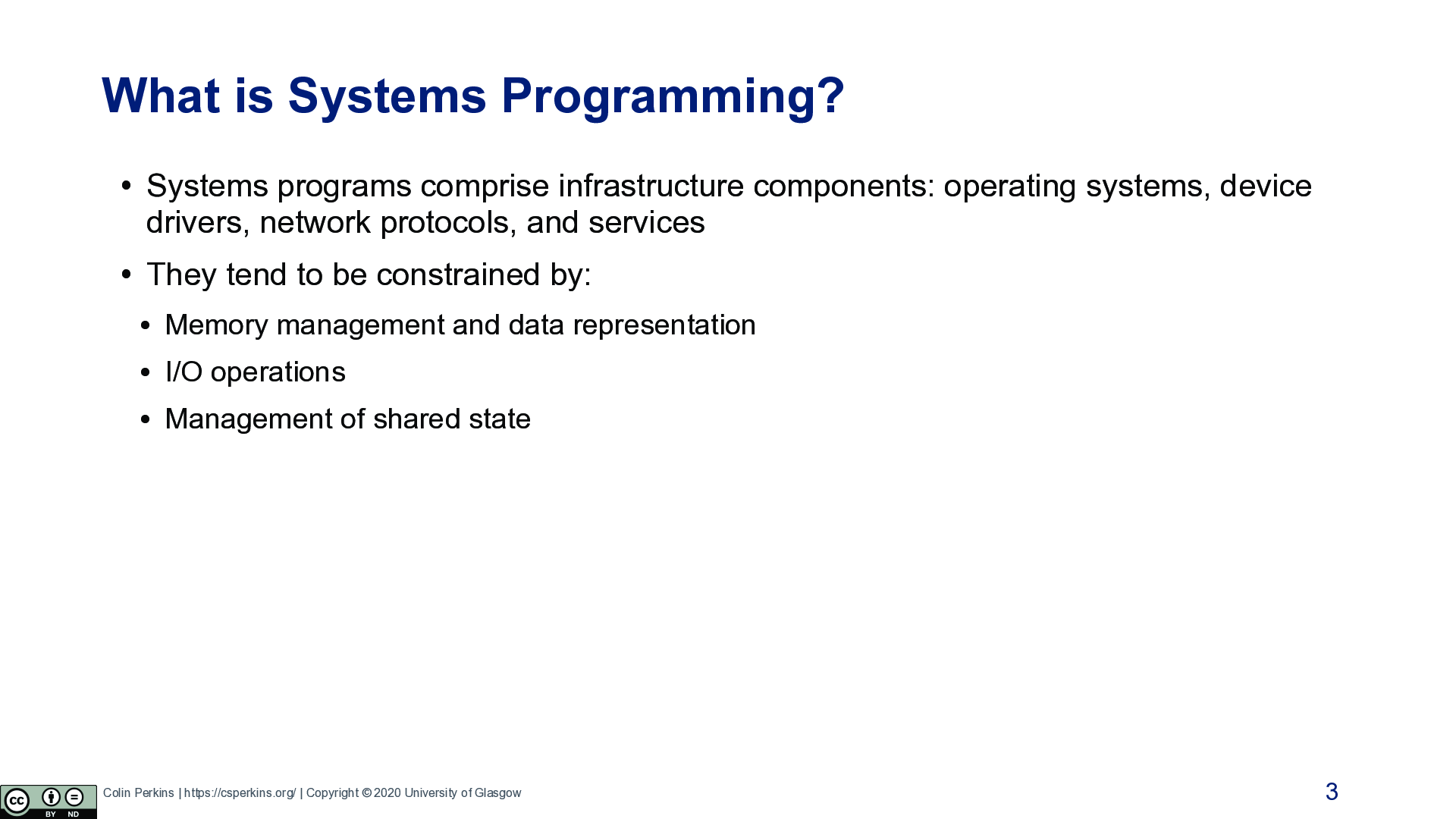
So, what are systems programs?
00:00:38.400
They’re the programs that form the infrastructure.
00:00:41.200
They comprise the operating systems,
00:00:43.533
device drivers, network protocol stacks, and services
00:00:47.533
on which the rest of the computing ecosystem is built.
00:00:51.633
Systems programs tend to be characterised by
00:00:54.233
strict performance constraints.
00:00:56.100
They must effectively manage memory,
00:00:58.533
and achieve high performance,
00:01:00.133
while matching externally-specified constraints
00:01:02.500
on the data representation.
00:01:04.466
Authors of device drivers and
00:01:06.533
network protocol implementations
00:01:08.566
don’t have the luxury of
00:01:09.900
choosing their own data representation:
00:01:12.066
they must match externally specified formats exactly.
00:01:15.400
And they must do so while achieving high performance.
00:01:18.800
This rules out surprisingly many programming languages
00:01:22.100
and environments, since they don’t provide such control.
00:01:25.800
It’s difficult to write high-performance systems
00:01:28.333
programs in Java or Python, for example,
00:01:30.866
since they don’t give you control over
00:01:32.966
how data is laid out in memory.
00:01:35.566
Languages like C, C++, and Rust do give such control.
00:01:42.400
Systems programs need to manage I/O efficiently.
00:01:46.100
In part, this is a continuation of the
00:01:48.366
previous point about data layout.
00:01:50.666
If the internal and external representations
00:01:53.366
of data differ,
00:01:54.333
then the format conversion hurts performance.
00:01:57.533
But it’s also that I/O performance of systems
00:02:00.000
programs is fundamental.
00:02:01.633
If a single application is slow,
00:02:04.100
then it can be replaced with minimal impact
00:02:05.866
on the rest of the system.
00:02:08.300
If the underlying operating system is slow,
00:02:10.666
the entire system is affected.
00:02:14.133
Systems programs also need to effectively
00:02:16.566
manage shared state.
00:02:18.933
Modern hardware is increasingly multicore,
00:02:21.533
and modern applications are concurrent.
00:02:24.400
Operating systems resources, device drivers,
00:02:27.466
network protocols, and other libraries
00:02:30.033
are always being accessed by multiple processes,
00:02:32.733
and in multiple contexts, at once.
00:02:35.366
Race conditions, deadlocks,
00:02:37.766
and poor performance at this level
00:02:39.733
affects everything running on the system.
00:02:42.200
It’s critical to making effective use
00:02:44.633
of the available resources.
00:02:50.633
Memory management for systems programs must be predictable.
00:02:54.366
There must be predictable bounds on memory usage.
00:02:57.733
The memory needed by the system should scale
00:03:00.466
with the tasks it’s performing,
00:03:01.866
and overheads should be small compared to the data.
00:03:06.200
It should be clear how much memory is used,
00:03:08.800
and when that memory is used,
00:03:10.900
so that the system as a whole can be understood.
00:03:14.233
This is especially important
00:03:16.033
as real-time applications become more common,
00:03:18.366
since unpredictability in memory management
00:03:20.966
can disrupt application timing performance.
00:03:24.066
Consistent and bounded memory usage
00:03:26.533
is beneficial overall though,
00:03:28.400
especially as relatively memory constrained
00:03:31.433
devices, such as IoT devices, wearables,
00:03:34.200
and smartphones, proliferate.
00:03:38.200
Data representation and locality matters for performance.
00:03:43.400
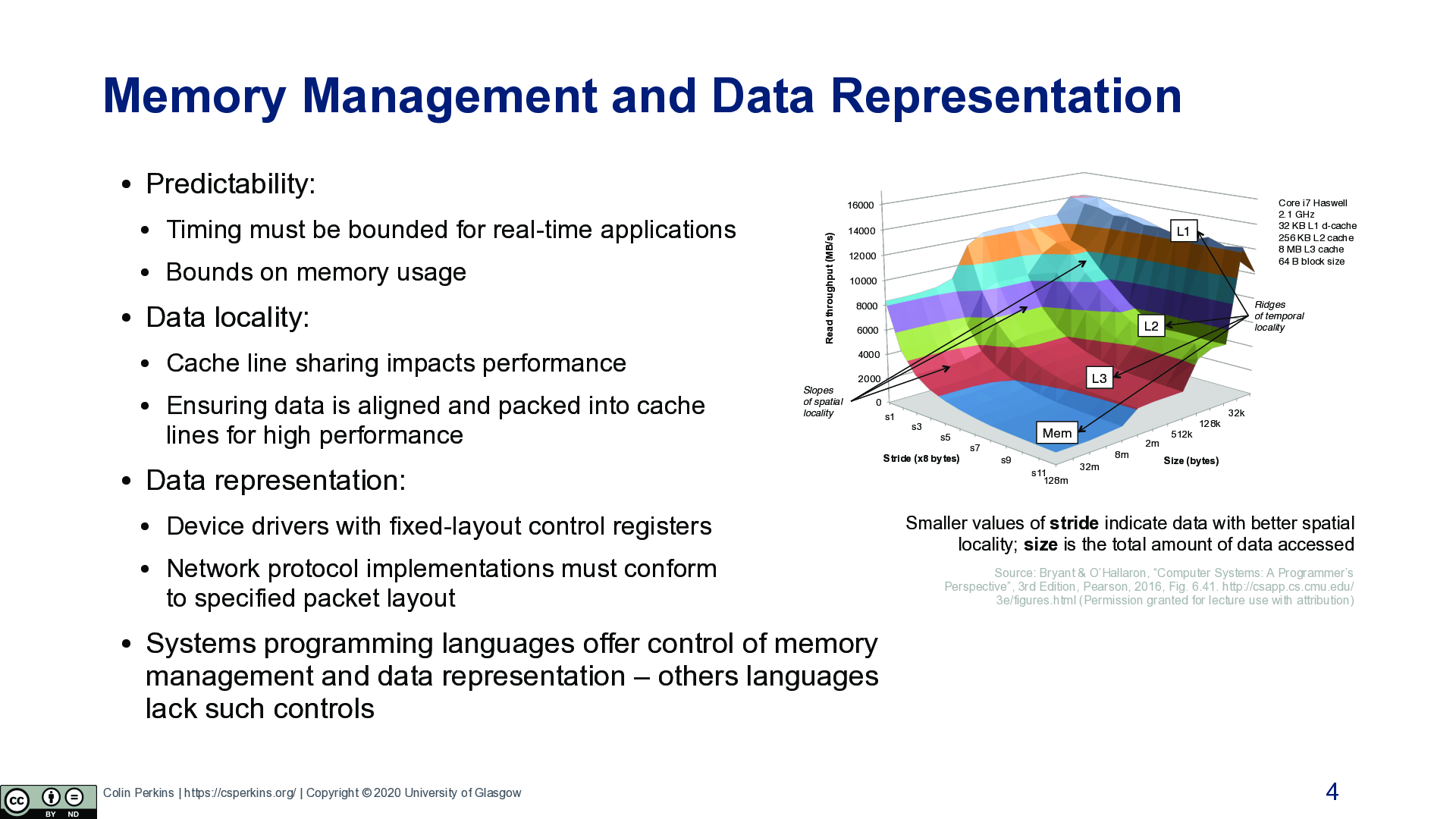
The diagram shows the effects of object sizes
00:03:46.366
and their spacing, known as the stride distance,
00:03:49.400
on read performance for a typical modern system.
00:03:52.566
We see that as the size of the objects being read increases,
00:03:56.366
the read throughput drops.
00:03:58.533
Similarly, as the stride increases,
00:04:01.100
that is, as objects are spaced further apart in memory,
00:04:04.100
throughput drops.
00:04:05.600
This drop in throughput can be dramatic:
00:04:08.400
the worst case shows several orders of magnitude performance
00:04:11.466
loss compared to the peak.
00:04:13.666
The cause is the CPU cache.
00:04:16.800
Modern processors can access small objects,
00:04:19.433
located close to each other in memory,
00:04:21.133
extremely quickly.
00:04:23.066
Fetching larger objects into the cache is slower.
00:04:26.400
And fetching widely, or irregularly,
00:04:28.700
spaced objects from memory is slower still.
00:04:32.266
Effective systems programs arrange data in memory
00:04:35.500
such that related objects are co-located,
00:04:37.933
to achieve high performance.
00:04:39.966
This requires a programming language
00:04:42.033
that gives precise control over data layout.
00:04:45.500
Similarly, device drivers and network
00:04:48.466
protocol implementation must confirm
00:04:50.500
to fixed external layouts.
00:04:52.733
Whether matching the structure
00:04:54.266
of a hardware control register,
00:04:55.966
or the format of a standard network protocol data unit,
00:04:59.200
such systems must have exact
00:05:01.133
bit-level control over the data representation.
00:05:05.266
The key feature of systems programming languages
00:05:08.233
is that they provide such control over data layout
00:05:10.966
and memory management.
00:05:12.366
This introduces complexity.
00:05:14.700
Pointers in C are undoubtably harder to
00:05:17.533
learn than objects in Java, for example.
00:05:20.466
But it’s needed if performance is to be maintained.
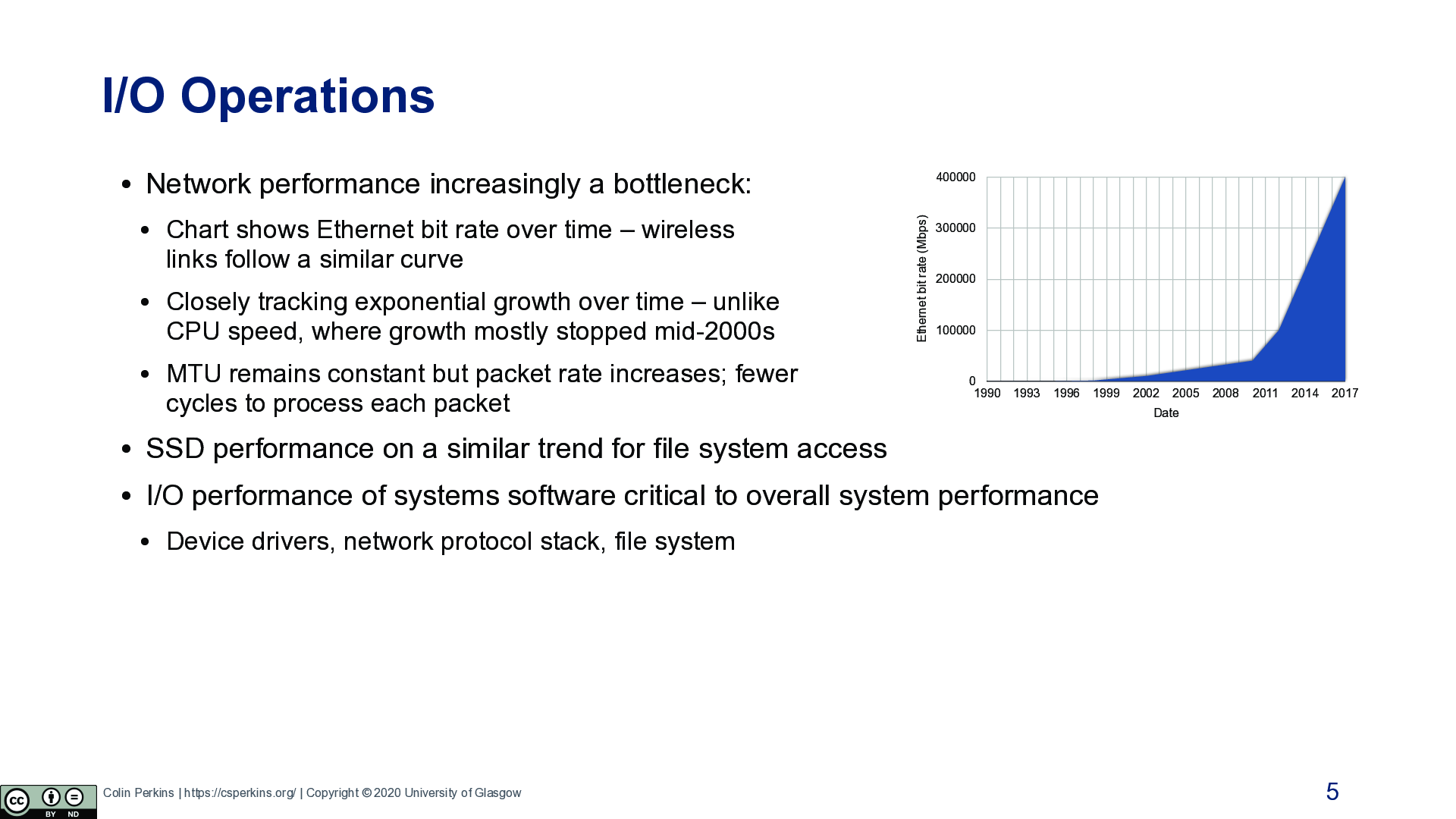
00:05:24.966
The second constraint on systems programs
00:05:27.933
tends to be I/O performance.
00:05:30.266
The chart shows how the transmission rate
00:05:32.600
of Ethernet has increased over time,
00:05:34.966
from the initial 1Mbps data rate,
00:05:37.700
to 40 Gbps parts,
00:05:40.133
and with 100 Gbps Ethernet becoming available.
00:05:44.266
It’s clear that the transmission rate of Ethernet,
00:05:46.666
in bits per second,
00:05:48.100
is still growing at something close to an exponential rate.
00:05:52.300
While this has been happening,
00:05:53.900
the maximum Ethernet packet size, the MTU,
00:05:57.133
has remained constant at 1500 bytes.
00:06:00.433
The result is that the number of packets sent per second
00:06:03.100
has increased exponentially.
00:06:05.766
Wireless link speeds follow a similar curve.
00:06:09.533
This is becoming problematic,
00:06:11.400
because single core CPU performance
00:06:13.633
peaked in the mid-2000s.
00:06:16.000
For over a decade now,
00:06:17.700
the number of network packets that must be processed
00:06:20.333
per second has been increasing,
00:06:22.033
while performance of the processors that must
00:06:24.400
handle those packets has improved little.
00:06:27.000
The result is that packets must be processed
00:06:29.666
more efficiently than ever before.
00:06:31.666
The system has less time to spend
00:06:33.800
processing each packet,
00:06:35.266
since it must process more packets
00:06:37.166
with approximately the same amount of resources.
00:06:40.700
To make matters worse,
00:06:42.233
while this has been happening,
00:06:43.566
we’ve also seen the move to encrypt virtually
00:06:45.833
all of the data passing over the network,
00:06:48.200
to improve security,
00:06:50.133
and the increasing use of streaming and interactive video.
00:06:53.633
Both of these increase the amount of work
00:06:55.600
that must be performed for each packet.
00:06:58.800
The combination of more work per packet,
00:07:02.000
more packets per second, and processors
00:07:04.366
the are not getting much faster,
00:07:06.333
make writing network device drivers,
00:07:08.566
protocol stack implementations,
00:07:10.500
and networked applications, increasingly difficult.
00:07:14.733
Similar trends exist for solid state disk performance.
00:07:18.833
The I/O stack, network and disk,
00:07:21.200
is fast becoming a critical bottleneck
00:07:23.233
in overall system performance.
00:07:25.800
Systems software to support I/O has to be highly efficient.
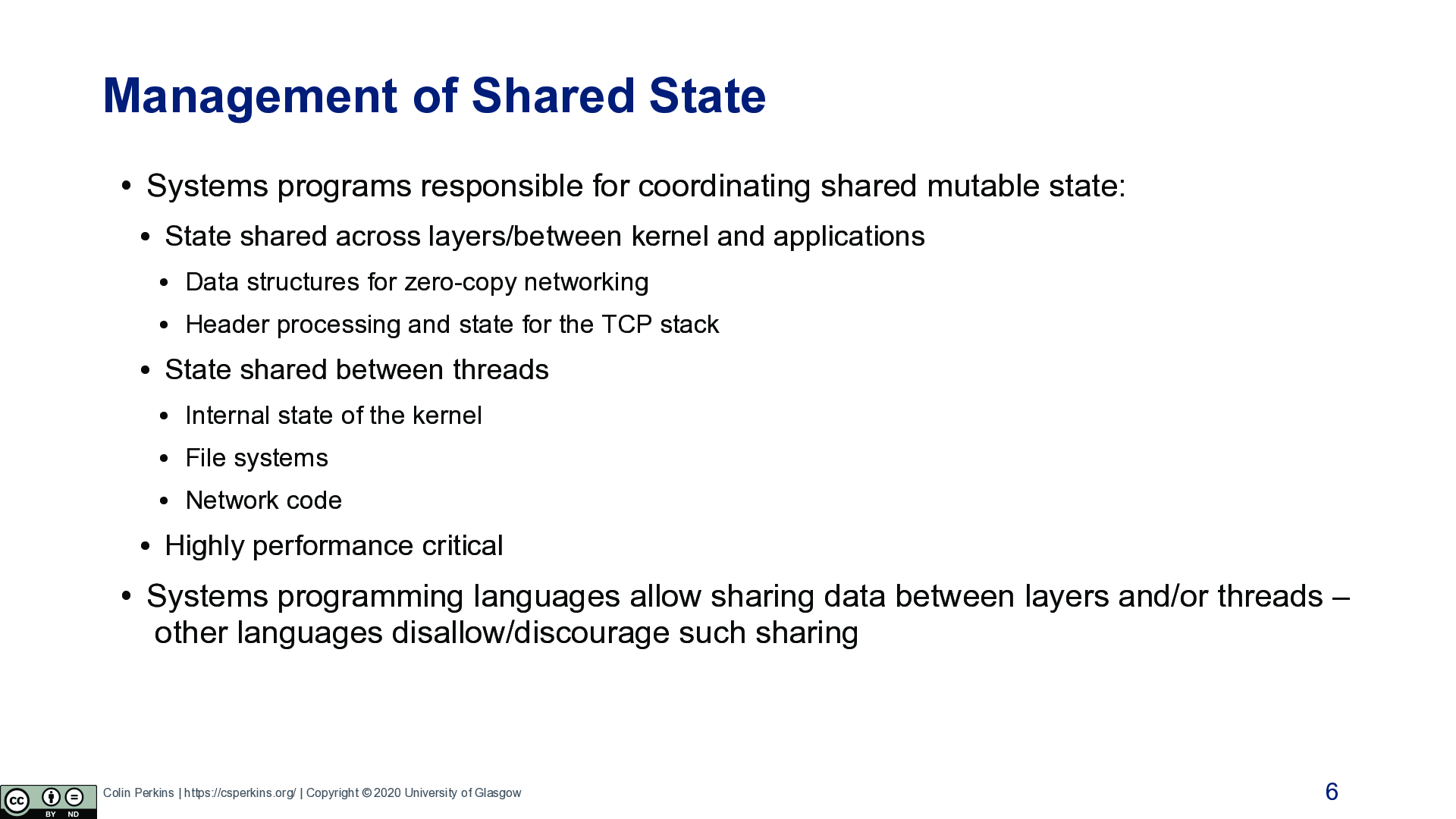
00:07:31.866
The final constraint on systems programs
00:07:34.100
is management of shared state.
00:07:36.566
Systems programs are responsible for coordinating
00:07:39.133
use of shared resources
00:07:40.766
between the operating system
00:07:42.500
and the applications running on the system.
00:07:44.833
They manage the internal state
00:07:46.733
of the operating system kernel,
00:07:48.600
the file systems,
00:07:49.900
network code, device drivers, etc.
00:07:53.033
All this is accessed concurrently by multiple threads,
00:07:56.033
as different applications access operating system resources.
00:08:01.066
Applications programs can be written in a way that
00:08:03.500
ignores concurrency,
00:08:05.033
and uses only a single thread of execution,
00:08:07.500
if the application programmer so chooses.
00:08:10.633
The systems programs that support those applications
00:08:13.600
don’t have that option.
00:08:15.100
They must support multiple applications running at once,
00:08:18.133
on multicore hardware.
00:08:20.466
Concurrency and parallelism
00:08:22.566
are pervasive concerns for systems programs,
00:08:24.900
and cannot be avoided.
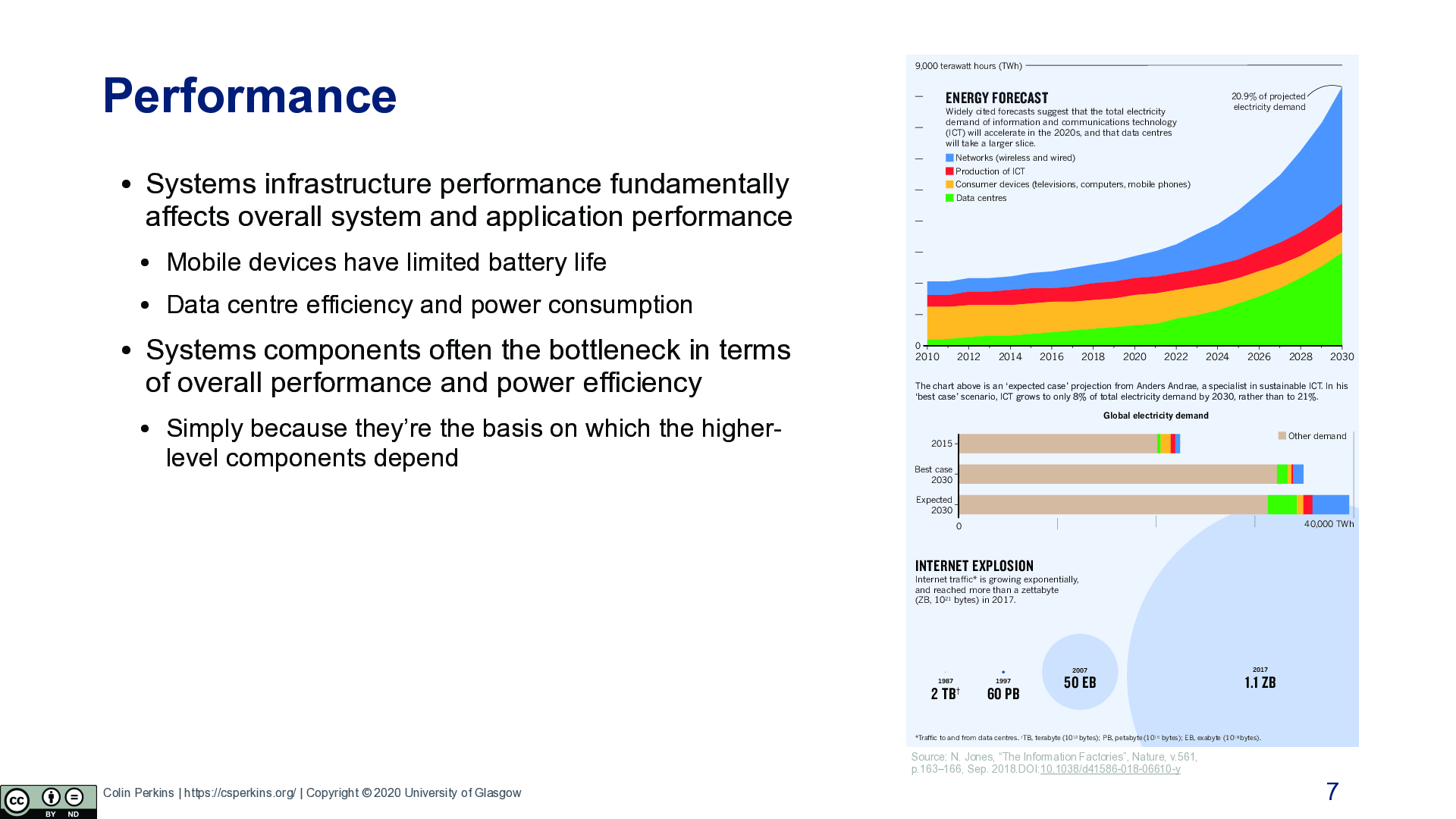
00:08:28.600
What is common to all these concerns
00:08:30.900
is that performance of the systems programs
00:08:33.166
comprising the infrastructure
00:08:34.766
fundamentally affects the overall system performance.
00:08:38.800
Inefficiencies in systems programs
00:08:41.266
will reduce performance,
00:08:42.733
and increase power consumption of the entire system,
00:08:45.733
irrespective of the application it’s running.
00:08:48.833
This means that systems components are often the bottleneck,
00:08:51.866
simply because they’re the basis
00:08:53.433
on which higher-layer components depend.
00:08:57.433
These trends push systems programming languages
00:09:00.466
to offer low-level control.
00:09:02.633
To achieve the necessary performance and efficiency,
00:09:05.466
it’s essential that the program be able to control
00:09:07.900
the layout of data in memory,
00:09:09.733
to manage when, and in what order, data is accessed,
00:09:13.366
and to have precise control of when,
00:09:15.566
and how, data is shared.
00:09:18.066
This is why languages, such as C and C++,
00:09:21.133
that give such low-level control,
00:09:23.200
remain popular for systems programming.
00:09:26.500
A C programmer can, if they choose,
00:09:29.200
control precisely the layout of data in memory,
00:09:32.166
and they have the flexibility to choose exactly when
00:09:34.766
and how data is shared between threads.
00:09:37.566
They don’t have to exercise that control,
00:09:39.900
but it’s available if necessary.
00:09:43.133
Providing this control is a hallmark
00:09:45.266
of systems programming languages.
00:09:47.866
It pushes the language, and it’s runtime,
00:09:50.233
to be more transparent and predictable
00:09:52.366
in how it compiles to machine instructions,
00:09:55.100
and about the costs of various operations,
00:09:58.166
and to favour simpler,
00:09:59.666
more predictable, runtime environments.
00:10:03.000
Languages such as Java, Python, and Go,
00:10:05.766
that do not provide such transparency and control,
00:10:08.500
are not well suited to such low-level systems programming.
00:10:12.800
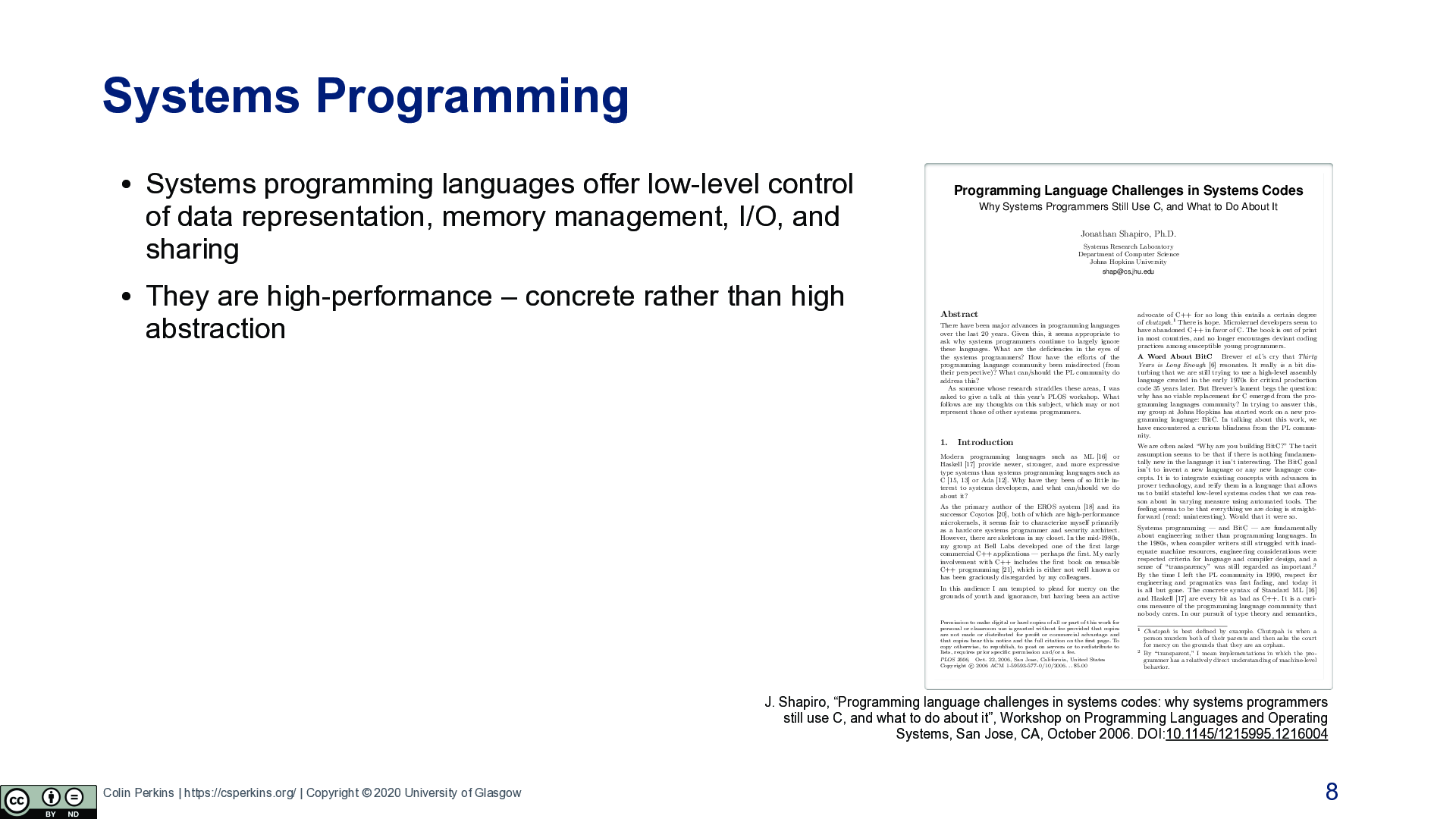
The paper listed on the slide,
00:10:14.966
“Programming language challenges in systems codes:
00:10:17.800
why systems programmers still use C,
00:10:20.033
and what to do about it”
00:10:21.700
by Jonathan Shapiro, explores these ideas,
00:10:25.133
and discusses what is systems programming, in more detail.
00:10:29.033
I strongly encourage you to read it.
00:10:33.000
That concludes this introduction
00:10:34.966
to what makes systems programming challenging.
00:10:37.466
In the next part, we’ll briefly discuss
00:10:39.533
the state of the art in systems programming languages
00:10:42.033
and operating systems.
Part 2: The State of the Art
The 2nd part of the lecture considers the state of the art in systems
programming. It reviews the history of C and Unix, and briefly
highlights their strengths and weaknesses.
00:00:00.066
What is the state of the art in operating systems
00:00:03.233
and systems programming?
00:00:05.733
Most modern computing systems
00:00:08.000
run some variant of Unix as their operating system.
00:00:11.266
That operating system, and many of its
00:00:14.166
supporting utilities and services,
00:00:16.100
are written in the C programming language.
00:00:18.866
If we think about the computers we carry with us every day,
00:00:21.933
for example,
00:00:23.233
Android phones run a variant of Linux,
00:00:26.166
and the iPhone operating system is also a Unix variant:
00:00:29.866
it’s derived from a combination of the Mach microkernel,
00:00:33.000
from Carnegie Mellon University,
00:00:35.200
and 4.3BSD Unix,
00:00:37.633
along with a large number of user space utilities
00:00:40.500
adapted from FreeBSD.
00:00:42.700
Both feature a Unix-like kernel, runtime,
00:00:46.066
and core system written in C,
00:00:48.400
augmented by user interface toolkits
00:00:50.566
and frameworks written in a higher-level language.
00:00:54.966
In the data centre, to support the applications we use,
00:00:58.133
are tens of thousands of Linux servers.
00:01:01.133
And on the desktop,
00:01:02.500
macOS is the same core software stack as the iPhone.
00:01:06.266
About the only popular system not
00:01:08.266
based on Unix is Microsoft Windows.
00:01:11.000
The Windows kernel is, instead,
00:01:12.900
heavily influenced by VMS,
00:01:15.766
another system that dates to the same era as Unix.
00:01:19.066
It’s also written in C.
00:01:22.900
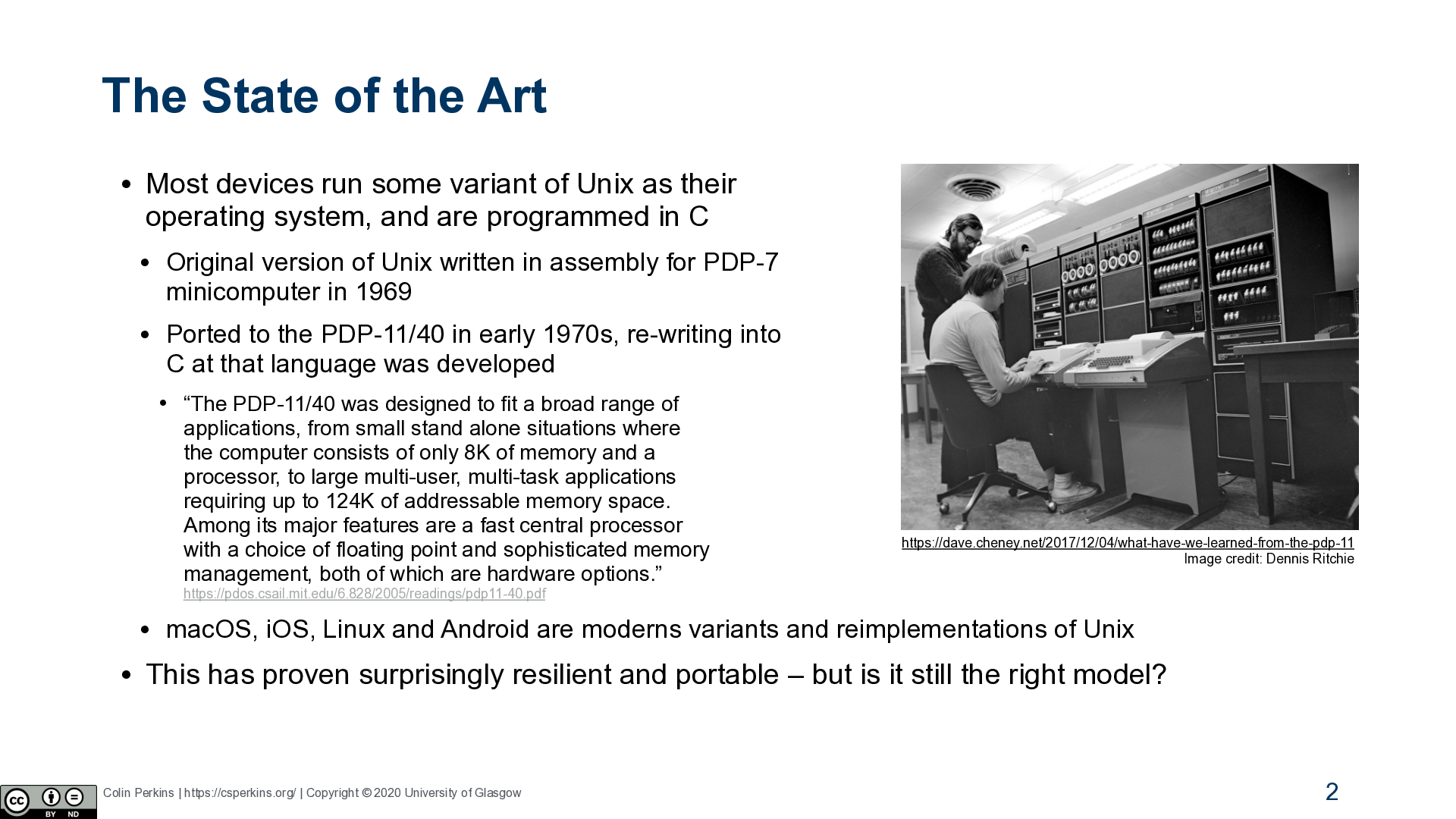
The core of Unix is not a modern design.
00:01:25.700
It was originally written in assembly
00:01:27.700
for the PDP-7 minicomputer in 1969,
00:01:31.733
and ported to the PDP-11 in the early 1970s.
00:01:36.366
The PDP-11, as shown in the photo,
00:01:39.433
was an impressive machine for its time,
00:01:42.000
capable of supporting large multi-user
00:01:44.600
and multi-tasking applications with up to 124K of memory.
00:01:50.566
This more powerful machine allowed the operating system
00:01:53.733
to be rewritten into a new,
00:01:55.800
higher-level, programming language,
00:01:57.800
developed in parallel with Unix, that eventually became C.
00:02:02.866
Unix was the first operating system to be written
00:02:05.666
in a high level language, with very little assembly code,
00:02:09.266
and this made it highly portable.
00:02:11.766
Indeed, there was a thriving open source community
00:02:14.733
developing Unix in the 1980s and early 1990s,
00:02:18.300
centred around the University of California Berkeley
00:02:21.500
and BSD Unix.
00:02:23.933
BSD Unix eventually became a
00:02:26.133
core part of Apple’s operating systems,
00:02:28.900
while Linux development was kick-started by a lawsuit
00:02:31.966
between AT&T, the original developers of Unix,
00:02:35.333
and the University of California,
00:02:37.566
over the status of BSD Unix.
00:02:41.466
The design of C and Unix
00:02:43.766
has proven surprisingly resilient and flexible.
00:02:46.900
The system calls, APIs, and user space tools
00:02:50.633
have been extended and augmented over the years,
00:02:53.533
but the core APIs, tools, and programming language
00:02:56.933
are recognisably the same.
00:02:59.700
Unix clearly did a lot of things right
00:03:02.566
– otherwise it could never have survived for this long,
00:03:04.966
and been adapted to so many different
00:03:07.100
platforms and environments
00:03:08.900
– but is it still the right model?
00:03:13.466
Much of the success of Unix came because it was portable,
00:03:17.200
and because the source code was available to universities,
00:03:20.400
allowing a strong developer and user community to form.
00:03:24.033
The development of the BSD Sockets API,
00:03:27.266
and one of the earliest TCP/IP stacks,
00:03:29.800
also helped Unix grow along with the Internet.
00:03:33.466
But I think there’s more than just community.
00:03:36.333
Unix has a small and, for its time,
00:03:39.133
a relatively clean and consistent programming API.
00:03:42.800
It’s easy to understand and extend,
00:03:45.300
robust and reasonably high-performance,
00:03:47.966
and its transparent and offers low-level control
00:03:51.033
and access when needed.
00:03:53.033
The kernel and utilities are, on the whole, well designed.
00:03:59.066
Further, the C programming language was portable,
00:04:02.400
easy to use, and offered features that were quite high-level
00:04:05.966
– for it’s time.
00:04:07.933
To programmers coming from writing systems programs
00:04:10.933
in assembly language, the abstraction of
00:04:13.566
pointers in C greatly simplified
00:04:15.766
writing portable device drivers and other low-level code.
00:04:19.366
The concept of pointers in C provides a single
00:04:23.533
mechanism to solve many problems.
00:04:25.833
The same approach lets you build
00:04:27.900
complex data structures,
00:04:29.500
manipulate data in memory,
00:04:31.433
and access hardware control registers
00:04:34.366
– no other programming language offers such a simple
00:04:37.200
and successful abstraction for such uses.
00:04:40.900
Further, the C type system is strong enough
00:04:44.366
to make writing systems programs significantly
00:04:46.633
easier than writing them in assembly,
00:04:48.933
yet weak enough to allow aliasing,
00:04:51.066
casting, and sharing of data
00:04:53.300
in ways that were necessary for performance.
00:04:56.500
For example, a zero copy network protocol stack
00:04:59.700
can be cleanly implemented in C,
00:05:01.866
passing pointers to different offsets inside a packet,
00:05:05.200
cast to different types,
00:05:07.133
to the next layer in the stack as the packet is processed.
00:05:10.866
Such aliasing and flexibility with types
00:05:13.566
is natural to an assembly language programmer,
00:05:16.166
and can be cleanly expressed in C,
00:05:18.633
but is a very poor fit for most other
00:05:20.900
programming languages.
00:05:24.833
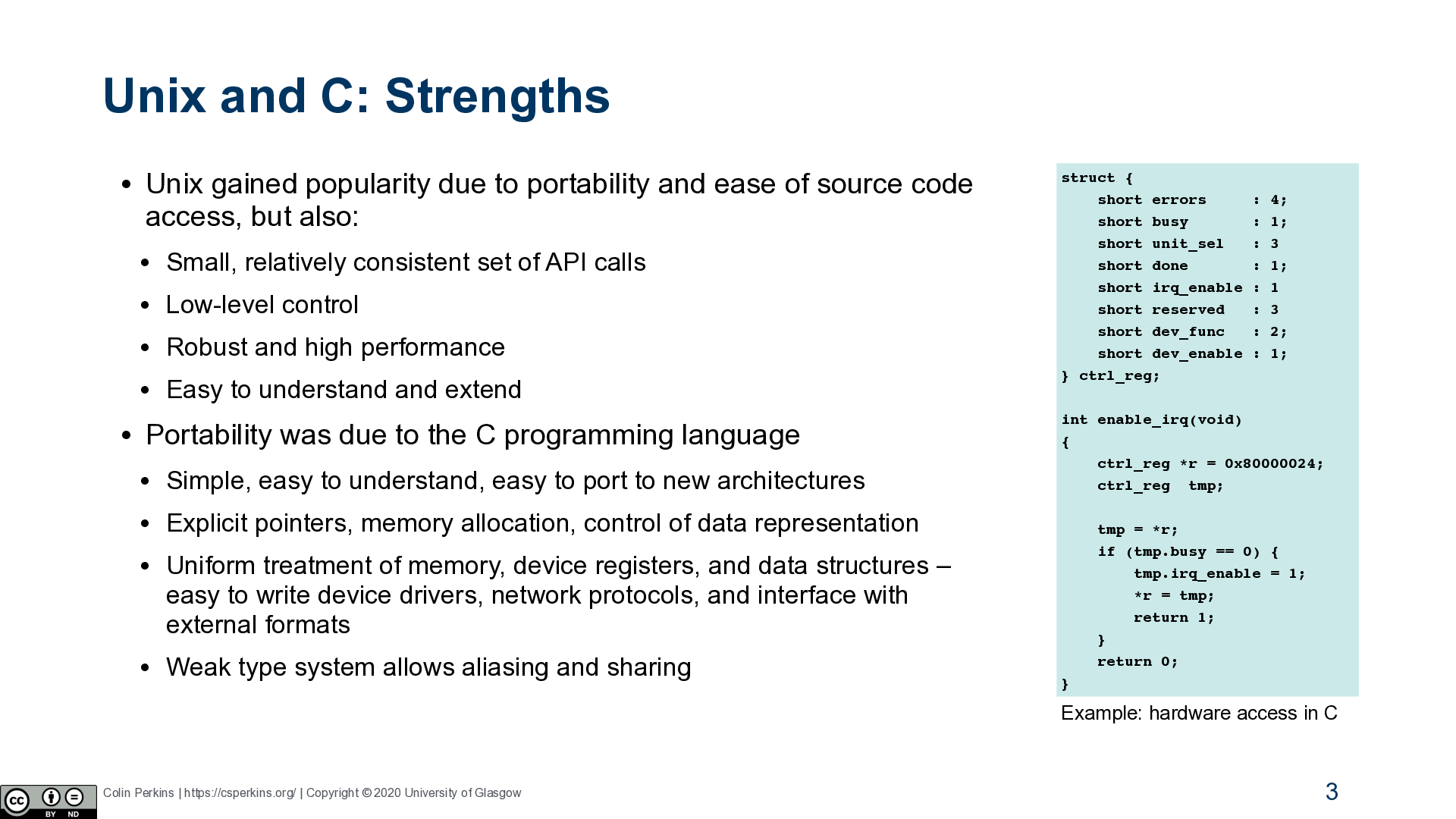
The code fragment on the slide gives an example,
00:05:27.600
to show how C can be used to cleanly write
00:05:30.100
portable device drivers.
00:05:32.333
There are two parts to this.
00:05:34.866
The first is the definition of a data type,
00:05:37.466
struct ctrl_reg,
00:05:39.566
and the second is the definition of the enable_irq()
00:05:42.566
function.
00:05:44.333
The struct definition
00:05:46.000
describes the format of a control register
00:05:48.300
for some hardware device.
00:05:50.300
It uses the bitfield syntax of C
00:05:53.033
to specify the exact layout of a 16 bit control word.
00:05:57.966
The enable_irq() function reads from a control register,
00:06:01.566
r, located at a fixed memory address,
00:06:04.866
0x80 00 00 24.
00:06:09.200
It checks if the busy bit,
00:06:11.433
the 5th bit in the control register,
00:06:13.400
is clear, and if so,
00:06:15.466
enables interrupts by setting the irq_enable bit
00:06:18.700
and writing to the control register.
00:06:21.633
It’s a simple example,
00:06:23.300
showing the sort of data structure and operation
00:06:25.900
that is common in device drivers,
00:06:27.900
and showing how cleanly, portably,
00:06:30.400
and readably device drivers can be written in C.
00:06:34.466
This sort of clean, low-level, access
00:06:37.000
is one of the key strengths of C.
00:06:41.200
That explains the benefits,
00:06:43.366
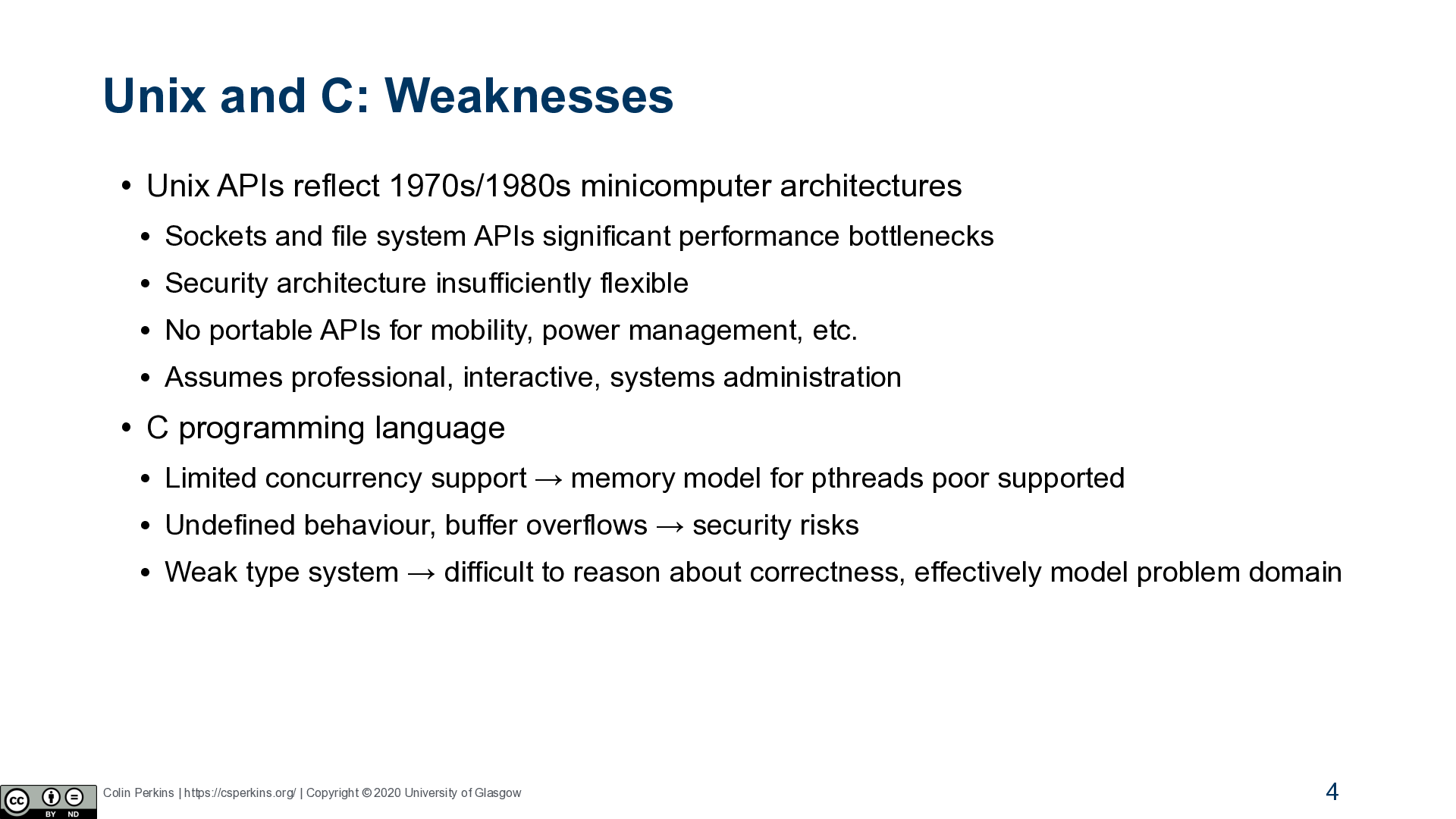
but what’s wrong with Unix and C?
00:06:47.333
The Unix networking and filesystem APIs
00:06:50.200
can be performance bottlenecks.
00:06:52.433
They emphasise saving buffer space
00:06:54.666
at the expense of additional system calls
00:06:56.900
in a way that made sense when memory capacity
00:06:59.200
was limited and system calls
00:07:01.000
were not so expensive,
00:07:02.366
but that doesn’t reflect modern hardware.
00:07:05.400
The Unix security model
00:07:07.300
is designed to arbitrate access by multiple
00:07:09.733
users to a single expensive machine,
00:07:12.433
not to control access to
00:07:14.033
personal data owned by a single user.
00:07:17.066
It can effectively prevent other users
00:07:19.600
on my machine from seeing my personal data,
00:07:22.266
but can’t easily control access for
00:07:24.133
applications I choose to run.
00:07:26.500
And Unix has no portable APIs for modern concerns,
00:07:29.900
such as mobility, power management, and so on.
00:07:34.900
The C programming language
00:07:36.766
offers a powerful and flexible abstraction
00:07:39.033
for memory access, in the form of pointers,
00:07:42.033
but this is perhaps too powerful.
00:07:44.700
It’s too easy to enable buffer overflows,
00:07:47.166
use-after-free bugs, or off-by-one errors,
00:07:49.933
or to invoke undefined behaviour,
00:07:51.933
and cause a security vulnerability.
00:07:54.800
The weak type system offers flexibility,
00:07:58.433
but makes it difficult to reason about
00:08:00.466
the correctness of the system.
00:08:02.366
Many bugs happen because the type system is flexible
00:08:05.400
enough to allow a particular design,
00:08:07.666
but not powerful enough to
00:08:08.966
check that design for correctness.
00:08:11.933
And C and Unix have limited support for concurrency.
00:08:16.200
Modern versions of C did, eventually,
00:08:18.933
get a well-defined model for when concurrent
00:08:21.000
memory accesses are visible across threads,
00:08:23.533
along with a portable multi-threading library,
00:08:26.533
but these are not well supported.
00:08:29.500
And, perhaps more importantly,
00:08:31.766
it’s not clear that multi-threading is the right
00:08:33.900
concurrency abstraction going forward.
00:08:37.133
It’s frequently forgotten today,
00:08:40.566
but multi-threading was an extremely controversial
00:08:43.500
addition to C and Unix.
00:08:45.633
The suggested benefits,
00:08:47.266
providing lower-overhead concurrency, were real.
00:08:50.600
Unfortunately, so too were the concerns around race
00:08:53.633
conditions and correctness.
00:08:58.133
Overall, Unix has proven to be a success.
00:09:01.566
It has some limitations,
00:09:03.533
especially around high-performance I/O,
00:09:05.666
power management, mobility, etc.,
00:09:08.233
but these can mostly be addressed with extensions,
00:09:11.200
retaining the older APIs for backwards compatibility
00:09:14.766
– and we’ll talk more about how this is
00:09:16.600
done later in the course.
00:09:19.100
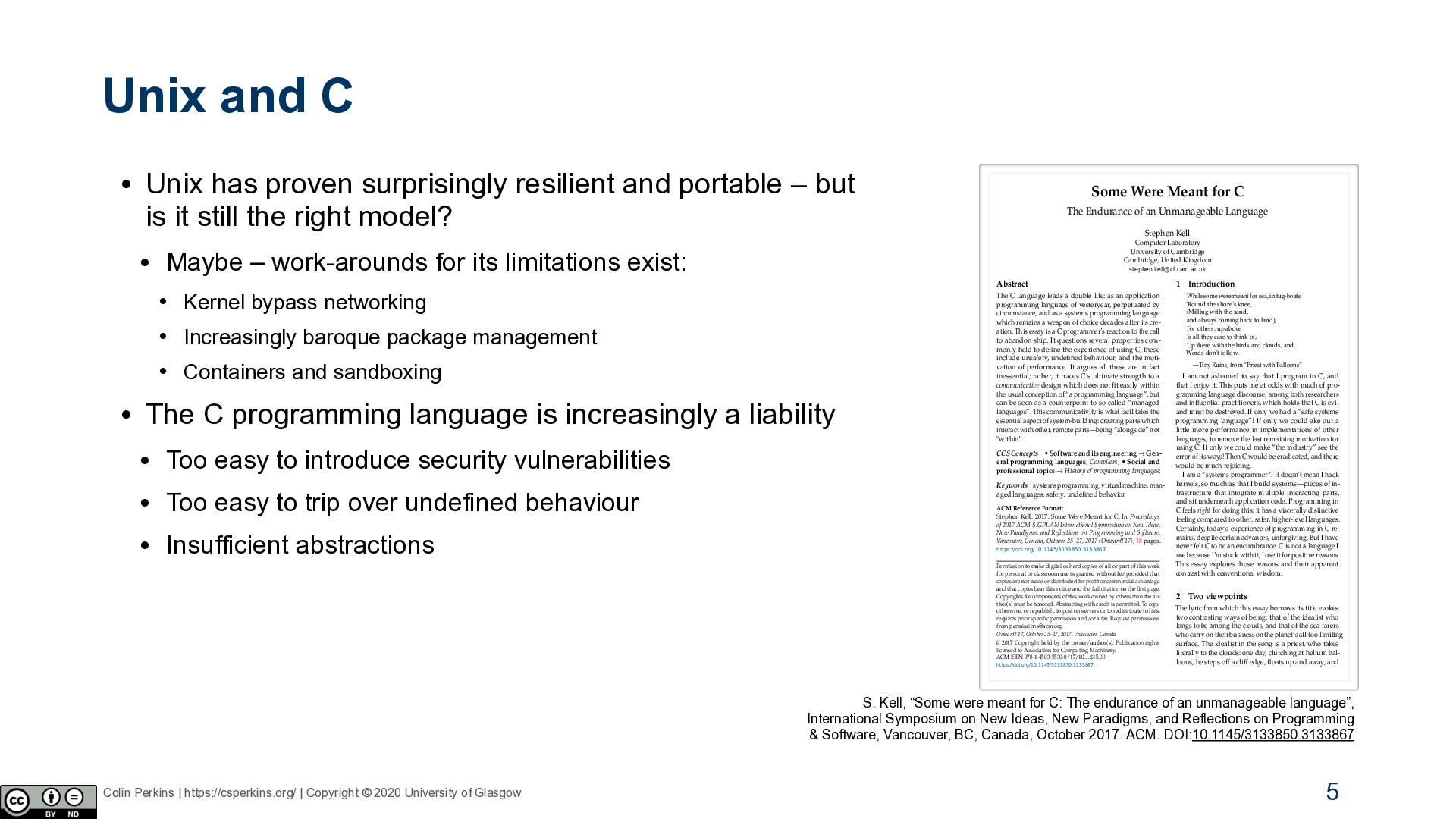
More concerning are the limitations of the security model
00:09:22.033
and package management systems.
00:09:24.333
The increasing use of containers, sandboxing,
00:09:27.200
and virtualisation to work around limitations and
00:09:30.333
improve security is a sign that the underlying
00:09:33.000
security and shared library mechanisms
00:09:35.400
are not meeting the current needs.
00:09:39.133
The C programming language
00:09:40.933
is increasingly becoming a liability.
00:09:43.166
It offers a flexible approach to memory management,
00:09:46.400
and the pointer abstraction is powerful,
00:09:48.966
but it’s proven too difficult to use correctly.
00:09:52.433
It’s too easy to introduce security vulnerabilities,
00:09:56.100
or to trip over undefined behaviour.
00:09:58.933
In practice, no-one seems able to
00:10:01.633
consistently write correct and secure C programs.
00:10:05.033
The answer here cannot be “better programmers”
00:10:07.866
– they don’t exist.
00:10:09.500
Rather, we need less error prone languages.
00:10:13.800
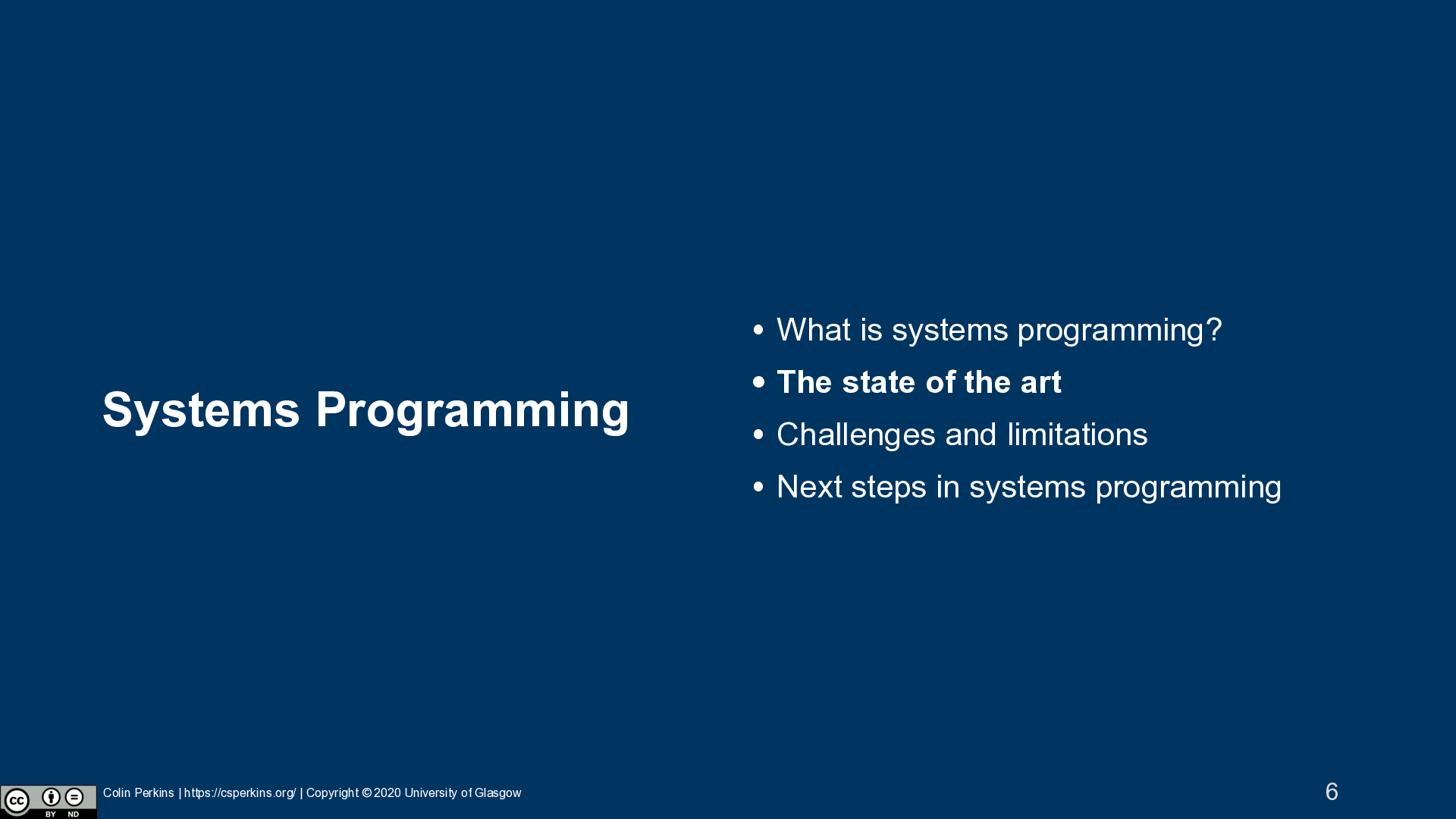
The paper, “Some were meant for C:
00:10:16.100
The endurance of an unmanageable language”,
00:10:18.266
by Stephen Kell,
00:10:19.800
discusses some of the issues with
00:10:21.633
the C language in more detail
00:10:23.333
– both its strengths and weaknesses.
00:10:26.500
Please read it, and think about these issues,
00:10:28.866
before the discussion session.
00:10:32.633
That concludes our brief review of the state of the art
00:10:35.600
in systems programming, and some of its limitations.
00:10:38.800
In the next part, we’ll talk more about some of the
00:10:41.666
changes in the environment that are pushing us to reconsider
00:10:44.633
how we write systems programs.
-
D. Cheney,
What Have We Learned from the PDP-11?, December 2017.
-
S. Kell,
Some were meant for C: The endurance of an unmanageable language,
International Symposium on New Ideas, New Paradigms, and Reflections
on Programming & Software, Vancouver, BC, Canada, October 2017. ACM.
Part 3: Challenges and Limitations
The 3rd part of the lecture discusses changes in the environment that
are affecting systems programs. It talks about the end of Moore's law
and the breakdown of Dennard scaling, and the implications of these
hardware trends on microprocessor architecture and concurrency. It
discusses the increasing need for secure systems due to the presence
of always-on connectivity and the Internet, and outlines some features
of C and Unix that are hard to secure. And it discusses the impact of
mobile, battery-powered, devices, and climate change, on need for
energy efficiency in systems programs.
00:00:00.133
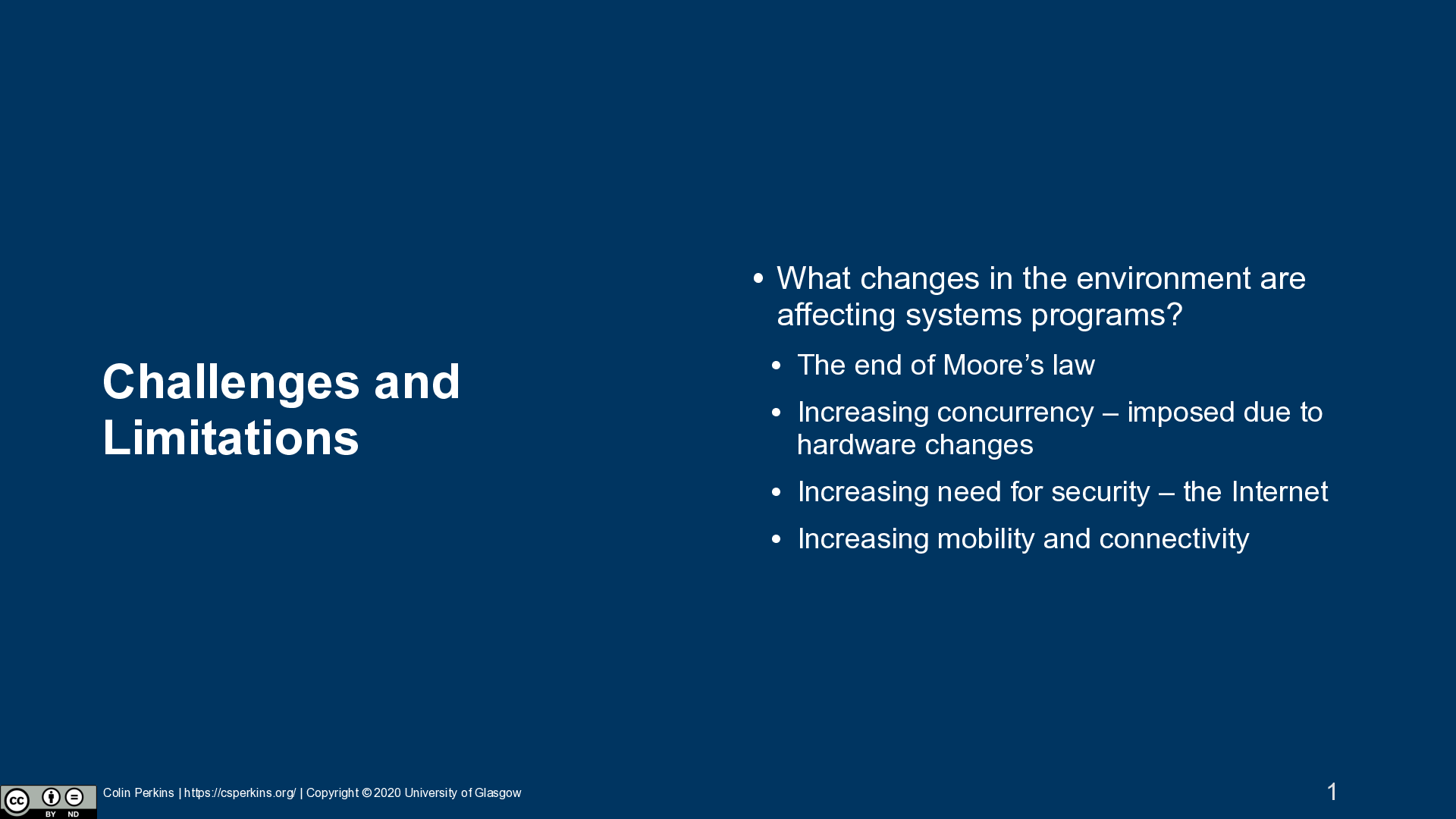
What changes in the environment
00:00:02.333
are affecting systems programs?
00:00:05.100
I see four trends.
00:00:07.033
The first is the end of Moore’s law and Dennard Scaling.
00:00:10.933
This is forcing
00:00:12.866
changes in the way processors are designed,
00:00:14.966
forcing more concurrency and more specialisation.
00:00:18.700
Second is that increase in concurrency,
00:00:21.433
and its impact on the way we design and build software.
00:00:25.600
Third is the increasing urgency
00:00:27.900
to build more secure systems,
00:00:29.700
as the ubiquity of the Internet,
00:00:31.933
and ever-connected devices,
00:00:33.666
exposes more and more vulnerabilities.
00:00:36.666
Fourth, and finally, is the impact of
00:00:40.033
connectivity, and the changes to the way
00:00:42.333
we write applications caused by pervasive connectivity,
00:00:45.833
mobility, and cloud computing.
00:00:50.700
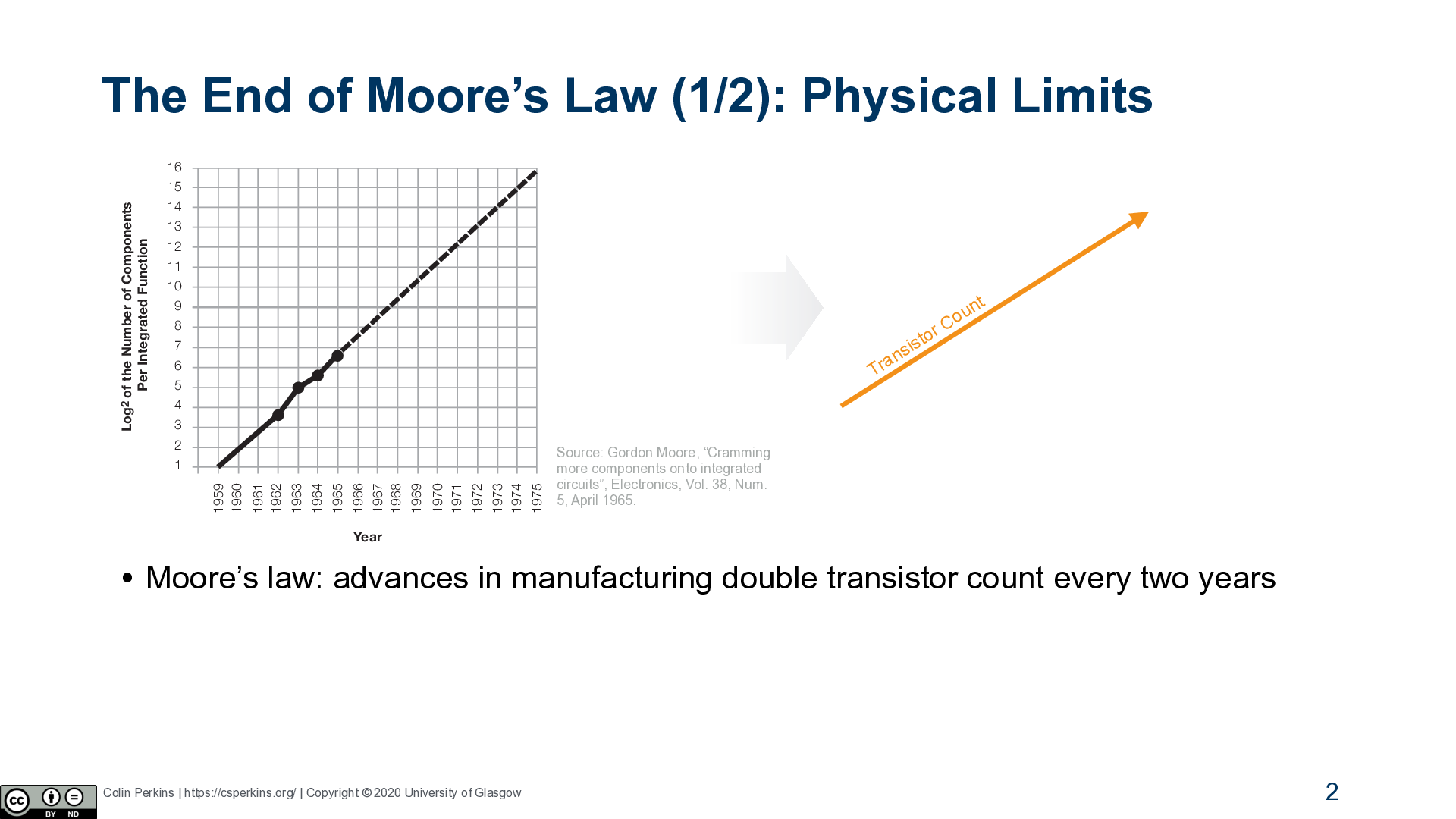
Moore’s law is the observation, made by Gordon Moore,
00:00:54.733
the co-founder of Intel, in 1965,
00:00:56.966
that the number of transistors
00:00:59.800
that can be integrated onto a single
00:01:02.266
device doubles roughly every two years,
00:01:04.400
due to improvements in manufacturing.
00:01:06.833
When plotted with time on the x-axis,
00:01:09.800
and number of transistors on a log
00:01:13.733
scale on the y-axis, such exponential growth
00:01:15.900
should appear as a straight line.
00:01:17.866
This is true for the original prediction,
00:01:20.500
shown in the graph on the left,
00:01:22.433
but isn’t very convincing. It was based
00:01:24.833
on four data points, capturing 1962-1965.
00:01:31.000
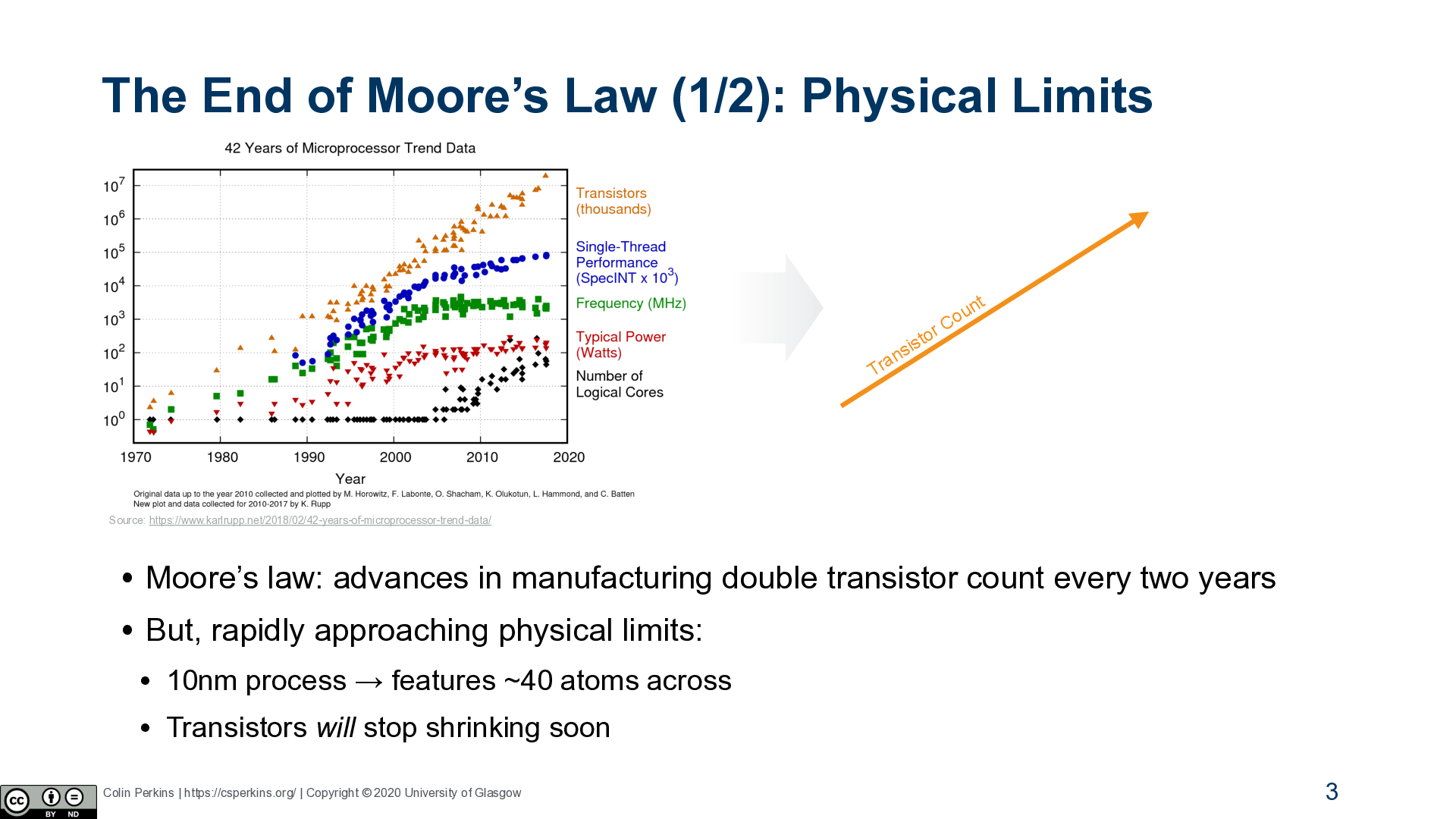
If we add modern data, though,
00:01:33.166
the pattern still holds up.
00:01:35.266
The orange points on this plot show
00:01:37.433
the number of transistors for processors released
00:01:39.766
between 1970 and 2018.
00:01:42.900
They follow the
00:01:44.766
same straight-line relation, at least approximately.
00:01:47.500
The industry has, through heroic effort,
00:01:50.066
ensured that Moore’s law continues.
00:01:54.000
But, we’re rapidly approaching physical limits.
00:01:57.733
The feature size of the transistors that
00:02:00.433
form modern microprocessors is 10nm, with some
00:02:03.900
manufacturers introducing devices with 5nm features.
00:02:08.300
A 5nm feature is roughly 20 atoms across.
00:02:13.366
Four more generators of Moore’s law
00:02:16.266
would result in features only one or two atoms in size.
00:02:20.133
There is a physical limit in how small things can go.
00:02:24.433
Transistors will stop shrinking soon.
00:02:27.166
Moore’s law will come to an end.
00:02:31.466
An issue that’s had greater impact than
00:02:33.800
Moore’s law, although it’s perhaps less well
00:02:36.966
known, is the breakdown of Dennard scaling.
00:02:39.900
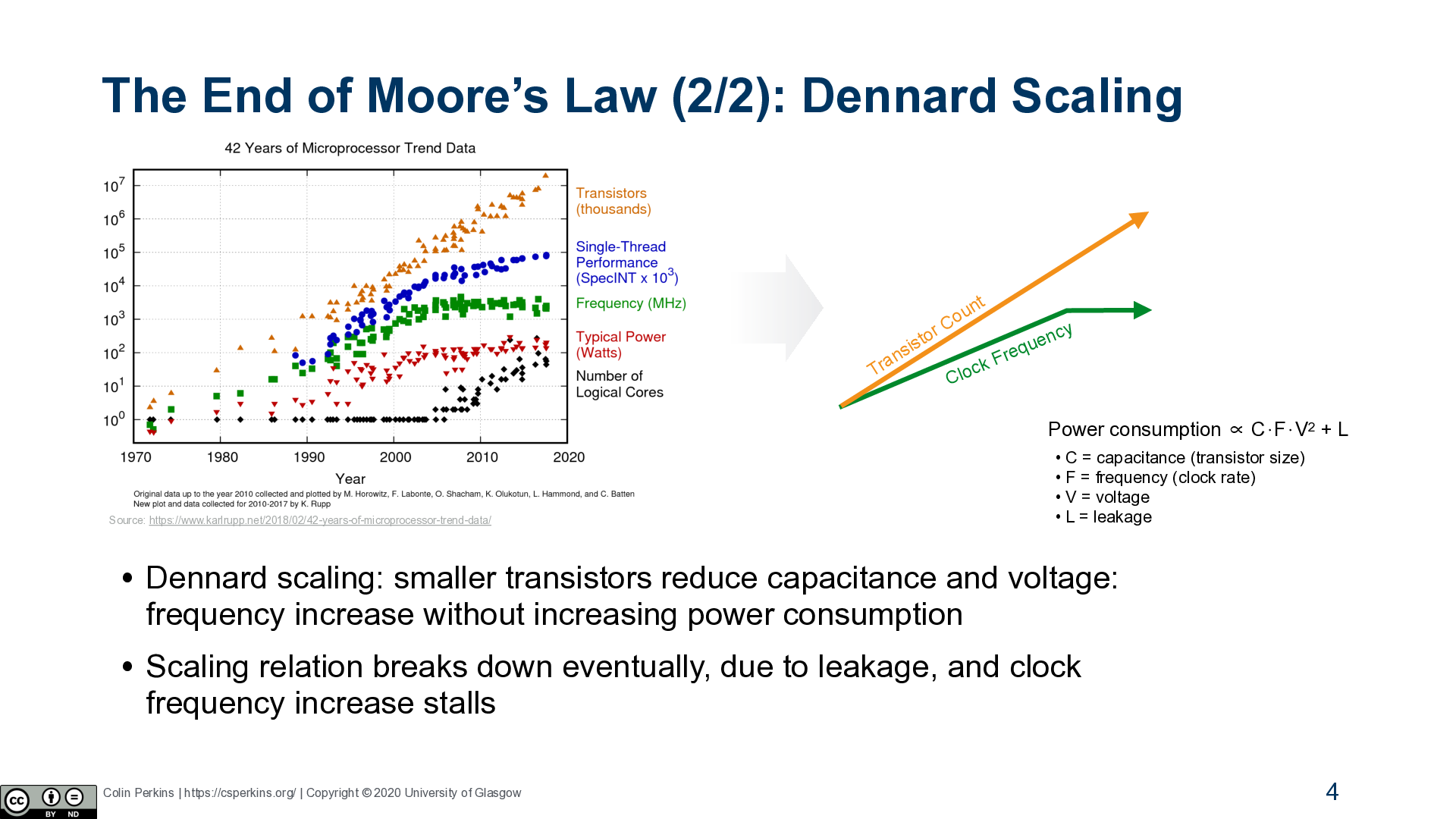
As we see in the equation on the right,
00:02:42.433
the power consumed by a transistor
00:02:44.733
is proportional to the capacitance of
00:02:48.133
the switching gate; the frequency at which
00:02:51.200
the transistor switches, that is, the clock
00:02:53.200
rate; and the square of the voltage applied.
00:02:55.466
Plus a constant term, known as the leakage current.
00:02:59.033
The voltage and capacitance,
00:03:02.300
in turn, directly relate to the size of the transistor.
00:03:06.533
The Dennard scaling relation is the observation
00:03:09.900
that, as transistors shrink in size,
00:03:11.733
due to Moore’s law, their power consumption will decrease,
00:03:15.300
since this reduces the voltage and capacitance.
00:03:19.400
This lets you build more power efficient computers.
00:03:23.000
Alternatively,as the capacitance and voltage decrease,
00:03:27.266
you can increase the clock frequency to match.
00:03:30.700
This lets you build faster computers
00:03:33.000
that use roughly the same amount of power.
00:03:36.433
From the home computers of the mid-1980s,
00:03:39.166
through to around 2005,
00:03:41.233
this was the story of the computer industry.
00:03:44.766
Moore’s law reduced the size of transistors and,
00:03:47.800
due to Dennard scaling, computers got faster.
00:03:51.466
We started with a clock rate of around 1MHz,
00:03:54.800
in the era of the Commodore 64 and BBC Micro,
00:03:58.033
and by the end had with PCs with Intel
00:04:01.200
Pentium IV processors running at 3.8GHz.
00:04:05.800
Unfortunately, as we see in the green
00:04:08.400
points in this figure,
00:04:09.933
the clock rate stopped increasing at that point.
00:04:13.866
The reason is the leakage current,
00:04:16.133
that started to grow exponentially when the
00:04:18.333
feature size dropped below around 65nm.
00:04:22.433
Moore’s law still gave power savings,
00:04:25.166
as the size of transistors decreased,
00:04:27.533
but those savings had to be taken,
00:04:29.900
keeping the clock rate constant, to balance
00:04:31.833
the increased power consumption due to the
00:04:34.133
greater leakage current.
00:04:37.033
It simply became difficult to make processors
00:04:39.400
faster without them melting, due to the
00:04:42.133
heat from the excessive power consumption.
00:04:45.100
For this reason, while Moore’s law has
00:04:47.433
continued to give us more transistors since
00:04:50.733
the mid-2000s, clock rates have remained stalled.
00:04:55.266
Given that Moore’s law is continuing,
00:04:57.766
how do processor designers use those additional transistors?
00:05:02.166
Mostly, as some combination of large caches,
00:05:05.500
and to support multicore operation.
00:05:08.733
Starting shortly after the breakdown of Dennard scaling,
00:05:11.933
when it became clear that
00:05:13.233
processor clock rates couldn’t increase anymore,
00:05:15.500
because we’d reached the limit in power consumption,
00:05:18.366
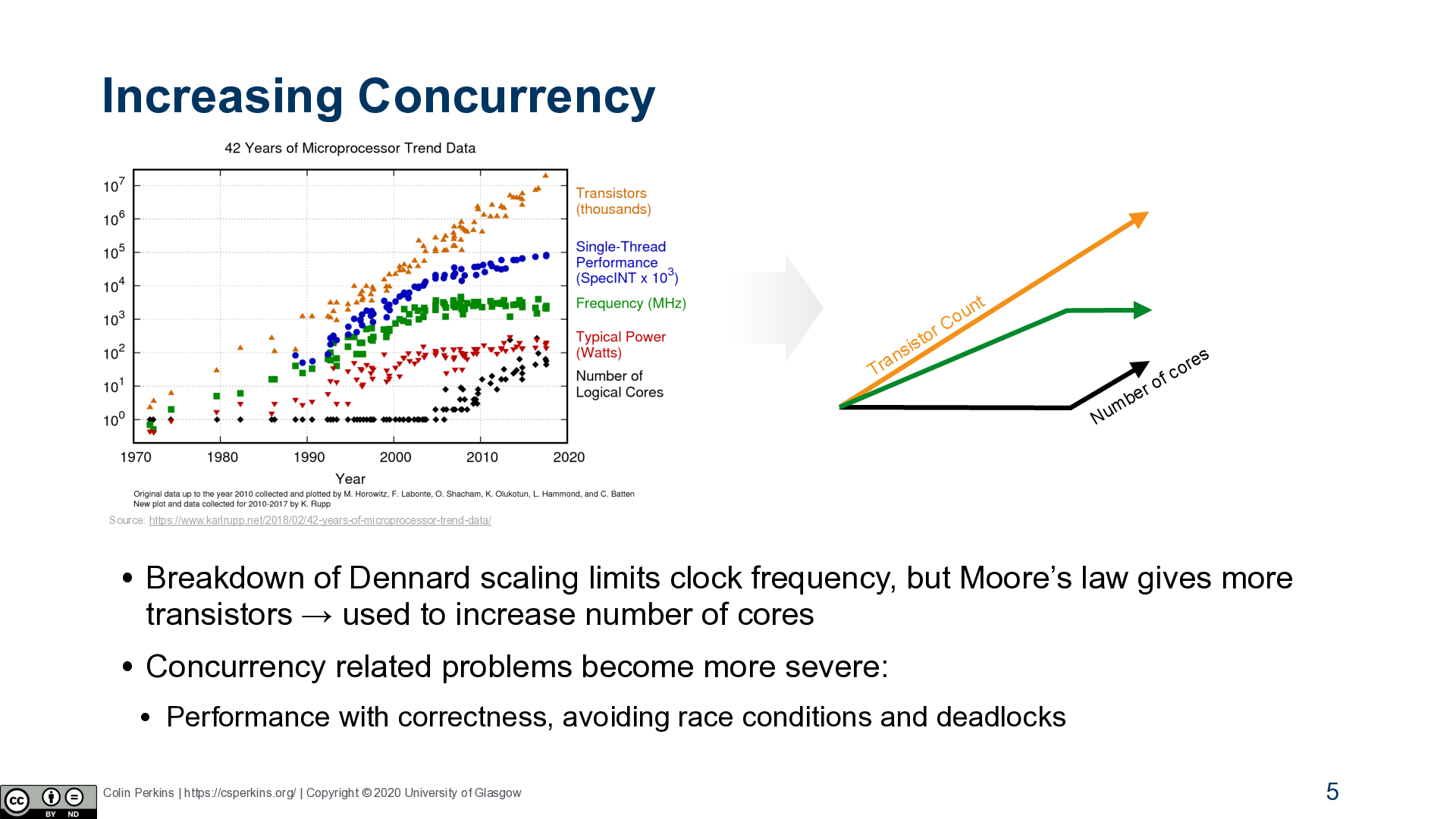
we see the number of processor cores start to increase.
00:05:22.400
This is shown on the figure as the black data points.
00:05:26.533
What’s interesting is that the increasing
00:05:28.233
number of cores plots as a straight line in this figure.
00:05:31.700
Given the log scale on the y-axis,
00:05:34.033
this implies the number of
00:05:35.233
cores is increasing exponentially.
00:05:38.800
A consequence of this, is that concurrent
00:05:41.266
programming is becoming more important.
00:05:44.033
Multiple threads of execution are needed to extract good
00:05:47.233
performance from modern processors.
00:05:50.566
Another consequence is that concurrency bugs more
00:05:53.000
becoming more visible.
00:05:55.233
Race conditions, deadlocks,
00:05:57.033
and other problems with interactions between multiple
00:05:59.300
threads tend to manifest themselves more often
00:06:02.066
as the amount of parallelism increases.
00:06:05.500
Not only are we increasingly seeing the
00:06:09.600
need for concurrency, we’re also seeing how
00:06:12.200
difficult it is to write concurrent software.
00:06:17.800
In addition to the changes in computer hardware,
00:06:20.600
leading to increased concurrency,
00:06:22.766
we’re also seeing far more devices
00:06:24.466
with always-on Internet connectivity.
00:06:28.366
Unfortunately, with this rise in connectivity
00:06:31.400
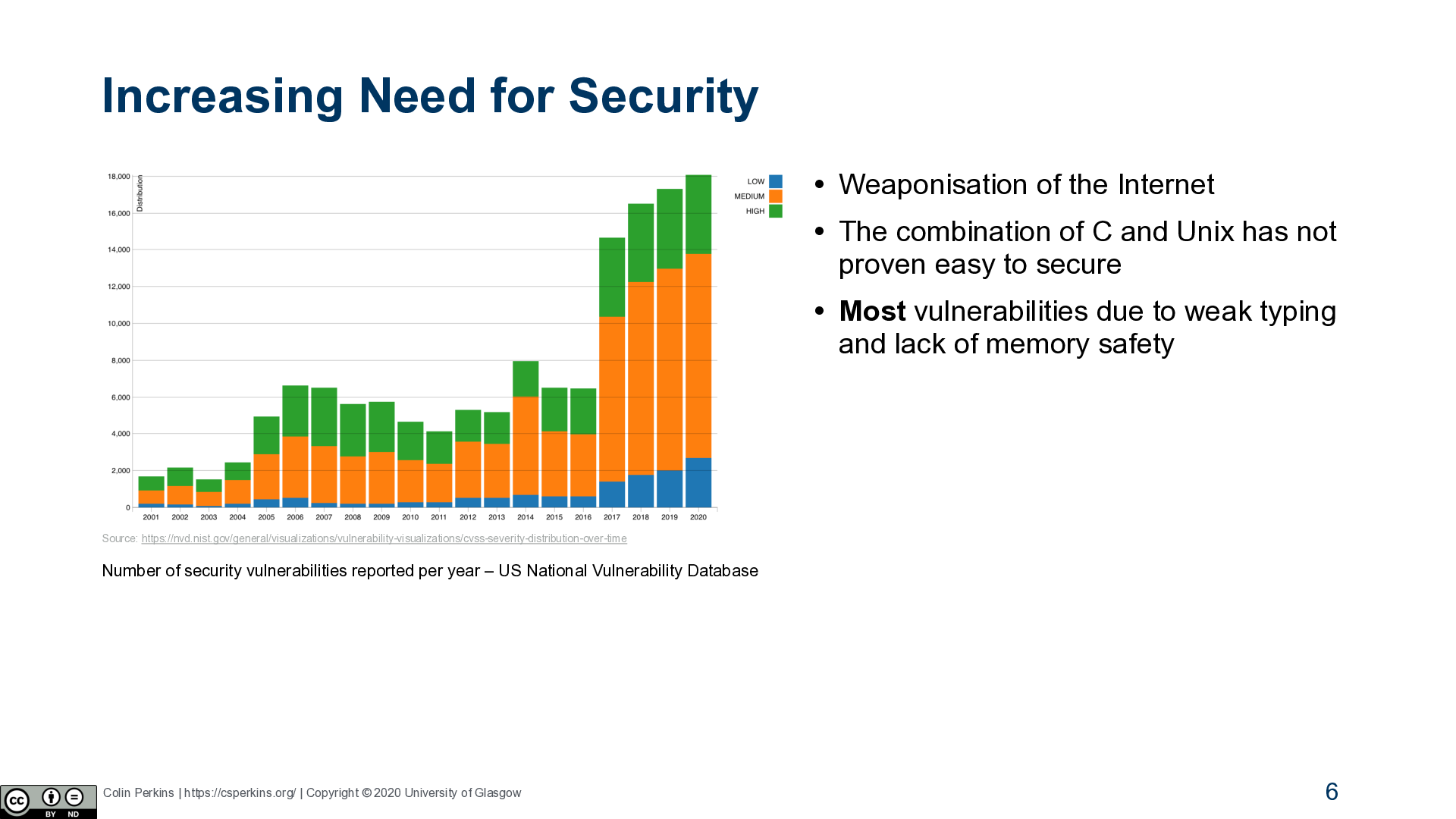
has come increasing numbers of security vulnerabilities.
00:06:35.133
The graph shows the number of security
00:06:36.933
vulnerabilities reported per year, since the year 2000,
00:06:40.800
colour-coded by severity.
00:06:43.766
What is clear is that the combination of Unix and C,
00:06:47.300
and the applications that run on such systems, has not
00:06:50.333
proven easy to secure.
00:06:53.066
As we’ll see later, most of these
00:06:55.466
vulnerabilities are due to weak type systems
00:06:58.200
and a lack of memory safety in modern systems.
00:07:01.366
That is, many of these
00:07:03.266
vulnerabilities are avoidable, in principle, by changing
00:07:06.666
the way we implement software systems.
00:07:11.500
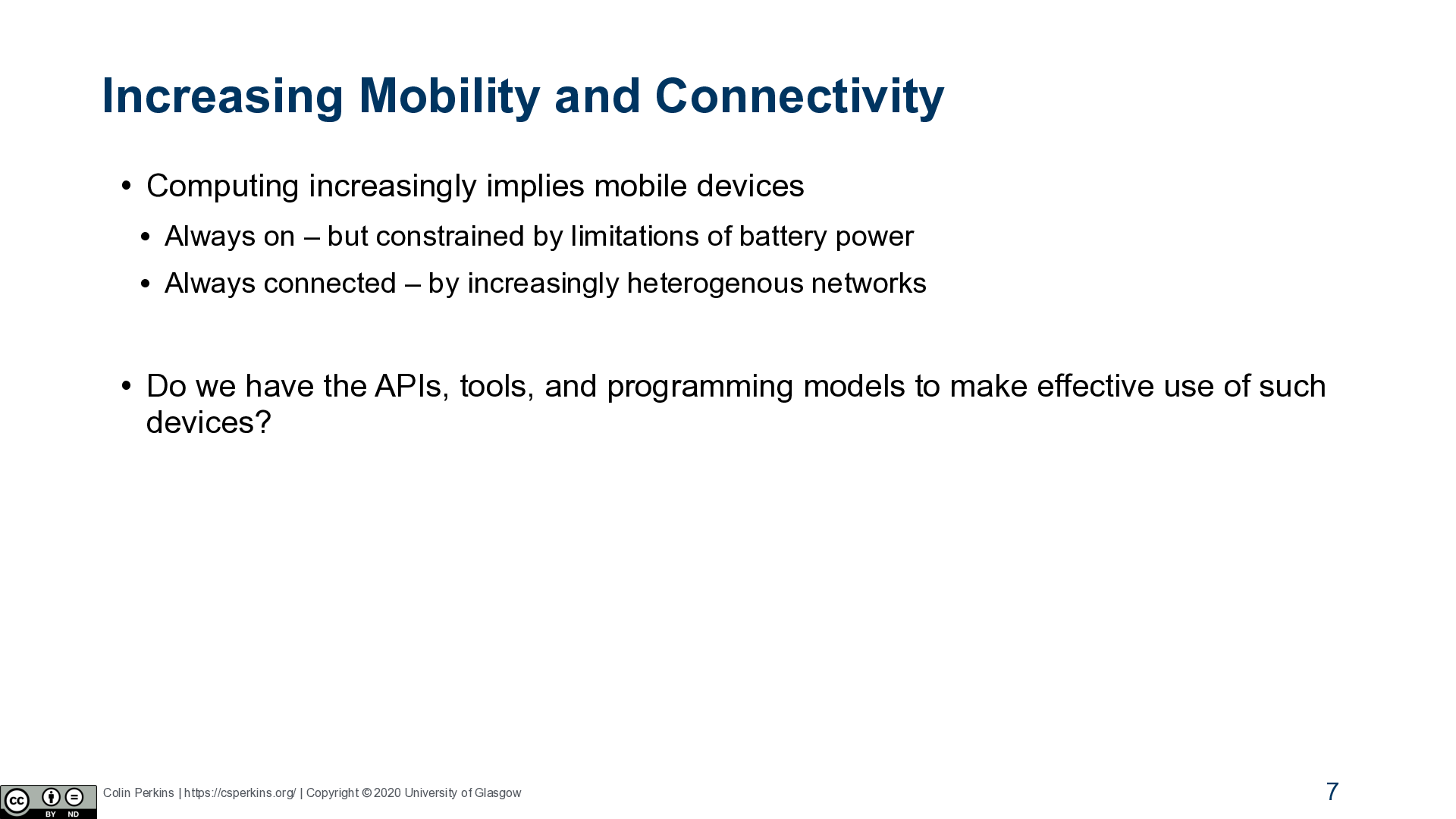
The final trend I want to highlight
00:07:13.933
is that of increasing mobility and connectivity.
00:07:17.300
Devices are mobile, always on, and always
00:07:20.066
connected to the network, and to remote computing resources.
00:07:24.466
But they’re also deeply constrained. They’re constrained
00:07:28.733
by the limitations of battery power,
00:07:30.333
and the vagaries of the networks to which they connect.
00:07:33.766
It’s not clear that we have the APIs, tools, and programming
00:07:37.066
models to make effective use of such
00:07:39.500
devices, or to adapt to the variation
00:07:42.700
in the environment.
00:07:45.466
This concludes the review of the challenges
00:07:47.900
and limitations facing systems programming.
00:07:51.133
I’m sure this is not complete,
00:07:53.100
and you can think of many more issues.
00:07:55.733
What is clear, though, is that we’ve
00:07:58.133
seen a radical shift in computing hardware,
00:08:00.133
and the way in which computing devices
00:08:02.066
are used, over the last fifteen years.
00:08:05.400
This shift has not been accompanied by a similar shift
00:08:08.133
in the way we design and implement
00:08:09.733
operating systems and systems software.
00:08:13.400
In the final part of this lecture,
00:08:15.433
we’ll discuss some possible ways operating systems
00:08:17.933
and programming languages could change,
00:08:20.033
to start to address these challenges.
-
G. Moore,
Cramming
more components onto integrated circuits, Electronics, Vol.
38, Num. 5, April 1964.
Part 4: Next Steps in Systems Programming
The final part of the lecture discusses how systems programming might
evolve. It outlines how modern type systems, memory safe languages,
and techniques from functional programming, can help improve systems
programs. In particular, it focusses on how the can improve security,
support for concurrency, and system correctness. This sets the scene
for the discussion in the remainder of the course.
00:00:00.300
In the previous parts of this lecture,
00:00:02.800
I discussed the state of the art
00:00:04.400
in operating systems and systems programming languages,
00:00:07.400
and some of the challenges and changes
00:00:09.466
that such systems face.
00:00:11.766
In the following, I’ll consider how advances
00:00:14.133
in programming languages, and the use of
00:00:16.100
strong type systems and functional programming techniques,
00:00:19.066
can help to improve the expressivity,
00:00:21.366
correctness, and security of systems programs,
00:00:24.666
to begin to address some of these challenges.
00:00:29.400
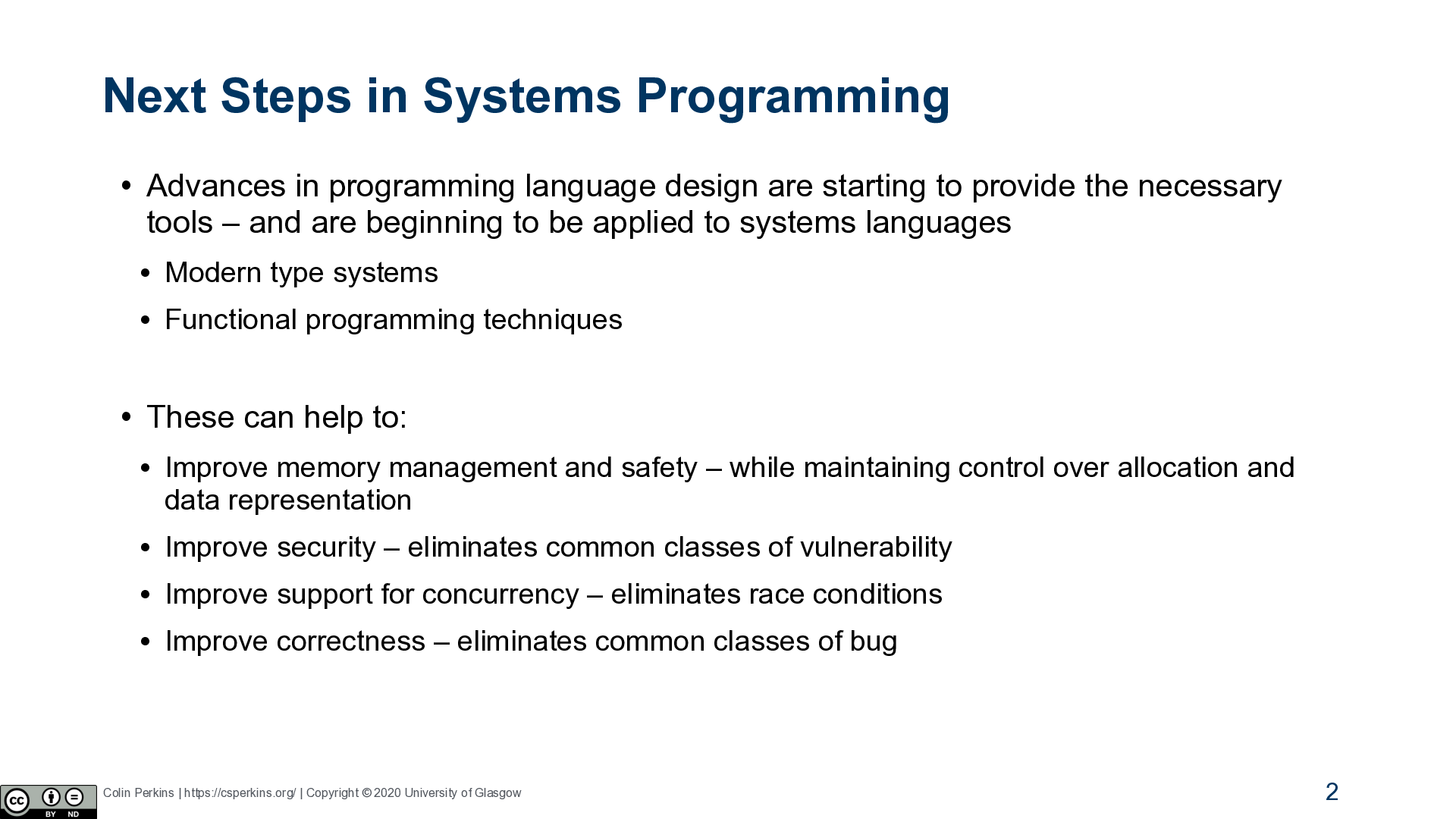
Advances in the theory of programming language
00:00:31.766
design have long provided tools that could
00:00:34.100
improve the way we write systems programs.
00:00:37.066
More recently, we’re finally starting to see
00:00:40.066
new programming languages being developed that incorporate
00:00:42.800
these ideas into practical languages and systems.
00:00:46.266
In particular, the ideas behind functional programming,
00:00:49.766
and modern type systems, can help to
00:00:52.200
improve memory management and memory safety,
00:00:54.700
while maintaining control over allocation
00:00:57.066
and data representation.
00:00:59.333
They can help to improve security by
00:01:01.966
eliminating certain classes of vulnerability.
00:01:04.600
For example, by preventing buffer overflows,
00:01:07.166
or helping to track untrusted data.
00:01:10.133
They can help to improve support for
00:01:12.266
concurrency by eliminating data races, by encouraging
00:01:15.533
immutability or tracking data ownership.
00:01:18.566
And, in general, the use of strong
00:01:20.666
type systems and functional approaches can help
00:01:23.966
eliminate entire classes of bug, by changing
00:01:26.866
the way we design programs using an
00:01:29.000
approach known as type-driven design.
00:01:32.833
To achieve these benefits, we’ll need to
00:01:35.166
apply functional programming techniques and modern type
00:01:37.866
systems to systems programming.
00:01:40.700
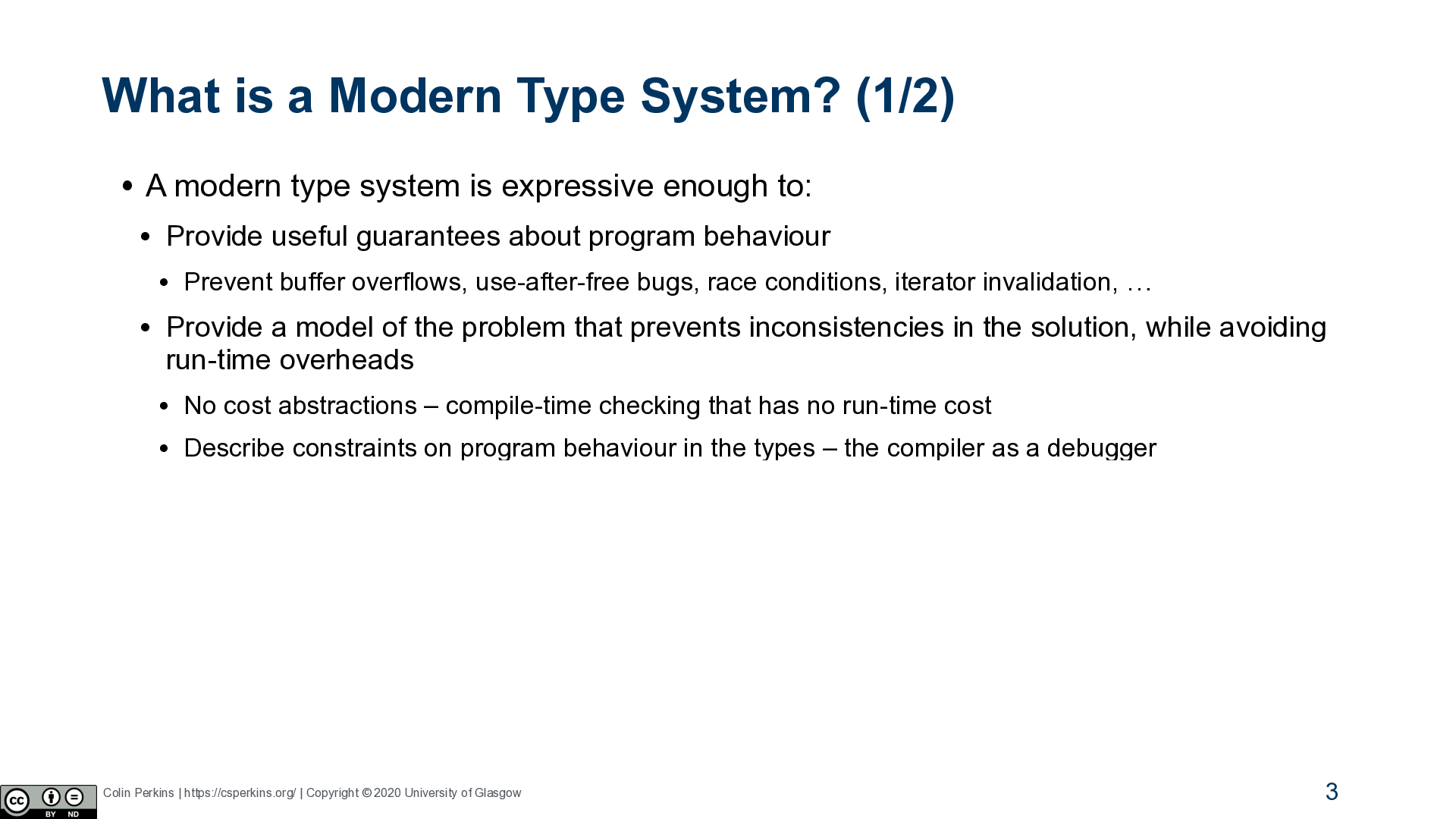
What do I mean by modern type systems?
00:01:43.300
Well, a modern type system is one
00:01:46.366
that can provide useful guarantees about program behaviour.
00:01:49.900
We’ve long had type systems that can
00:01:51.800
describe basic properties of data. For example,
00:01:54.733
languages that let us specify that a
00:01:56.566
particular value is an array that can store integers,
00:01:59.533
rather than floating point numbers, are unsurprising.
00:02:03.000
A more interesting type system is one
00:02:05.633
that can enforce, at compile time,
00:02:07.866
that there are no out-of-bounds accesses to that array.
00:02:11.033
Or that there are no use-after-free bugs in a program.
00:02:14.266
Or no memory leaks.
00:02:15.566
No race conditions between threads.
00:02:17.566
No iterator invalidation. And so on.
00:02:20.466
Modern type systems let us reason about,
00:02:23.433
and prove, interesting properties of real systems programs.
00:02:27.633
They can help ensure concurrent code is correct,
00:02:30.633
and they can help avoid particular classes of bugs
00:02:33.200
and security vulnerabilities.
00:02:36.166
Modern type systems also help
00:02:38.133
us to model the problem space, and allow us
00:02:40.600
to detect inconsistencies and problems in our solutions.
00:02:44.233
They support the concept of no cost abstraction.
00:02:47.466
That is, compile-time checks of system
00:02:49.733
properties that have no run-time cost.
00:02:52.466
This lets us describe, and check,
00:02:54.700
our design, and put constraints on possible
00:02:57.466
program misbehaviours, before running the code.
00:03:01.300
Modern type systems help us to describe
00:03:03.300
the problem space, and its constraints,
00:03:05.466
in a way that allows us to check
00:03:07.233
useful properties of the system as
00:03:09.000
we elaborate on our design and implementation.
00:03:12.100
Essentially they allow us to use the
00:03:14.300
compiler as a debugger for our designs.
00:03:18.533
As an example of this, think about
00:03:20.700
how we write networking code.
00:03:23.366
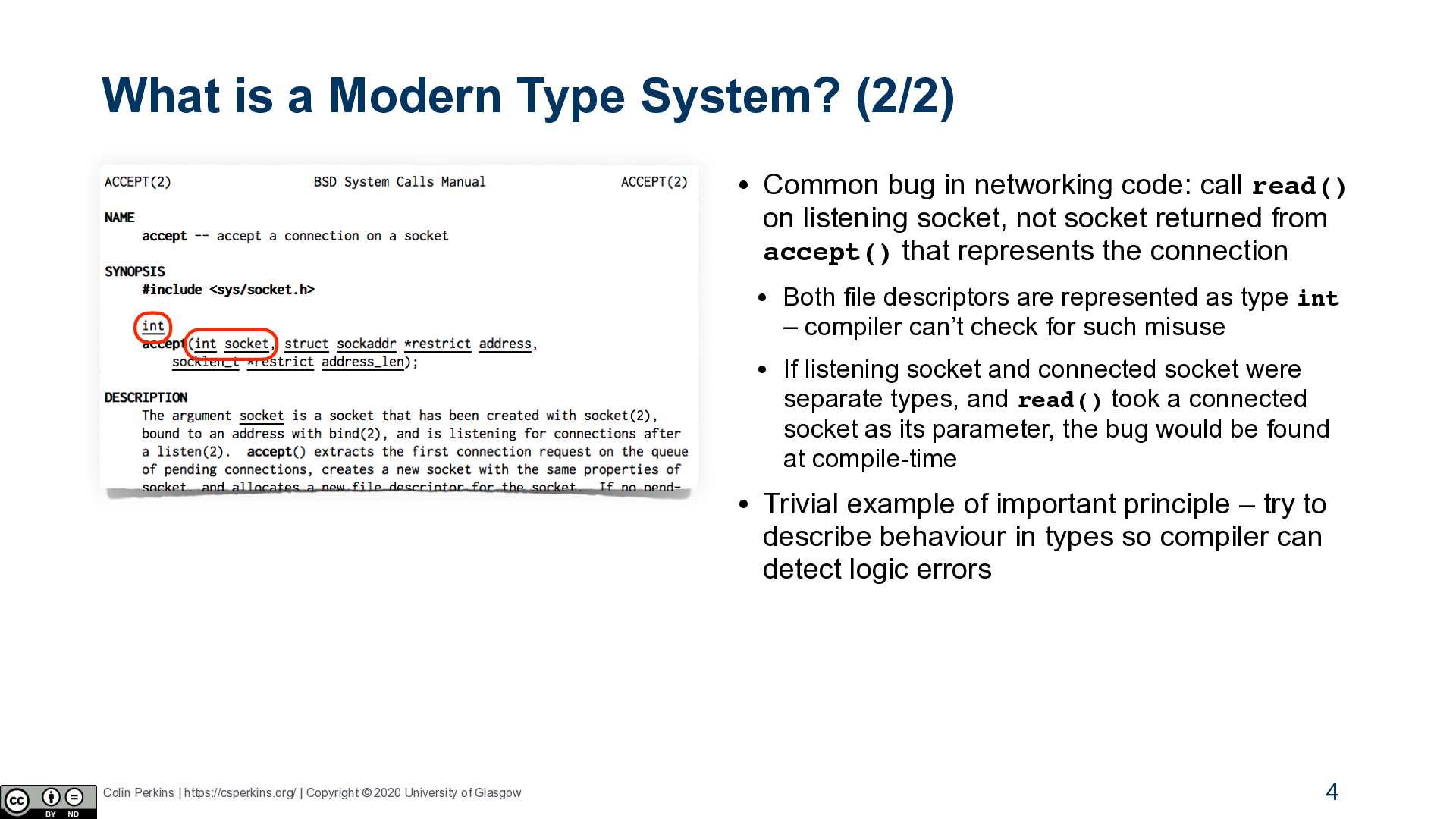
In the Berkeley Sockets API, used to
00:03:25.666
write network servers in C, one calls
00:03:28.366
the accept() function on a socket to
00:03:30.433
accept an incoming TCP connection.
00:03:33.200
The accept() function takes as its parameter an existing
00:03:36.566
socket that’s listening for connections, and returns
00:03:39.333
a new socket that represents the newly accepted connection.
00:03:43.333
A common bug in networking code is
00:03:45.866
to mix up these two sockets.
00:03:48.100
For example, to attempt to send data
00:03:50.133
using the socket that’s listening for new connections,
00:03:52.866
rather than using a socket that
00:03:54.433
represents a previously accepted connection.
00:03:57.366
This compiles, but fails at runtime.
00:04:00.800
Such code compiles because sockets are identified
00:04:03.400
by simple integers in C.
00:04:06.200
The read(), write(), and accept() calls
00:04:08.733
take file descriptors,
00:04:10.233
with type int, to identify the sockets.
00:04:13.466
As a result, the compiler can’t tell the two types
00:04:16.966
of socket, connected and listening, apart.
00:04:20.866
A better API would use the type system to distinguish
00:04:24.100
the different types of socket.
00:04:25.933
There should be separate Connected Socket
00:04:28.133
and Listening Socket types.
00:04:30.233
The accept() function should take as its first parameter a
00:04:33.133
Listening Socket, and should return a Connected Socket.
00:04:36.833
And the read() and write() functions should accept
00:04:39.500
only Connected Sockets.
00:04:41.833
In systems where the networking library works this way,
00:04:45.166
a program that tries to write() to a listening socket
00:04:47.900
will fail to compile, since the compiler can distinguish
00:04:51.500
the two types of socket, and detect the mismatch.
00:04:55.266
Connected sockets and listening sockets
00:04:57.833
can still represented by integers,
00:05:00.000
so the generated code doesn’t change,
00:05:02.600
and can be just as efficient.
00:05:04.833
But, by making them distinct types of integer,
00:05:07.600
the compiler could help us find bugs.
00:05:10.700
This is a trivial example, but the principle is important.
00:05:14.900
The more information that can be represented in the types,
00:05:18.300
the more the compiler can help check
00:05:20.100
that those types are used consistently.
00:05:22.700
This means we find bugs at compile
00:05:24.466
time, rather than having to debug the code at runtime.
00:05:29.933
The other advance that can help systems
00:05:32.133
programming is the application of some ideas
00:05:34.333
from the functional programming community.
00:05:37.633
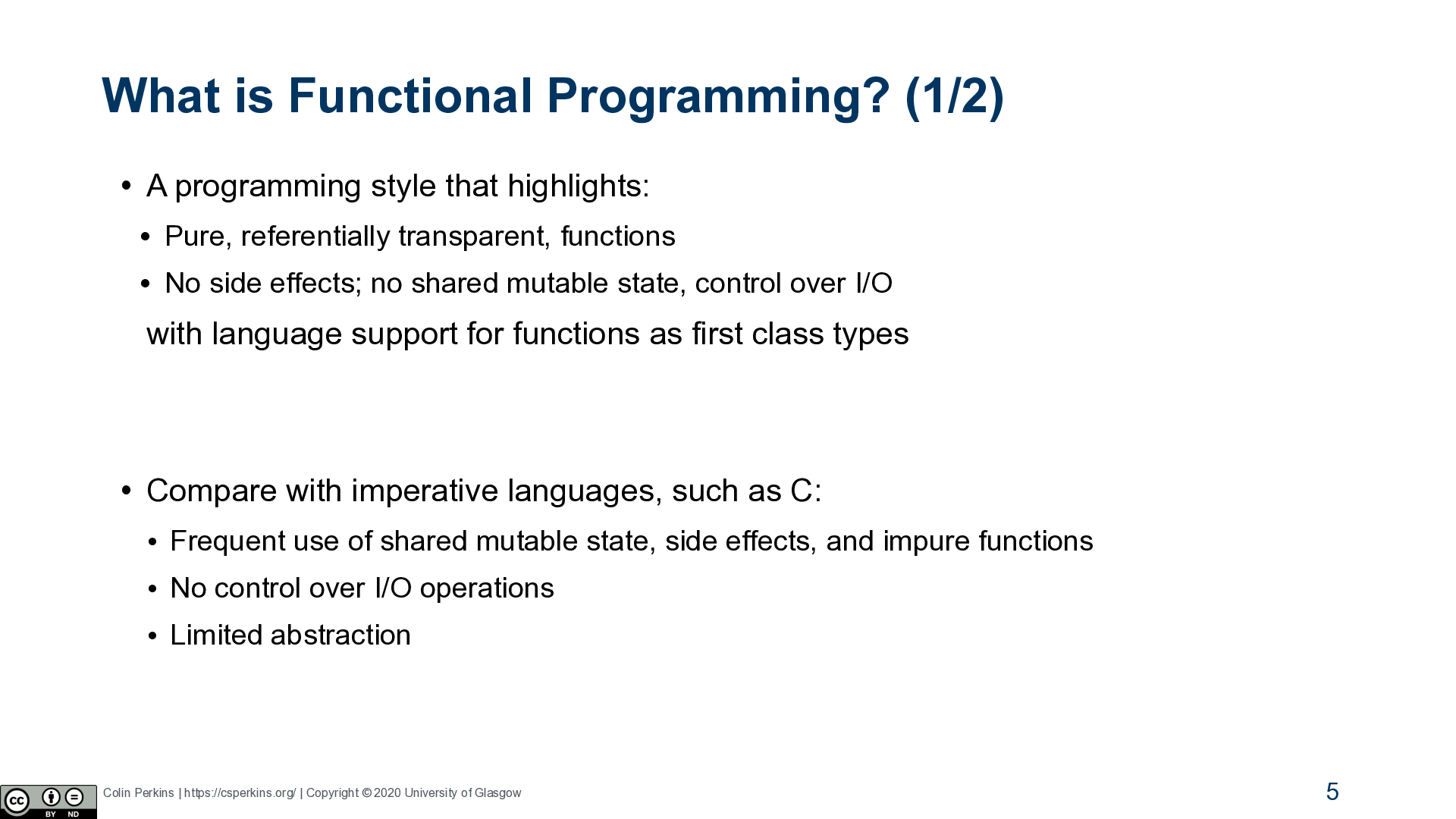
Functional programming is a programming style that
00:05:40.166
emphasises the avoidance of side effects and
00:05:42.466
shared state, and that promotes structuring code
00:05:45.166
as referentially transparent functions.
00:05:48.466
Imperative languages,
00:05:50.000
and especially object-oriented languages,
00:05:52.500
tend to actively encourage the opposite approach,
00:05:55.600
leading to programs full of shared state,
00:05:58.500
side effects, and impure functions.
00:06:01.666
The entire point of objects, for example,
00:06:04.400
is to hold shared state.
00:06:06.700
And methods in object oriented languages
00:06:09.133
are generally called in order to invoke the side effect
00:06:11.500
of modifying the object’s state.
00:06:14.500
I argue that this style of programming
00:06:16.666
is problematic for systems programs, and it’s
00:06:19.200
much better to avoid shared state and
00:06:21.300
program in a functional style where possible.
00:06:24.666
Why?
00:06:26.400
Because, side effects and shared state make
00:06:28.466
code difficult to reason about, and harder to debug.
00:06:32.300
They increase coupling between seemingly
00:06:34.500
unrelated sections of code, and make it
00:06:37.200
difficult to understand the behaviour of parts
00:06:39.300
of a program in isolation.
00:06:41.766
And, importantly, the presence of side effects
00:06:44.933
and shared state makes concurrent code much
00:06:47.600
harder to write.
00:06:49.566
Concurrent accesses to shared state have to
00:06:51.933
be protected by locks, to avoid race conditions.
00:06:55.800
Experience has shown that it’s difficult
00:06:57.566
to get the locking right, in any non-trivial program.
00:07:01.433
By systematically writing code in a functional style,
00:07:04.500
where possible, and avoiding shared state,
00:07:07.266
the number of locks that are needed can be greatly reduced.
00:07:10.933
It’s easier to get the locking right,
00:07:13.400
and avoid race conditions,
00:07:15.300
if there are fewer things to lock.
00:07:18.433
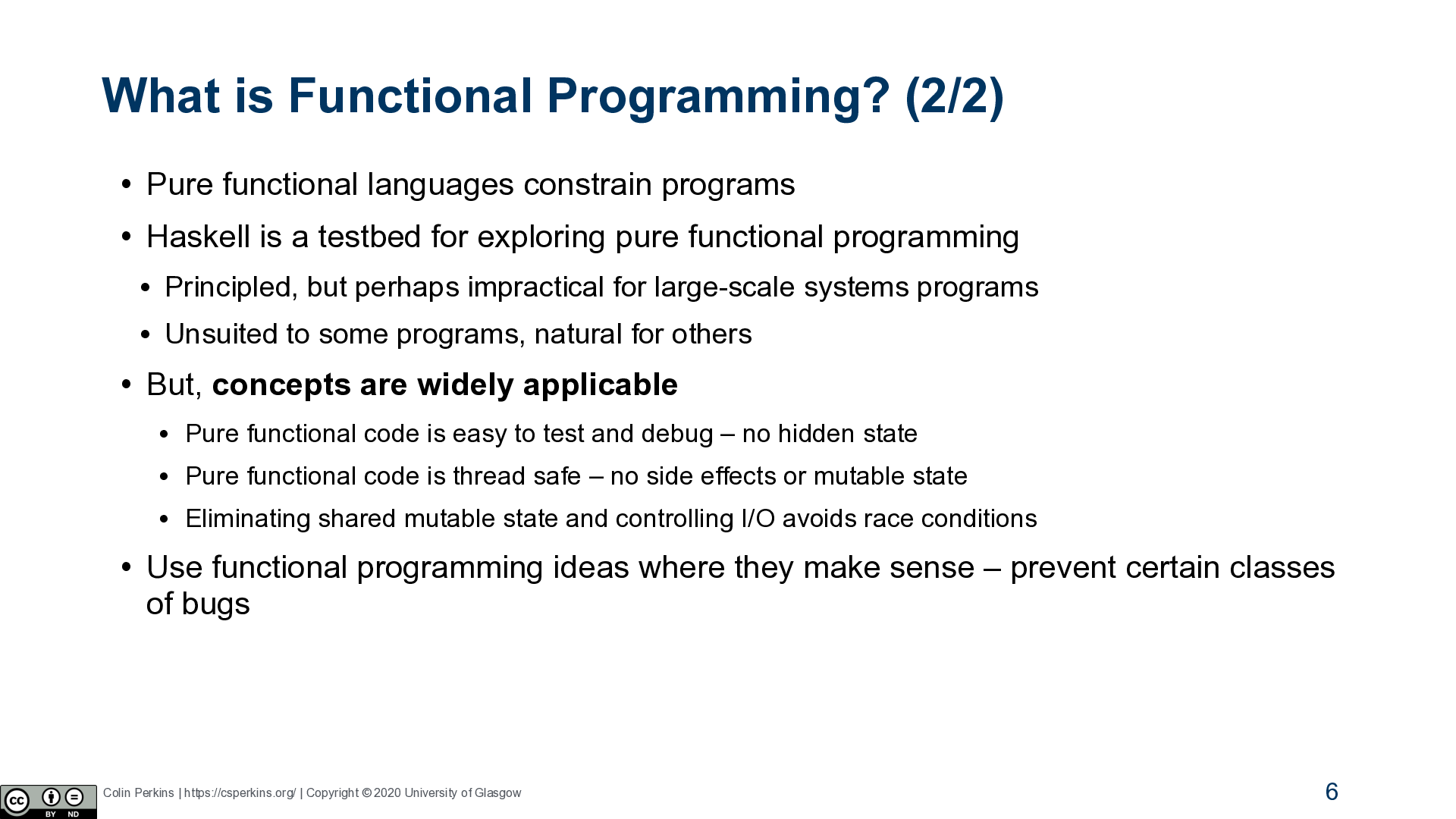
The essential benefit of writing programs in
00:07:20.900
a pure functional style is that it
00:07:22.833
constrains what’s possible.
00:07:25.000
Code written using referentially transparent functions,
00:07:28.133
without side effects, is easier to test
00:07:30.700
and debug - because there’s no hidden state.
00:07:34.266
Such code is also thread safe,
00:07:36.566
since there are no side effects,
00:07:38.133
and no mutable state to share between threads.
00:07:41.766
By constraining the way programs are written,
00:07:44.400
certain classes of bugs and certain problems
00:07:46.800
can be avoided.
00:07:48.400
Avoiding these problems is
00:07:50.100
desirable, if we want to write concurrent,
00:07:51.933
secure, and correct systems programs.
00:07:55.466
Accordingly, when possible,
00:07:57.400
I encourage you to adopt
00:07:58.566
a functional style when writing code.
00:08:01.633
Note, though, that I’m not saying
00:08:03.700
“write your programs in Haskell”.
00:08:06.100
Haskell is a great language,
00:08:07.900
if your goal is to develop the concept
00:08:09.833
of pure functional programming.
00:08:11.833
It takes this one idea,
00:08:13.733
and pushes it as far as is possible.
00:08:16.933
That’s wonderful, if you’re a programming language
00:08:19.033
researcher. And many of the ideas that
00:08:21.333
came out of Haskell are widely applicable
00:08:23.566
to programming in general.
00:08:25.600
But, it’s clear that not everything
00:08:27.400
can be naturally expressed in the functional style.
00:08:30.566
Some programs are just easier to write in an imperative,
00:08:33.533
or object oriented, way.
00:08:36.000
That’s fine.
00:08:37.533
Use functional programming ideas where they make
00:08:39.566
sense, to prevent certain classes of bugs.
00:08:43.166
If another approach works better, do that.
00:08:46.466
But, always think about how to reduce
00:08:48.933
shared state, and reduce side effects.
00:08:54.133
We can use functional programming techniques
00:08:56.600
and modern type systems to help improve memory
00:08:58.766
management, and make it safer and less error prone.
00:09:02.933
Systems programmers are used to manual memory management,
00:09:06.200
as implemented in C.
00:09:08.133
Memory is allocated by calling the malloc() function,
00:09:11.300
that returns a pointer to the newly allocated memory.
00:09:15.000
When that memory is no longer used,
00:09:16.800
the programmer calls the free() function with that pointer,
00:09:19.233
to release the memory.
00:09:21.266
The system performs few checks on what
00:09:23.133
is done with the memory between those calls.
00:09:26.233
For example, the value returned by malloc()
00:09:28.900
can be cast to a pointer to
00:09:30.866
any type of object, whether or not the size of that object
00:09:34.300
matches the size of the allocated memory,
00:09:36.866
and the program can interpret the same region of
00:09:39.866
memory as different types of object simultaneously,
00:09:42.866
whether or not that makes sense.
00:09:45.833
Similarly, the behaviour of a program that
00:09:48.066
accesses memory outside the region returned by
00:09:50.166
malloc() is undefined, but the system makes
00:09:52.966
no attempt to prevent such accesses.
00:09:56.633
Finally, arrays and strings are represented as
00:09:59.166
pointers to their first element, and don’t
00:10:01.633
store the length of the array,
00:10:03.533
and array indexing is represented by pointer arithmetic.
00:10:07.433
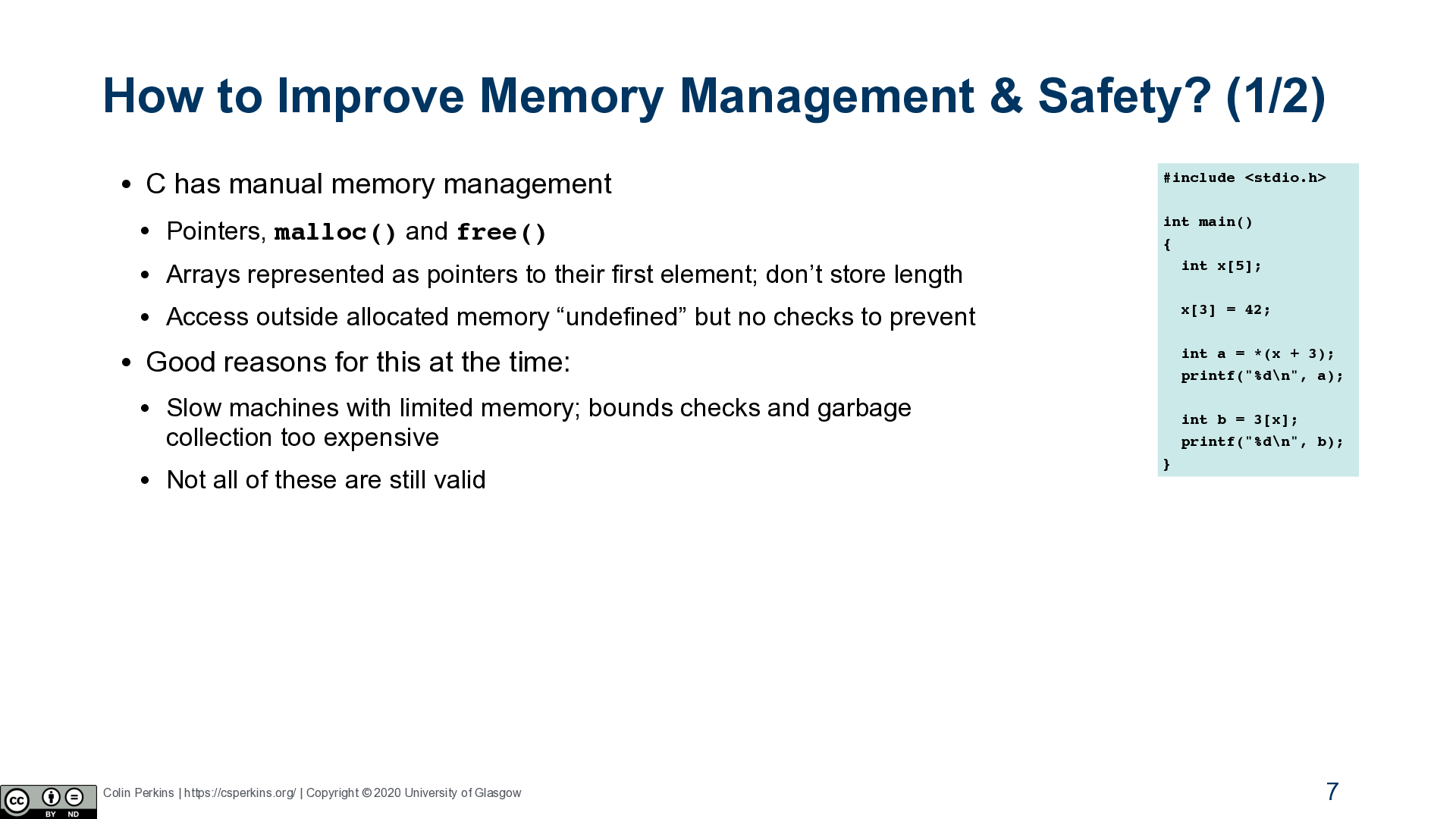
The code fragment on the slide illustrates this
00:10:10.266
– compile and run this code,
00:10:11.933
to see if it behaves as you expect.
00:10:14.766
An important consequence of this
00:10:16.466
definition of arrays is that the runtime
00:10:18.966
cannot check whether array accesses are within bounds,
00:10:22.033
since the bounds aren’t recorded.
00:10:25.533
There were good reasons for this behaviour
00:10:28.000
when C was designed.
00:10:30.033
Machines were slow, and memory was limited.
00:10:33.200
Storing the size of the allocation
00:10:35.766
along with the allocated object takes memory,
00:10:38.500
and memory was in short supply
00:10:40.133
on the machines where C was developed.
00:10:42.800
Similarly, checking array bounds takes
00:10:44.866
time and requires additional code.
00:10:48.400
These concerns mattered at the time,
00:10:50.466
but are not necessarily valid today.
00:10:53.400
On machines with kilobytes of memory and
00:10:55.433
MHz clocks, the memory and runtime overheads
00:10:58.700
mattered. On modern machines, that have millions
00:11:02.500
of times more memory, and processors that
00:11:05.300
are tens-of-thousands of times faster, the overheads
00:11:08.233
are less significant.
00:11:10.366
Compiler technology and program
00:11:12.400
optimisations have also improved,
00:11:14.733
to the extent that compilers can often now determine when
00:11:17.466
bounds checks are unnecessary, and remove them
00:11:20.166
from the generated code.
00:11:22.700
We can certainly afford to check array
00:11:24.800
bounds and other memory accesses on modern systems
00:11:28.000
– but we need to move away from C
00:11:29.900
as a systems programming language to do so.
00:11:35.466
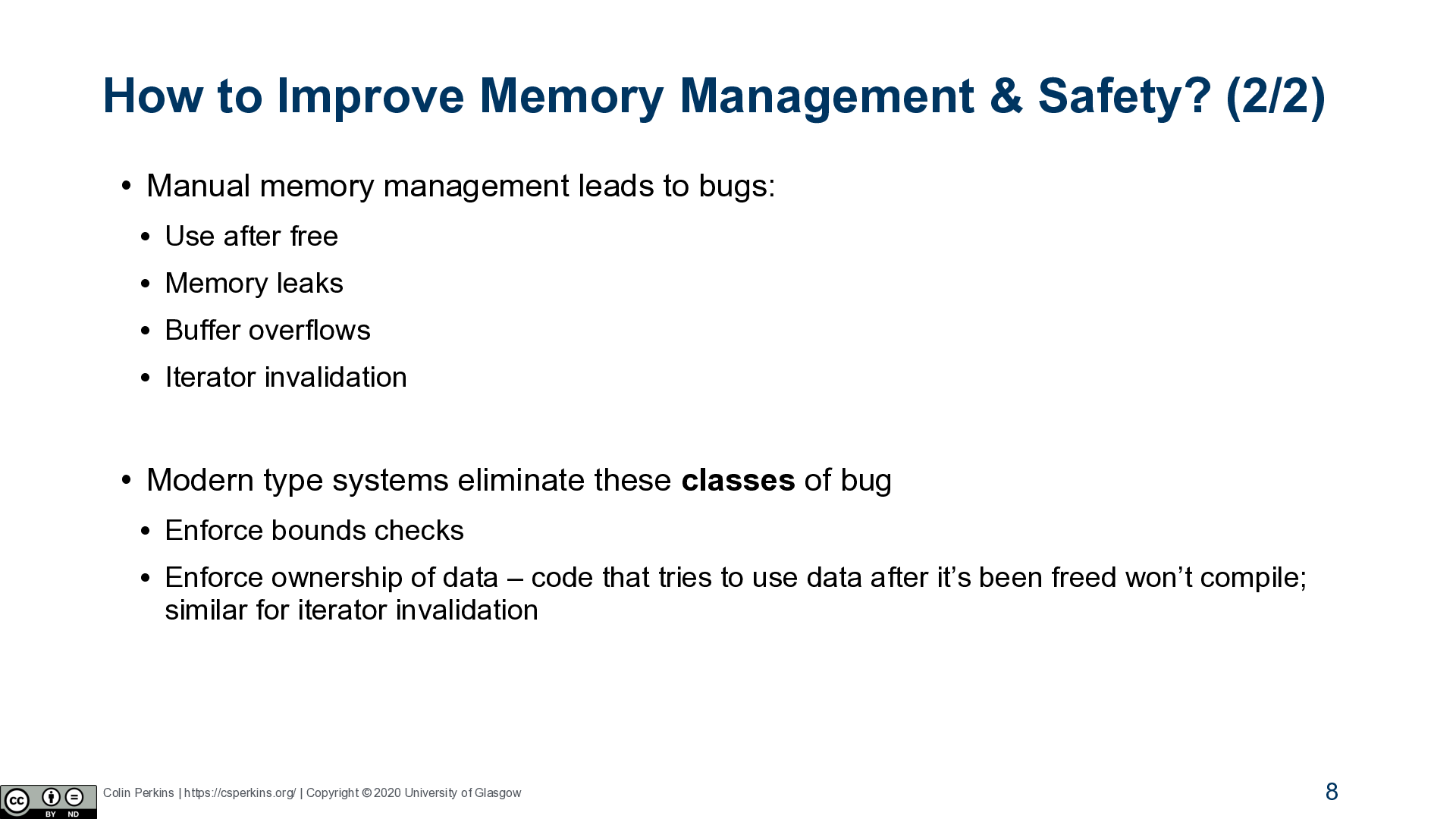
What is now clear is that
00:11:37.400
manual memory management is a source of bugs.
00:11:40.666
It leads to use-after-free bugs, where memory
00:11:43.333
is accessed after it has been deallocated.
00:11:46.366
It leads to memory leaks, where memory
00:11:48.700
is never deallocated, even after it has
00:11:51.000
ceased to be referenced by the program.
00:11:53.466
It leads to buffer overflows,
00:11:55.800
where the program tries to access memory outside the
00:11:58.100
region it has allocated.
00:12:00.066
And it leads to iterator invalidation,
00:12:02.533
where the contents of a list can
00:12:04.166
change while a program is accessing it,
00:12:06.600
making a previously valid pointer invalid,
00:12:09.100
and leading to out of bounds memory access.
00:12:13.033
All of these problems can be eliminated
00:12:15.266
when using programming languages with modern type systems.
00:12:19.300
Managed languages such as Java,
00:12:21.833
running on virtual machines, have been able to trap
00:12:24.700
such events at run time for many years.
00:12:27.733
They take a performance hit to
00:12:29.600
do so, compared to systems languages that
00:12:31.833
compile to native code, but gain safety.
00:12:35.933
Recently, though, we’ve seen new programming languages
00:12:39.066
start to emerge that can track and
00:12:40.866
detect these problems at compile time.
00:12:43.433
The Rust programming language, for example,
00:12:46.200
will detect iterator invalidation and use-after-free bugs,
00:12:49.566
and throw a compile time error if they occur in a program.
00:12:53.333
The Idris programming language
00:12:55.100
can do the same with buffer overflows.
00:12:58.266
As programmers, we fix the same types
00:13:00.300
of problem, again and again, in heroic
00:13:03.166
debugging sessions. Alternatively, we should consider if
00:13:06.933
there’s a better solution, that can prevent
00:13:09.500
such classes of bug entirely.
00:13:14.233
The concern about memory management becomes critical
00:13:17.033
when we look at causes of security vulnerabilities.
00:13:21.066
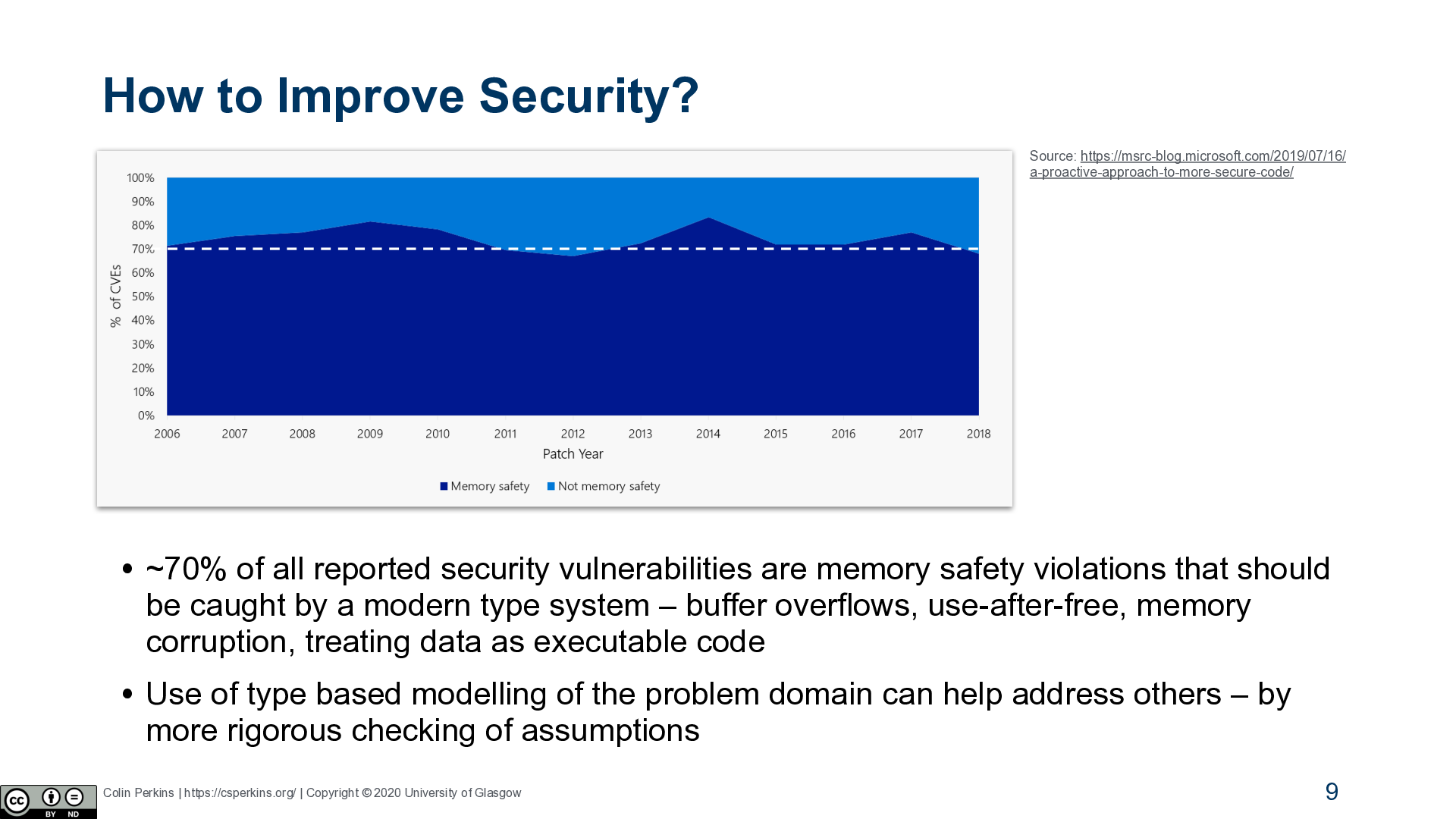
The figure on the slide is from Microsoft.
00:13:24.166
It tracks the root cause of bugs
00:13:25.733
found in software developed by Microsoft,
00:13:28.300
Windows, Office, Teams, etc., for the period
00:13:31.100
from 2006 to 2018.
00:13:35.233
What it shows is that around 70%
00:13:37.466
of all reported security vulnerabilities in Microsoft
00:13:40.266
software, for that time period, relate to memory safety.
00:13:45.933
70% of reported security vulnerabilities are buffer
00:13:49.833
overflows, use-after-free bugs, memory corruption,
00:13:53.366
iterator invalidation, and so on.
00:13:56.633
By switching to a memory safe language,
00:13:59.233
Microsoft could eliminate two-thirds of the security
00:14:02.100
vulnerabilities in their systems.
00:14:04.733
Now, obviously this is difficult to do.
00:14:08.066
Rewriting Windows and Office would be an enormous job,
00:14:11.866
and would almost certainly introduce
00:14:13.366
more bugs than it would fix.
00:14:15.933
But surely there’s a lesson that can be learnt for new code?
00:14:20.333
Once we’ve started to address the low-handing
00:14:23.066
fruit around memory safety, we should start
00:14:25.500
to think about the root causes of
00:14:27.300
other security vulnerabilities.
00:14:30.100
What is common, is that vulnerabilities are
00:14:32.500
the result of mismatched assumptions.
00:14:35.300
One part of the code assumes some property
00:14:37.733
is true of data it processes.
00:14:40.100
Other code is supposed to validate that the property
00:14:43.166
holds, but a check is missed somewhere.
00:14:45.333
Such problems are easy to miss,
00:14:47.633
because the assumptions and constraints tend to
00:14:49.866
be visible only in the comments and
00:14:51.766
documentation around the code, and so can’t
00:14:54.000
be automatically checked.
00:14:57.166
One approach to reducing security vulnerabilities is
00:15:00.333
to encode as many of these assumptions,
00:15:02.966
and as much of this knowledge as
00:15:04.566
possible, into the types.
00:15:07.500
Once this knowledge is available in a machine readable form,
00:15:10.933
a compiler can check the code for
00:15:13.200
consistency, and highlight problems before they become
00:15:16.066
security vulnerabilities.
00:15:19.066
Doing so is more up-front work.
00:15:21.800
It’s more effort to write code in a way that records,
00:15:24.766
and can automatically check
00:15:26.333
your assumptions, using the type system.
00:15:29.366
But, over time, that effort pays off
00:15:31.633
through having fewer surprises when the code is used.
00:15:35.466
You trade-off design time,
00:15:37.033
and compile time, effort, for less time
00:15:39.833
spent debugging the system, and correcting security
00:15:42.600
vulnerabilities, after it’s been deployed.
00:15:48.200
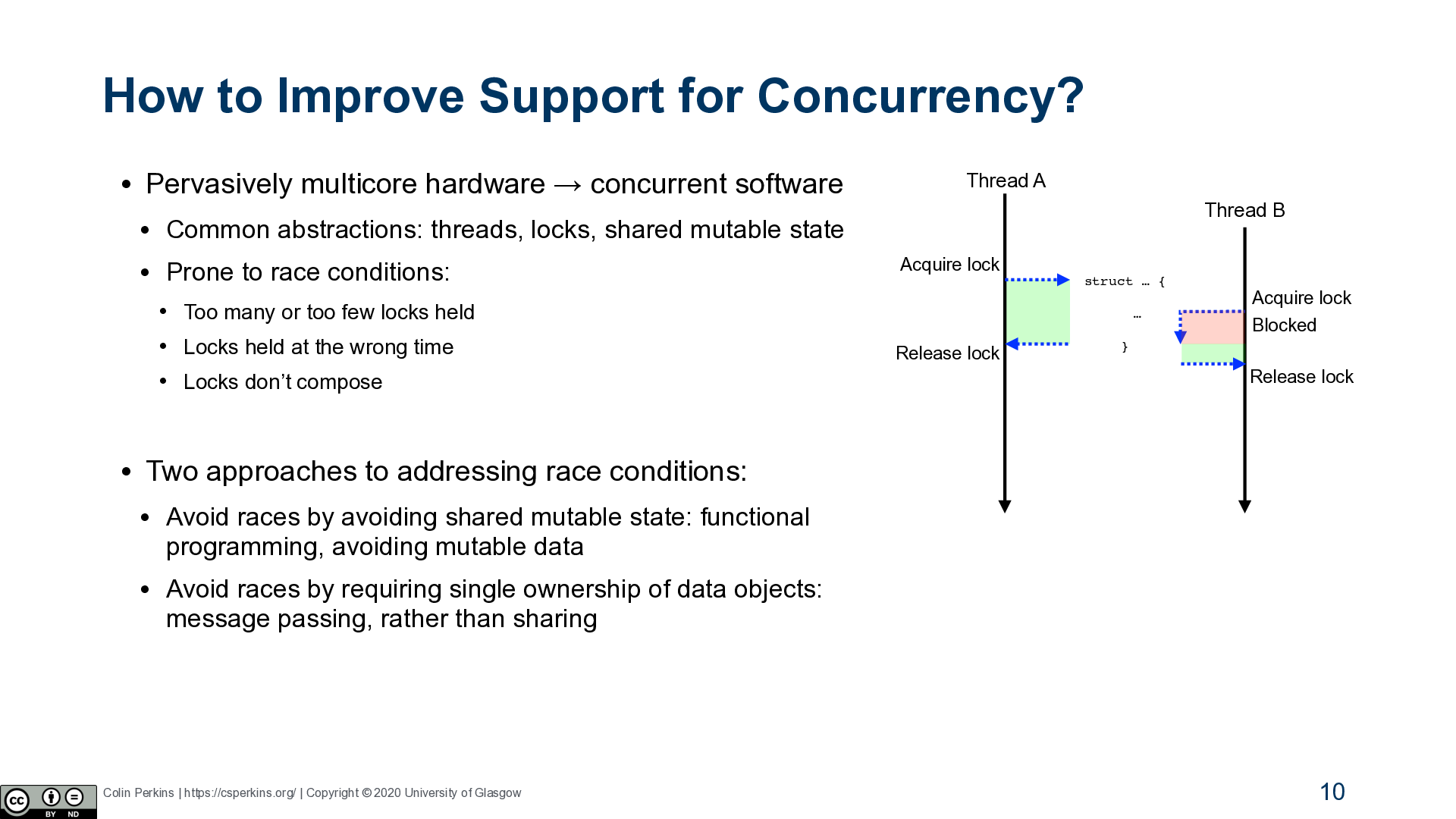
We see similar classes of behaviour around concurrency.
00:15:52.400
The common abstraction is that of threads,
00:15:54.733
locks, and shared mutable state.
00:15:57.666
This is pthreads if you’re a C programmer,
00:15:59.866
or synchronised methods and objects
00:16:01.700
if you’re a Java programmer.
00:16:04.133
Before accessing a shared resource,
00:16:06.466
you must acquire the appropriate lock. Then, once you’ve
00:16:09.600
finished the resource, release the lock.
00:16:12.733
And, if you access multiple resources at once,
00:16:15.333
you must remember to acquire and release
00:16:17.266
those locks in the right order to avoid deadlock.
00:16:21.100
The problem is, as anyone who’s tried
00:16:23.200
this at any scale knows, that it’s
00:16:25.100
easy to get the locking wrong.
00:16:27.266
To hold too many, or too few,
00:16:29.600
locks. Or to acquire or release the
00:16:31.966
locks at the wrong time, or in the wrong order.
00:16:35.766
More critically, it’s clear that locks don’t compose.
00:16:40.300
If you start with two libraries that use locking correctly,
00:16:43.633
and combine them, then the result might
00:16:46.000
not have the correct amount of locking.
00:16:48.566
The locking requirements to protect
00:16:50.633
the combined data might differ
00:16:52.200
from those of the individual components.
00:16:55.066
The usual example here is a banking program.
00:16:58.500
Such a program probably has a bank account object,
00:17:01.400
recording the balance of an account,
00:17:03.566
and allowing money to be deposited or withdrawn.
00:17:07.100
Such an object needs locking,
00:17:09.100
to avoid corruption of the balance if deposits
00:17:11.433
and withdrawals are made simultaneously.
00:17:14.666
What’s less clear is that if you transfer money
00:17:17.266
from one bank account to another,
00:17:19.066
it’s not sufficient for each account
00:17:20.866
to be correctly locked.
00:17:22.833
If the money is to be transferred atomically, so it
00:17:26.233
either appears in one account or the other,
00:17:28.166
then locking the individual accounts is not sufficient.
00:17:31.766
There’s a risk the system
00:17:33.533
is observed during the transfer, and the
00:17:35.700
money either appears in neither account,
00:17:37.933
or in both, depending on how the transfer was implemented.
00:17:41.800
Additional locking is needed to prevent this,
00:17:44.633
over and above the composition of the locking
00:17:46.633
needed on the individual accounts.
00:17:50.000
There are two approaches to avoid problems
00:17:52.066
with locking and concurrency.
00:17:54.633
One is to apply the techniques of functional programming.
00:17:58.000
Race conditions don’t occur
00:17:59.966
if only immutable data is shared,
00:18:01.733
and if the program is structured to avoid
00:18:03.900
shared state and side effects.
00:18:06.433
The other is to avoid races by tracking ownership of data.
00:18:10.166
Structure programs so that the transfer of data is atomic
00:18:13.633
and that every object has a single owner at all times,
00:18:16.933
and so that data is either mutable, or visible to others,
00:18:20.766
but never both.
00:18:23.200
There are trade-offs in the two approaches,
00:18:25.400
that we’ll discuss in detail later in the course.
00:18:28.366
What’s interesting, though, is that
00:18:30.233
both eliminate entire classes of concurrency-related bugs,
00:18:33.866
and can be checked for correctness by a compiler.
00:18:39.533
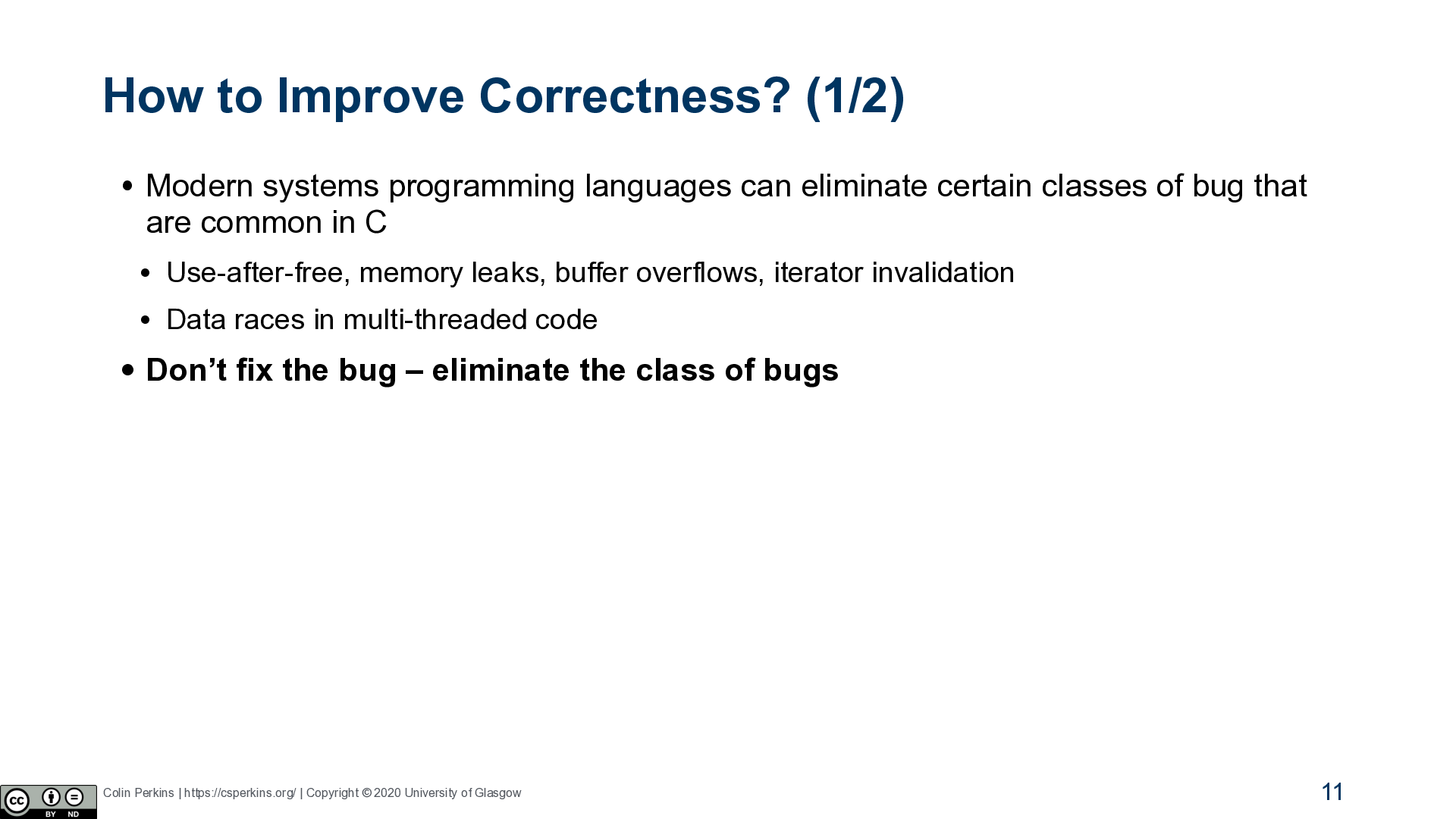
This is the key point I want to get across.
00:18:43.133
There are many types of problem that frequently occur
00:18:45.533
in systems programs
00:18:47.033
because those systems programs are written in C.
00:18:51.066
Problems such as use-after-free bugs, memory leaks,
00:18:54.233
buffer overflows, iterator invalidation, and data races
00:18:58.400
in multi-threaded code, are common in C programs.
00:19:02.366
Many are also common in programs
00:19:04.200
written in higher-level languages.
00:19:06.633
But, there are new and emerging languages and tools
00:19:10.066
that can not just fix these bugs,
00:19:12.266
but that can eliminate these classes of bug,
00:19:14.633
while maintaining the control
00:19:16.666
and efficiency needed for systems programming.
00:19:19.466
There exist programming languages that can flag,
00:19:22.033
at compile time, whether a given piece
00:19:24.166
of code suffers from data races,
00:19:26.566
iterator invalidation, buffer overflows, use after free
00:19:29.600
bugs, and so on.
00:19:31.500
It’s not always easy to switch to these languages,
00:19:34.766
but where possible, maybe we should consider to do so?
00:19:40.100
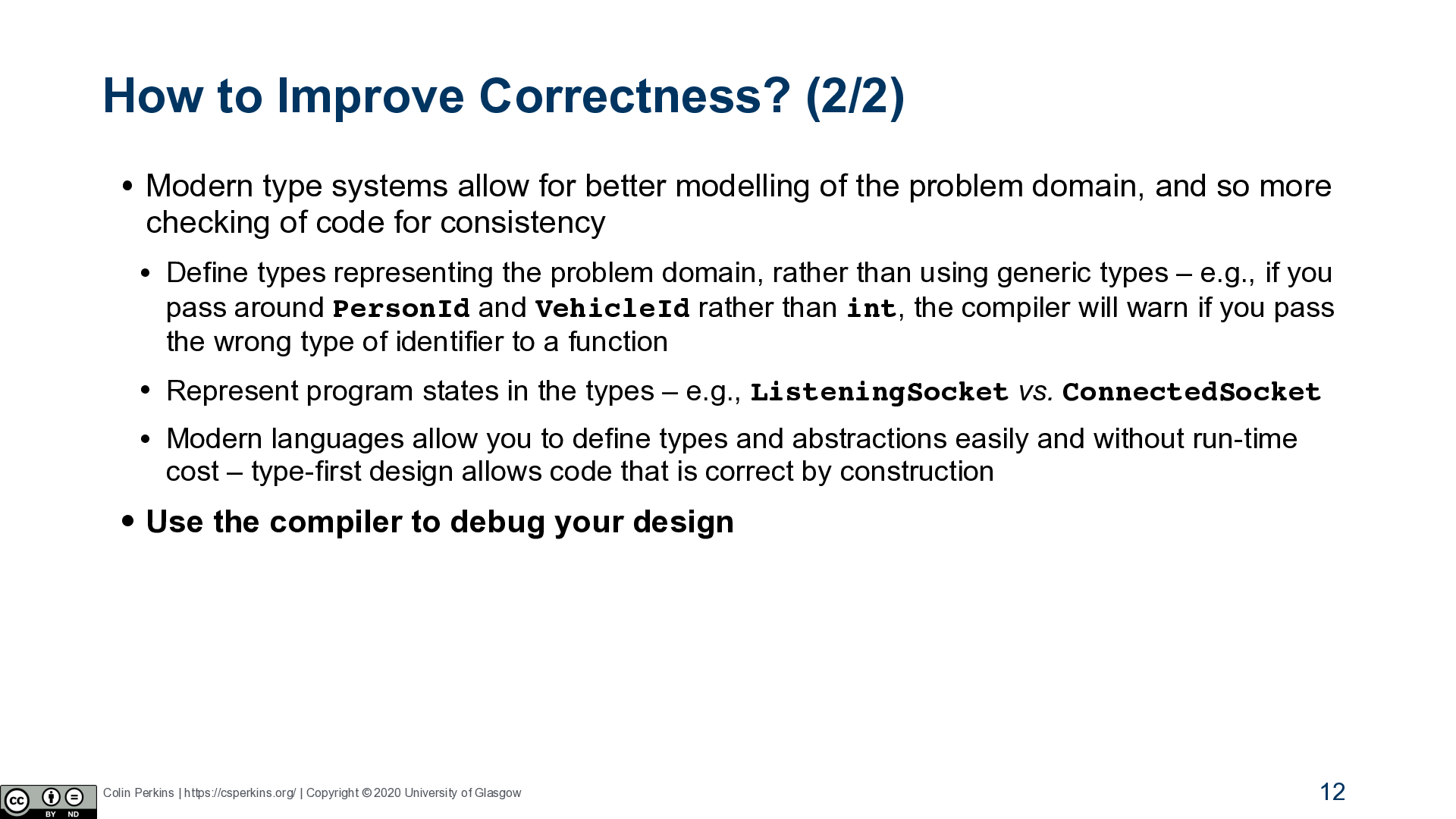
In addition, modern type systems are flexible
00:19:42.733
enough to effectively model the problem space
00:19:45.366
in many case. This allows us to
00:19:48.100
use the types to check our designs for consistency.
00:19:52.466
When writing code,
00:19:53.933
define types representing the problem domain.
00:19:56.866
For example, rather than using an int,
00:19:59.766
define a PersonID type, an Age,
00:20:02.533
or a Temperature, or similar.
00:20:05.233
With modern languages,
00:20:06.666
these compile down to the exact
00:20:08.166
same code as would using the generic primitive type,
00:20:11.633
but with the advantage that the compiler
00:20:13.866
can check that you’re passing the right type of data around.
00:20:18.166
Similarly, encode constraints on when an object
00:20:20.933
can be used as part of its type.
00:20:23.566
The example here is the ListeningSocket vs ConnectedSocket
00:20:26.966
distinction in networking code we discussed earlier,
00:20:29.633
but the technique is generally applicable.
00:20:33.733
Modern systems programming languages let you define
00:20:37.000
new types and abstractions easily,
00:20:38.600
and without run-time cost.
00:20:40.900
Use this ability:
00:20:42.500
define the types and function signatures first,
00:20:45.400
and let the compiler check your design for consistency,
00:20:48.533
and only then write the body of the functions.
00:20:51.800
We’re used to debugging code at runtime.
00:20:54.766
What I’m suggesting is that if you can represent
00:20:57.366
the key features of the problem
00:20:58.733
domain in your program’s types,
00:21:00.300
then the compiler can also help debug your design.
00:21:06.300
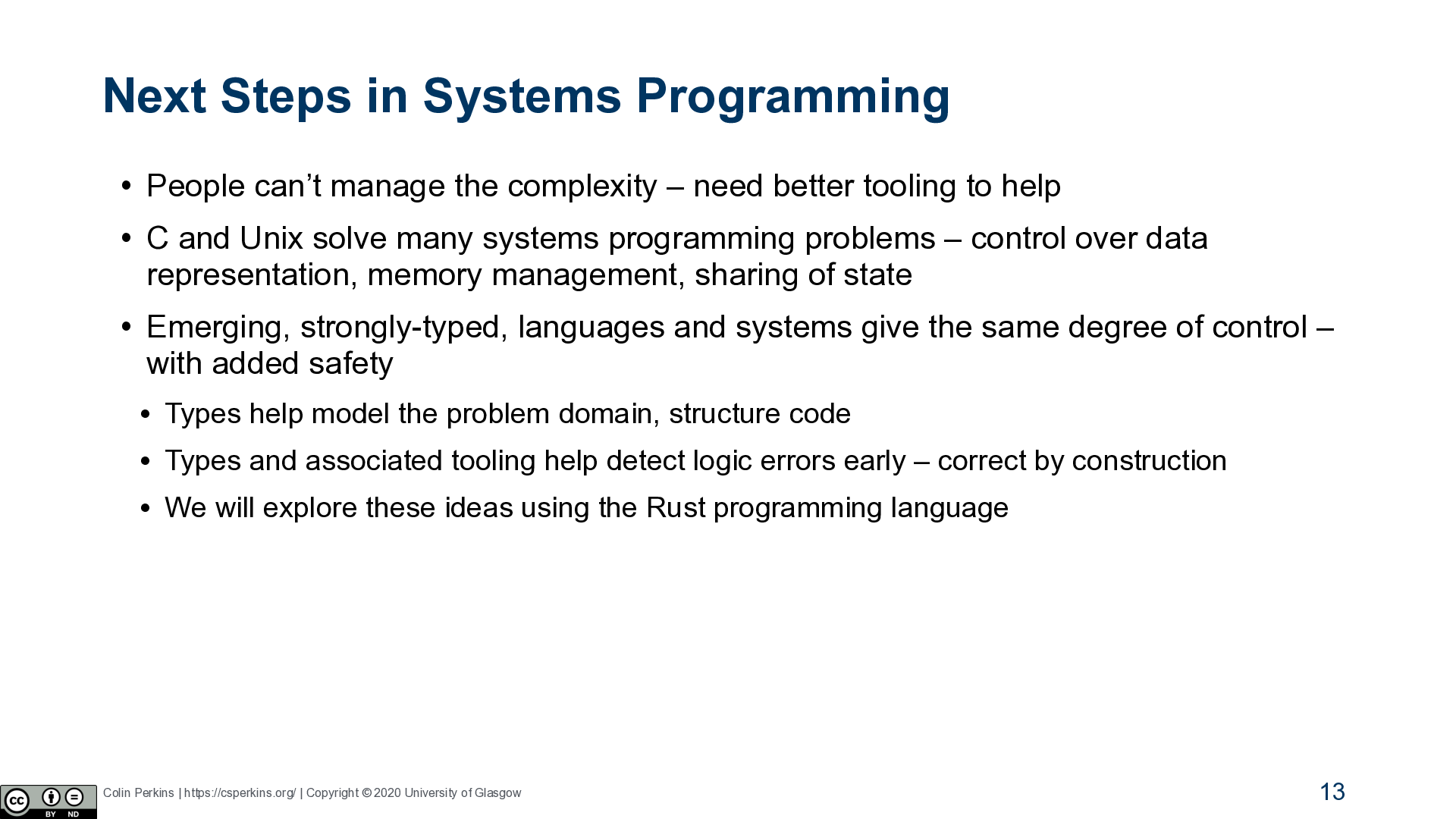
What seems clear is that systems programs,
00:21:09.033
and much software in general,
00:21:10.733
have reached the stage where people
00:21:12.500
can’t manage the complexity.
00:21:15.100
The C programming language gives precise control
00:21:18.033
over data representation, memory management, and sharing
00:21:21.666
of state. But exercising that control has
00:21:24.800
proven too difficult.
00:21:26.933
Bugs and security vulnerabilities abound in software,
00:21:30.233
and pervasive connectivity and concurrency are making
00:21:33.500
the problem worse.
00:21:35.566
Emerging, strongly-typed, languages and systems
00:21:38.833
give the same degree of control, with added safety.
00:21:42.566
They allow us to use the type system to eliminate
00:21:45.166
certain classes of common bugs,
00:21:47.100
and to model the problem space via the types
00:21:49.900
in a way that helps us detect logic errors early.
00:21:53.400
We can improve systems programming.
00:21:56.066
In the remainder of this course, we’ll explore how,
00:21:59.066
using the Rust programming language as an example.
00:22:03.666
So, to summarise.
00:22:05.700
Systems programming is infrastructure programming.
00:22:09.133
It’s programming where efficiency
00:22:11.133
and control over data representation matters,
00:22:13.833
and where concurrency and security are pervasive challenges.
00:22:17.500
The state of the art in deployed systems is Unix and C.
00:22:22.333
Old, but surprisingly flexible, systems,
00:22:25.333
that are reaching the end of their life.
00:22:27.966
To address the challenge of writing secure
00:22:30.400
and highly concurrent code,
00:22:32.000
we need better tools and techniques to help tame the
00:22:34.500
complexity, and help us debug our designs.
00:22:38.233
I believe we’re now starting
00:22:39.633
to see such tools being developed.
00:22:41.933
I’ll introduce these in the remainder of this course.
-
Microsoft Security Response Centre,
A proactive approach to more secure code, July 2019.
Discussion
Discussion will include presentation and discussion of the slides you
prepared in lab 1 plus the material below.
The lecture highlighted two papers that will be discussed in detail
this week:
Programming language
challenges in systems codes: why systems programmers still use C, and what
to do about it by Jonathan Shapiro, and
Some were meant for
C: The endurance of an unmanageable language by Stephen Kell.
Make sure you read, and think about, these papers before the
discussion session.
These papers explore what is a systems programming language, and discuss
some common features of systems languages. In particular they highlight
that performance is critical, but also that systems languages tend to
offer low-level control of data representation, memory management, and
I/O, and that systems programmers make use of this control. The authors
suggest that systems languages that attempt to trade performance for
safety, or that rely on compiler optimisations to fix data layout, will
not be accepted by the broader community.
Do you agree with this definition of systems programming?
Do you agree that the issues identified are real?
The lecture and readings also suggest that the C programming language
is increasingly a liability: it's too easy to introduce security
vulnerabilities and trip over undefined behaviour, and it provides
insufficient abstraction. But, C provides important control over data
representation and allows interworking with external data.
Do you agree with this critique of C?
What features of C do you think work well?
What are the most problematic?
The lecture also reviewed Moore's law and Dennard scaling, and discussed
how these trends in hardware development are driving changes in software.
In particular, it highlighted the hardware factors leading to increasing
use of concurrent programming.
Do you understand this discussion?
Do you have questions about the hardware trends?
To help address the challenge of concurrent programming, the lecture
suggested the use of functional programming and modern programming
languages with improved type systems.
In particular, it noted that purely functional code is thread safe,
because it has no shared mutable state, and easy to test because it
has no internal state.
Do you think the ideas functional programming can improve
concurrent systems programs?
Can you write C code in a functional style, and would it help?
Finally, the lecture also claims that modern type systems can help to
prevent certain types of unsafe behaviour, such as buffer overflows,
use-after-free bugs, race conditions, and iterator invalidation, and
allow us to better model the problem space. This can improve system
correctness and eliminate certain classes of security vulnerability.
Does the suggestion that we should change our approach to writing
software, and focus on memory safe languages, modelling, and debugging
the design, rather than debugging the code, make sense?