Lecture 3: Types and Systems Programming
Lecture 3 discusses some of the concepts around types and type systems,
and tries to highlight the benefits of moving from a weakly-typed
language, such as C, to a more strongly-typed, safer, systems
programming language. It begins to introduce the Rust programming
language, as an example of such a safer systems language.
Part 1: Types and Systems Programming
The 1st part of this lecture discusses the idea of types in programming
languages. It review what is a type and a type system, and discusses
the concepts of static vs. dynamic typing, strong vs. weak types, and
safe vs. unsafe programming languages. It highlights the benefits of
strongly typed safe languages for systems programming.
00:00:00.466
In this lecture, I want to move
00:00:02.600
on from the general discussion of the
00:00:05.200
problems with systems programming, and talk about
00:00:07.800
types and systems programming in more specific terms.
00:00:11.000
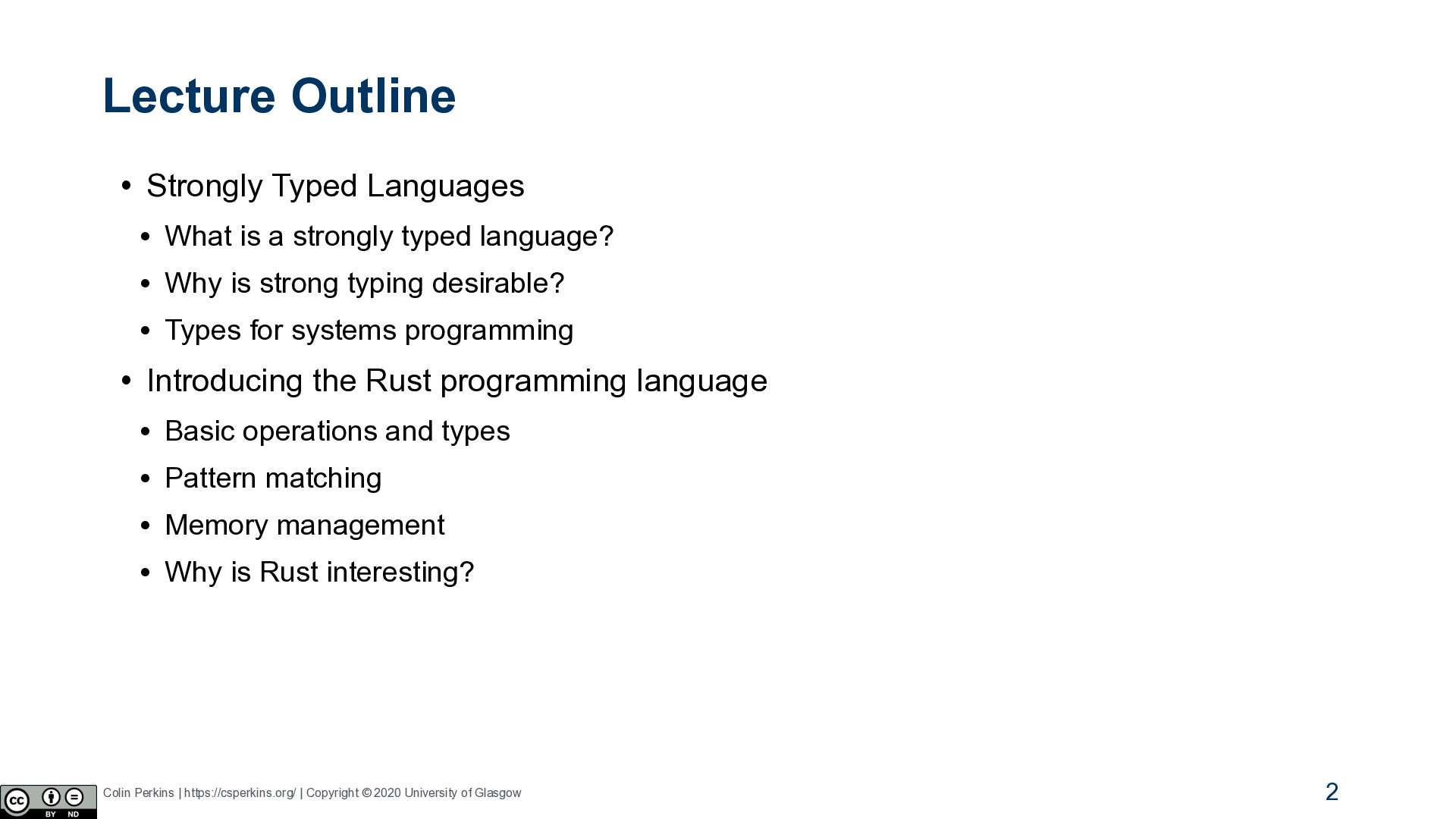
In particular, I want to talk about
00:00:13.300
strongly typed languages, talk a bit about
00:00:15.700
what is a strongly typed language,
00:00:18.133
why strong typing is desirable,
00:00:20.133
and how we can make use of types for systems programming.
00:00:23.800
And I want to move on and start to
00:00:25.600
introduce the Rust programming language,
00:00:27.666
talking about the basic operations and types
00:00:29.600
that are feasible in that language,
00:00:31.400
the way it does pattern matching and
00:00:34.400
memory management, and finally talk a bit
00:00:37.666
about why Rust is interesting
00:00:40.266
as a systems programming language.
00:00:43.300
To begin, I want to talk about strongly typed languages.
00:00:46.700
I want to talk about what is strongly typed language,
00:00:49.666
why it's desirable,
00:00:50.966
and how types can be used for systems programming.
00:00:55.500
So first of all, what is a type?
00:00:58.266
Well, a type in programming languages is
00:01:01.000
something which describes what an item of
00:01:03.300
data represents.
00:01:05.233
It tells us whether a particular variable
00:01:07.833
can hold an integer, a floating point
00:01:10.433
value, a file, a sequence number,
00:01:12.666
a username, or whatever it happens to
00:01:14.700
be. It says conceptually what is the
00:01:17.366
data which is represented by a variable,
00:01:20.000
and how is that data represented?
00:01:22.833
Types are very familiar in programming.
00:01:25.233
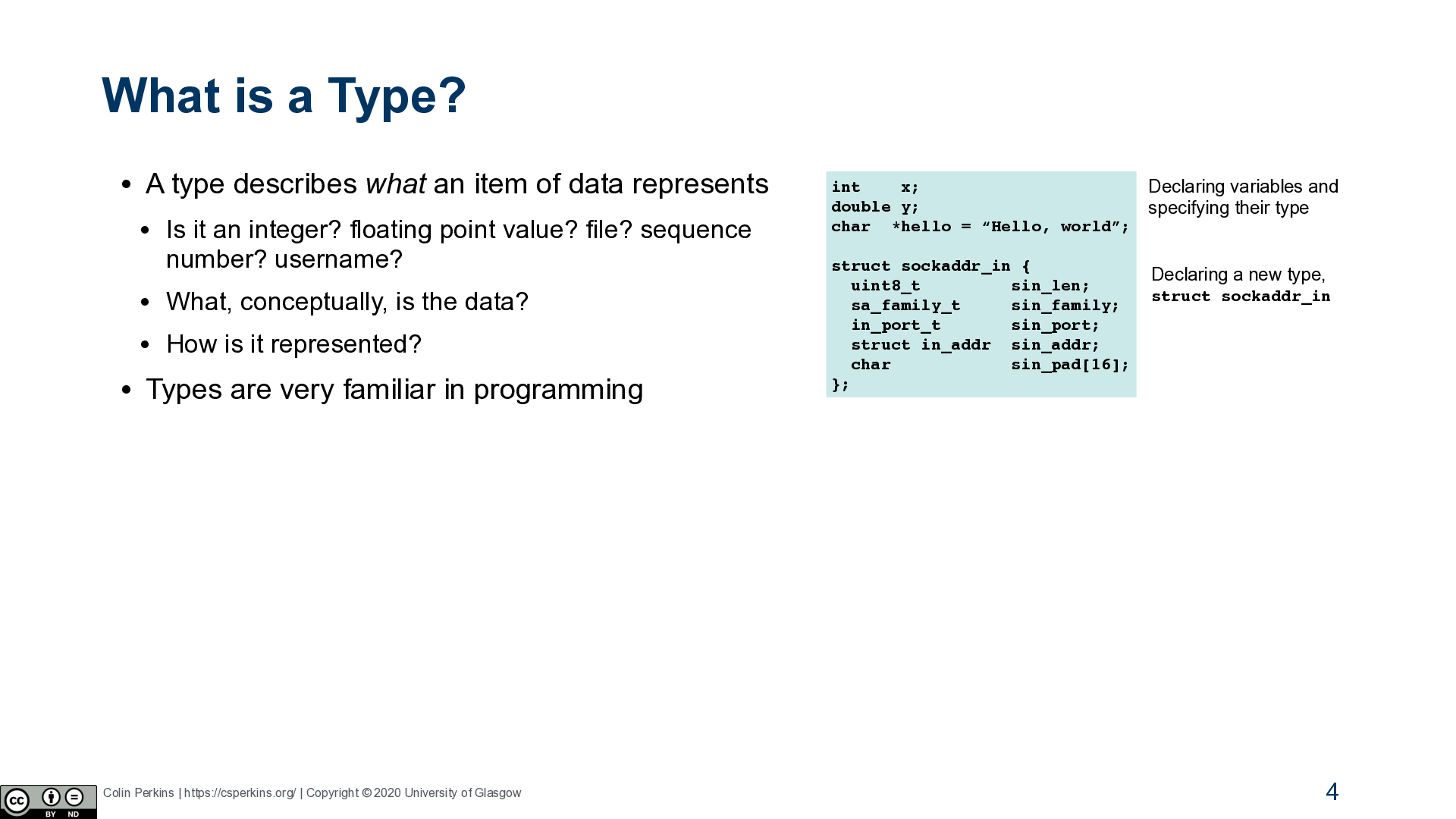
For example, if we look at the
00:01:26.433
code on the right hand side of
00:01:28.400
the screen, which is C code,
00:01:30.166
we see a number of variable declarations.
00:01:32.300
We can specify the types of the variable.
00:01:34.666
We specify that x holds an integer,
00:01:37.033
for example; that y holds a double
00:01:39.200
precision floating point value; and that the
00:01:41.366
variable hello is a pointer to a
00:01:43.533
character, in this case a pointer to
00:01:45.733
the first character of the string “Hello, world”.
00:01:48.100
We also see that it’s possible to
00:01:50.066
define new types. For example, the definition
00:01:53.300
of the struct, struct sockaddr_in, on the slide
00:01:56.600
defines a compound type holding five fields:
00:02:00.033
length, family, port, addr, and some padding.
00:02:03.266
Each of which has its own type,
00:02:05.333
and the type of one of these
00:02:07.533
is, in turn, a compound type, struct in_addr.
00:02:11.566
This lets us build up reasonably complex
00:02:14.233
types, to represent the different types of
00:02:16.200
data that we’ll work with in our program.
00:02:19.700
So given this definition of a type,
00:02:22.233
what is a type system?
00:02:23.733
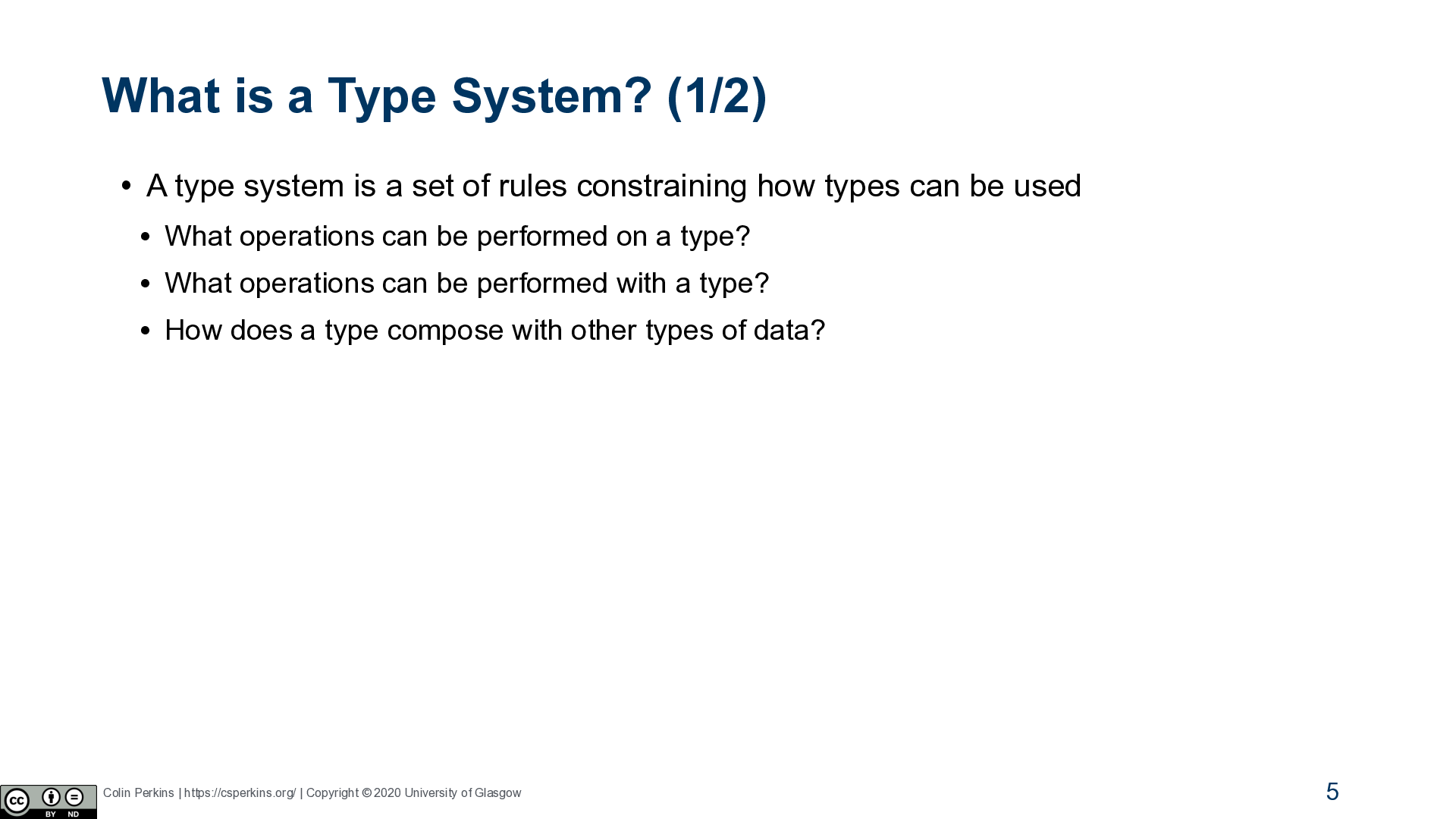
Well, a type system is a set of
00:02:26.366
rules that constrains how the types can be used.
00:02:29.300
The type system specifies what operations can
00:02:32.066
be performed on particular types of data.
00:02:34.900
What operations can be performed with those
00:02:37.000
types of data, and how the different
00:02:40.033
types of data compose with other types
00:02:42.166
of data to form compound data types,
00:02:45.033
or types specifying different alternatives.
00:02:49.266
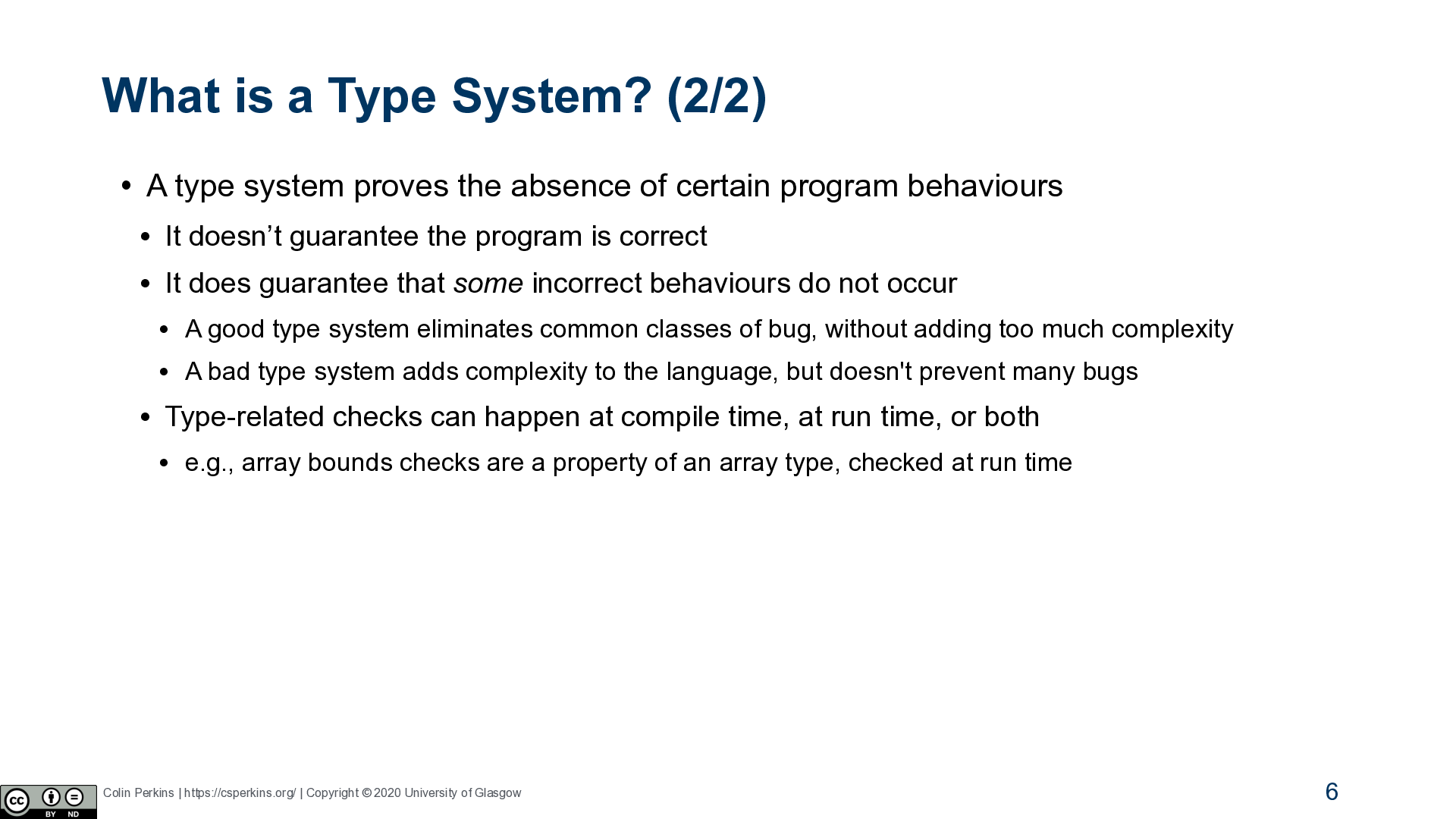
A type system specifies what the program
00:02:52.633
can do. It specifies the legal behaviour
00:02:55.533
for objects of those particular types.
00:02:58.066
Equally, it proves that the program can't
00:03:01.033
do certain things. It proves that the
00:03:04.000
program can't perform certain illegal behaviours.
00:03:06.666
This doesn't guarantee that the program is
00:03:09.400
correct, of course, but it does guarantee
00:03:12.133
that some types of incorrect behaviour don't
00:03:14.900
occur in a well-typed program.
00:03:16.966
Type systems eliminate certain classes of bugs,
00:03:19.700
hopefully without adding too much
00:03:21.466
complexity to the language.
00:03:23.900
Some of the bugs the
00:03:25.600
type system helps us prevent are straightforward.
00:03:28.500
It prevents us adding apples to oranges
00:03:31.400
and getting a meaningless answer, for example.
00:03:34.366
Or it guarantees that we can't access
00:03:36.900
the 11th element of the collection,
00:03:38.566
which only holds 10 elements. Some type
00:03:41.600
systems can help protect against more subtle bugs, though.
00:03:44.466
Modern type systems, for example, can help
00:03:47.400
make sure that race conditions don't occur
00:03:49.833
in multi threaded code. Or they can
00:03:52.233
check various invariants of the program behaviour,
00:03:54.666
and check that particular features of the design are upheld.
00:03:58.233
The goal of designing a type system
00:04:00.633
is to balance complexity, through the complexity
00:04:03.000
and the features of the type system,
00:04:05.400
with the ability to catch bugs.
00:04:07.566
A badly designed type system adds complexity
00:04:10.500
and syntactic overhead to the language,
00:04:12.500
but doesn't really catch any problems.
00:04:15.566
Some would suggest that the type system
00:04:18.533
in languages like Java is in this category.
00:04:21.733
Ideally what we want, though, is a
00:04:24.400
language where the type system is sophisticated
00:04:26.800
enough to catch real problems with the
00:04:29.166
code, yet low enough overhead that people
00:04:31.100
are willing to use it.
00:04:33.400
Types are a fundamental feature of a
00:04:35.600
program. We’re used to thinking of types
00:04:37.833
as a compile time feature because the
00:04:40.033
compiler complains when we get them wrong.
00:04:42.366
But types exist at runtime too,
00:04:44.700
and certain types of type checking also happen at runtime.
00:04:48.566
For example, array bounds checks are very much a property of
00:04:51.233
an array type, but are typically checked at runtime,
00:04:54.100
rather than compile time.
00:04:57.866
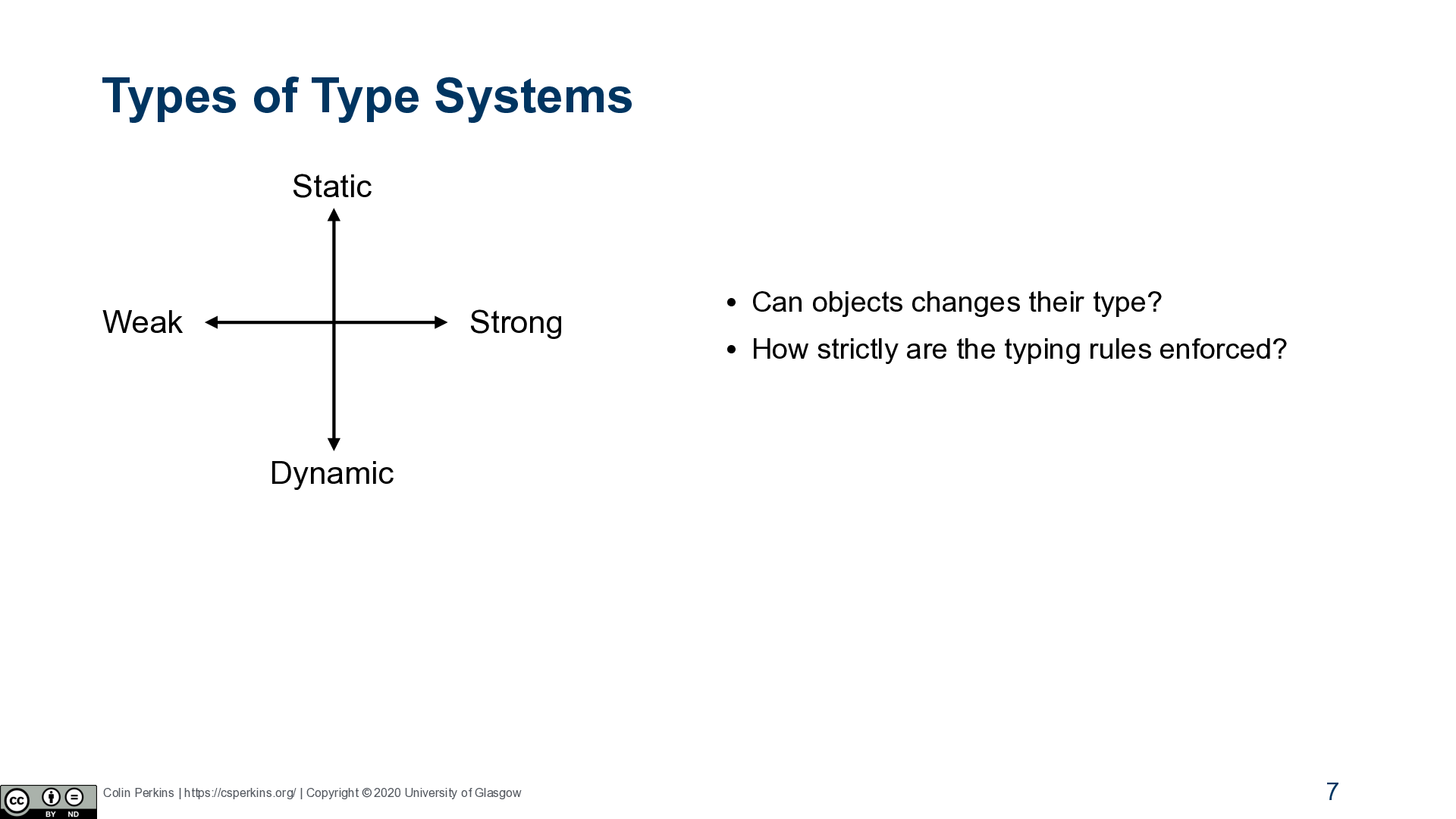
Different languages have different type systems.
00:05:01.466
Some languages are strongly typed, and provide
00:05:04.266
no flexibility, no escape from the type rules.
00:05:07.166
In others, the type checking is much
00:05:09.966
weaker, and it's possible to subvert the
00:05:12.366
rules or to cast between different types of data.
00:05:15.533
Some languages apply types statically, and when
00:05:17.833
a variable is assigned a particular type,
00:05:20.133
its type can never change and it
00:05:22.433
can only hold variables of, hold values of, that type.
00:05:25.800
Other languages are more dynamic, and allow
00:05:27.933
the types that variables can hold to
00:05:29.866
change at different points in the program.
00:05:34.333
There are different trade offs here.
00:05:36.033
There's no right or wrong answer.
00:05:37.900
And when we're thinking about type systems,
00:05:39.833
we need to think about, to what
00:05:42.066
extent the typing rules are strictly enforced,
00:05:44.166
and to what extent objects can change
00:05:46.633
their types as the program’s execution proceeds.
00:05:52.033
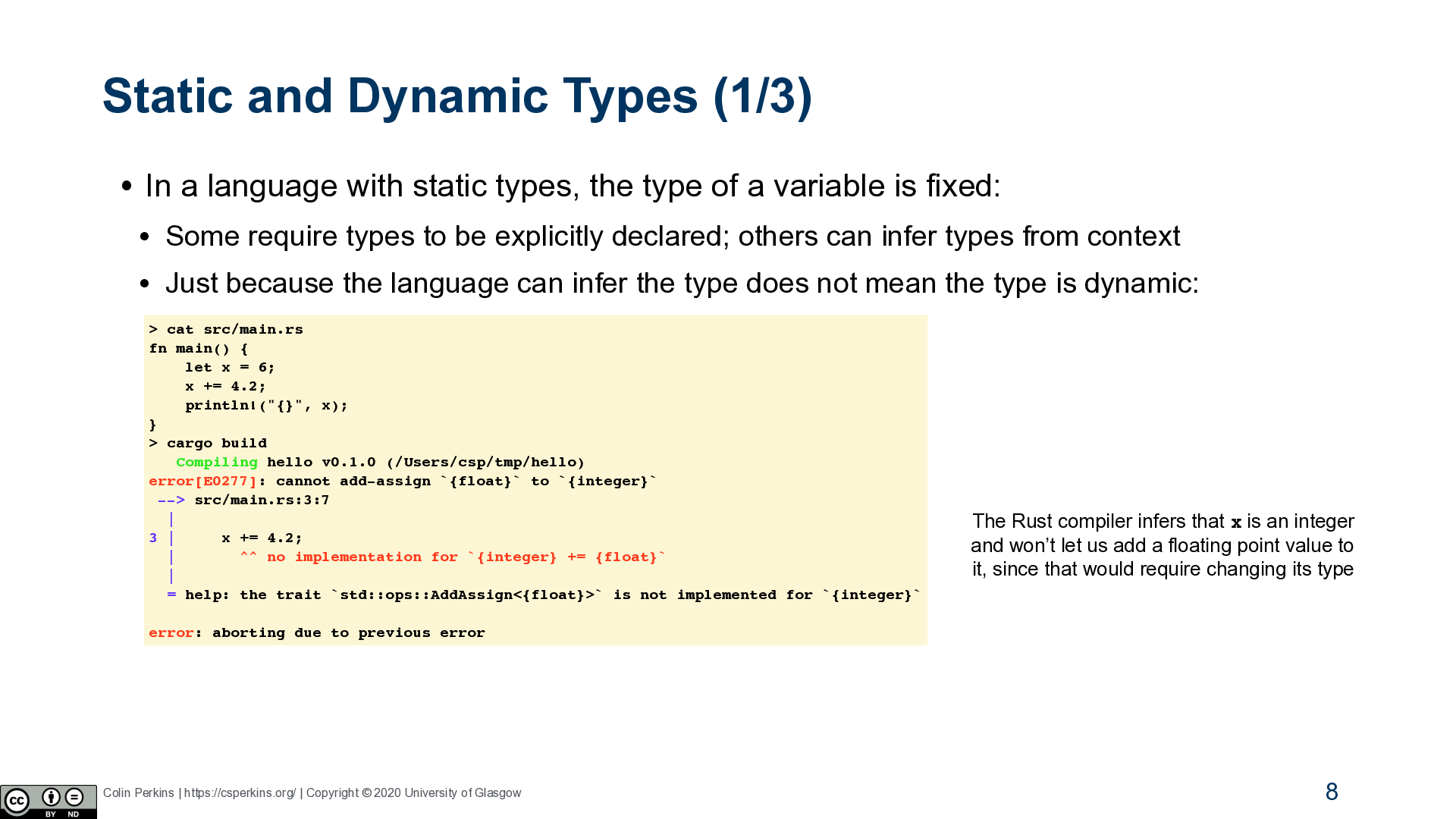
In a language with static types,
00:05:53.933
the type of a variable is fixed.
00:05:56.166
In the example at the bottom of
00:05:58.400
the slide, for example,
00:05:59.600
we have a Rust program which declares
00:06:02.133
the variable x to hold an integer
00:06:04.500
type and then tries to add the
00:06:06.866
floating point number 4.2 to it.
00:06:09.000
And since Rust is a statically typed
00:06:11.466
language, this fails and the compiler complains
00:06:13.966
that you can't add a floating point
00:06:16.433
number to a value which is holding
00:06:18.900
an integer type. The types don’t match.
00:06:21.466
What's interesting in this example, though,
00:06:23.500
is that we never specified that the
00:06:25.833
variable x holds an integer type
00:06:27.933
Some statically typed languages require that the
00:06:30.800
types of variables are explicitly declared.
00:06:33.233
C and C++ and Java fall into
00:06:36.100
this category, for example. Others, like Rust,
00:06:38.966
and like the example we see on
00:06:41.833
the slide, can infer types from the context.
00:06:44.833
However, just because the language can infer
00:06:47.433
the type of variable doesn't mean that
00:06:49.666
the type is dynamic.
00:06:51.033
With Rust, once the type of variable
00:06:53.600
x has been inferred to be an
00:06:55.433
integer we can't add a floating point
00:06:57.766
value to it, even though we never
00:07:00.666
explicitly said that x can hold integers.
00:07:02.600
The type is still static, it just
00:07:04.733
saves us the typing of specifying what it is.
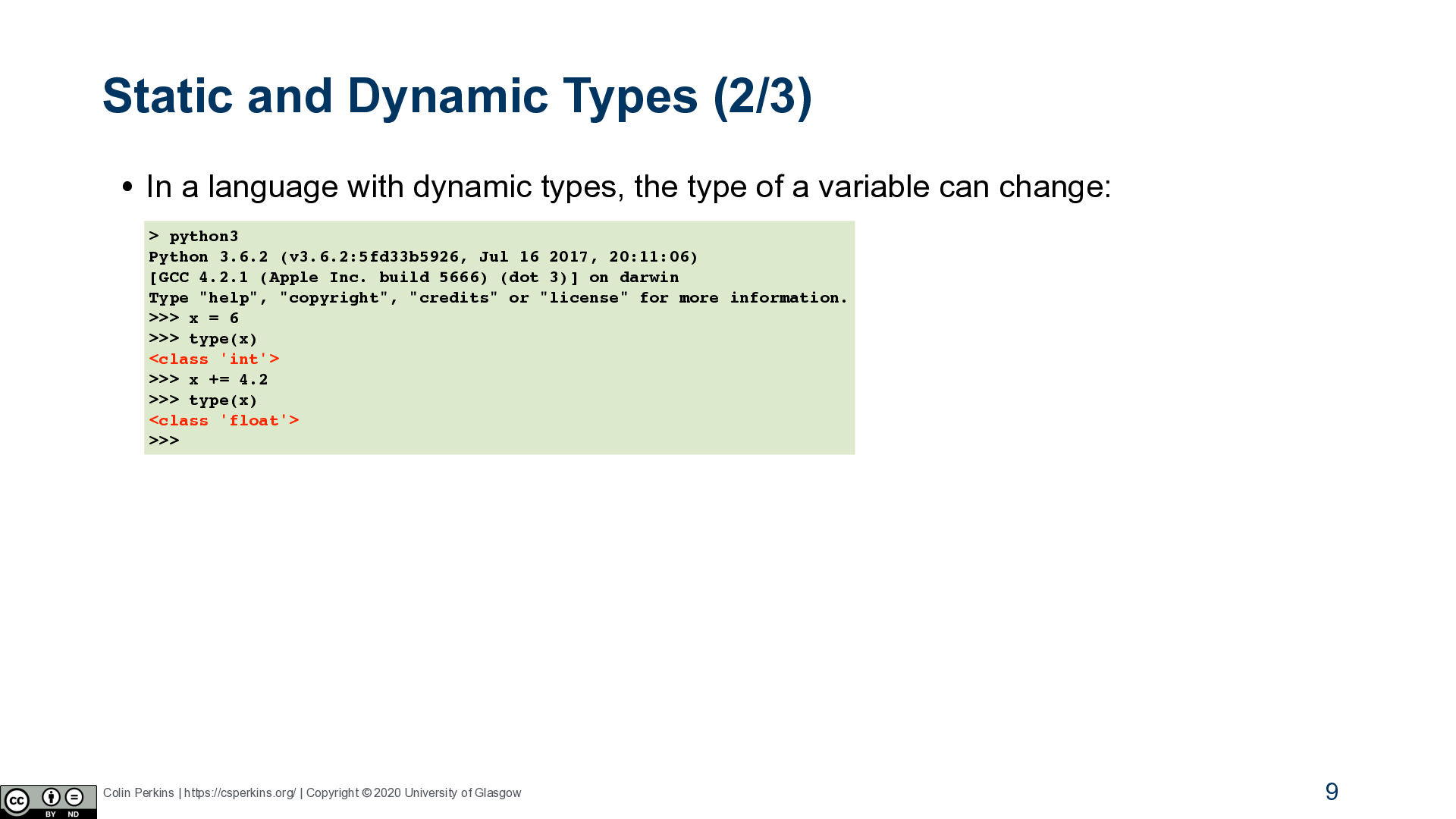
00:07:09.766
In other languages, the types are much more dynamic.
00:07:13.200
The example show some Python code.
00:07:15.033
And again, we set a variable x
00:07:17.200
the hold the value six. We inspect
00:07:18.866
its type, and we see that its
00:07:21.233
type is an integer. And again,
00:07:23.333
Python has inferred the type in much
00:07:25.533
the same way that Rust did in the previous slide.
00:07:28.700
However in this case, when we add
00:07:30.800
the value 4.2 to it, which is
00:07:32.866
a floating point value, it succeeds.
00:07:34.900
And if we look at the type,
00:07:36.733
we inspect the type of x,
00:07:38.533
we see that its type has changed
00:07:40.600
to that of a floating point number
00:07:42.766
In Python types of dynamic, and it's
00:07:45.633
safe to convert an integer to a
00:07:48.466
floating point value, it doesn't lose any
00:07:51.333
information, so when we ask the interpreter
00:07:53.466
to do so, the conversion succeeds
00:07:55.066
and the type of the variable changes.
00:07:59.566
Which is better, a dynamically typed language
00:08:03.133
or statically typed language?
00:08:05.266
Well, it very much depends what you're
00:08:07.200
doing, and there are different trade offs.
00:08:09.200
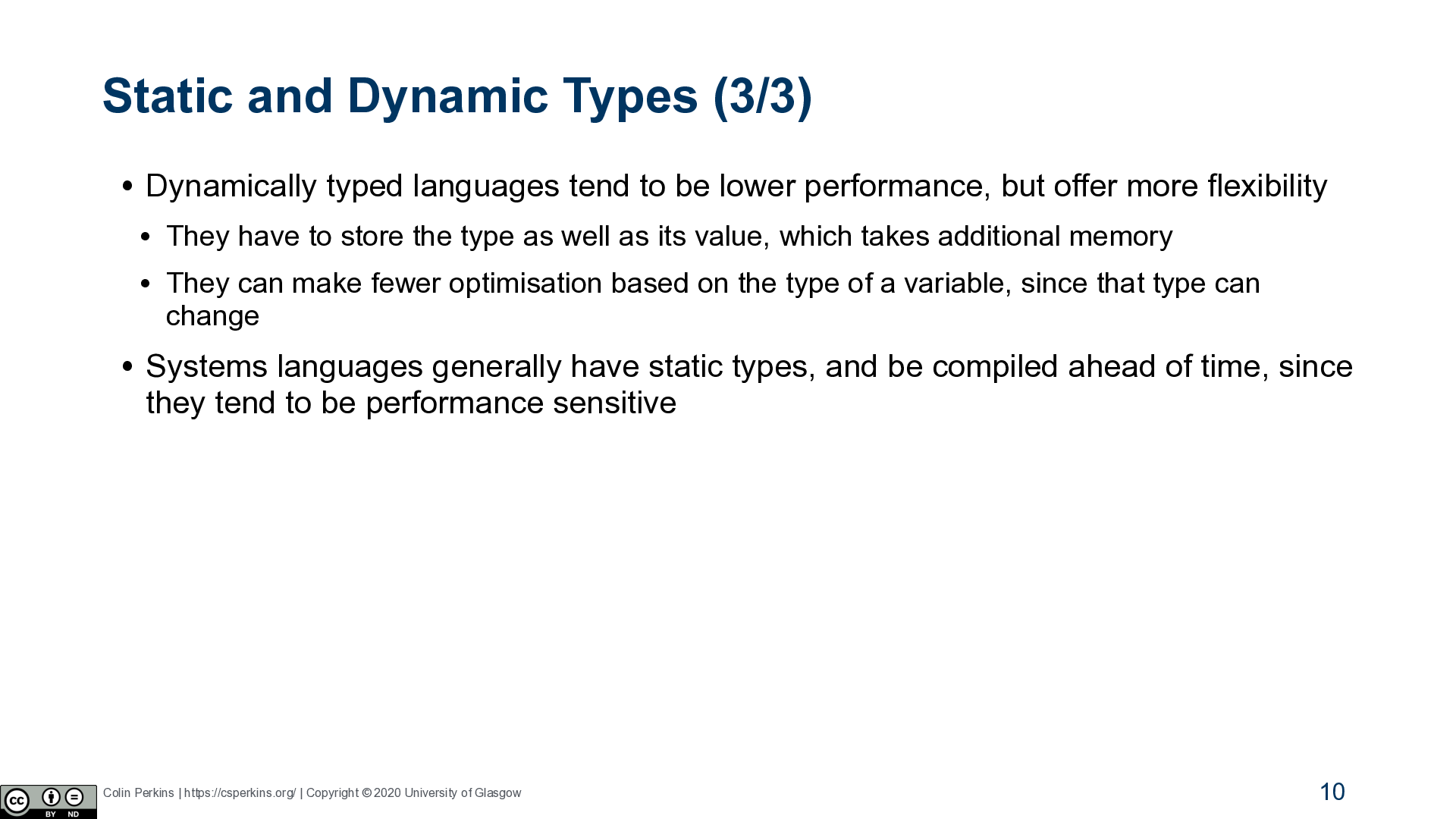
Dynamically typed languages tend to perhaps be
00:08:12.200
lower performance, but they offer more flexibility.
00:08:15.266
A dynamically typed language has to store
00:08:17.333
the type of a variable as well
00:08:19.400
as its value at runtime. And this
00:08:21.466
tends to take up additional memory.
00:08:23.333
It also has to check that the
00:08:25.366
variables are of the correct type before
00:08:27.366
it performs the various operations, and it
00:08:29.400
has to perform those checks at runtime.
00:08:31.400
Again, because the types can change over time.
00:08:33.600
And similarly, it can make fewer optimisations
00:08:36.566
based on the types of the variable,
00:08:38.566
again because the types of can change.
00:08:42.166
Systems languages tend to have static types,
00:08:44.733
and they tend to be compiled ahead
00:08:47.266
of time, because they’re performance sensitive.
00:08:49.533
If the types of fixed, and if
00:08:51.500
that the compiler can look at code
00:08:53.466
and make optimisation decisions based on the code,
00:08:55.733
and can do so ahead of time,
00:08:57.766
without worrying about performing those
00:08:59.833
optimisations quickly,
00:09:00.966
it can generally achieve better performance.
00:09:03.333
Systems programming languages tend to trade-off performance
00:09:07.633
for flexibility, and have very static type systems.
00:09:12.100
In a language with strong types,
00:09:14.366
every operation must conform to the type system.
00:09:17.500
A strongly typed language makes sure that
00:09:19.866
operations which can't be proven to be
00:09:21.866
correct, that can't be proven to conform
00:09:24.166
to the typing rules, are not permitted.
00:09:27.466
More weakly type languages provide ways of
00:09:30.566
circumventing the type checker.
00:09:32.466
For example, a lot of languages allow
00:09:35.366
safe conversions, safe and automatic conversions,
00:09:37.866
between certain types. For example, a lot
00:09:40.133
of languages allow conversions between floating point
00:09:43.700
and double precision types, to extend the
00:09:46.600
precision of a type, or from an
00:09:49.533
integer to a long integer
00:09:52.200
And in all these cases the conversion is safe.
00:09:56.133
In other cases, the language can allow
00:09:58.566
more open-ended casts. The code fragments at
00:10:00.966
the bottom of the slide shows a
00:10:03.066
common idiom in C.
00:10:04.900
The variable, buffer, holds an unstructured sequence
00:10:07.800
of characters, and the recv() call reads
00:10:09.833
data into that buffer.
00:10:12.466
Once the read has successfully retrieved that
00:10:15.300
data, it’s cast to a different type
00:10:18.100
representing the expected contents of the buffer.
00:10:21.033
This is very unsafe behaviour. The programmer
00:10:23.666
is essentially telling the compiler “Trust me,
00:10:26.300
I know what I’m doing”. Trust that
00:10:28.933
this sequence of bytes is actually,
00:10:31.200
in this example, an RTP packet.
00:10:33.566
If the programmer is correct, and the
00:10:36.233
sequence of bytes really is an RTP
00:10:38.366
packet, this is safe and high performance.
00:10:41.200
If the programmer is not correct,
00:10:44.066
the data doesn't match its type,
00:10:46.500
then the behaviour is undefined.
00:10:49.766
A weakly type language provides these sort
00:10:52.566
of escape hatches. Ways of circumventing the
00:10:54.633
type system. Ways of telling the compiler
00:10:57.066
“Trust me, I know what I'm doing”.
00:10:59.666
This can provide a lot of power.
00:11:01.600
It's also very risky because if the
00:11:04.200
programmer gets it wrong, the program crashes unpredictably
00:11:10.233
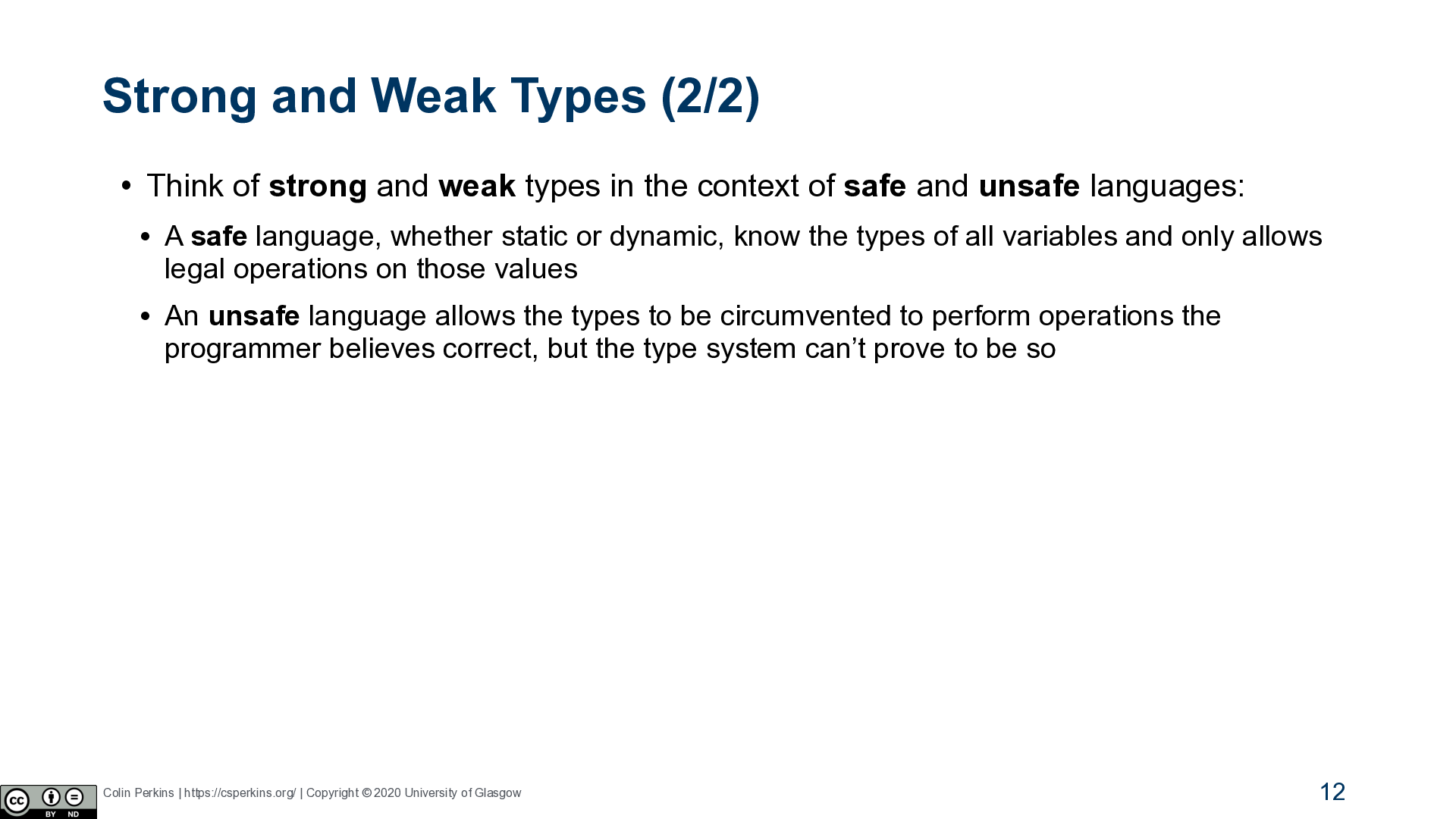
When thinking about strong and weak types,
00:11:12.966
it’s essentially important to them in the
00:11:15.700
context of safe and unsafe languages.
00:11:18.166
A safe language, whether the typing is
00:11:20.700
static or dynamic, knows the types of
00:11:23.266
all the variables, and only allows legal
00:11:25.833
operations on those values at any time.
00:11:28.500
An unsafe language, on the other hand,
00:11:30.833
allows the types to be circumvented.
00:11:32.800
It allows the programmer to specify to
00:11:35.133
the compiler “Trust me, I know what I'm doing”.
00:11:38.233
It lets the programmer perform operations which
00:11:40.633
they believe to be correct, even though
00:11:43.033
the type system can't prove them to be so.
00:11:46.200
It pushes the burden of checking for
00:11:48.566
correctness onto the programmer, rather than allowing
00:11:51.000
the type system to help.
00:11:54.133
Unsafe languages provide a lot of flexibility.
00:11:56.633
They allow you to do things which
00:11:59.133
are not possible in safe languages.
00:12:01.366
They’re also much riskier. It's much easier
00:12:05.066
to mess up in an unsafe language,
00:12:07.766
and to have the program crash.
00:12:11.600
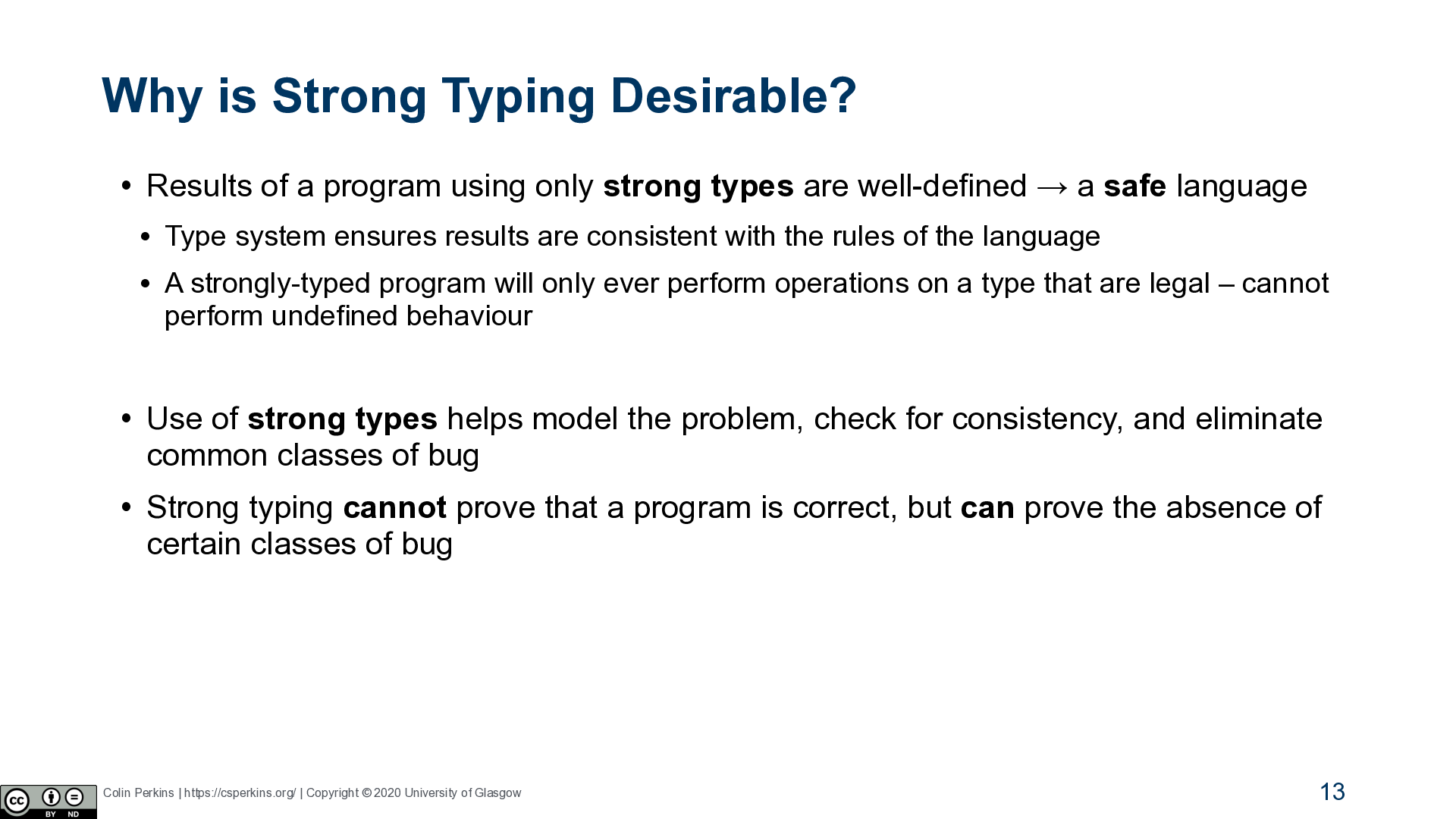
And this is why strong typing is
00:12:14.033
desirable, I think. Results for a program
00:12:16.433
that only use strong types are always
00:12:18.866
well defined. The language is always safe.
00:12:21.366
The results are always consistent with the
00:12:23.700
rules of the language.
00:12:25.166
A strongly typed program only ever performs
00:12:28.200
operations that are legal. It can never
00:12:30.233
perform undefined behaviour.
00:12:32.633
Strong typing helps us model the problem
00:12:35.233
space. It helps us check our designs
00:12:37.833
and the resulting code for consistency.
00:12:40.066
It helps eliminate certain classes of bugs.
00:12:42.766
That is, the type system can't prove
00:12:45.366
that the program is correct, but it
00:12:47.966
can prove that certain behaviours don't happen
00:12:50.600
because they're not legal for those types.
00:12:53.300
Weakly typed systems, on the other hand,
00:12:55.866
can't make such guarantees, because the programmer
00:12:58.766
always has the option of circumventing the type system.
00:13:03.566
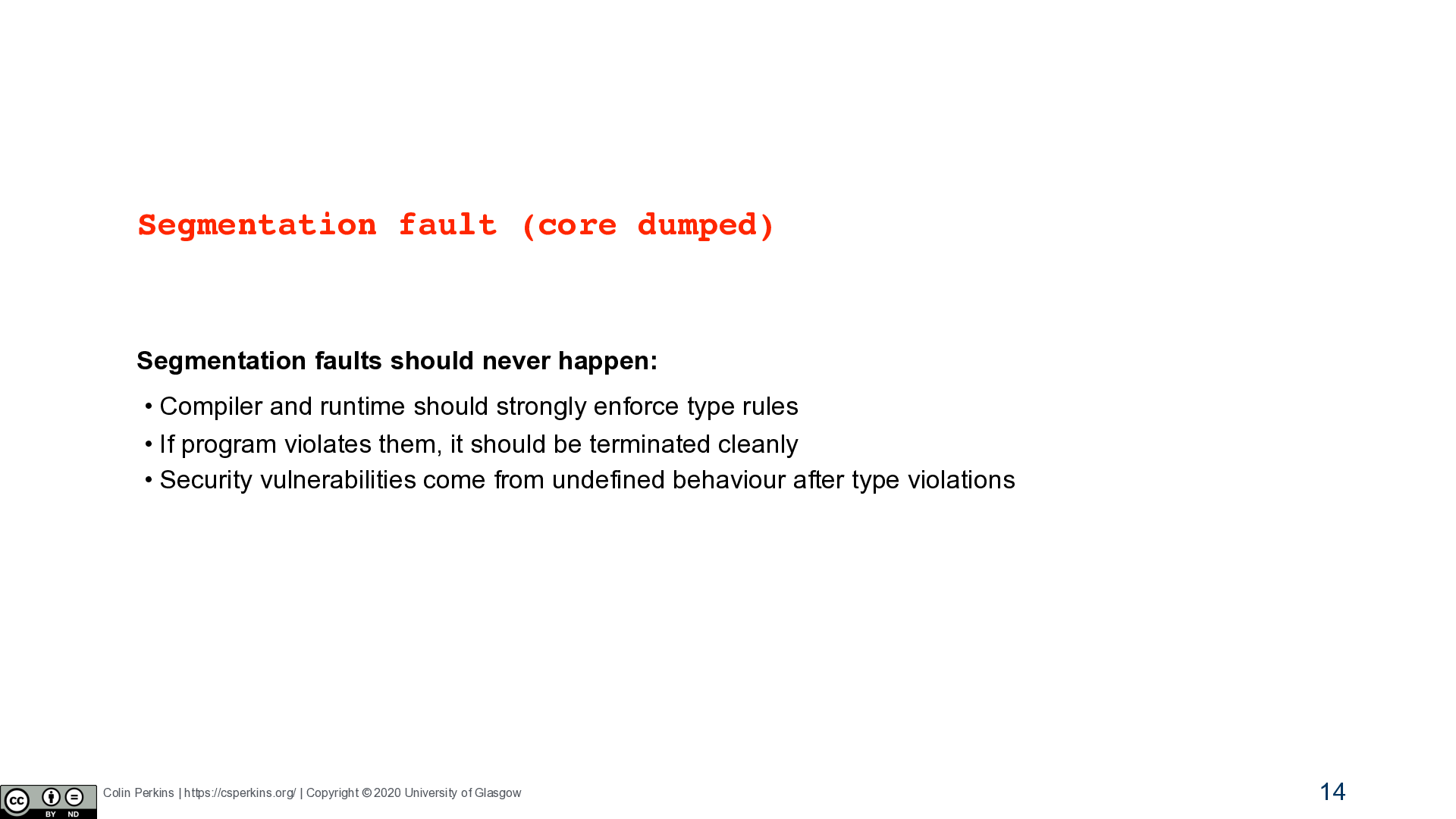
We've all seen this message, segmentation fault
00:13:07.233
(core dumped), when writing C programs.
00:13:10.500
I'd argue, though,
00:13:11.866
that segmentation faults should never happen.
00:13:14.566
The compiler and the runtime should be
00:13:17.266
able to enforce the typing rules,
00:13:19.566
and make sure that if the program
00:13:22.266
violates them, it's terminated cleanly.
00:13:24.266
A segmentation fault happens when the program
00:13:27.233
is not terminated cleanly, and the program
00:13:29.766
perform some behaviour which is illegal,
00:13:31.733
accesses memory which it doesn't own,
00:13:33.700
and the operating system kills it.
00:13:37.966
That's a useful safety measure. It's important
00:13:40.866
that the operating system can stop wayward programs.
00:13:44.200
Unfortunately, it's not a very precise safety measure.
00:13:47.633
There are lots of behaviours which access
00:13:49.966
memory outside the bounds of an object,
00:13:52.300
but which don't go outside the bounds
00:13:54.666
of memory allocated by the operating system.
00:13:57.100
These give undefined behaviour. They silently corrupt
00:14:00.333
and modify other parts of the program’s
00:14:03.600
state. It’s these types of types of misbehaviour
00:14:06.666
that tend to lead to security
00:14:08.500
vulnerabilities, as a result of undefined behaviour
00:14:12.066
due to weak type systems.
00:14:15.766
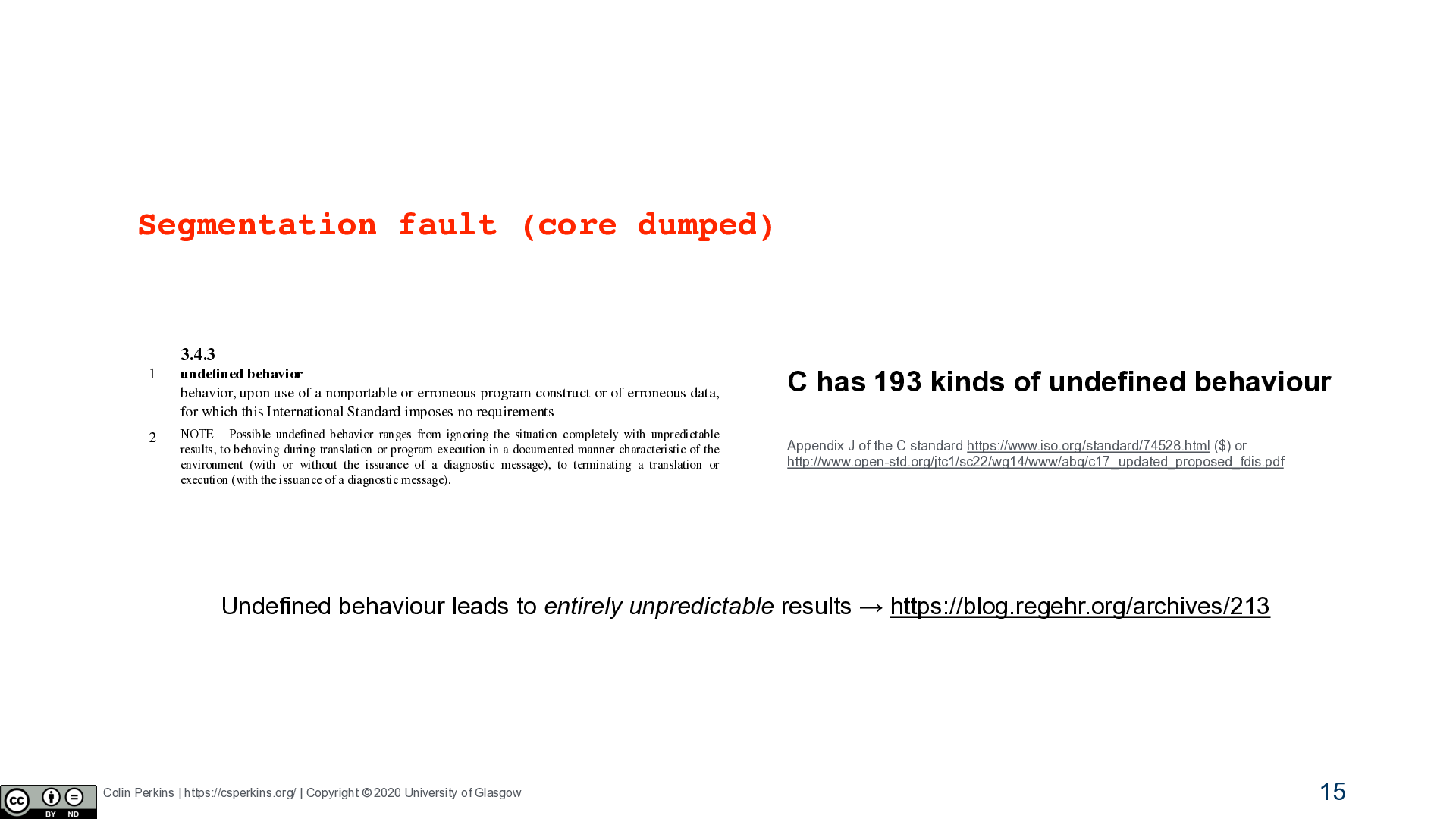
The C programming language is especially bad
00:14:19.066
for this. The C standard documents 193
00:14:22.366
different kinds of undefined behaviour in the language.
00:14:26.233
And I think what's more worrying is
00:14:28.633
that any of these undefined behaviours can
00:14:31.033
lead to entirely unpredictable results.
00:14:32.866
If the program hits undefined behaviour,
00:14:35.300
the standard says anything can happen.
00:14:37.733
It doesn't make any guarantees. That's really
00:14:40.566
worrying if we're trying to write secure,
00:14:43.400
correct, and trustworthy code.
00:14:45.133
The link on the slide, to the
00:14:48.466
blog post, points to some discussion of
00:14:51.433
this. And it's really quite alarming the
00:14:53.633
sorts of behaviours that C programs can perform.
00:14:59.366
As we've seen, C is a weakly typed language,
00:15:02.466
yet it's widely used for systems programming.
00:15:05.700
Why is this, why do we use
00:15:08.333
a language which provides so few guarantees?
00:15:10.666
And can we write systems programs in
00:15:13.033
languages which are strongly typed? And what
00:15:15.266
are the difficulties in doing so?
00:15:18.500
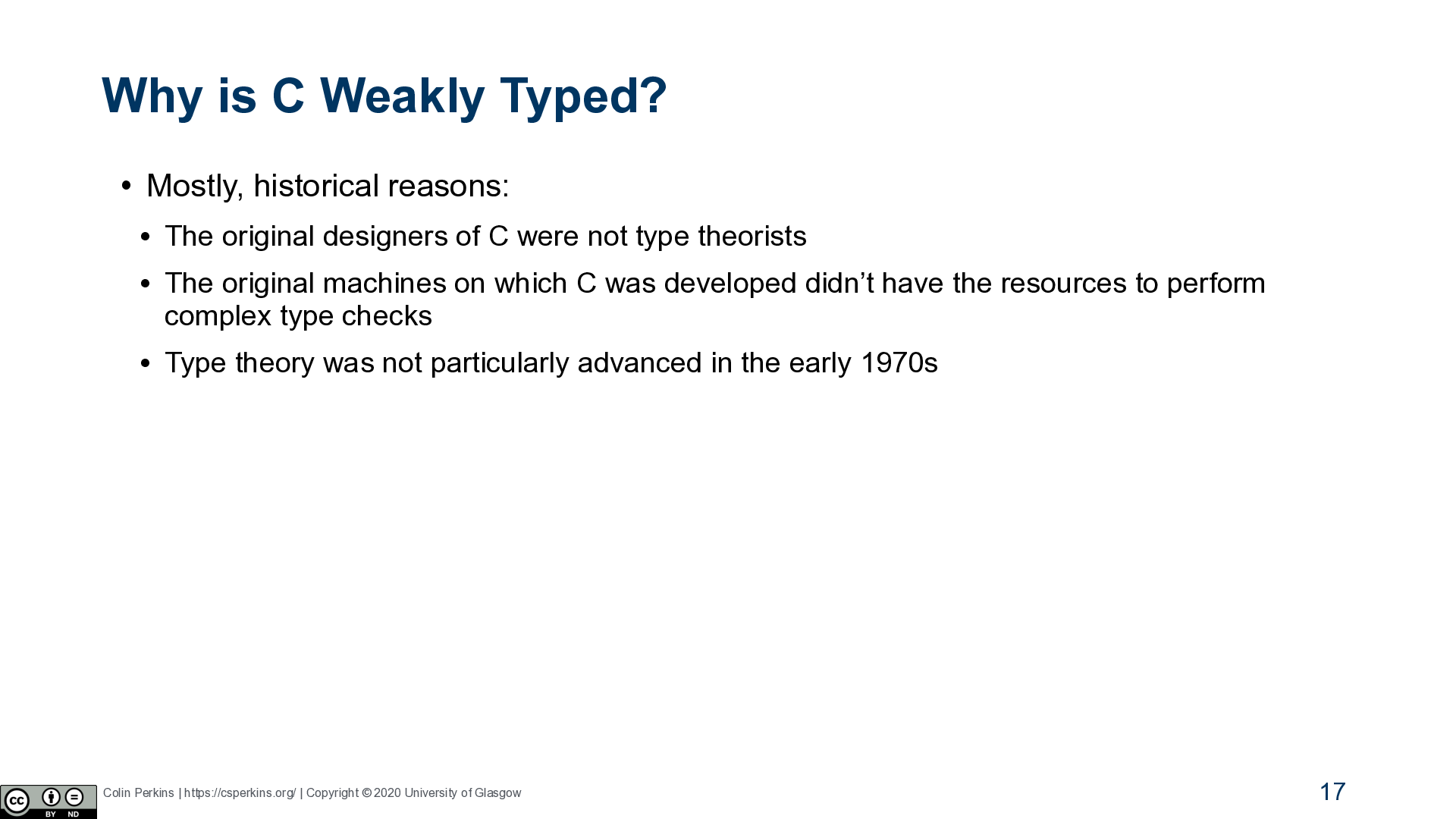
Well, I think, the question is why
00:15:20.933
C is weakly typed is a historical accident.
00:15:24.966
Partly is because the original designers of
00:15:28.200
C were not type theorists.
00:15:30.166
They were operating systems designers,
00:15:32.133
rather than programming language
00:15:34.300
designers, programming language theorists.
00:15:36.533
In part, it's because of the machines
00:15:38.866
and which C was developed didn't have
00:15:41.200
the resources to perform complex type checks.
00:15:43.666
Even if the people designing the language
00:15:46.100
had been experts in programming language theory,
00:15:48.566
and even if we’d had sophisticated type
00:15:51.000
systems and the ability to perform such
00:15:53.466
checks, the machines they were running the
00:15:55.900
code on, didn't have the resources to do that.
00:15:59.166
In part because type theory wasn't particularly
00:16:02.000
well advanced in the early 1970s,
00:16:03.833
when C was being designed.
00:16:05.500
We didn't know how to perform
00:16:07.266
the various checks that are possible today.
00:16:11.900
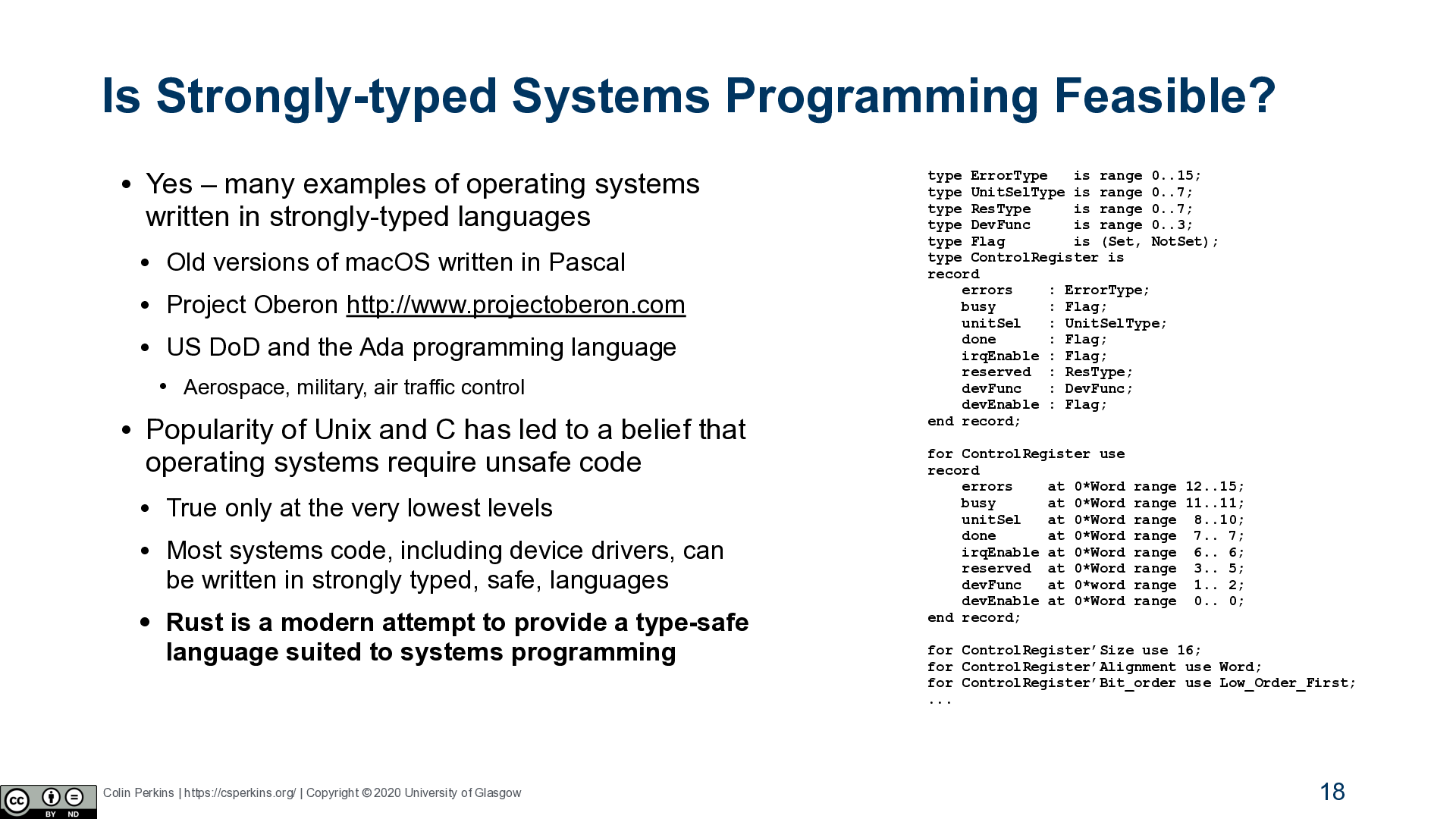
Is strongly typed systems programming feasible?
00:16:15.266
Well, yes, I think it is.
00:16:17.333
In fact, there's been many examples of operating
00:16:19.566
systems which are written in strongly typed languages.
00:16:22.966
The original version of the Mac operating
00:16:25.566
system, for example, was written in Pascal.
00:16:28.266
There was a research project in the 80s
00:16:31.000
known as project Oberon, which used a
00:16:33.733
language called Oberon, a descendant of Pascal
00:16:36.500
to write operating systems.
00:16:38.166
And the US Department of Defence developed
00:16:41.033
the Ada programming language for aerospace,
00:16:43.500
military applications, and air traffic control,
00:16:45.733
and that's very much a strongly typed
00:16:48.333
language designed for systems programming.
00:16:51.000
The code fragment on the right is
00:16:53.233
a sample of Ada code. And we
00:16:55.466
see that it very precisely specifies the
00:16:57.700
ranges of the various numeric types.
00:16:59.733
It specifies that the order in which
00:17:02.533
fields are packed into the various control
00:17:05.233
registers. It even specifies the byte order
00:17:08.166
of the types. In some ways it
00:17:10.600
provides even more low level control than
00:17:13.300
C does, although perhaps in a much more verbose way.
00:17:17.800
Over the years the popularity of C
00:17:20.400
and Unix has kind of led to
00:17:22.633
a belief that operating systems require unsafe
00:17:24.866
weakly type code.
00:17:26.866
That may be true at the very lowest levels;
00:17:30.300
programming interrupt registers, programming particular
00:17:32.866
hardware registers, but most systems code,
00:17:35.666
including most device drivers, can pretty much
00:17:38.466
be written in strongly typed safe languages,
00:17:41.500
with only tiny fragments of unsafe code.
00:17:44.600
The Rust programming language is a modern
00:17:47.466
attempt to try and provide a type
00:17:50.300
safe language which is suitable for systems programming.
00:17:53.433
What I hope to show in this
00:17:55.666
course, is that this is very much
00:17:57.733
achievable, and we can use safe languages
00:17:59.833
to write systems programs.
00:18:02.866
What I've done in this lecture.
00:18:05.000
I've spoken a little bit about what
00:18:07.533
is a strongly typed language, and the
00:18:10.033
differences between strong and weak typing,
00:18:12.200
and static and dynamic typing, and the
00:18:14.733
differences between safe and unsafe languages.
00:18:16.966
I’ve hopefully explained why strong typing is
00:18:19.633
desirable, and talked a little bit about
00:18:22.300
types for systems programming.
00:18:23.900
In the remainder of this lecture,
00:18:25.800
I'll start by introducing the Rust programming
00:18:28.000
language as an example of a statically
00:18:30.200
typed, strongly typed language, which I believe
00:18:32.400
is suitable for systems programs.
Part 2: Introducing Rust (1/3)
The 2nd part of the lecture introduces the Rust programming language,
as an example of a strongly typed systems programming language. It
reviews the basic features and types of Rust.
00:00:00.533
In this second part, I want to
00:00:02.766
Introduce the Rust programming language,
00:00:04.866
with a focus on basic types and operations.
00:00:09.000
The Rust programming language is a modern
00:00:11.233
systems programming language.
00:00:13.466
It was initially developed by Graydon Hoare
00:00:15.666
as a side project, starting in 2006,
00:00:18.766
and development was sponsored by Mozilla for
00:00:21.033
over ten years starting in 2009.
00:00:24.366
The 1.0 release of the language was
00:00:26.733
made in 2015. And in December 2018,
00:00:30.466
a cleaned-up but backwards compatible version,
00:00:33.000
the Rust 2018 Edition, was released.
00:00:36.466
Since then, Rust has released new versions
00:00:39.066
every six weeks, maintaining a strong policy
00:00:41.533
of ensuring backwards compatibility
00:00:43.766
while adding new features.
00:00:48.000
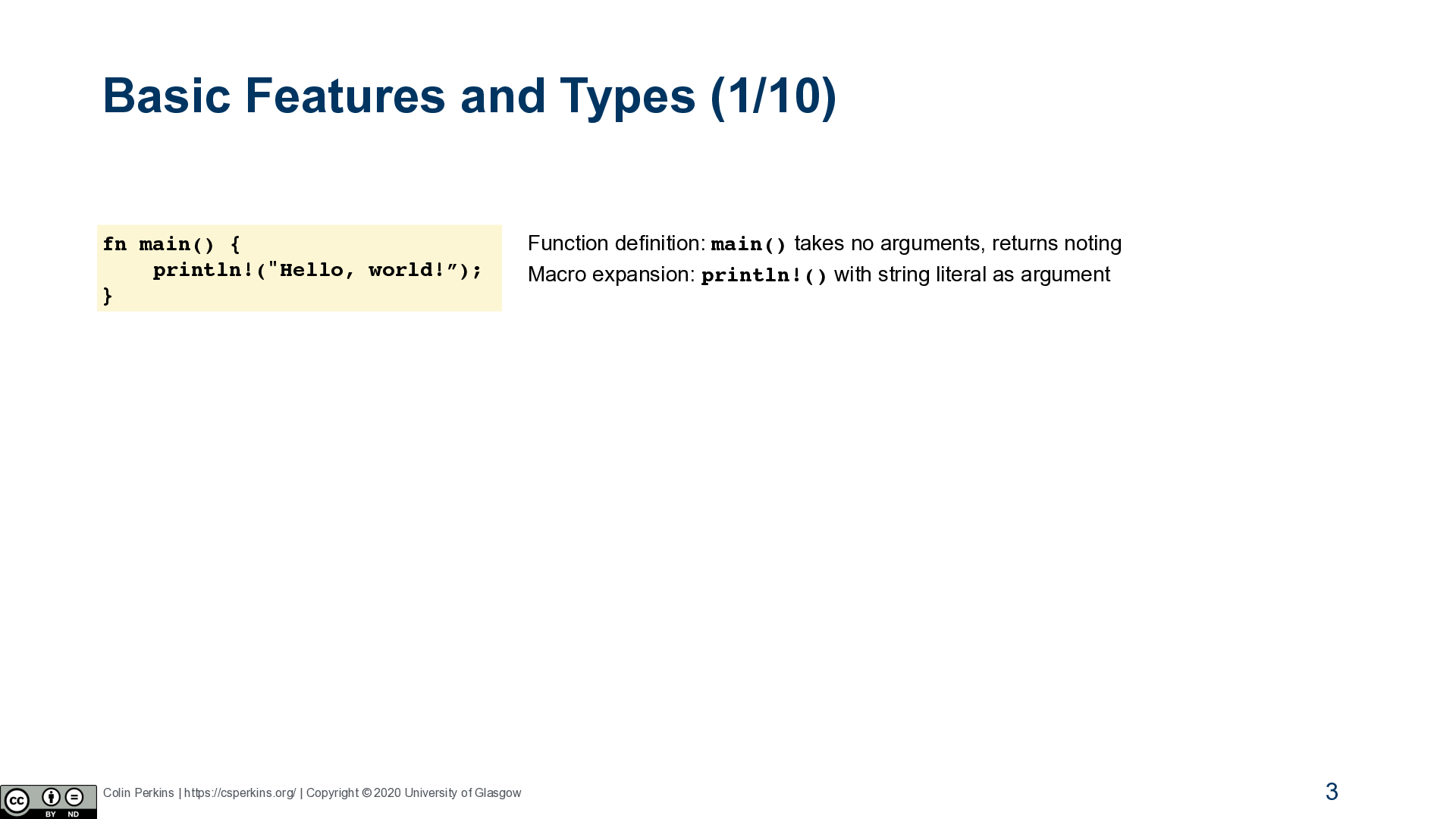
The Rust version of the “Hello,
00:00:49.800
world!” program is shown on the slide.
00:00:52.466
As with many other languages, execution starts
00:00:55.233
with the main function.
00:00:57.366
Functions are defined with the fn keyword,
00:01:00.766
followed by the function name, its arguments
00:01:03.466
within parenthesis, and any return type.
00:01:06.566
The main() function in the example takes
00:01:09.000
no arguments and returns nothing.
00:01:12.000
The body of the function follows,
00:01:13.600
enclosed in braces.
00:01:16.100
In this case, the body comprises a
00:01:18.333
macro, println!(), that’s expanded at compile time.
00:01:22.800
Macro invocations in Rust always end with
00:01:25.400
an exclamation point, to distinguish them from
00:01:27.633
function calls. Macros in Rust are a
00:01:30.533
more sophisticated, and type safe, version of
00:01:33.366
the #define feature in C.
00:01:38.133
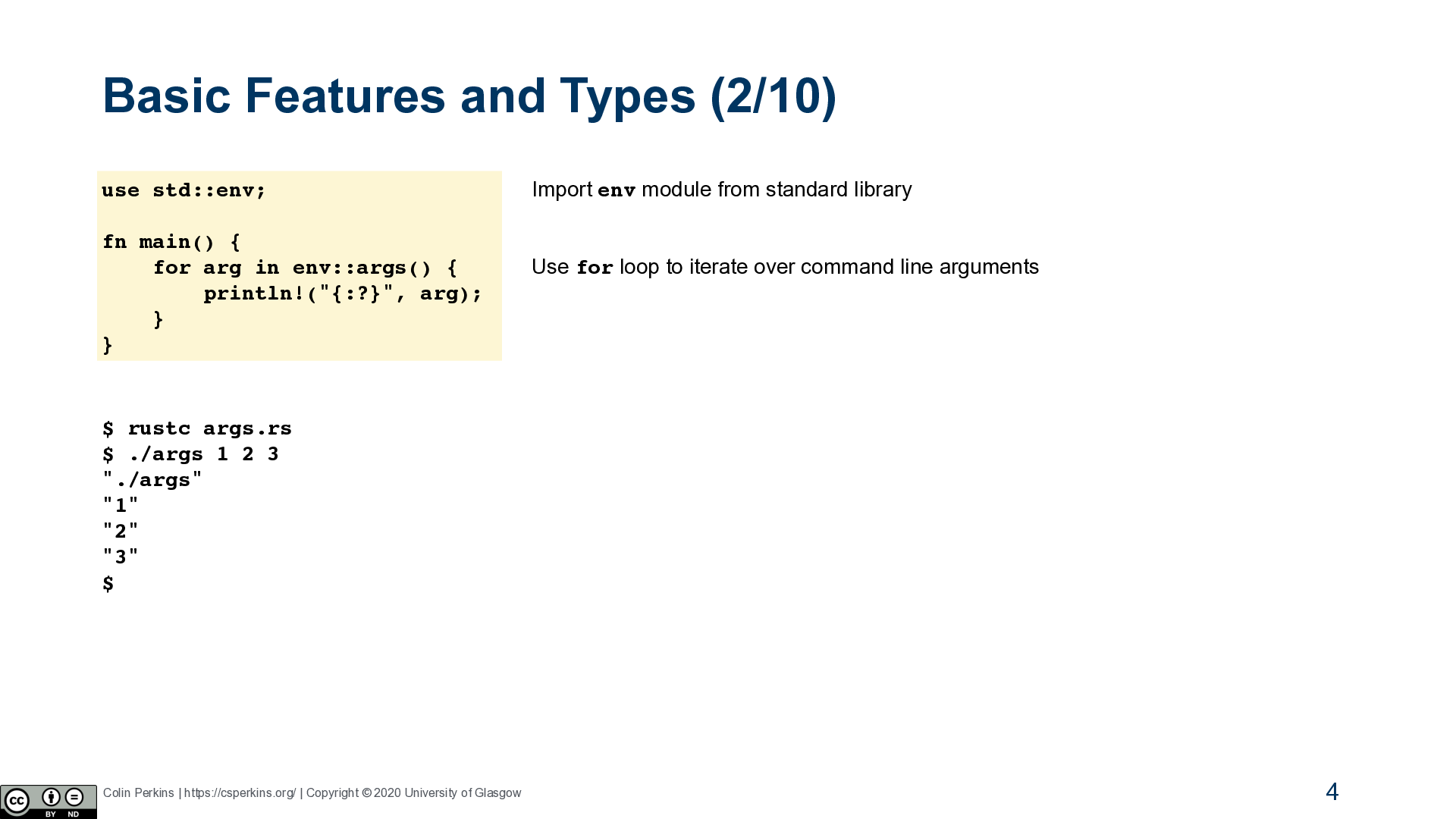
This slide shows a slightly more sophisticated example.
00:01:42.200
The first line is a use statement,
00:01:44.566
that imports a library module. In this
00:01:47.066
case, the module env, that provides command
00:01:49.366
line argument parsing, is imported from the
00:01:51.600
standard library.
00:01:53.666
A use statement brings the public functions,
00:01:56.166
types, and other definitions of the imported
00:01:58.433
module into scope. Those functions can then
00:02:01.800
be referenced by name, relative to the
00:02:03.733
imported path, much like imports in Python.
00:02:07.866
For examples, this code call the env::args() function.
00:02:12.966
The main() function in this example shows
00:02:15.733
a for loop in operation. The env::args()
00:02:18.700
function returns an iterator that returns the
00:02:21.166
command line arguments one-by-one, and the for
00:02:23.866
loop consumes the values generated by that
00:02:25.866
iterator, executing the body for each in turn.
00:02:30.700
The println!() macro takes format strings to
00:02:33.566
specify how values are printed. This works
00:02:36.333
a lot like the format string in
00:02:38.100
a C printf() statement, except that the
00:02:40.233
format specifiers are surrounded by braces rather
00:02:42.533
than preceded by a % sign.
00:02:45.900
As we see from the bottom of
00:02:47.633
the slide, this program prints its command line arguments
00:02:53.000
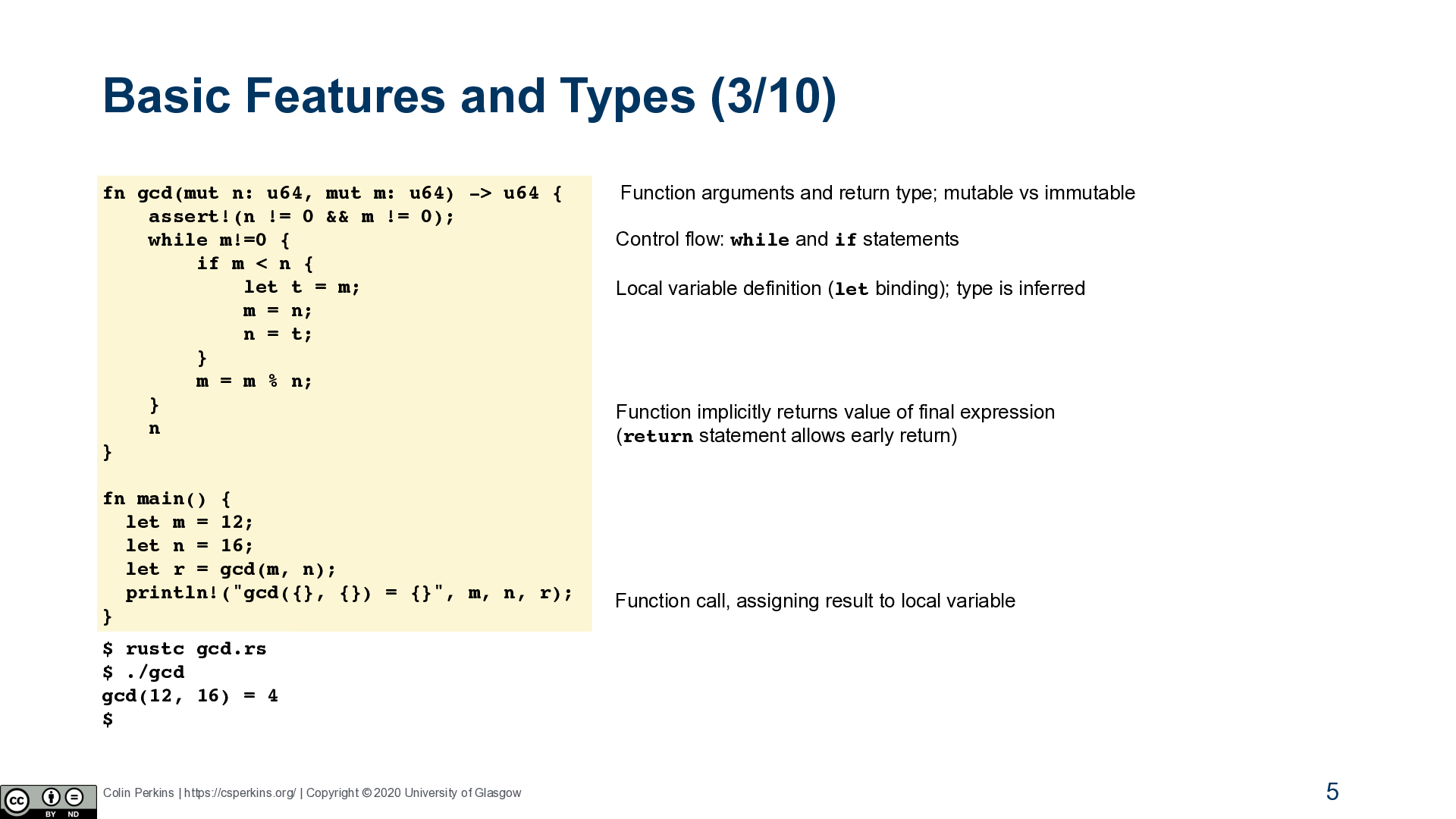
This third example is more sophisticated still.
00:02:57.266
Looking at the main() function, we see
00:02:59.933
that variables are defined in let bindings,
00:03:02.366
such as “let m = 12”.
00:03:05.400
This defines a new variable, m,
00:03:07.800
and binds the value to that variable.
00:03:11.000
The type of the variable is inferred
00:03:12.833
from the context. If the compiler can’t
00:03:16.100
infer the type, it can be specified
00:03:18.366
by following the variable name with a
00:03:20.000
colon, then the type name, before the
00:03:22.133
assignment of the value.
00:03:24.566
By default variable bindings are immutable.
00:03:28.033
That is, the value of the variables
00:03:30.066
m, n, and r in this function
00:03:32.900
cannot be changed after they have been bound.
00:03:36.500
To make a mutable binding, that is
00:03:38.933
a variable whose value can change,
00:03:41.166
add the “mut” qualifier following the let
00:03:43.333
statement. For example, one could write “let
00:03:46.833
mut m = 12” to make m a mutable variable.
00:03:52.200
Finally in main(), we see a call
00:03:54.266
to the gcd() function, to calculate the
00:03:56.800
greatest common divisor of m and n.
00:04:00.666
The gcd() function is defined first in
00:04:03.733
the code. We see that it takes
00:04:06.566
two parameters, m and n. Each of
00:04:09.733
these is mutable, that is, it can
00:04:11.833
be changed within the body of the
00:04:13.466
function, and is of type u64,
00:04:16.933
a 64 bit unsigned integer. The return
00:04:20.566
type of the function is also a u64.
00:04:24.466
You’ll see that Rust requires the types
00:04:26.900
of the function arguments, and the return
00:04:28.766
type if the function returns a value,
00:04:31.366
to be explicitly stated. While it would
00:04:34.266
often be possible for the compiler to
00:04:36.233
infer the types of function arguments and
00:04:38.200
return value, the designers of Rust decided
00:04:41.800
they must always be explicitly stated to
00:04:43.900
avoid confusion, and provide documentation.
00:04:47.466
Within the function body, we see use
00:04:50.033
of the assert() macro, and if and
00:04:52.133
while statements. These all function in the
00:04:54.833
conventional way. The let binding within the
00:04:57.800
if statement creates a local variable binding.
00:05:02.000
You may notice one unusual feature of
00:05:04.066
the function: there is no return statement.
00:05:07.666
Rust distinguishes between statements and expressions.
00:05:11.433
Expressions evaluate to some value; statements have
00:05:14.766
no value. Statements end in semicolons,
00:05:18.400
expressions do not.
00:05:20.733
The gcd() function ends with an expression:
00:05:23.533
n. Like all expressions, it has a
00:05:27.100
value. And, since this value is the
00:05:29.833
last thing in the function, it is
00:05:31.333
returned. This is known as an implicit
00:05:34.233
return, and is a common idiom in Rust.
00:05:37.733
An explicit return, in the form
00:05:39.966
of a return statement, like in other
00:05:41.733
languages, is also possible.
00:05:44.733
Take a copy of the code on
00:05:46.300
the slide. Change the expression at the
00:05:48.166
end of the gcd() function, the line
00:05:51.700
with just n on its own,
00:05:53.666
into a statement by adding a semicolon
00:05:55.866
to the end, and compile the result.
00:05:58.566
Make sure you understand the error message
00:06:00.500
that results, and why it occurs.
00:06:06.033
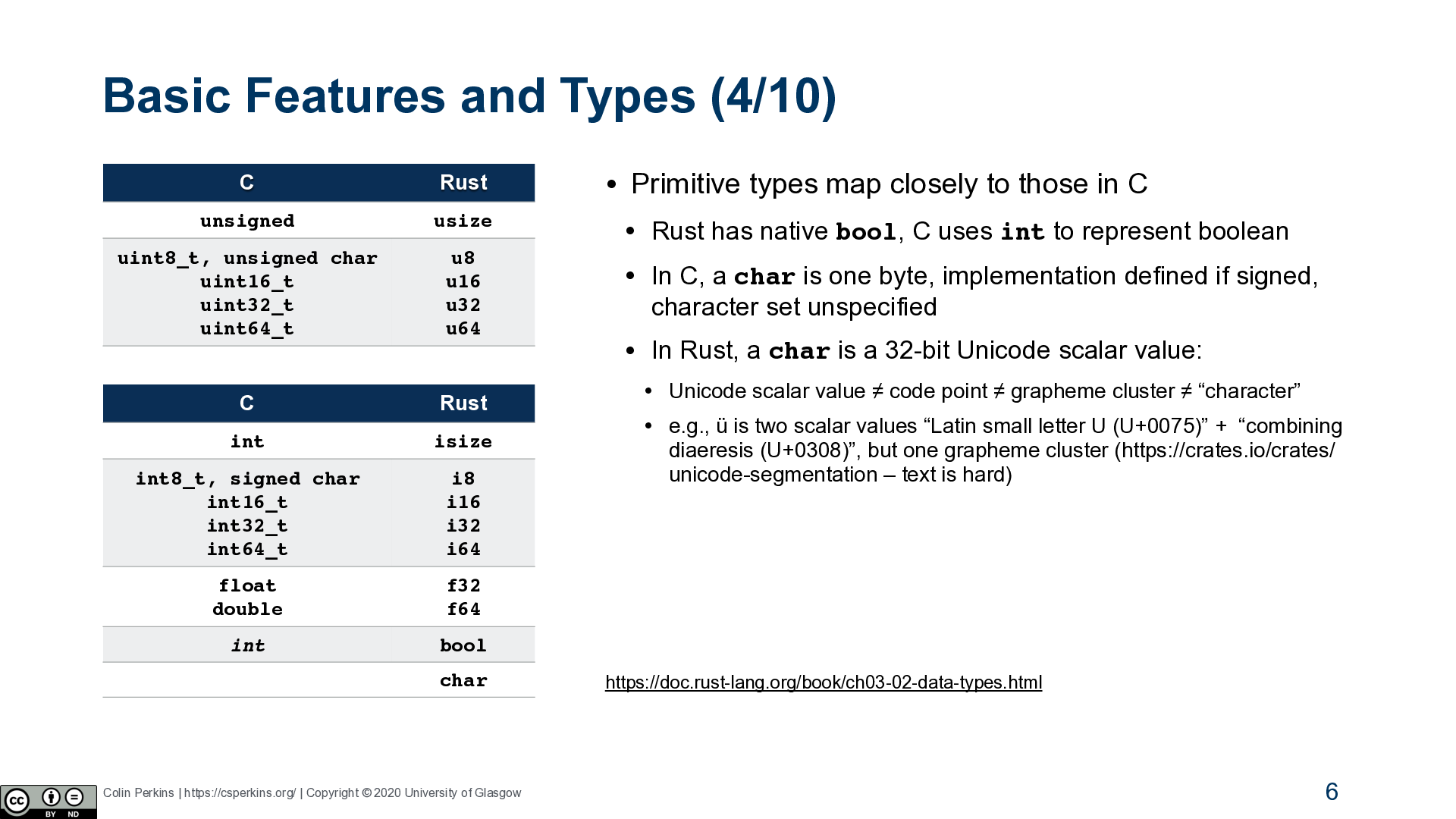
We’ve seen some of the primitive types
00:06:07.900
available in Rust already. The available types
00:06:11.533
are very similar to those available in
00:06:13.833
C, although the type names are different.
00:06:16.233
The table shows the correspondence.
00:06:19.966
Aside from the names, there are two major differences.
00:06:24.400
The first is that Rust has a
00:06:26.233
native bool type to hold a boolean
00:06:28.433
value, true or false. C does not
00:06:31.566
have a boolean type, and uses integers
00:06:33.633
to represent booleans, with a zero value
00:06:36.333
representing false, and non-zero representing true.
00:06:40.466
The second is the character type.
00:06:43.033
In C, a char is defined to
00:06:45.100
be one byte in size. The number
00:06:47.533
of bits in that byte, and whether
00:06:49.600
it is signed or unsigned are implementation
00:06:51.366
dependent, and the character set is not
00:06:53.833
specified. This makes it difficult to write
00:06:56.966
portable text handling code in C.
00:07:00.733
Rust, on the other hand, defines a
00:07:02.766
char to be a 32-bit Unicode scalar
00:07:05.100
value. This is entirely unambiguous in terms
00:07:08.800
of both the size of the character,
00:07:10.900
and the character set used. This makes
00:07:13.866
it much easier to write portable,
00:07:15.600
and internationalised, text handling code in Rust.
00:07:19.500
Note, though, that while Rust is better
00:07:21.766
than C here, Unicode is still very complicated.
00:07:25.800
In particular, when dealing with text,
00:07:28.133
it’s often necessary to distinguish between the
00:07:30.266
Unicode concepts of scalar values, as used
00:07:33.066
in Rust; code points; grapheme clusters;
00:07:36.600
and characters. It makes sense for Rust
00:07:40.166
to use scalar values for its character
00:07:42.000
type, since these are the basic component
00:07:44.600
of Unicode. But, many things that people
00:07:47.066
recognise as characters, including emoji, are actually
00:07:50.300
Unicode grapheme clusters, represented as sequences of
00:07:54.166
scalar values, and cannot be encoded as a single char.
00:07:58.633
If you want to process text character
00:08:00.933
by character, you probably want to use
00:08:02.866
libraries, such as the Unicode segmentation library
00:08:05.533
mentioned on the slide, that let you
00:08:07.566
work with grapheme clusters, rather than using
00:08:09.666
char values directly.
00:08:14.500
In addition to the primitive types,
00:08:16.600
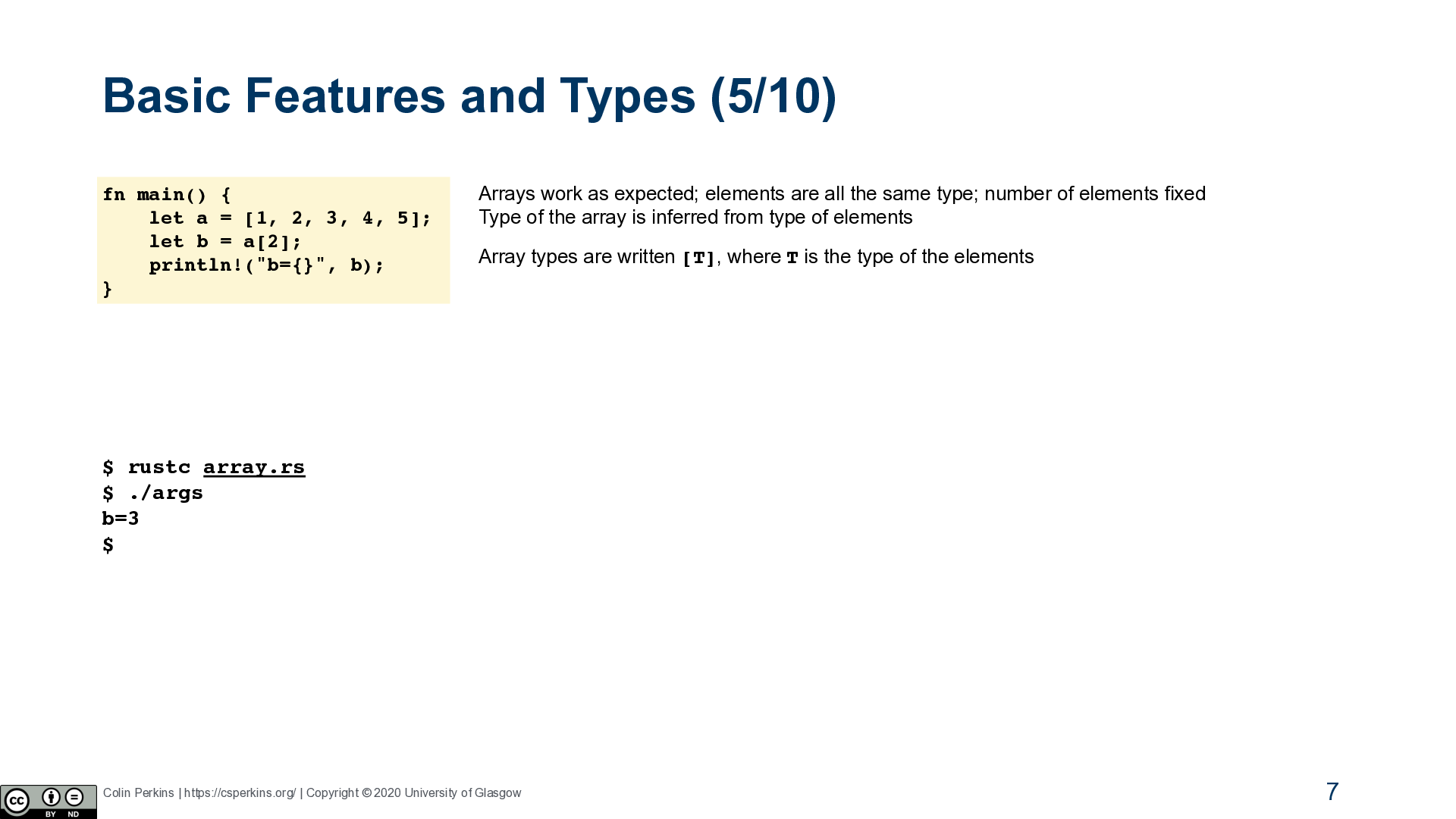
Rust supports the usual set of compound data types.
00:08:21.100
Arrays work as you might expect.
00:08:23.533
They hold a fixed number of elements,
00:08:25.600
all of the same type. Array bounds
00:08:28.266
are checked at run time.
00:08:32.000
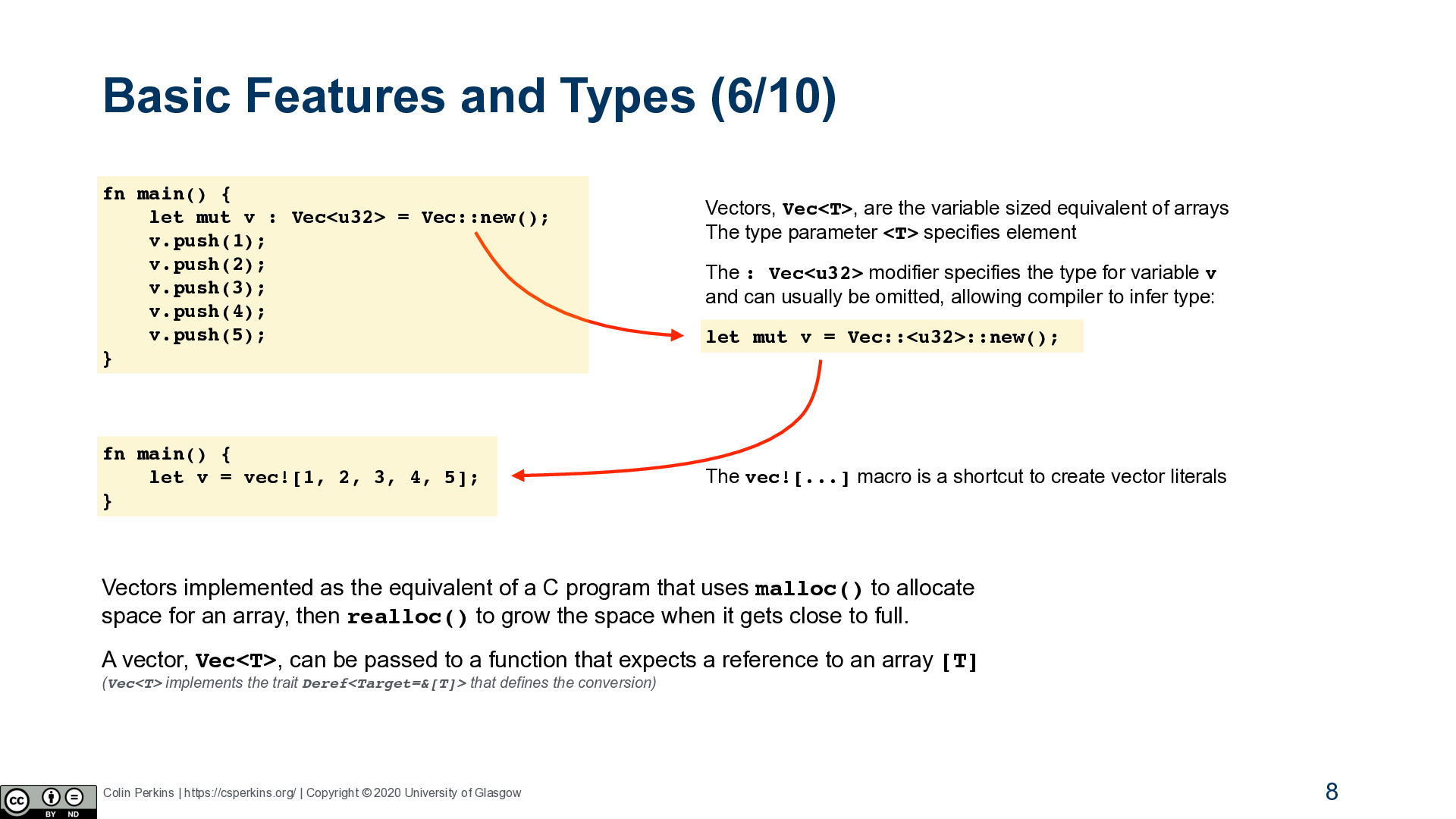
In cases where you need a variable
00:08:33.666
length list, Rust provides a Vector,
00:08:36.166
Vec, type as part of the standard library.
00:08:39.733
The Vec types follows a common pattern,
00:08:42.400
exposing a new() method that creates a
00:08:44.633
new instance of that type, as we
00:08:46.966
see in the example at the top of the slide.
00:08:49.833
What’s notable here is that Vec takes
00:08:52.533
a type parameter, T, that indicates the
00:08:55.166
type of elements it will hold.
00:08:57.500
This parameter has to be specified when
00:09:00.166
creating an empty vector. We see two ways of doing this.
00:09:04.966
The first is to call Vec::new() without
00:09:08.233
specifying the type parameter, but to assign
00:09:11.466
to a variable where the type is specified.
00:09:14.600
The example here specifies that the
00:09:16.533
variable, v, has type Vec, and the
00:09:20.533
new vector is assigned to that.
00:09:23.733
The second way is to explicitly include
00:09:26.033
the type parameter when creating the vector,
00:09:28.900
rather than calling Vec::new(),
00:09:31.966
call Vec::::new().
00:09:37.200
There’s also a convenience macro, that we
00:09:39.466
see at the bottom left, that creates
00:09:41.333
a vector from an array literal.
00:09:44.533
Internally, vectors are implemented as the equivalent
00:09:47.400
of a C program that uses malloc()
00:09:49.333
to allocate space for an array,
00:09:51.266
then realloc() to grow the space when
00:09:53.066
it becomes full. As a consequence of
00:09:56.166
this. conversion from a vector to an
00:09:58.166
array is extremely fast. The vector type
00:10:01.700
implements the Deref trait that provides such
00:10:05.666
a conversion to arrays, allowing vectors to
00:10:07.966
be passed to functions that expect array types.
00:10:14.166
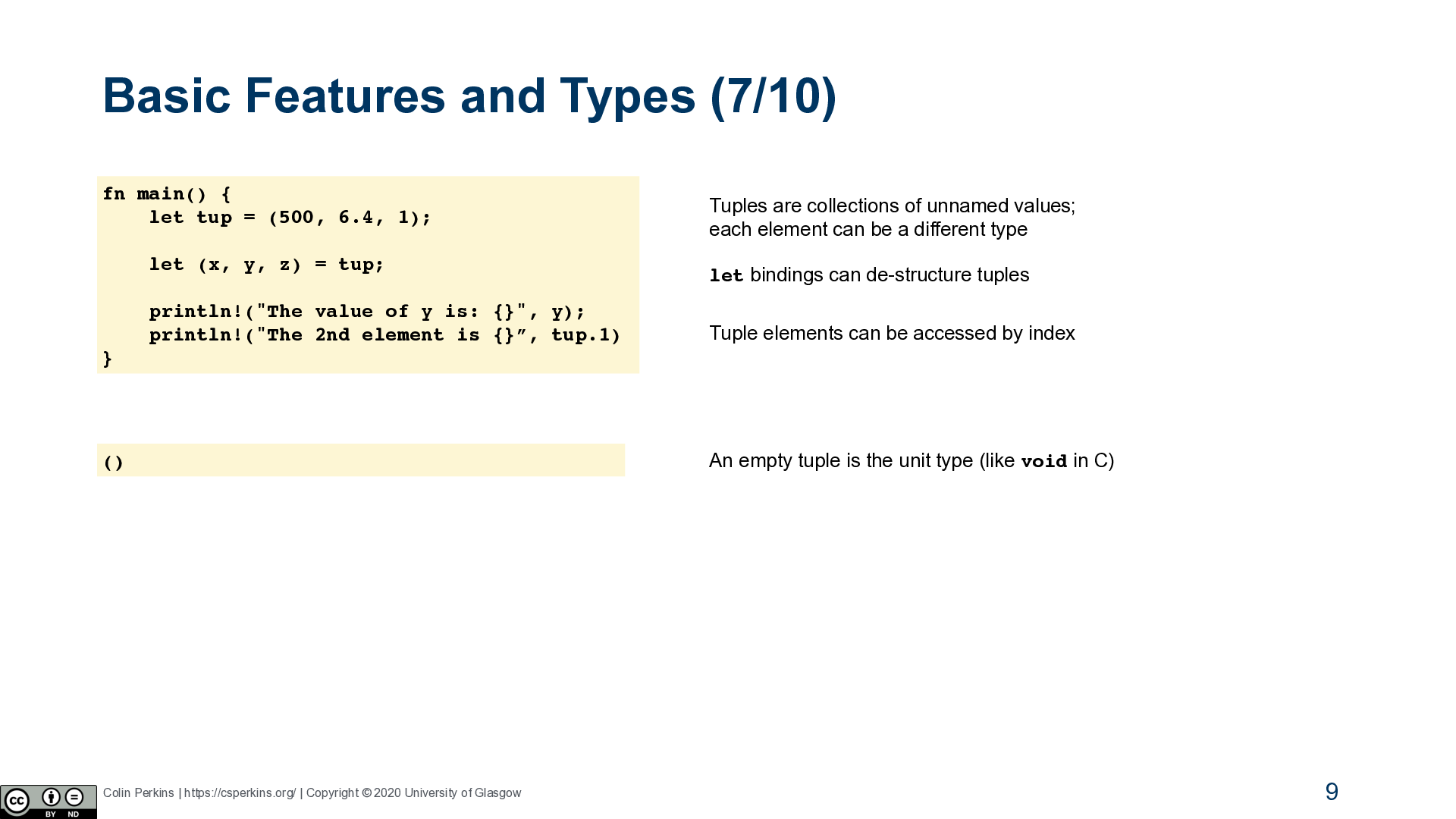
Rust supports tuples, that are collections of
00:10:16.833
unnamed values where each element can be
00:10:18.600
a different type.
00:10:20.833
In this example, the first and last
00:10:23.033
elements of the variable tup are integer
00:10:25.166
values, while the middle element is a
00:10:27.700
floating point value.
00:10:30.400
Elements of a tuple can be accessed
00:10:32.133
by index, starting at zero, using dot notation.
00:10:36.933
Tuples can also be de-structured in a
00:10:39.233
let binding, as we see in the
00:10:41.133
second line of the function on the
00:10:42.566
slide, where the variables x, y,
00:10:45.033
and z are set to the elements
00:10:46.566
of the tuple. This behaviour is similar to that of Python.
00:10:51.966
Rust also permits empty tuple values,
00:10:54.800
as we see at the bottom of
00:10:56.233
the slide. These represent the absence of
00:10:59.300
a value, much like the void type in C.
00:11:04.866
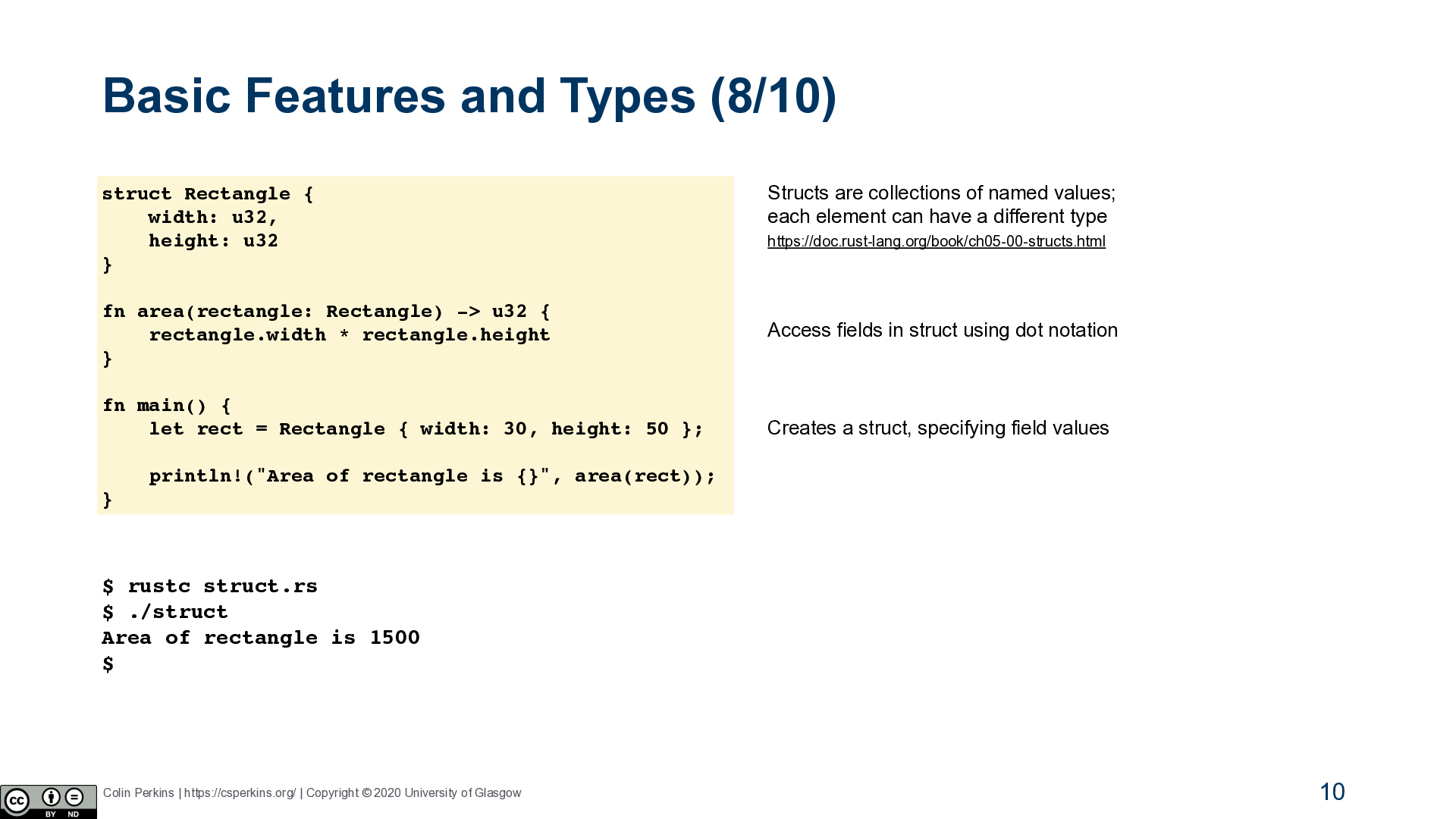
Rust also supports structure types, that are
00:11:08.166
collections of named values, where each element
00:11:10.466
can have a different type.
00:11:13.100
Elements of a struct are accessed using
00:11:15.633
dot notation, as in other languages.
00:11:18.733
Instances of structs are created as we
00:11:21.533
see in the main() function, by specifying
00:11:23.800
the name of the struct, followed by
00:11:25.966
the values for its fields in braces.
00:11:31.000
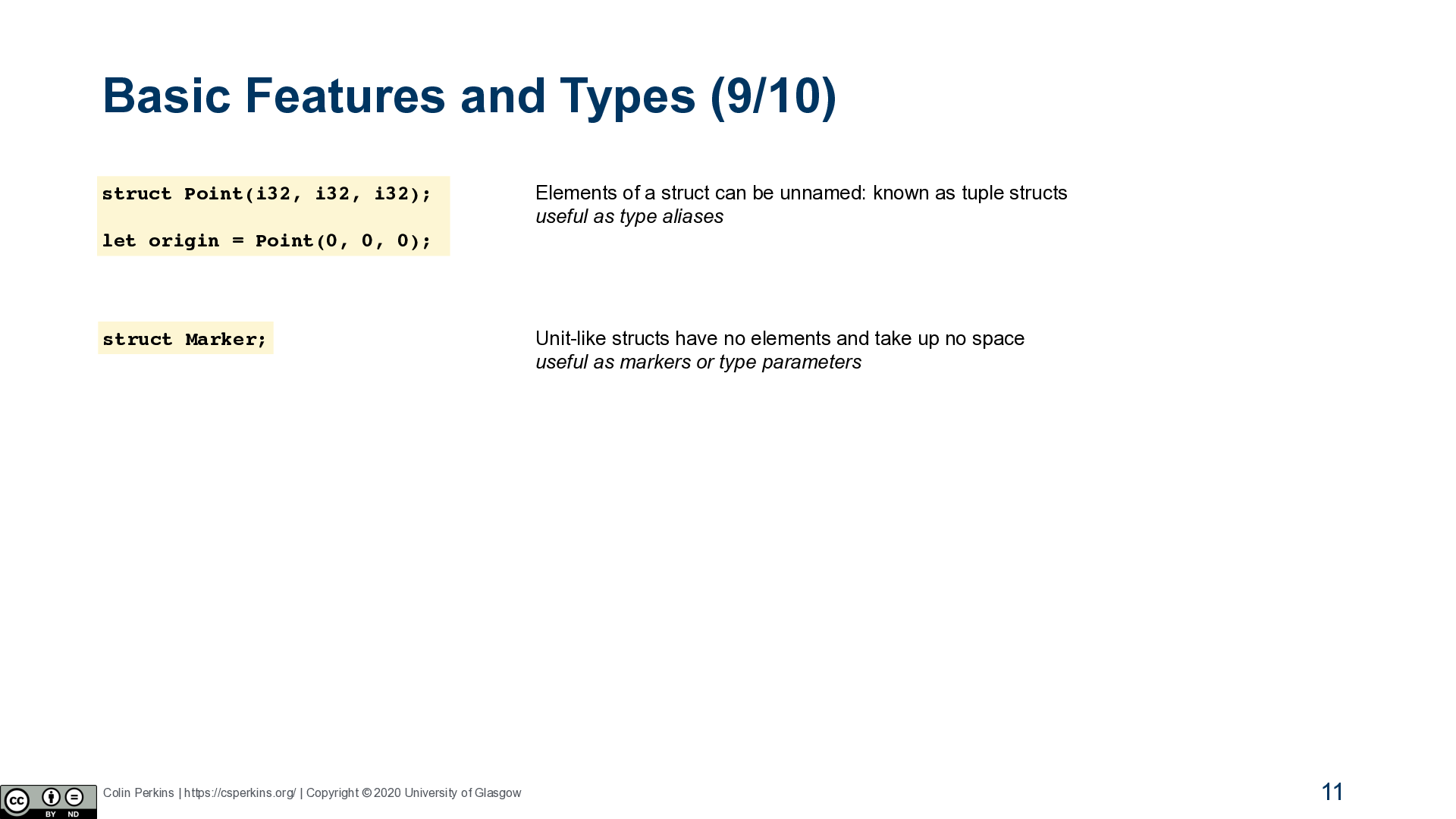
It’s also possible to specify structs with unnamed fields.
00:11:34.733
These are known as tuple structs.
00:11:37.833
Values of a tuple struct can
00:11:39.666
be accessed in the same way as
00:11:41.166
values of a tuple, and instances of
00:11:43.466
a tuple struct are created by specifying
00:11:45.500
the struct name followed by the values
00:11:47.666
of its fields in parenthesis.
00:11:50.366
Tuple structs can be useful as type aliases.
00:11:55.033
A struct can also be defined that
00:11:57.066
has no elements. These are known as
00:11:59.633
unit-like structs. Since they has no content,
00:12:03.800
unit-like structs takes up no space.
00:12:07.066
They’re useful as marker types or type parameters.
00:12:11.233
We’ll discuss uses of tuple structs and
00:12:13.700
unit-like structs more in lecture 4.
00:12:19.466
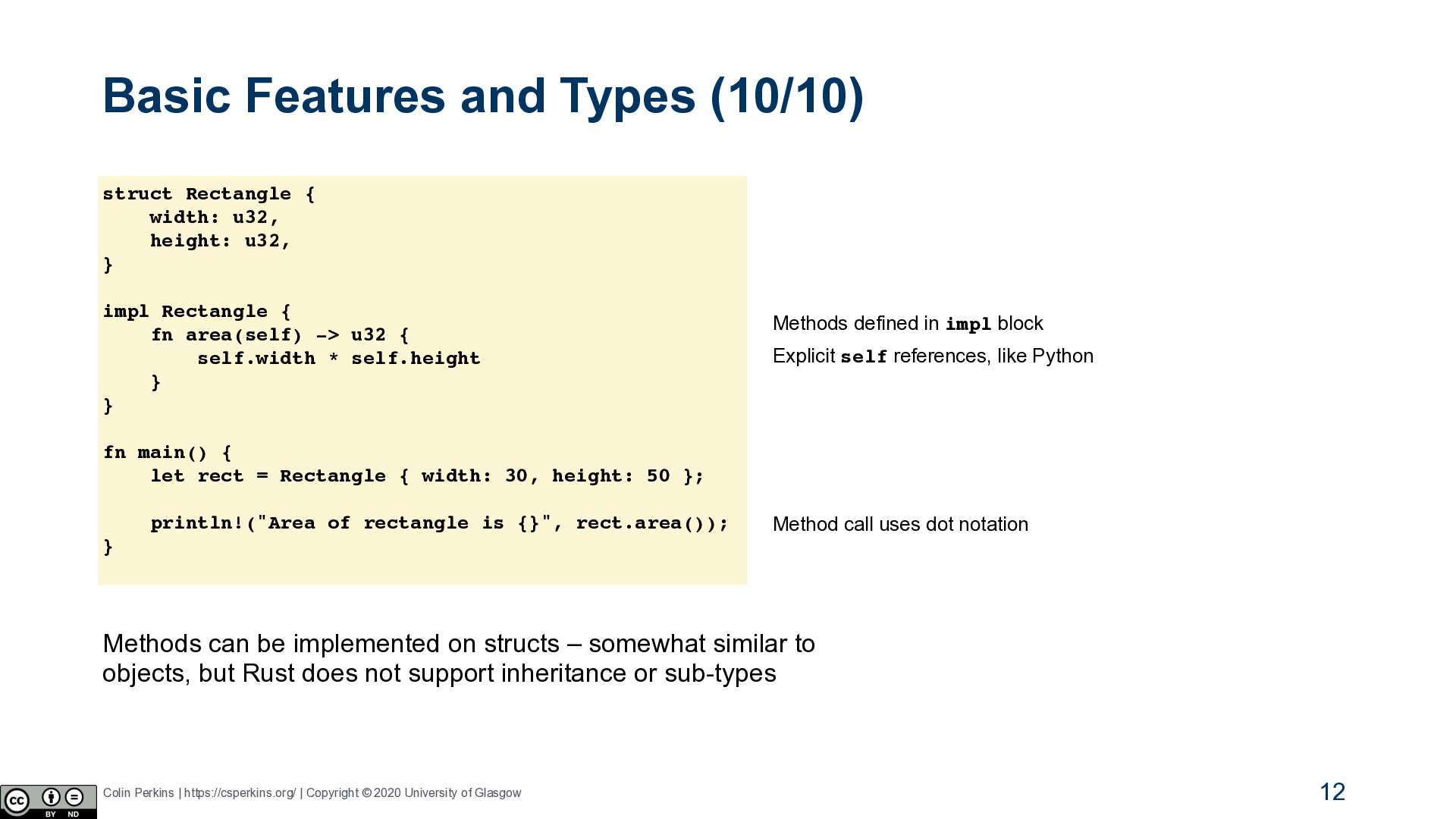
Finally, it’s possible to implement methods on a struct.
00:12:23.600
This is done by writing an impl
00:12:25.266
block, specifying the struct to be implemented,
00:12:27.866
as we see on the slide.
00:12:29.966
Method definitions take self as a parameter,
00:12:33.033
representing the struct on which they are
00:12:34.800
implemented. Access to fields of that struct
00:12:38.433
is via explicit self references, like in Python.
00:12:42.800
Methods are called using the dot notation, in the usual way.
00:12:48.200
A struct that implements methods looks a
00:12:50.266
lot like an object in Java or
00:12:52.233
Python. It’s different, though, in that Rust
00:12:55.566
does not support inheritance or subclassing.
00:12:58.866
Instead, it uses a feature known as
00:13:00.966
traits, that we’ll talk about in the next part.
00:13:05.933
That concludes our introduction to the basic
00:13:08.266
operations and types provided by Rust.
00:13:11.100
At this level, Rust is a conventional
00:13:13.266
language, that offers few surprises.
00:13:16.400
In the next part, we’ll move on
00:13:18.200
to discuss traits, enumerations, and pattern matching,
00:13:21.133
that give Rust some more sophisticated behaviours.
Part 3: Introducing Rust (2/3)
The 3rd part of the lecture continues the introduction to the Rust
programming language. It reviews some of the features Rust provides
to support abstraction: traits, enumerated types, and pattern matching.
00:00:00.417
In this part, I’ll move on to
00:00:01.959
discuss some more advanced features of Rust,
00:00:04.750
including traits, enumerations, and pattern matching.
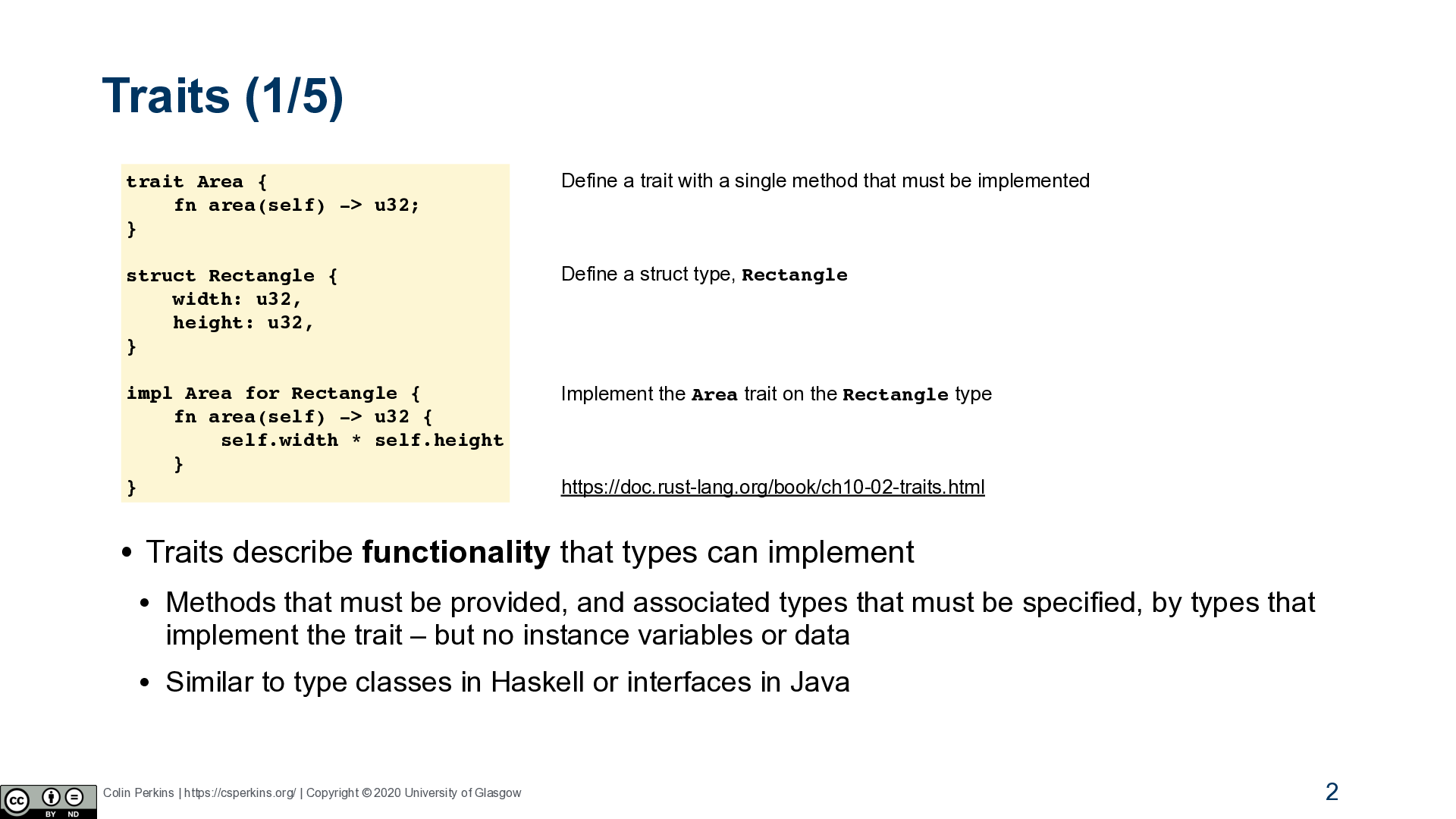
00:00:10.417
Traits are one of the primary ways
00:00:12.250
in which Rust introduces abstraction. They allow
00:00:15.333
you to define a set of operations
00:00:17.291
that can be performed on a type,
00:00:19.000
and to write code that works with
00:00:20.333
any type that implements those operations.
00:00:23.959
A trait defines a set of methods
00:00:25.834
and types. Those methods and types must
00:00:28.542
be implemented by any type that implements that trait.
00:00:32.583
In the code sample on the slide,
00:00:34.417
for example, we see the definition of
00:00:36.834
trait Area. This trait includes the signature
00:00:40.291
of a single method, area(), that takes
00:00:42.959
self as a parameter and return a
00:00:45.000
value of type u32. The body of
00:00:47.917
the method is not specified.
00:00:50.834
The code then defines a struct,
00:00:52.792
Rectangle, with width and height, then implements
00:00:56.417
the trait Area for that struct.
00:00:59.417
The syntax “impl Area for Rectangle” specifies
00:01:02.917
that the Rectangle struct has an implementation
00:01:05.166
of the Area trait, and the body
00:01:07.583
of the impl block contains a definition
00:01:09.625
of the area() method, matching the signature
00:01:12.542
of the method given in the trait definition.
00:01:15.792
Trait definitions usually just include method signatures,
00:01:18.708
as shown here, but they may also
00:01:20.959
include complete method implementations. Methods that have
00:01:24.875
their complete implementation specified in the trait
00:01:27.291
definition do not need to be written
00:01:29.291
in the impl block, but the impl
00:01:31.208
block needs to be present to indicate
00:01:33.083
that the type implements the trait.
00:01:35.708
Traits define functionality.
00:01:38.000
Trait definitions cannot contain
00:01:39.792
instance variables or data; they just specify methods.
00:01:44.375
At this level, traits behave like interfaces
00:01:47.208
in Java, or type classes in Haskell.
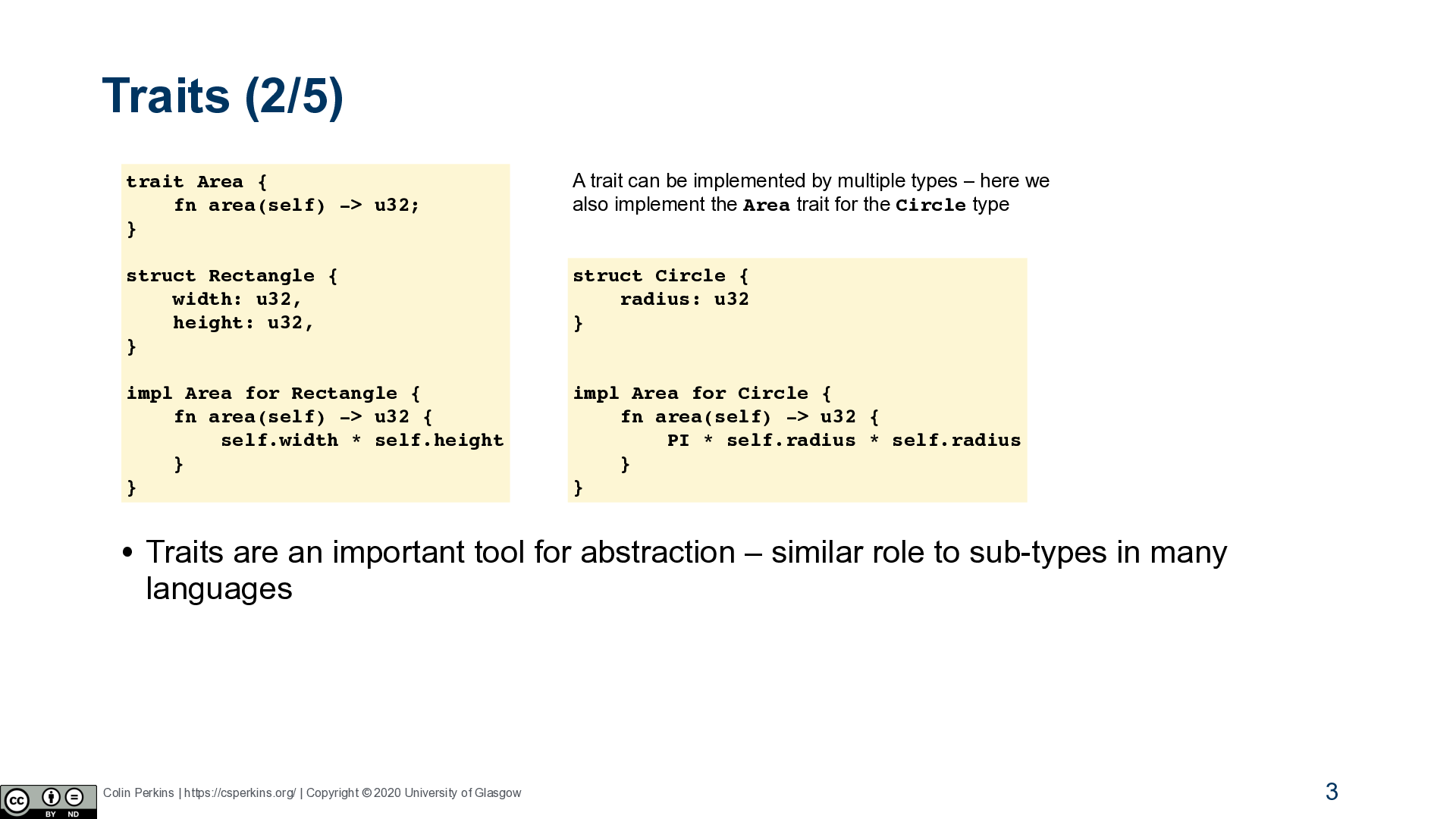
00:01:52.542
A trait can be implemented by multiple types.
00:01:56.500
In this example, we show how we
00:01:58.542
can also define a struct Circle,
00:02:00.500
and implement the Area trait for that type too.
00:02:04.125
Both Rectangle and Circle implement the Area
00:02:06.458
trait, and so include an area() method
00:02:08.667
with the same signature. The body of
00:02:11.125
the two methods differs, though.
00:02:14.041
Traits are an important tool for abstraction.
00:02:17.125
They allow you to describe common sets
00:02:19.041
of functionality that can be implemented by different types.
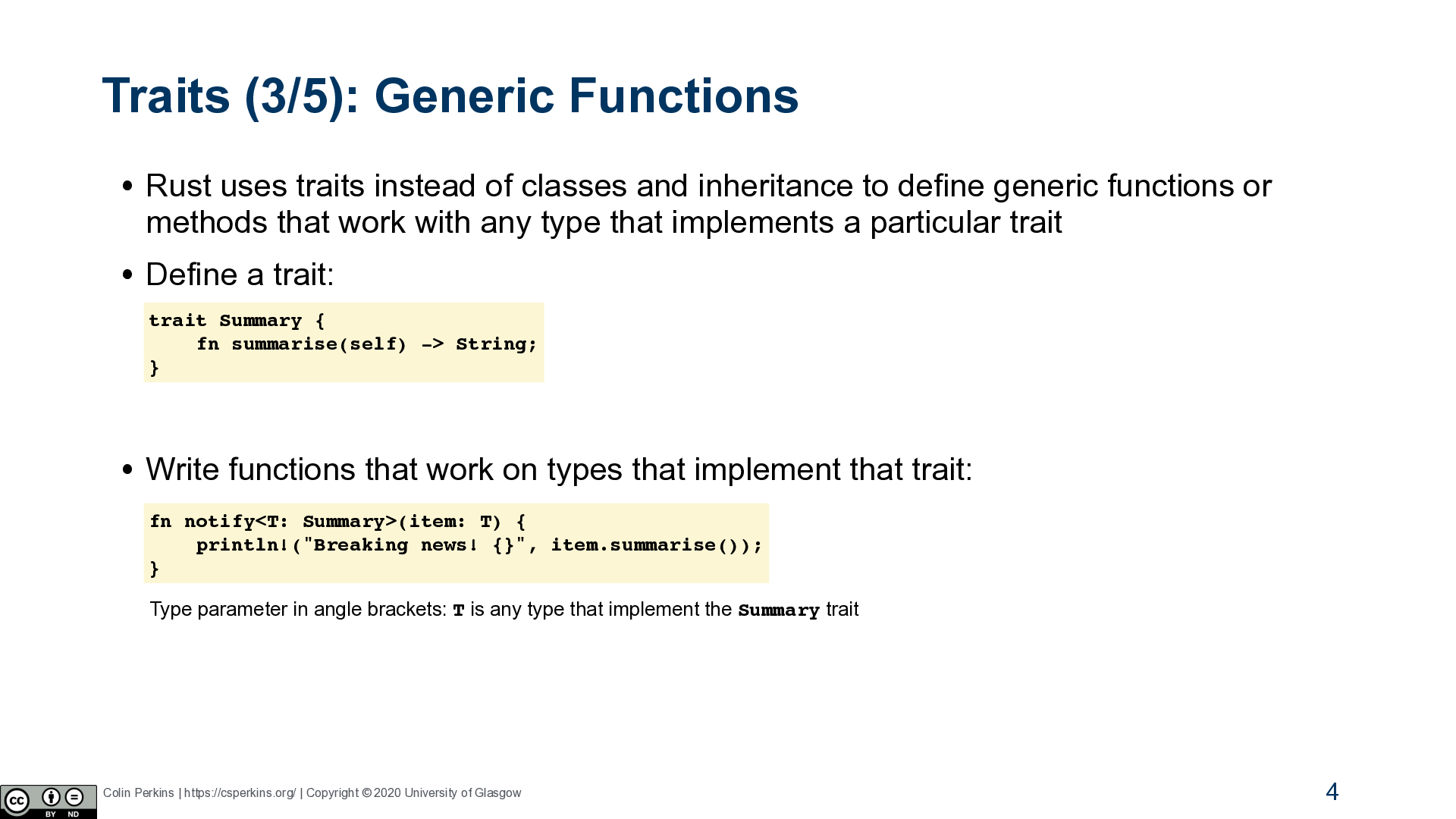
00:02:25.000
Rust is not an object oriented language,
00:02:27.417
and you cannot inherit from a type,
00:02:29.417
or write code that works with subclasses
00:02:31.166
of a particular type. What you can
00:02:33.834
do, though, is write code that works
00:02:35.625
with any type that implements a particular trait.
00:02:39.250
The slide shows the definition of a
00:02:41.250
trait, Summary, that include a single method, summarise().
00:02:45.625
This is followed by definition of a function, notify().
00:02:49.166
The notify() function takes a single parameter,
00:02:52.125
item, of type T. The type,
00:02:55.208
T, is a type parameter.
00:02:58.041
Type parameters are defined in angle brackets,
00:03:00.458
after a function’s name and before its
00:03:02.208
arguments. The definition here indicates that T
00:03:06.166
has type Summary. That is, T is
00:03:09.125
any type that implements the Summary trait.
00:03:12.208
Since all that is known about T
00:03:14.125
is that it implements the Summary trait,
00:03:16.542
the only legal operations on the variable,
00:03:18.750
item, with type T, are those defined
00:03:21.041
on that trait. As we see in
00:03:23.917
the println!() macro, we can call the
00:03:26.083
summarise() method on item, but we can
00:03:28.125
perform no other operations.
00:03:31.250
This approach lets us write generic code.
00:03:34.000
The function, notify(), doesn’t know or care
00:03:36.917
what is the actual type of T,
00:03:38.917
and whether it implements other traits, methods,
00:03:41.375
or instance variables,
00:03:42.959
provided it implements the Summary trait.
00:03:48.000
A number of traits are very widely implemented.
00:03:51.000
For example, the standard library includes the
00:03:53.792
Debug trait that formats a value for
00:03:56.041
printing by a debugger. This is implemented
00:03:59.500
by all the primitive types, and by
00:04:01.166
most other types in the standard library.
00:04:04.750
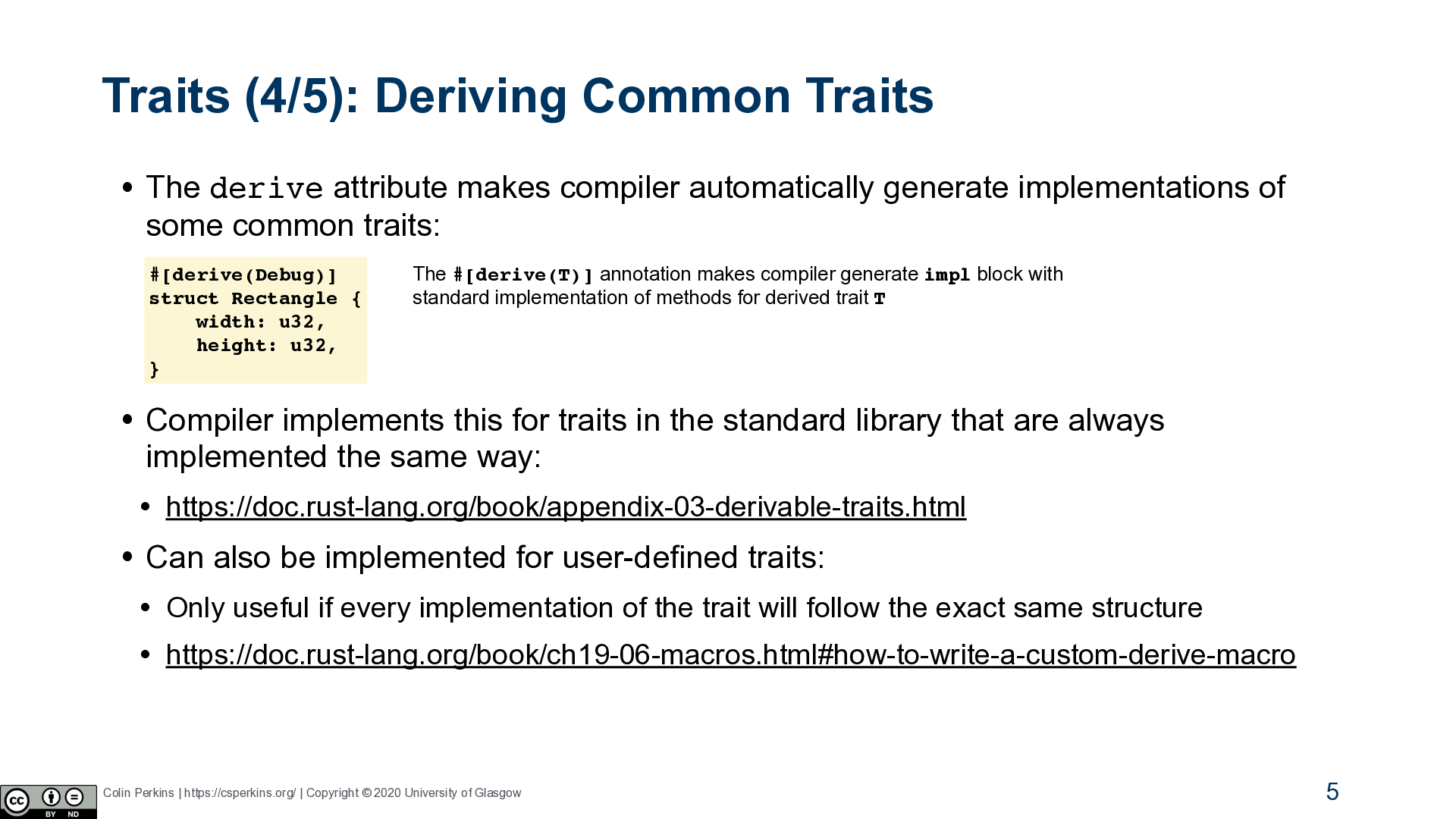
The Rust compiler understands an annotation,
00:04:07.500
derive, written as shown in the code
00:04:09.583
sample on the slide.
00:04:12.083
The derive annotation can be added to
00:04:14.083
a struct definition, and tells the compiler
00:04:16.917
to generate a standard implementation for the derived type.
00:04:21.250
For example, by writing # [derive(Debug)] on
00:04:24.375
struct Rectangle, as shown, we tell the
00:04:27.792
compiler to auto-generate an "impl Debug for
00:04:30.667
Rectangle" block.
00:04:33.000
This is possible, because every implementation of
00:04:35.708
the Debug trait proceeds in exactly the
00:04:37.708
same way. The code for the impl
00:04:40.333
block can be generated in an entirely
00:04:42.583
mechanical way, and always has the same structure.
00:04:46.792
The first link on the slide points
00:04:48.708
to the list of derivable traits.
00:04:52.083
The second points to a description of
00:04:53.750
how to implement auto-derivation for a trait
00:04:56.000
you might define. While possible, it’s extremely
00:05:00.291
rare to implement auto-derivation for types you define.
00:05:05.959
Using the # [derive(Debug)] annotation, though,
00:05:08.083
is extremely common. This can be used
00:05:10.959
to derive standard traits such as Debug
00:05:13.250
so the object can be printed by
00:05:14.959
a debugger; to implement equality tests for
00:05:17.917
structures, by deriving an implementation of the
00:05:20.291
Eq trait; and to allow copies to
00:05:23.041
be made of objects by deriving the
00:05:25.083
Copy trait, and so on.
00:05:30.000
Finally, traits can include definitions of associated
00:05:32.959
types. That is, that can specify that
00:05:37.250
certain types must be specified when the
00:05:39.417
trait is implemented.
00:05:41.792
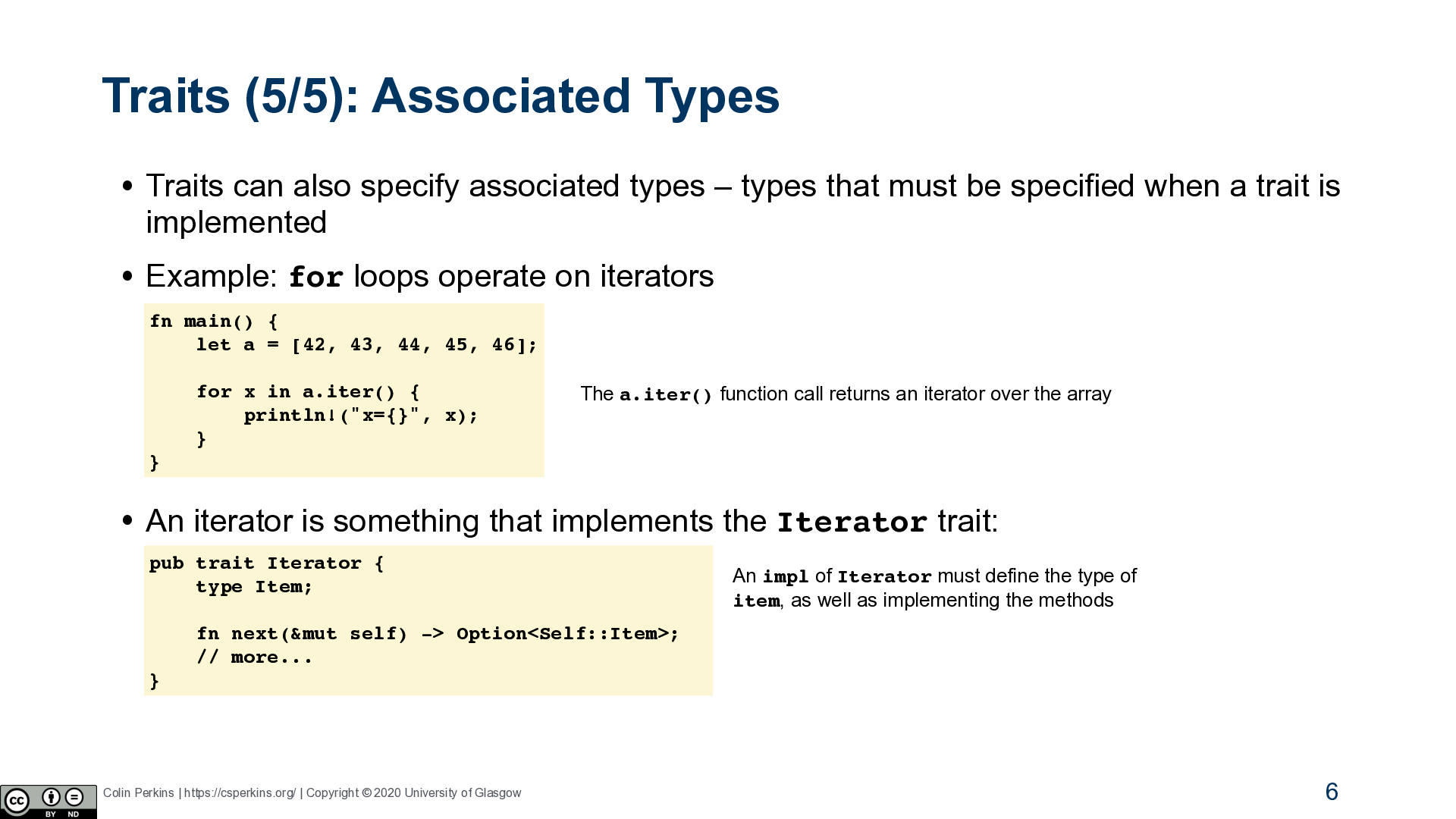
For example, for loops in Rust operate
00:05:44.625
on iterators, where an iterator is defined
00:05:47.041
to be something that implements the Iterator trait.
00:05:50.333
The Iterator trait defines a method and an associated type.
00:05:54.917
The method is called next(). It returns
00:05:58.417
the next element in the sequence produced
00:06:00.083
by the iterator, or an indication that
00:06:02.417
there are no more elements. This is
00:06:05.041
an instance of an enum type,
00:06:06.583
Option, that we’ll discuss in a minute.
00:06:09.542
The Option includes a type parameter,
00:06:12.125
Self::Item. This references the other element of
00:06:16.625
the trait definition, a type called Item.
00:06:20.667
What is the Item type? The trait
00:06:23.750
definition doesn’t specify. It indicates that all
00:06:27.500
implementations of the trait need to define
00:06:30.375
the Item type, but otherwise puts no
00:06:32.291
constraint on what it may be.
00:06:34.959
Every Implementation of the Iterator trait must
00:06:37.917
include a line, type Item = something,
00:06:40.917
to specify that type, and must define
00:06:43.500
the next() function to return an optional
00:06:45.458
value of that type. The trait is
00:06:48.417
generic, over any possible type.
00:06:54.000
Traits allow you to write code that
00:06:55.750
operates on many different types, by abstracting
00:06:58.000
away the operations that need to be
00:06:59.667
performed on those types.
00:07:02.458
Enumerated types, enums, allow you to write
00:07:05.500
code that can access the value of
00:07:07.417
data that may be of several different types.
00:07:10.917
In the simplest case, enums work the
00:07:13.333
same way they do in C or
00:07:15.041
Java. They specify a set of named
00:07:17.625
values that an item may take.
00:07:21.750
Rust also allows two more general forms of enum, though.
00:07:25.834
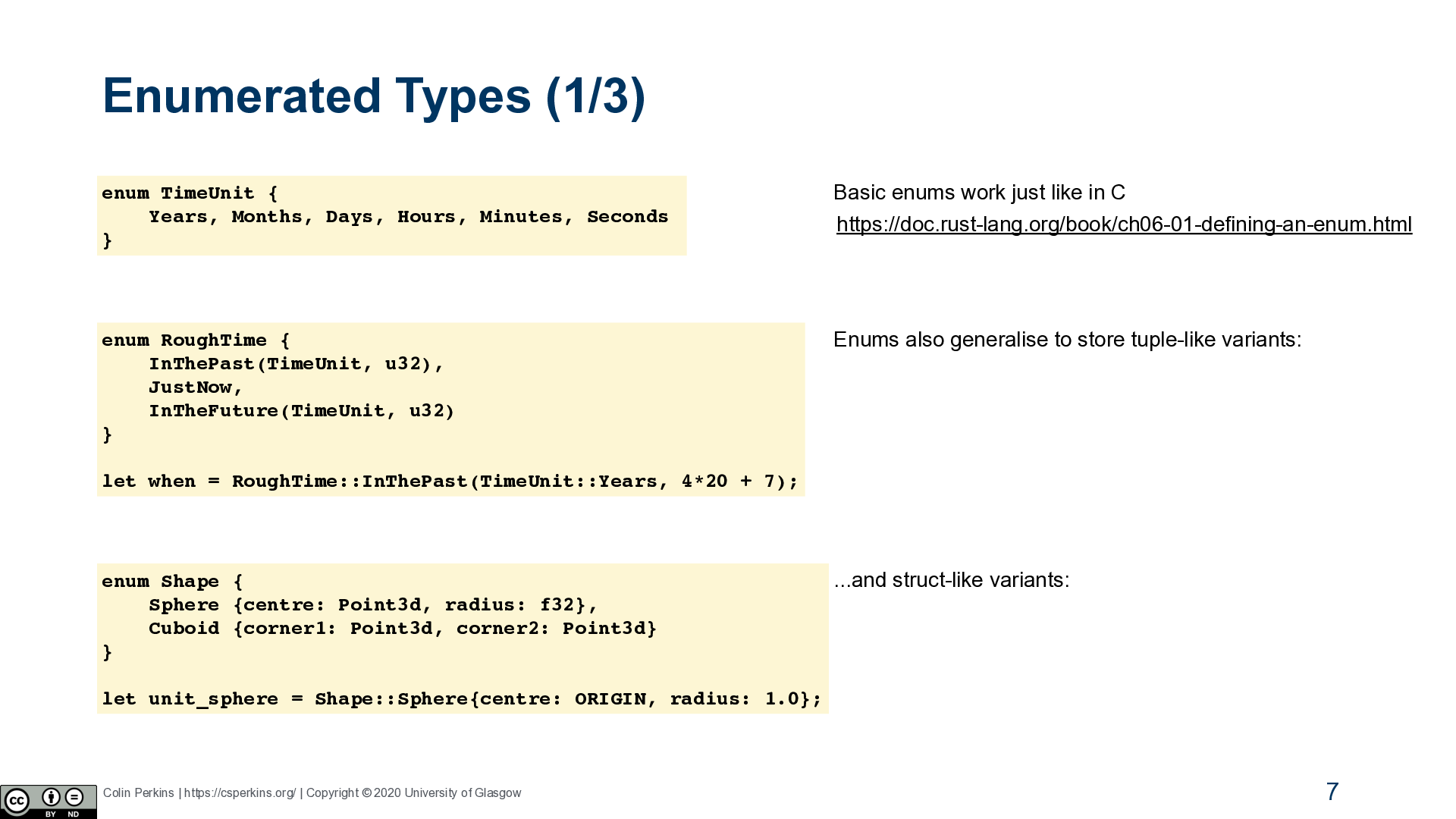
The first is an enum that can
00:07:27.583
hold unnamed data items, like a tuple
00:07:29.917
struct that can take several different variants.
00:07:33.583
In this example, the RoughTime enum can
00:07:36.125
hold values indicating JustNow, InThePast, or InTheFuture.
00:07:41.417
If the value is in the past
00:07:43.208
or future, the enum also holds a
00:07:44.959
time unit and a count.
00:07:47.625
For example, the variable “when” in the
00:07:50.166
code fragment indicates something that happened four
00:07:53.000
score and seven years ago. The InThePast
00:07:56.375
variant of the enum takes two unnamed
00:07:58.500
parameters, a TimeUnit and a number,
00:08:02.708
four score and seven.
00:08:06.166
An enum can also hold named data,
00:08:08.792
acting like a struct that can take
00:08:10.458
several different variants.
00:08:13.083
In this example, the enum Shape,
00:08:15.250
can be either a Sphere, with a
00:08:16.959
centre and a radius, or a Cuboid
00:08:20.000
specified by the locations of two corners.
00:08:25.000
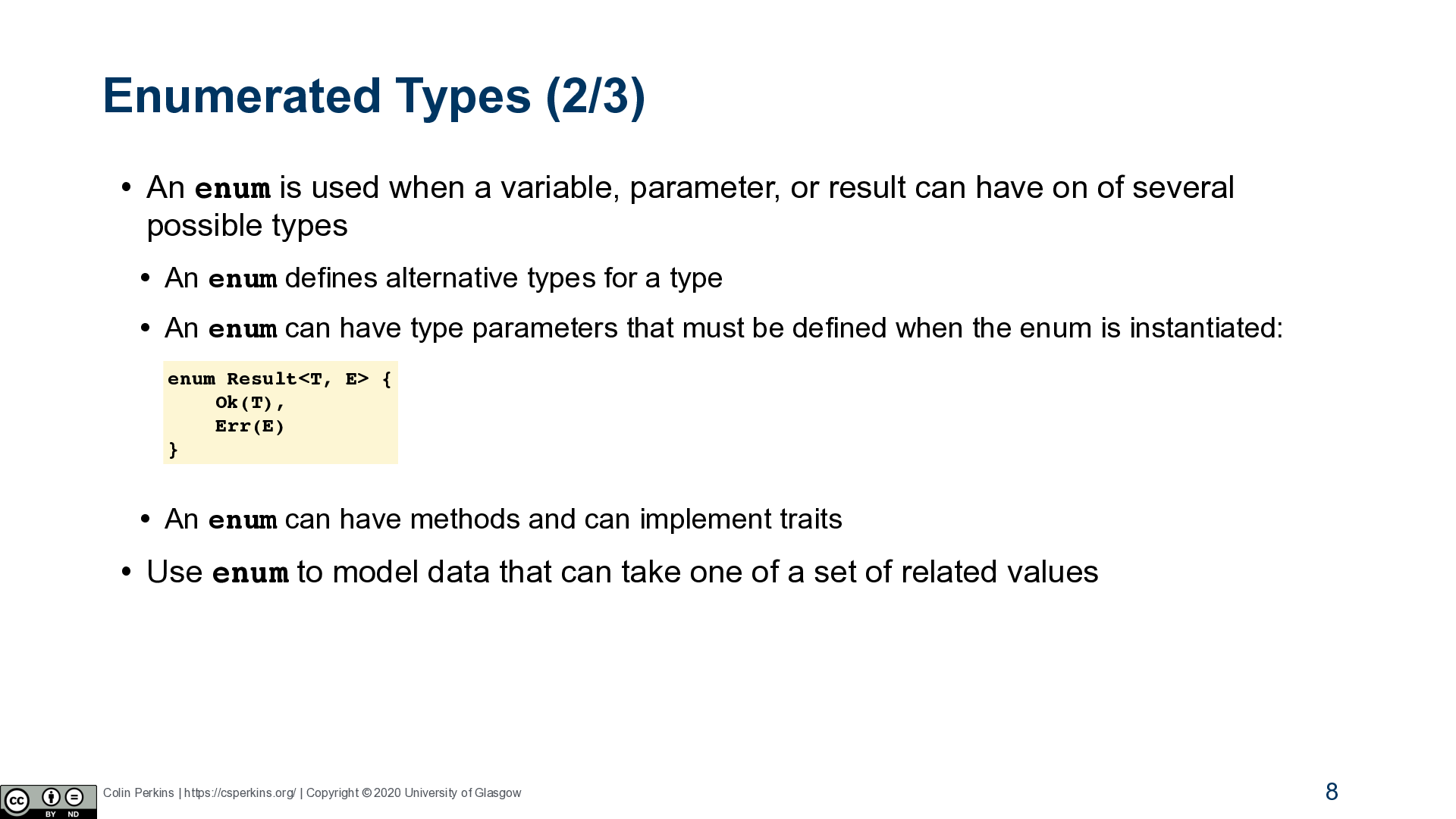
An enum is used when a variable,
00:08:27.375
parameter, or result can have on of
00:08:29.625
several possible types. Enums define the set
00:08:32.834
of possible alternative types for a type,
00:08:35.708
and are used to model data that
00:08:38.125
can take one of a set of related values.
00:08:40.834
Like structs, enums can have type parameters
00:08:43.458
that must be specified when the enum
00:08:45.417
is instantiated. For example, the Rust standard
00:08:48.792
library defines an enum Result, that takes
00:08:51.166
two type parameters, T and E.
00:08:54.792
There are two variants to the Result
00:08:56.750
enum. The Ok(T) variant is used to
00:09:00.500
indicate a successful result, wrapping a value
00:09:03.000
of type T. The Err(E) variant is
00:09:07.667
used to indicate an error, wrapping a result of type E.
00:09:12.333
Enums can also have impl blocks that
00:09:14.834
define methods that can be invoked on
00:09:16.583
the enum, and they can themselves implement traits.
00:09:22.000
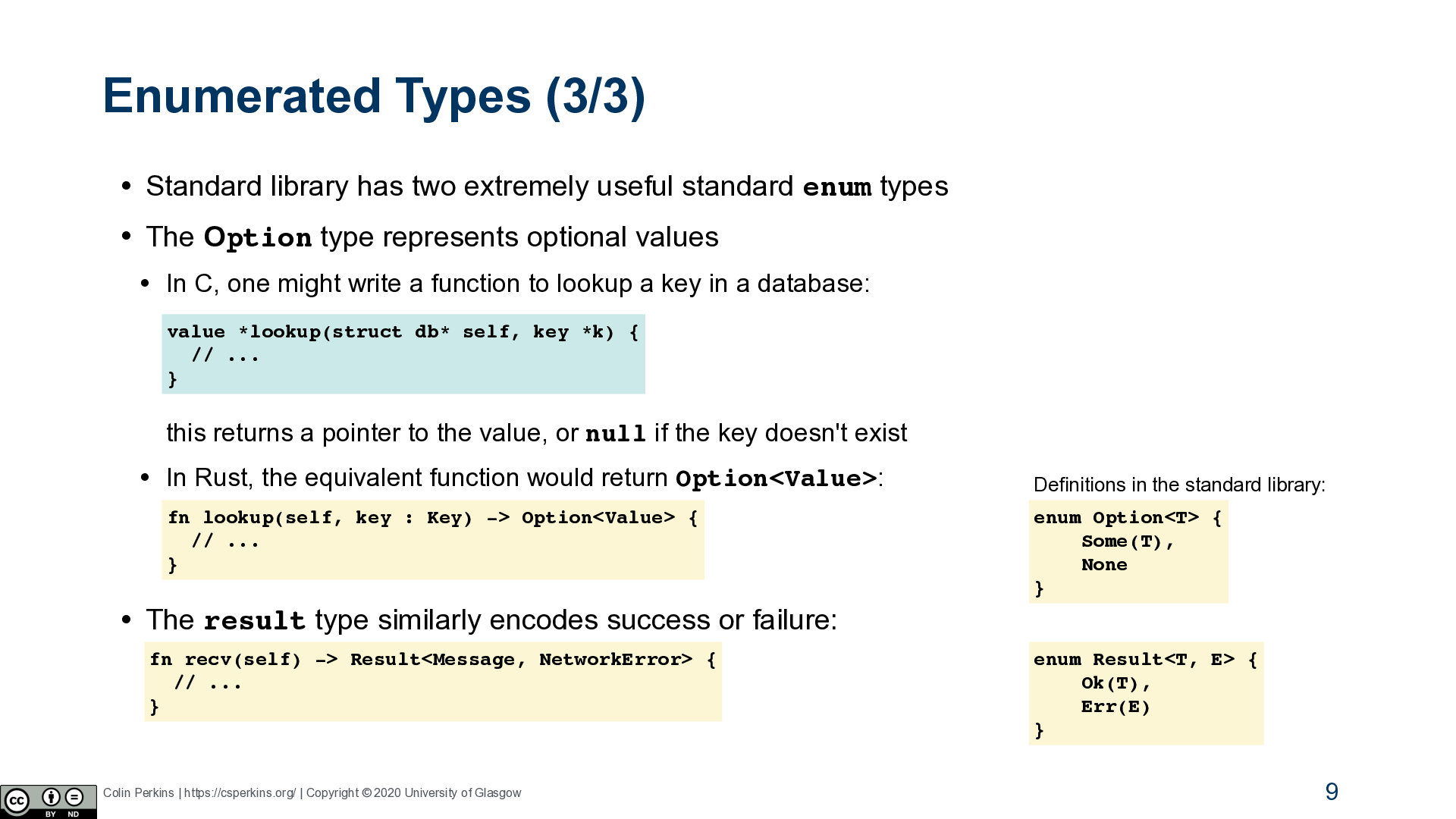
The Rust standard library defines two extremely
00:09:24.708
useful standard enum types.
00:09:27.417
One is the Result type, that we
00:09:29.250
saw previously, that’s returned by functions that
00:09:31.667
may either succeed or fail. For example,
00:09:34.750
at the bottom of the slide we
00:09:36.375
see the definition of a recv() function,
00:09:38.875
that returns a Result that can be
00:09:40.500
either Ok, wrapping a value of type
00:09:42.667
Message, or an Err variant that wraps a NetworkError object.
00:09:48.250
The other is the Option type.
00:09:50.500
This represents a value that might not exist.
00:09:53.917
In a C program, for example,
00:09:56.125
one might write a function to lookup
00:09:58.125
a key in a database. This function
00:10:00.625
might take a pointer to the struct
00:10:02.291
representing the database, and a pointer to
00:10:04.917
the key to be found. If the
00:10:07.625
key is found in the database,
00:10:09.250
such a function will return a pointer
00:10:11.333
to the corresponding value, or it will
00:10:13.458
return null if they key doesn’t exist.
00:10:16.959
A Java program would be similar,
00:10:18.708
except that lookup() would be a method
00:10:20.583
on the database object, and would return
00:10:22.667
a reference to an object holding the value, or null.
00:10:26.583
In Rust, the equivalent function would return
00:10:29.625
an instance of the Option type.
00:10:32.083
Option is an enum, that takes a
00:10:33.875
type parameter T, and has two possible variants.
00:10:38.333
Some(T) indicates that the item is
00:10:40.750
present, and None indicates that it is
00:10:43.166
not. The Rust function would therefore return
00:10:46.708
an Option, with the variant indicating whether
00:10:49.792
the result exists or not.
00:10:52.542
This looks like a minor syntactic difference,
00:10:54.917
but as we’ll see later in the
00:10:56.208
lecture, it lets the Rust compiler check
00:10:58.625
for errors much more effectively.
00:11:03.000
The final Rust feature I want to
00:11:04.625
discuss in this part of the lecture is pattern matching.
00:11:08.917
Pattern matching introduces the match statement.
00:11:12.166
This is a generalisation of the switch
00:11:14.208
statement in languages like C and Java.
00:11:17.917
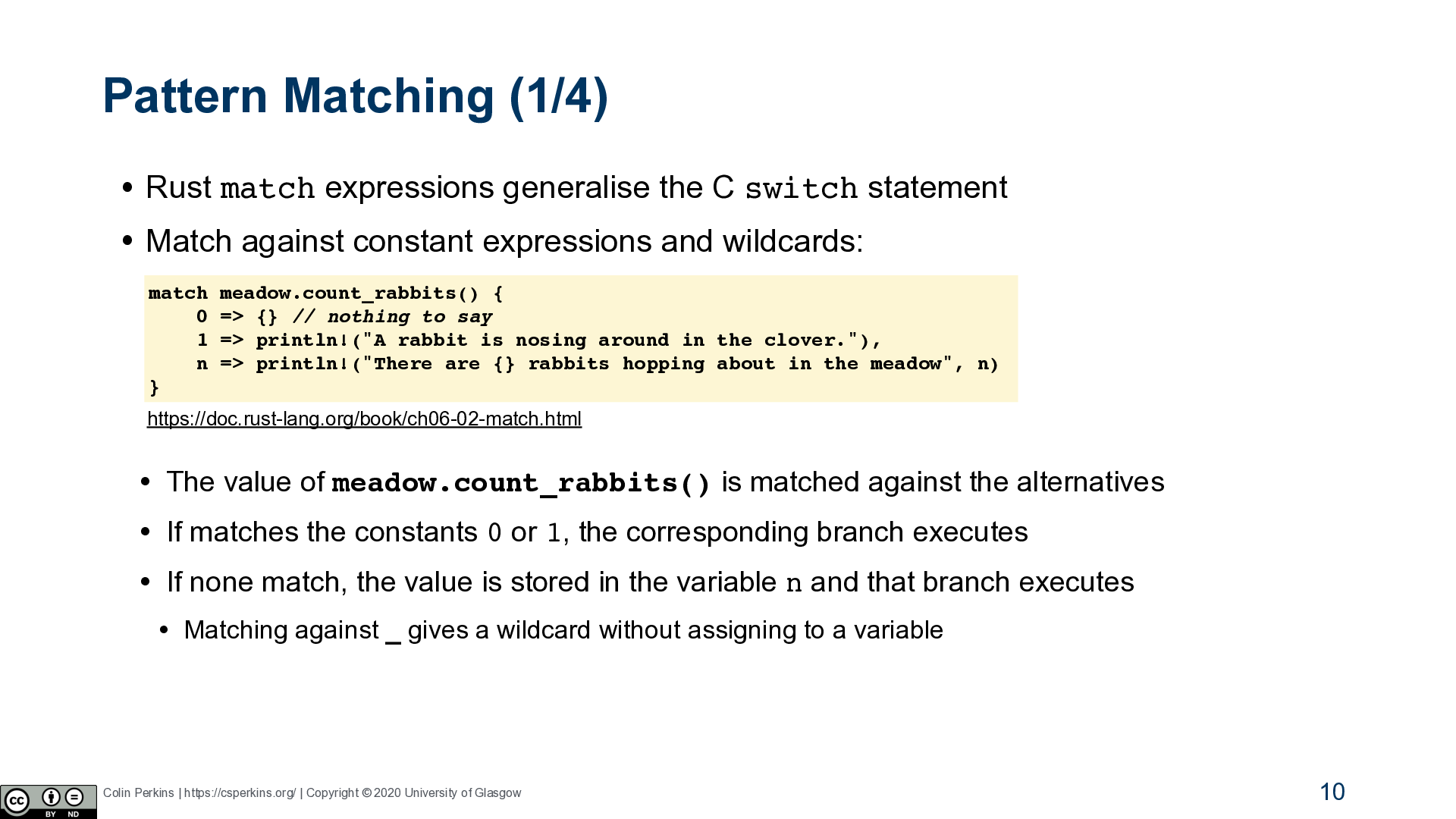
In the simplest case, much like in
00:11:20.417
C, a match statement can match on
00:11:22.875
an integer value. In this example,
00:11:26.458
the count_rabbits() method is called on the meadow object,
00:11:29.500
and the match statement operates on the result.
00:11:33.000
If there are no rabbits, nothing is printed.
00:11:36.375
If there is one rabbit,
00:11:37.667
it prints that a rabbit is nosing
00:11:39.250
around. And if there are several rabbits,
00:11:41.792
it prints to say how many rabbits are hopping about.
00:11:45.583
The last variant shows the first extension
00:11:48.333
of the Rust match statement compared to
00:11:50.625
the C switch statement. A match can
00:11:53.417
include a variable that’s bound if none
00:11:55.250
of the other variants match, and that
00:11:57.625
variable can be used when that branch
00:11:59.458
of the switch statement is executed.
00:12:02.333
A wildcard that doesn’t bind to a
00:12:03.834
value can be specified using an underscore
00:12:07.083
as the value to match.
00:12:09.375
Match statements in Rust are exhaustive.
00:12:11.875
That is, every possible value must match,
00:12:14.583
or there must be a wildcard or variable match.
00:12:18.250
It’s a compile time error if some
00:12:20.125
values are not covered by the match.
00:12:25.000
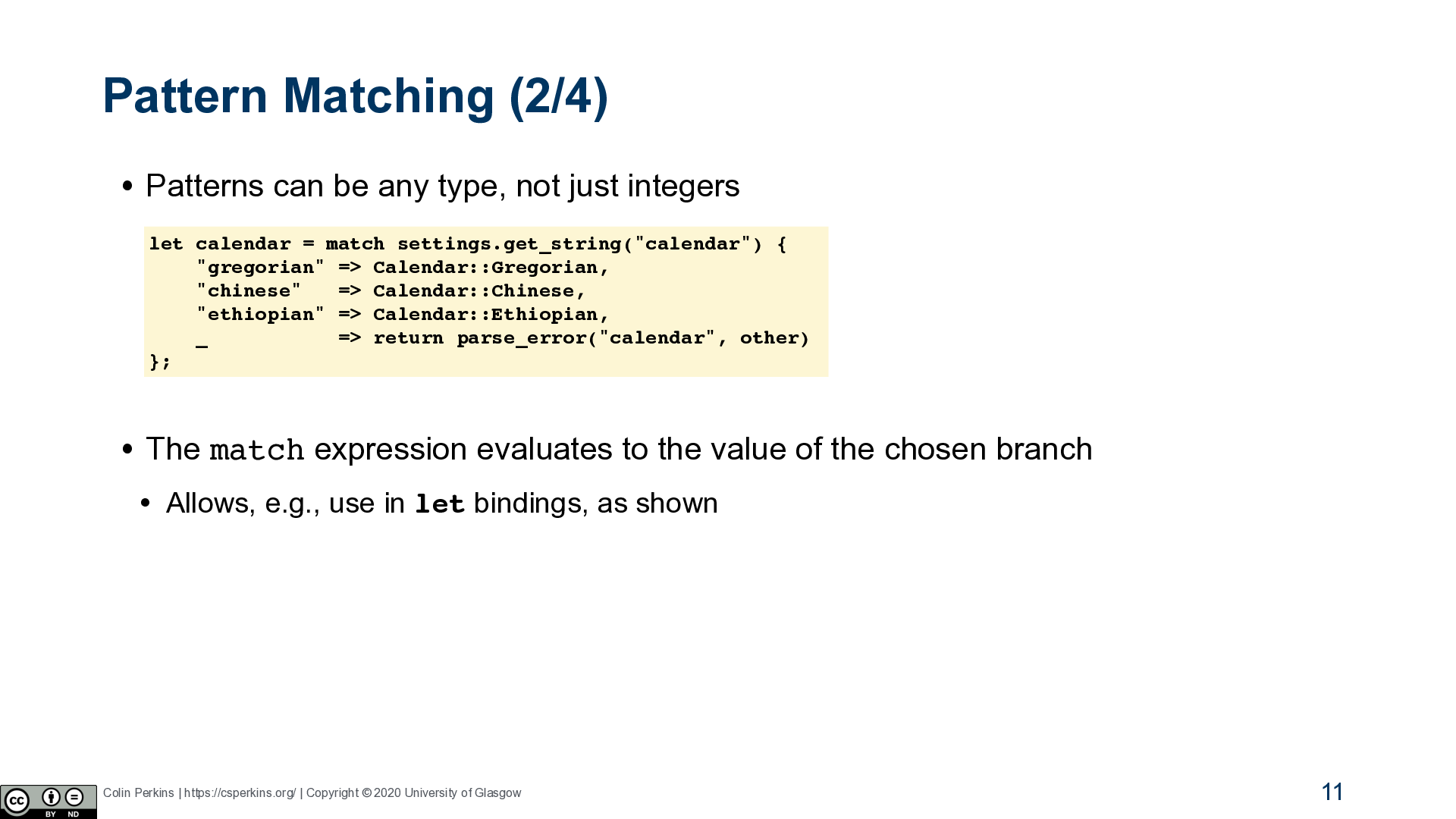
Rust also generalises the match statement to
00:12:27.625
allow matching on other types, not just integers.
00:12:31.250
The slide shows a match against
00:12:32.750
string values, for example,
00:12:34.333
that evaluate to an enum variant.
00:12:37.708
A match statement in Rust has a
00:12:39.750
value that’s equal to that of the
00:12:41.333
chosen branch. This means it’s possible to
00:12:44.583
use a match statement to assign a
00:12:46.208
value to a variable in a let
00:12:47.583
binding, as shown in the slide.
00:12:51.917
All variants of a match statement must
00:12:53.917
evaluate to give values of the same type, or to nothing.
00:13:01.000
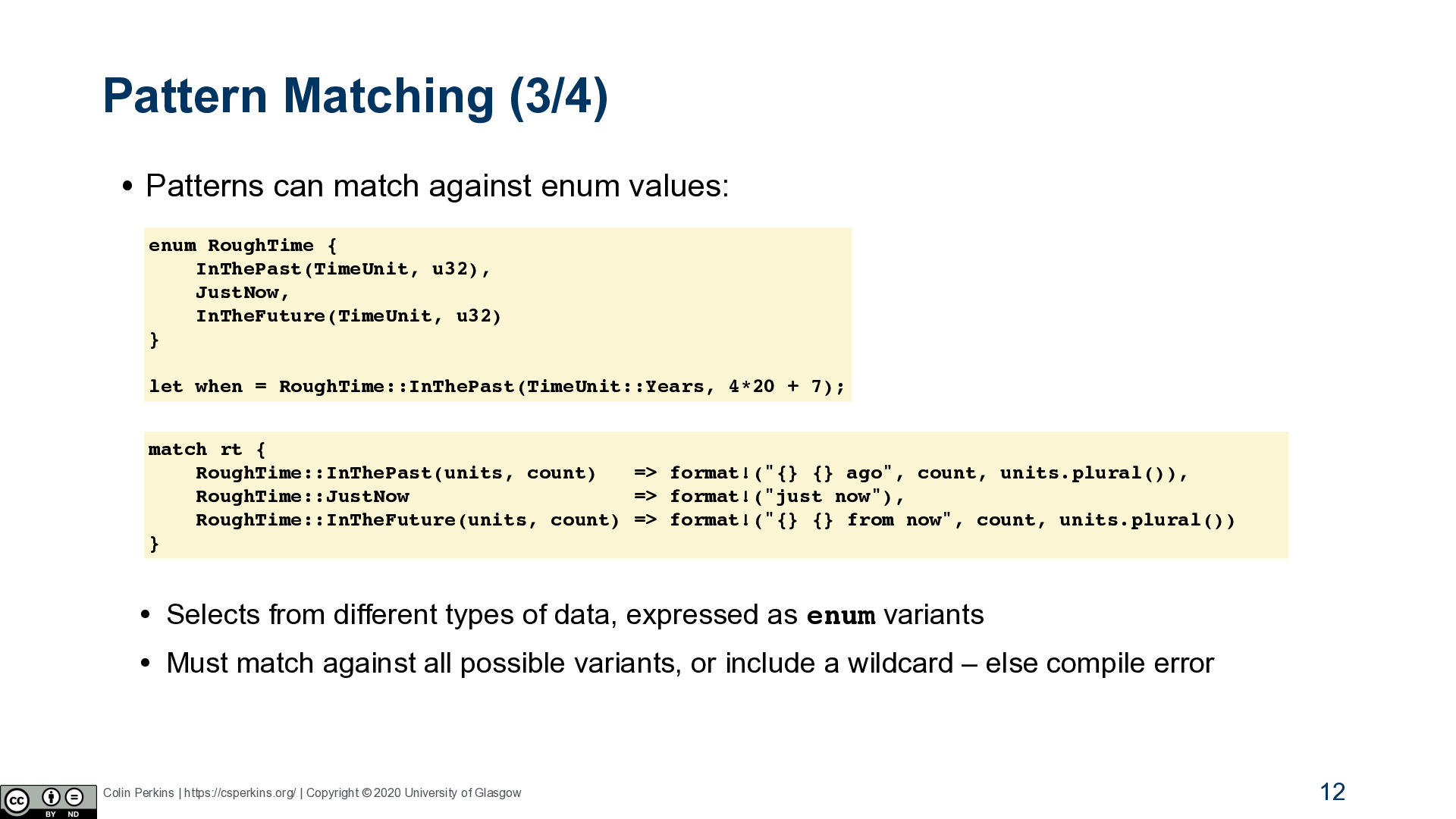
Match statements in Rust
00:13:02.125
can also match against enum variants.
00:13:05.417
On this slide we have the same
00:13:07.333
RoughTime example as used before, with a
00:13:09.917
match statement that checks
00:13:11.208
which variant of the enum is present,
00:13:13.250
and produces a different value in each case.
00:13:17.166
This allows code to be written that
00:13:18.834
can deal with data that can be
00:13:20.417
one of several different variants,
00:13:22.250
one of several different types.
00:13:24.500
Since matches are exhaustive,
00:13:26.417
the compiler will guarantee that all code
00:13:28.458
handles all possible variants.
00:13:32.834
This is extremely useful for writing code
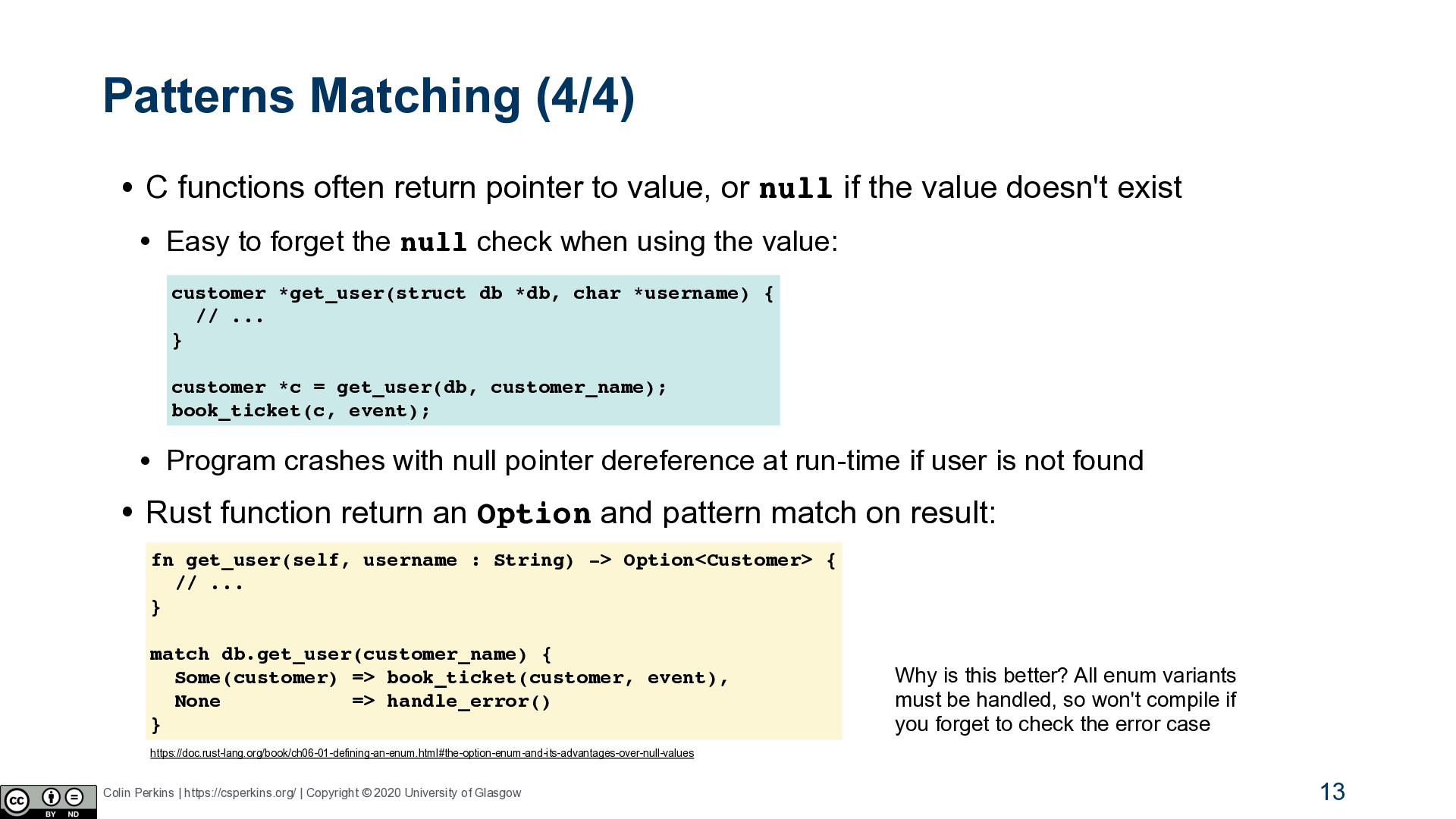
00:13:35.291
that handles optional values and results that may fail.
00:13:39.250
For example, in C one might write
00:13:42.083
a function that looks up a user
00:13:44.000
in a database then books a ticket for that user.
00:13:47.291
The get_user() function returns
00:13:48.792
a pointer to the customer record on
00:13:50.959
success, or null on failure.
00:13:54.291
It’s easy to write code, as shown
00:13:56.875
on the slide, that assumes the get_user()
00:13:59.542
function succeeds and always tried to book
00:14:01.667
the ticket, causing the book_ticket() function to
00:14:04.750
crash when passed a null pointer.
00:14:08.000
C cannot catch the bug at compile time.
00:14:12.250
In Rust, though, the get_user() function will
00:14:15.208
return an instance of the Option enum,
00:14:17.750
and the code will eventually have to
00:14:19.417
pattern match against this to get at the result.
00:14:22.792
The pattern match must be
00:14:24.417
exhaustive, which means that the code won’t
00:14:27.083
compile unless both the Some() and None
00:14:29.375
variants of the Option type are handled.
00:14:32.291
The Rust compiler can’t make you write
00:14:34.625
meaningful error handling, for cases where the
00:14:37.583
get_user() function fails, but it does force
00:14:40.333
you to check for and handle the
00:14:42.083
error somehow, and the code won’t compile
00:14:44.667
if you forget the error handling.
00:14:47.125
Rust therefore turns a runtime failure in C into
00:14:51.125
a compile time check.
00:14:55.000
In this part, I’ve introduced the concepts
00:14:57.625
of traits and enums, that provide abstraction
00:15:00.000
in Rust, and the idea of pattern
00:15:01.917
matching for working with variant data.
00:15:05.125
We’re also now starting to see how
00:15:07.250
the type system can help us write reliable
00:15:09.375
and robust software.
00:15:11.750
The Option and Result enums are small types in themselves,
00:15:15.458
but when used systematically, in combination with
00:15:18.417
exhaustive pattern matching, they remove a common
00:15:21.208
source of bugs: forgetting to check for
00:15:23.667
failures in the return value of function calls.
00:15:27.125
In the next part, we’ll move on
00:15:29.542
to talk about how Rust handles pointers,
00:15:31.834
and start to talk about memory management.
Part 4: Introducing Rust (3/3)
The 4th part of the lecture concludes this introduction to the Rust
programming language. It discusses how Rust supports references, and
what constraints it imposes on their use; how memory allocation and
boxing work; and the various string types provided. Finally, it
talks about what makes Rust interesting as a systems language, and
what is novel about its design.
00:00:00.083
In the final part of the lecture,
00:00:01.959
I'd like to start to discuss one of the
00:00:03.917
more unusual features of Rust:
00:00:05.750
how it handles memory management.
00:00:08.166
I'll also say little more about why I think
00:00:10.000
Rust is an interesting systems programming language.
00:00:15.083
At first glance,
00:00:16.500
memory management in Rust
00:00:17.917
looks a little like it does in C.
00:00:20.417
Like in C,
00:00:21.708
the act of taking a reference
00:00:23.291
to a pointer to an object is explicit.
00:00:26.291
And, similarly, so is
00:00:28.083
dereferencing a pointer to access the referenced object.
00:00:32.083
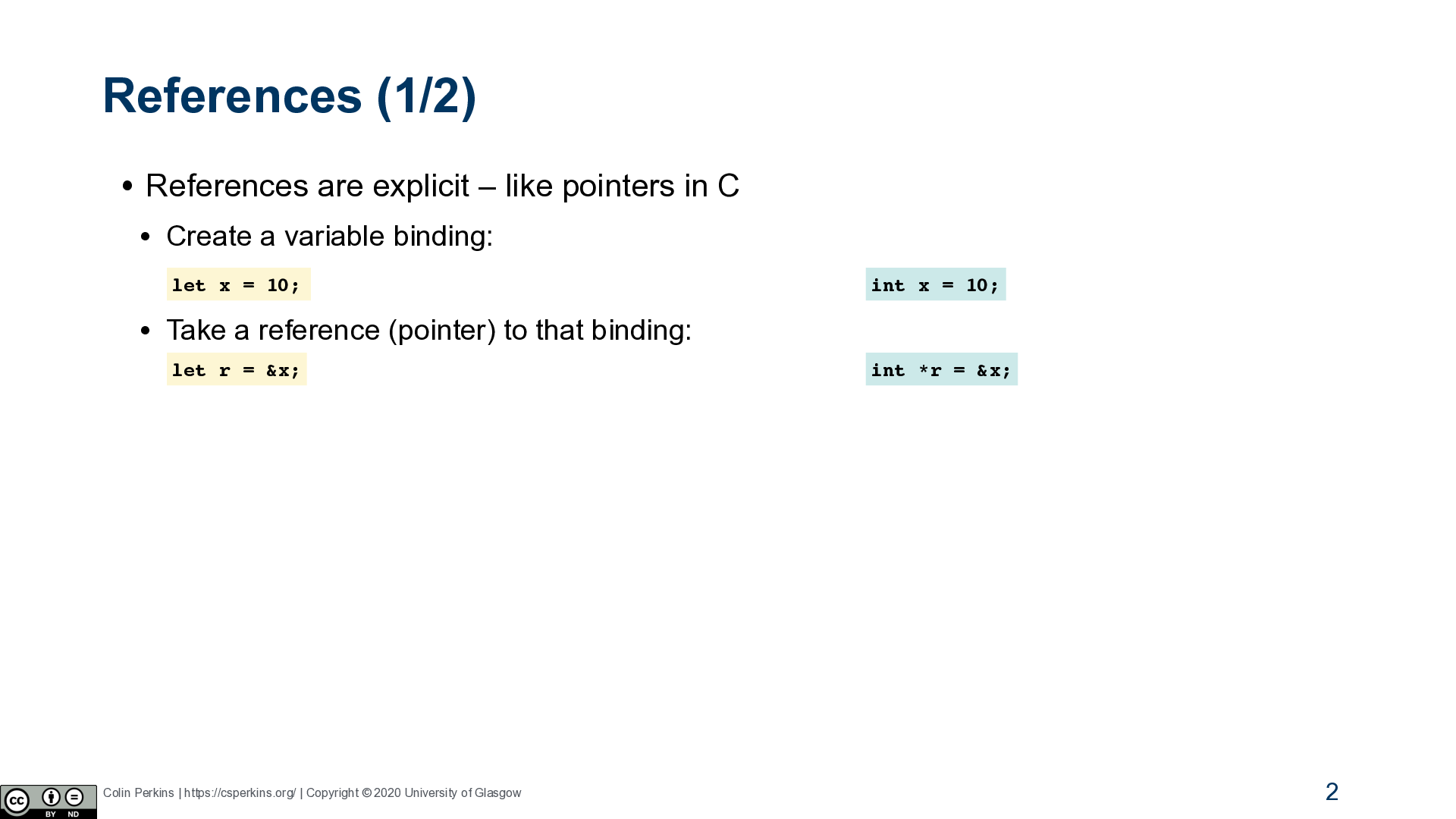
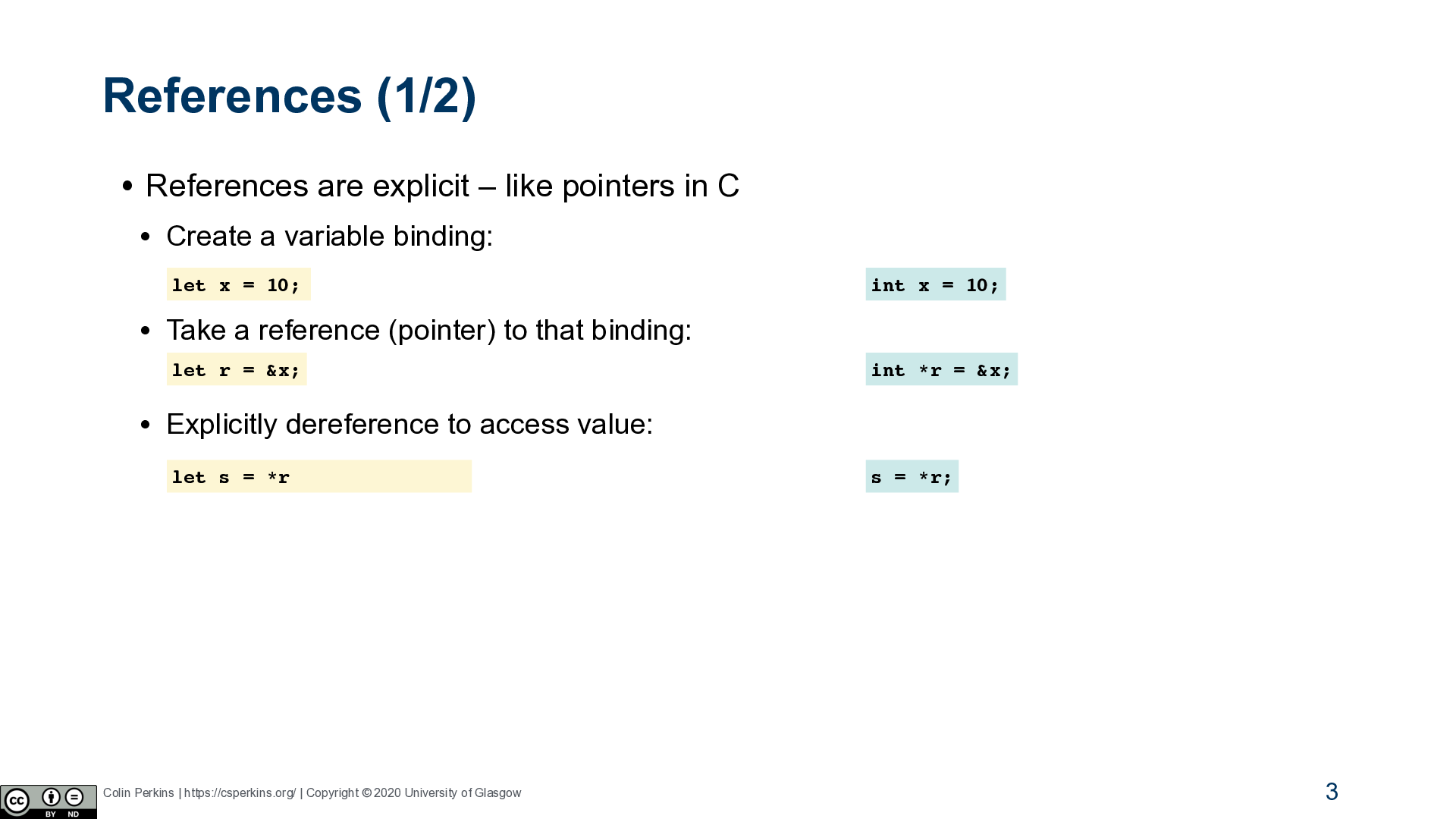
The slide shows has creates a variable binding:
00:00:35.291
let x = 10.
00:00:37.708
And it demonstrates how to take a reference to that binding:
00:00:40.959
let r = &x.
00:00:44.792
In both cases,
00:00:46.250
we see that Rust infers the types of x and r.
00:00:49.500
Whereas, in the equivalent C code,
00:00:51.708
shown on the right, we have to explicitly write the type.
00:00:55.917
And the terminology is different,
00:00:58.166
with Rust using the term reference,
00:01:00.208
whereas C calls it a pointer.
00:01:02.500
But otherwise the code is the same.
00:01:07.166
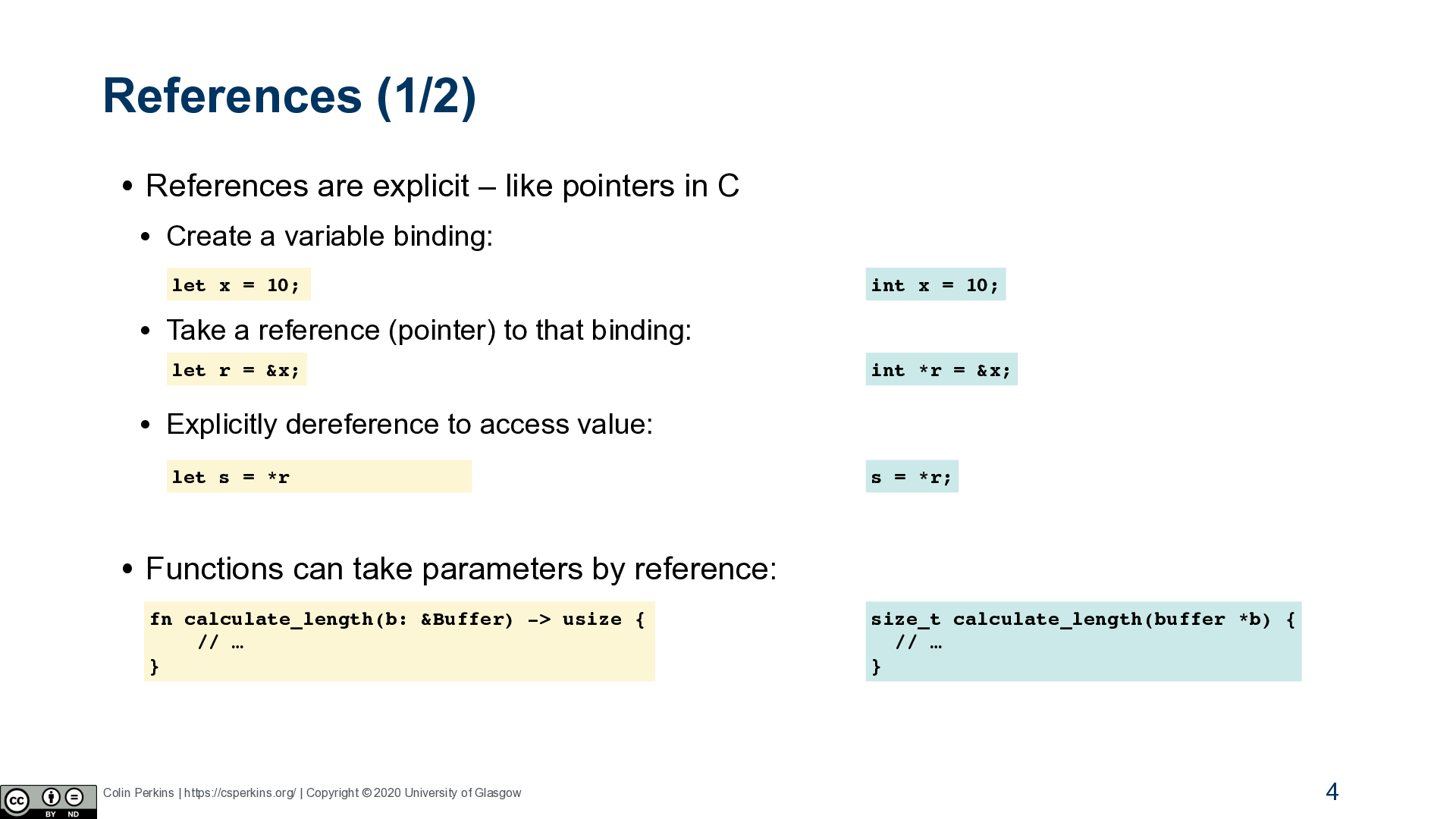
The same is true for dereferencing,
00:01:09.834
where we wriite let s = *r.
00:01:13.750
The * operator
00:01:15.417
used to dereference pointers
00:01:17.250
is the same in both languages.
00:01:22.083
Functions can take their parameters by reference.
00:01:25.917
For example,
00:01:27.083
the calculate_length() function
00:01:28.834
shown on the slide
00:01:30.291
is passed a reference to a buffer
00:01:32.417
rather than on passing the buffer itself.
00:01:35.208
This behaves the same as the equivalent C code,
00:01:38.000
that passes a pointer to the buffer.
00:01:40.708
Rust is a little more consistent than C here.
00:01:44.083
It uses the & syntax
00:01:46.417
to both take a reference,
00:01:47.959
and to pass a reference to a value.
00:01:50.792
While C uses the & syntax to take a reference,
00:01:54.250
but the * syntax to pass a reference.
00:01:58.208
The compiler generates the exact same code
00:02:00.708
for the Rust and C programs in all of these cases.
00:02:06.917
One of the unusual features of Rust
00:02:09.500
is that it distinguishes two different types of reference:
00:02:12.875
immutable references
00:02:14.917
and mutable references.
00:02:17.875
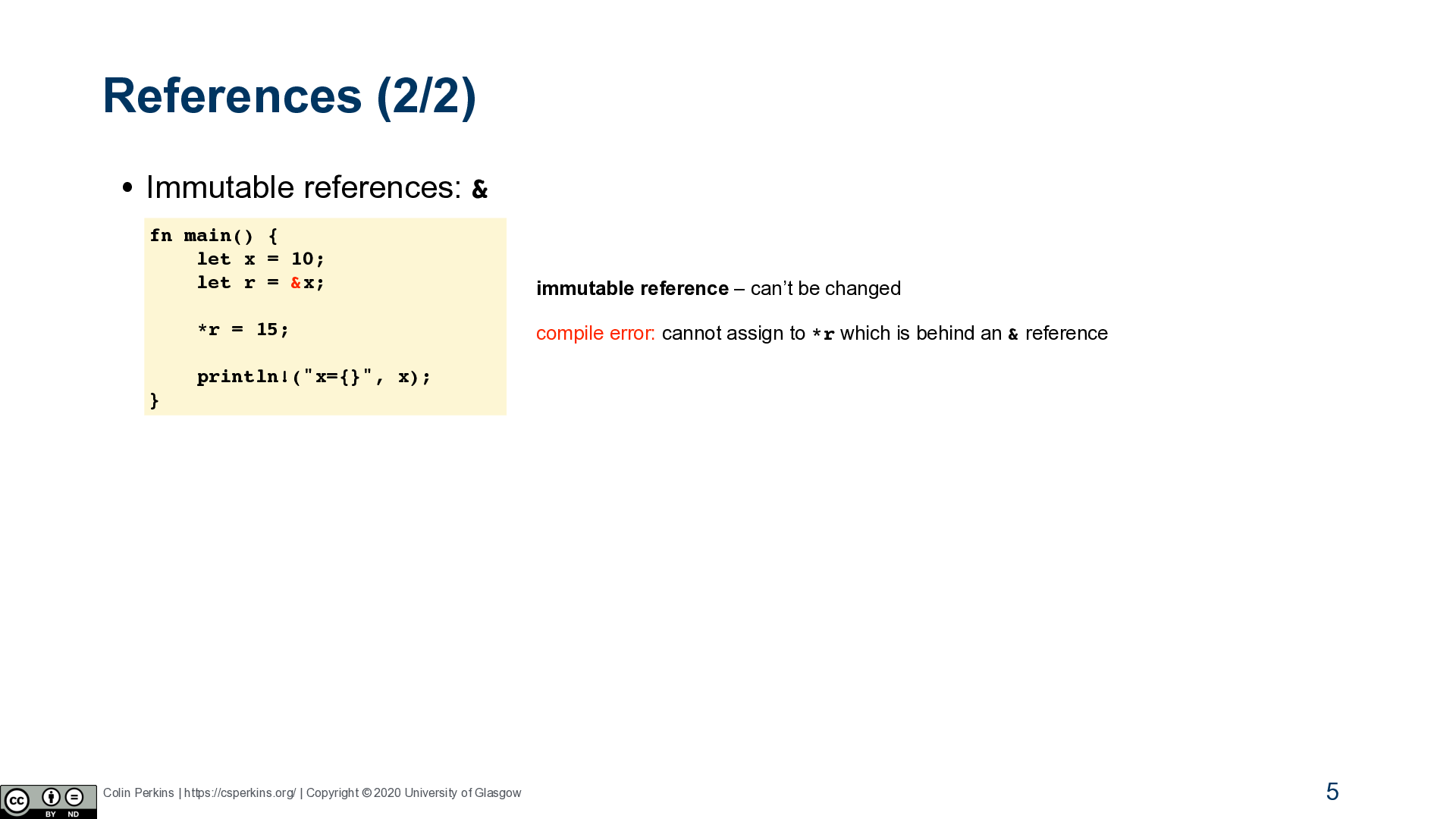
And immutable reference is written using an ampersand,
00:02:21.375
as in the code fragment shown:
00:02:23.792
let r = &x.
00:02:27.834
An immutable reference
00:02:29.792
is a reference to an object that cannot change.
00:02:33.708
The code fragment,
00:02:35.250
which takes an immutable reference to a variable
00:02:38.166
then tries to change the referenced value
00:02:40.708
and won't compile.
00:02:43.041
The compiler notices that the reference is immutable
00:02:46.417
and throws an error,
00:02:47.708
indicating that it cannot assign to the referenced value.
00:02:51.125
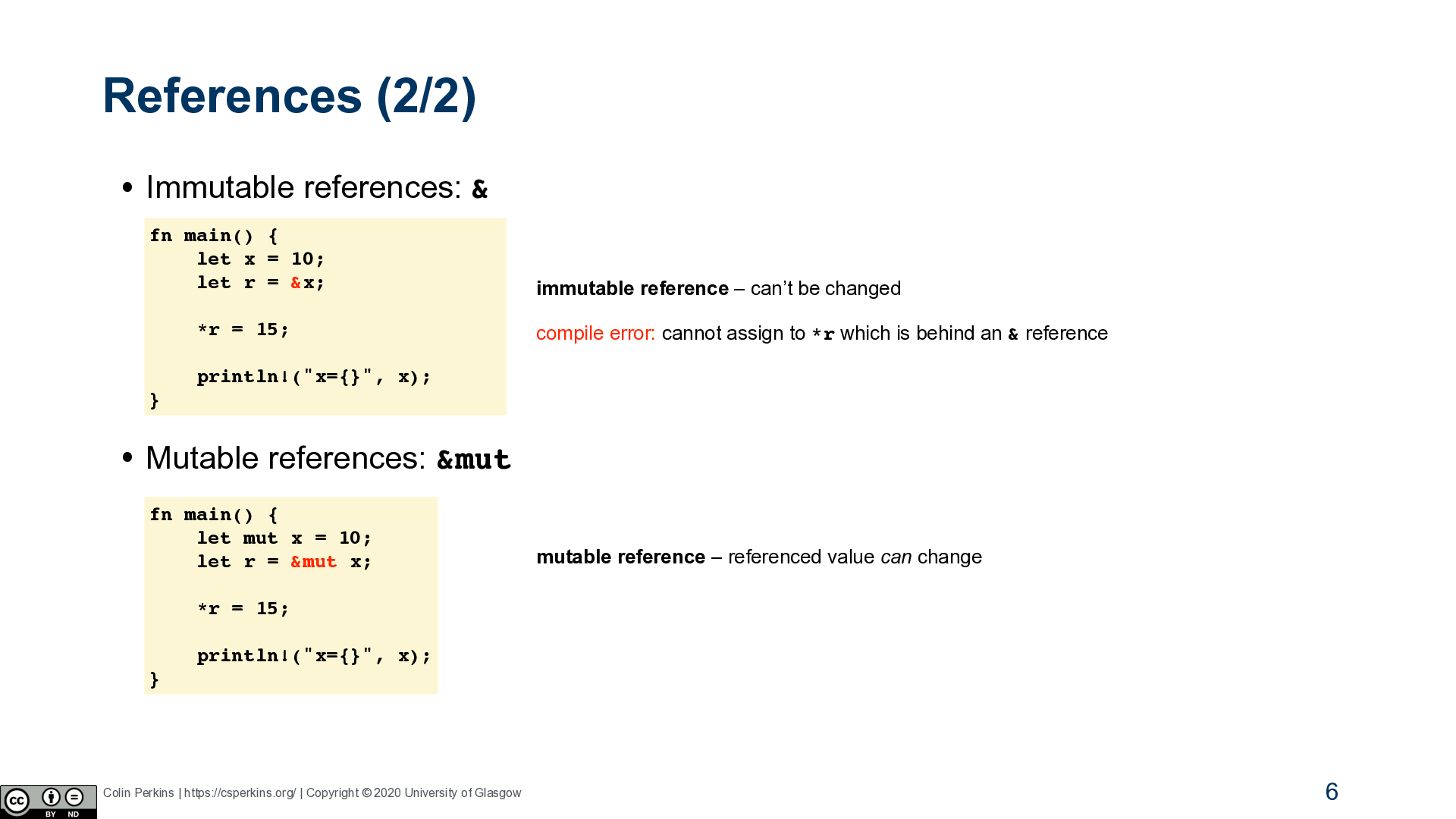
Sometimes, though, you need to mutable reference.
00:02:54.875
A reference that lets you change the referenced item.
00:02:58.959
Rust allows this.
00:03:00.750
Mutable references are written using the syntax
00:03:03.458
&mut as we see in the second code fragment.
00:03:07.333
They allow the referenced value to change.
00:03:10.291
And if you compile and run the code,
00:03:12.333
you''ll see that it prints the value 15
00:03:14.583
after having successfully changed the value of x
00:03:17.375
via the reference.
00:03:21.750
In addition to distinction between mutable
00:03:24.417
and immutable references,
00:03:26.166
Rust enforces a number of constraints
00:03:28.917
on how references can be created and used.
00:03:33.208
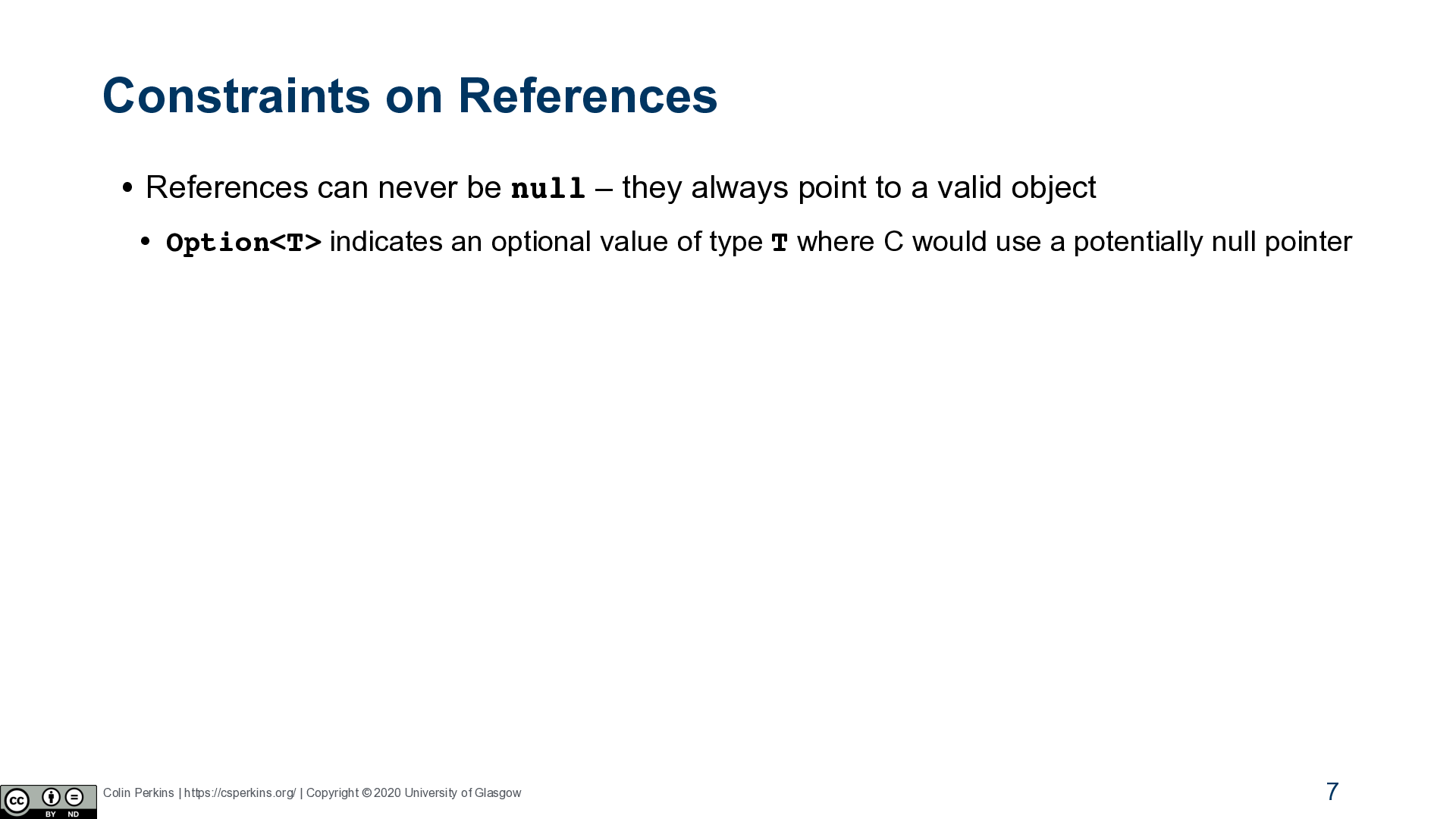
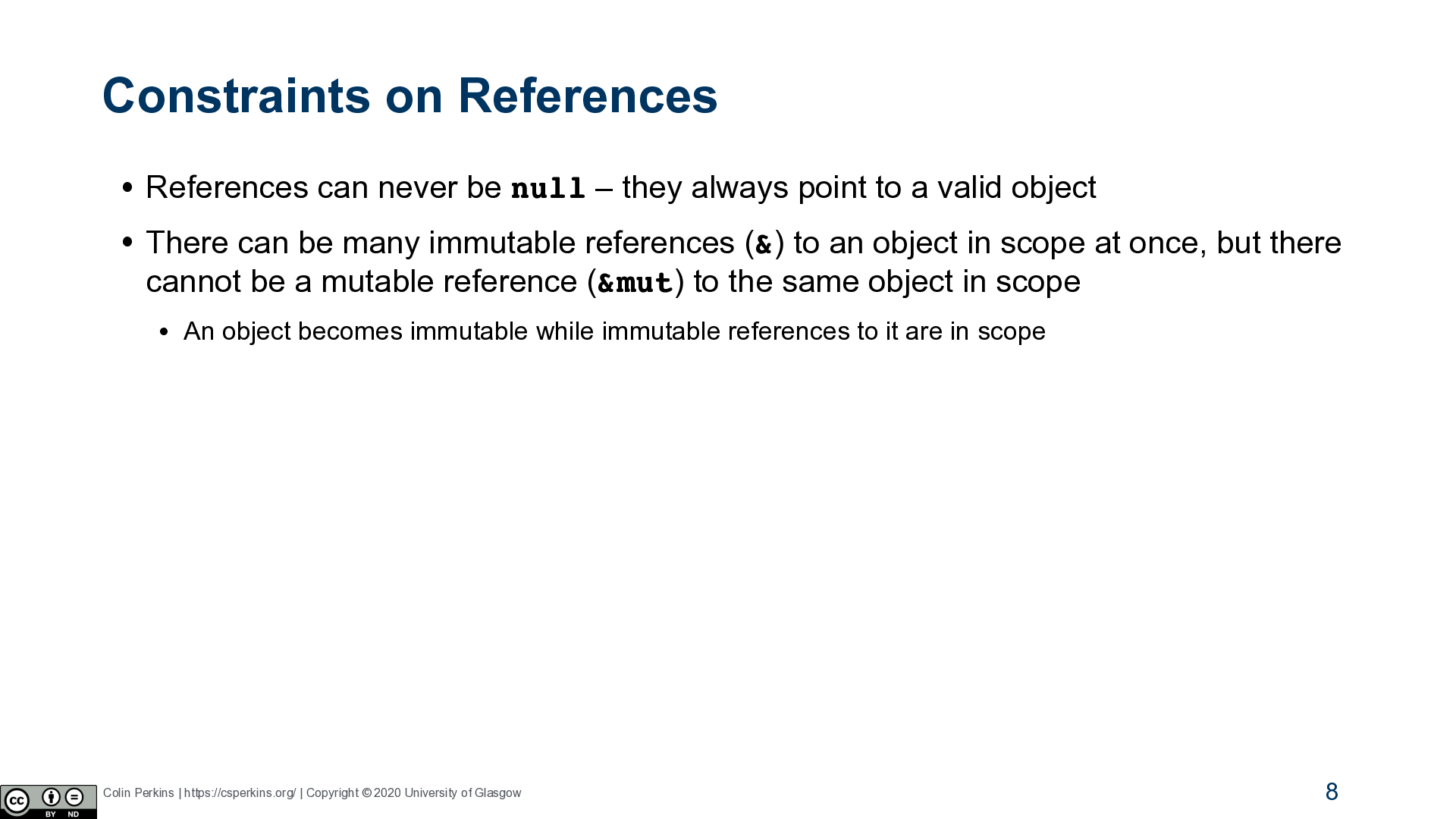
The first is that a reference in Rust can never be null.
00:03:37.750
A reference always points to a valid object.
00:03:41.417
it's not possible to create or return
00:03:44.208
a null pointer in Rust.
00:03:46.250
Values that would be a potentially null pointer in C or Java
00:03:50.625
are handled by returning an option type.
00:03:54.041
As we saw in the previous parts of the lecture,
00:03:56.542
this is an enum, that either has the value some X
00:04:00.125
where X is the value,
00:04:02.166
or has the value none.
00:04:04.500
The option is extracted using pattern matching,
00:04:07.250
allowing the compiler to enforce
00:04:09.375
the check for the none case.
00:04:13.375
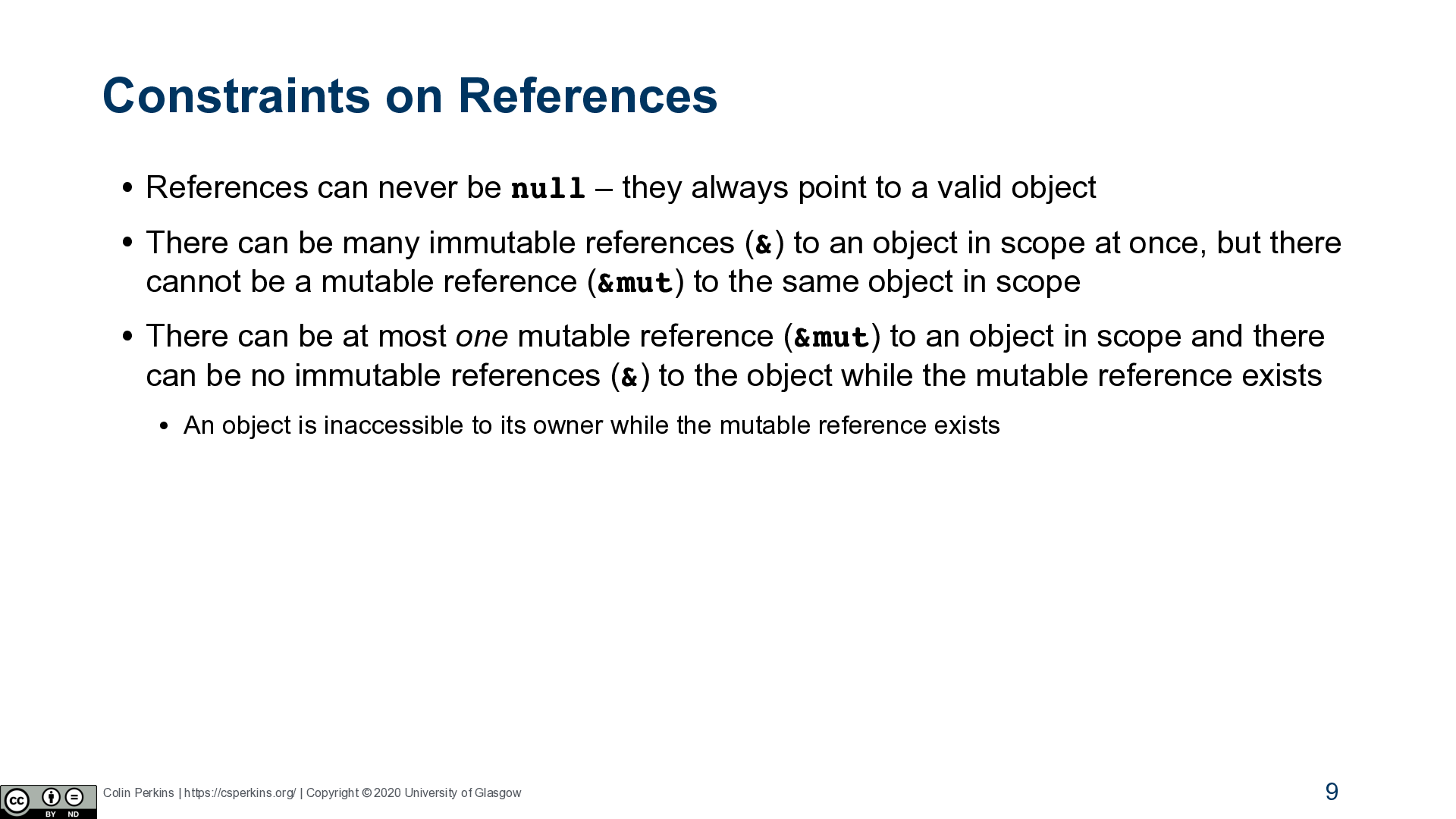
The second constraint
00:04:14.875
is that while Rust allows many immutable references
00:04:18.000
to an object to exist,
00:04:19.583
it prohibits there from being any mutable references
00:04:22.708
to that object at the same time.
00:04:25.834
And while an immutable reference to an object exists,
00:04:29.250
the Rust compiler enforces that
00:04:31.250
the referenced object is immutable,
00:04:33.750
even if that's object was declared to be mutable.
00:04:38.000
This means that you can be absolutely sure that,
00:04:40.917
while an immutable reference to an object exists,
00:04:43.917
the referenced object will not change.
00:04:48.041
The compiler enforces this constraint.
00:04:51.959
If you try to write code that has both mutable
00:04:54.917
and immutable references to the same object
00:04:57.417
at the same time, that code will not compile.
00:05:03.250
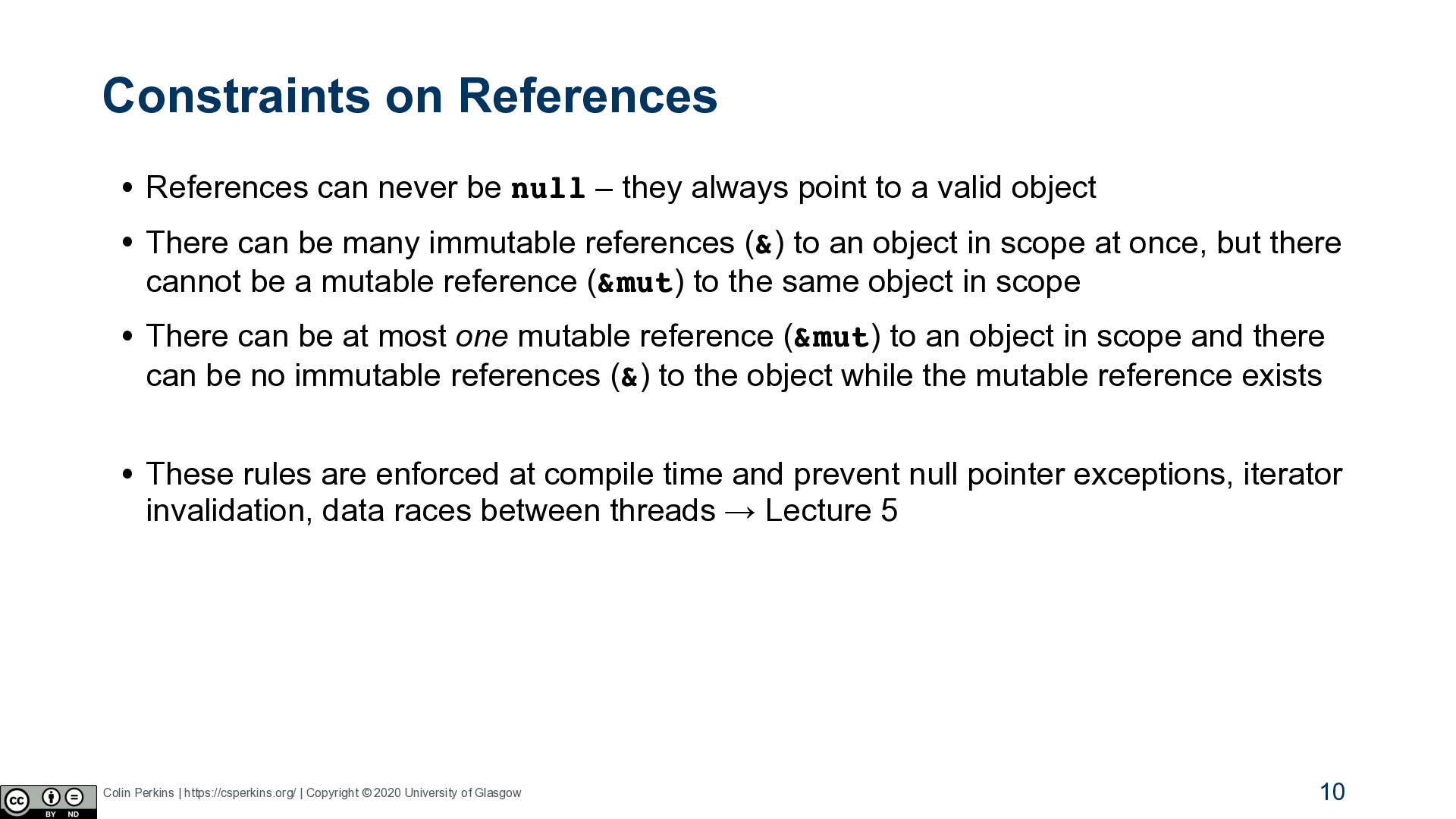
Furthermore, the compiler enforces that
00:05:06.083
there can be at most one mutable
00:05:08.500
reference to an object in scope,
00:05:10.750
and that there can be no immutable references to the object,
00:05:14.291
while a mutable reference exists.
00:05:17.667
The compiler also enforces that the original object
00:05:21.000
is inaccessible while the mutable reference exists.
00:05:25.083
If you have a mutable reference to an object,
00:05:27.959
you can read or modify that object via the reference,
00:05:31.375
and only via that reference.
00:05:34.250
And you can be sure that no other part of the
00:05:36.542
program has access to that object.
00:05:40.959
The compiler strictly enforces these guarantees.
00:05:45.041
They limit what types of program you can write,
00:05:47.542
by enforcing constraints on what references
00:05:50.083
to data can exist at different times.
00:05:53.583
As a consequence, though,
00:05:55.208
these rules make null pointer exceptions,
00:05:57.750
iterator invalidation,
00:05:59.375
and data races between threads
00:06:01.500
impossible in Rust.
00:06:04.208
They trade off flexibility for safety.
00:06:07.792
Code that would compile but crash,
00:06:10.417
or throw an exception at runtime,
00:06:12.959
and C, C++, Java, and many other languages
00:06:16.583
simply will not compile in Rust.
00:06:20.083
Code that gives unpredictable undefined behavior
00:06:23.250
in those languages also, in many cases,
00:06:25.875
will not compile in Rust.
00:06:28.917
We'll talk about this more in lecture five.
00:06:34.583
In addition to allowing references to existing objects,
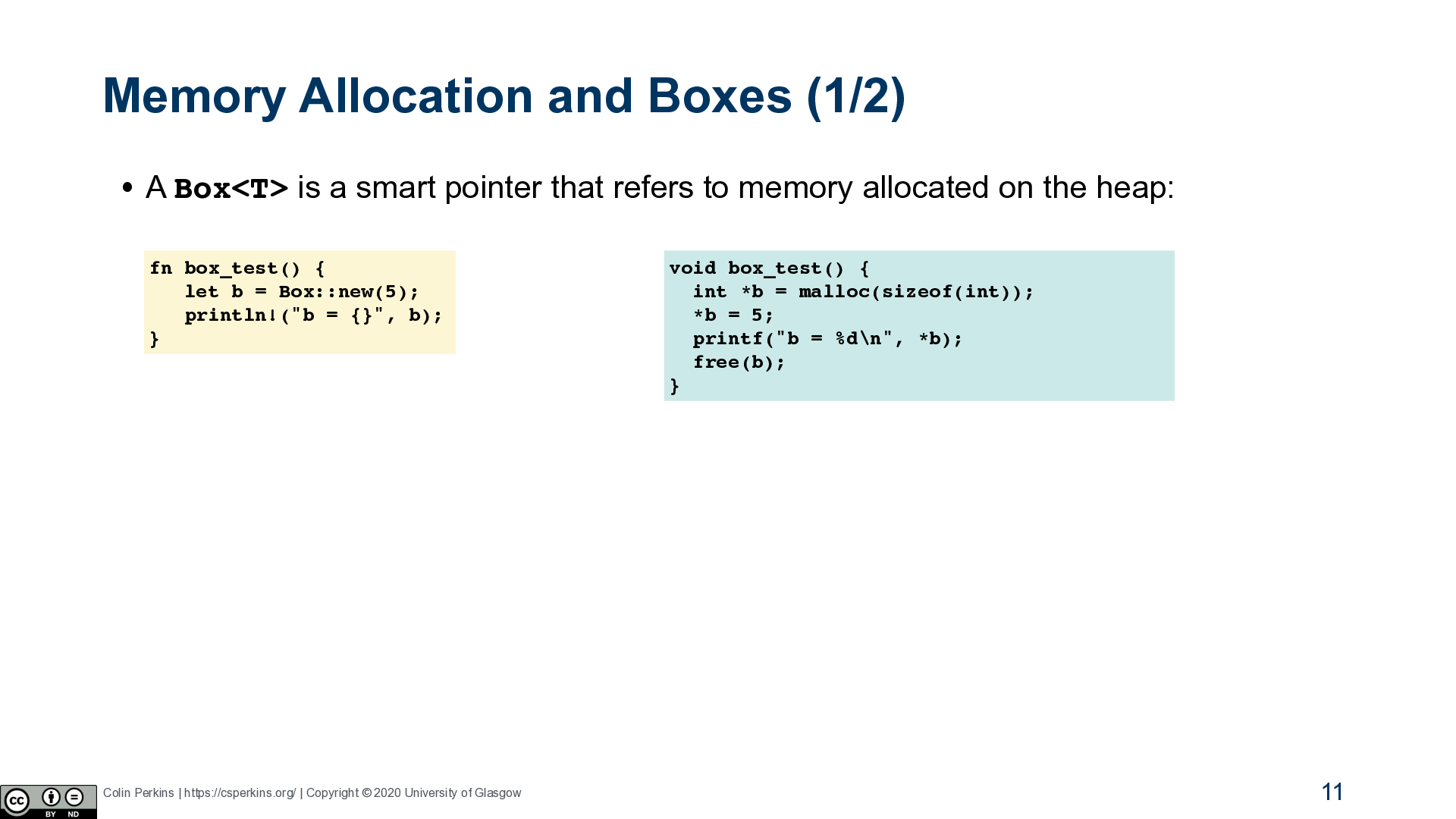
00:06:37.917
Rust makes it possible to allocate memory on the heap.
00:06:42.458
In C, memory on the heap
00:06:44.625
is allocated using the malloc() function.
00:06:47.959
This takes as it's argument
00:06:49.542
the size of the required allocation,
00:06:51.875
and returns a pointer to uninitialised heap memory,
00:06:54.792
of the appropriate size.
00:06:57.333
The value can then be stored in the allocated memory
00:07:00.166
by writing to the dereferenced pointer.
00:07:03.875
We see this in the code on the right hand side of the slide,
00:07:07.291
where the malloc() call allocates space for an integer
00:07:10.750
and assigns this to the pointer, b.
00:07:13.583
Then, in the next statement,
00:07:15.834
the code write the value five to the allocated space.
00:07:21.458
Rust uses a type known as Box
00:07:24.750
to refer to heap allocated memory.
00:07:28.583
The Box type is a smart pointer type
00:07:31.875
that references an object of type T
00:07:34.583
that's stored on the heap.
00:07:36.583
In the code on the left,
00:07:38.417
the statement let b = Box::new(5) creates a new box.
00:07:46.291
While the equivalent C code allocates the memory,
00:07:49.291
and then separately assigns a value to that memory.
00:07:52.583
The box new function is given the value to be stored
00:07:56.333
and allocates the memory and stores the value in one call.
00:08:01.291
That is, when we write Box::new(5)
00:08:05.375
we're not saying allocate five bytes of memory.
00:08:09.083
Rather we're saying, allocate enough
00:08:11.125
memory to hold an integer
00:08:12.834
and store the integer value "5" into that memory.
00:08:18.041
The implementation of box,
00:08:19.667
is as a pointer to the heap allocated memory.
00:08:23.083
The variable, b, is represented in exactly the same way
00:08:27.083
and the Rust code and in the C Program.
00:08:29.917
The differences in the way allocation
00:08:32.083
is exposed to the programmer.
00:08:37.083
The result is that memory allocation in Rust
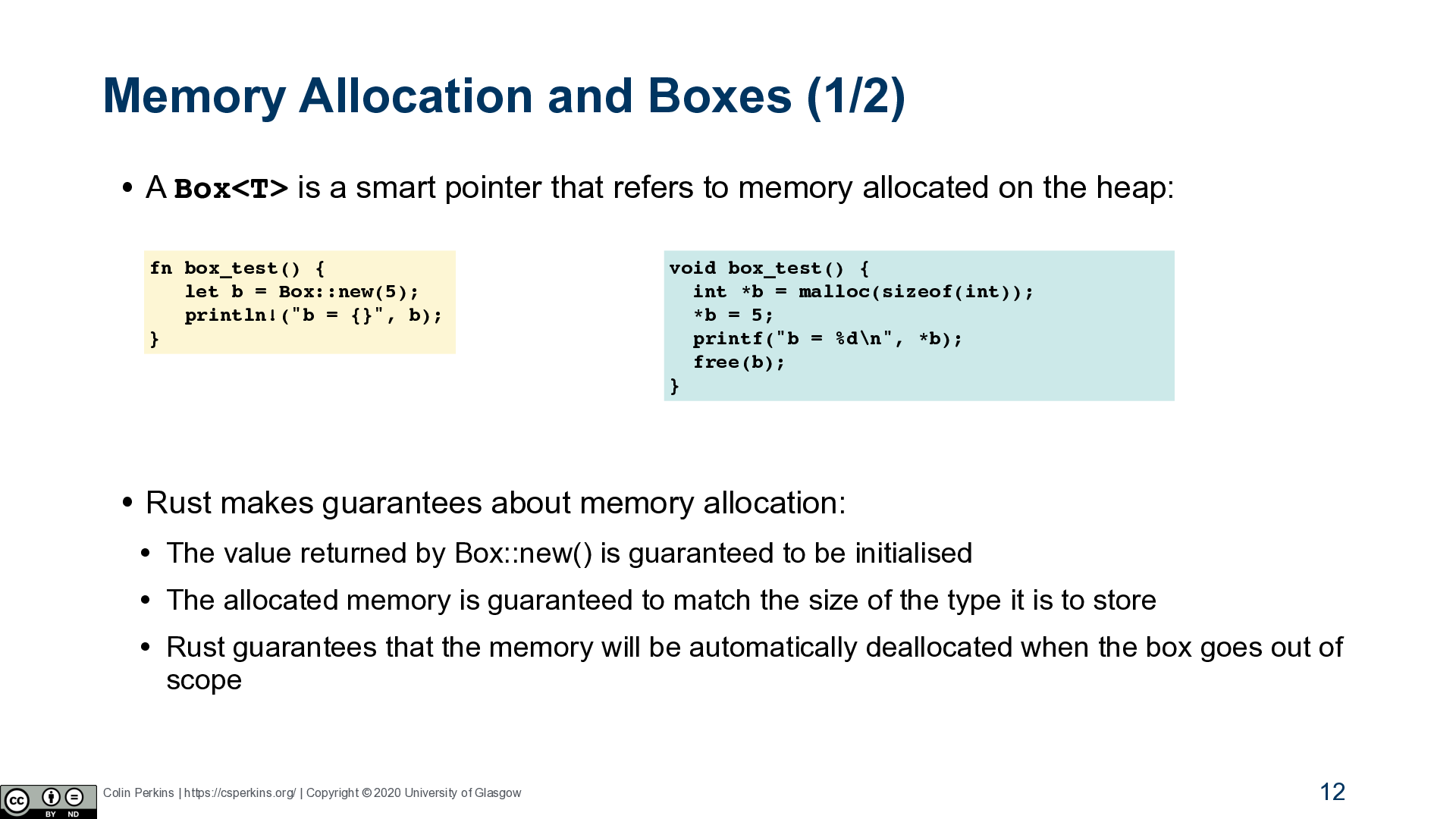
00:08:39.834
is safer than the equivalent in C.
00:08:42.583
There are three reasons for this.
00:08:46.542
First, the value returned by the Box::new() call
00:08:50.333
is guaranteed to be initialized.
00:08:52.875
There's no way to read from uninitialized memory in Rust,
00:08:56.667
whereas C allows you to read from the allocated memory,
00:08:59.542
before making an assignment,
00:09:01.166
which gives undefined unpredictable behavior.
00:09:05.583
Second, the application is guaranteed
00:09:08.458
to be the correct size in Rust.
00:09:11.542
The C language makes no attempt to check
00:09:14.708
that the size of the memory allocated by malloc()
00:09:17.542
matches the size of the object stored in that memory,
00:09:20.959
and has undefined, and unpredictable behavior,
00:09:24.291
if the object is larger than the allocation.
00:09:28.333
And, finally, Rust guarantees that the memory will be
00:09:31.417
automatically deallocated when the box goes out of scope.
00:09:35.875
In C it's necessary to manually call the free() function
00:09:40.000
to deallocate memory, and it's easy to either forget
00:09:43.834
to the free memory, wasting resources,
00:09:46.250
or to free memory too early, leading to undefined behavior.
00:09:53.792
By default, a box in Rust is immutable
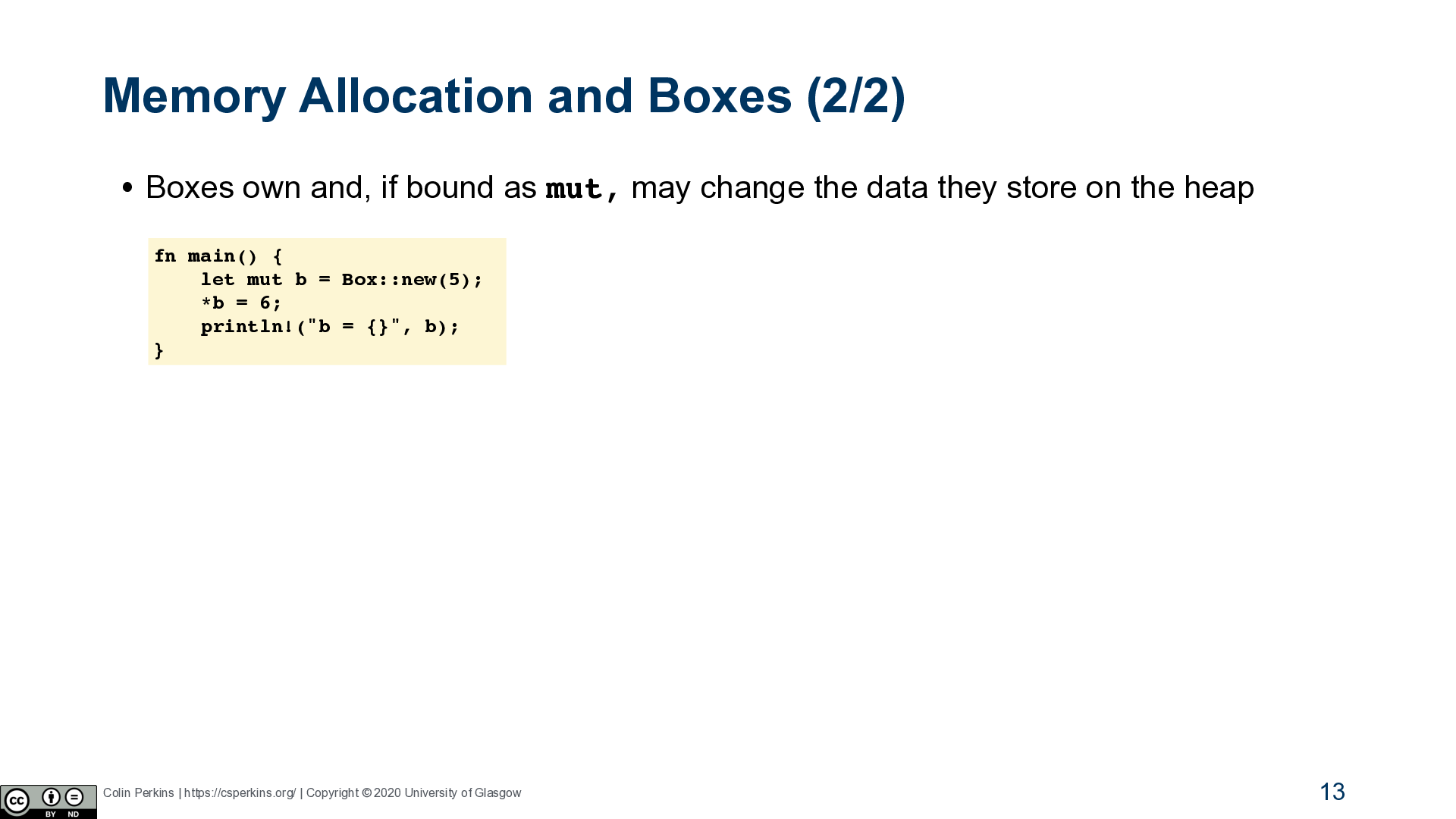
00:09:57.583
and its contents cannot be changed.
00:10:00.291
A mutable box can be created
00:10:02.500
that does allow the value to change,
00:10:04.708
using the "let mut" syntax, as shown.
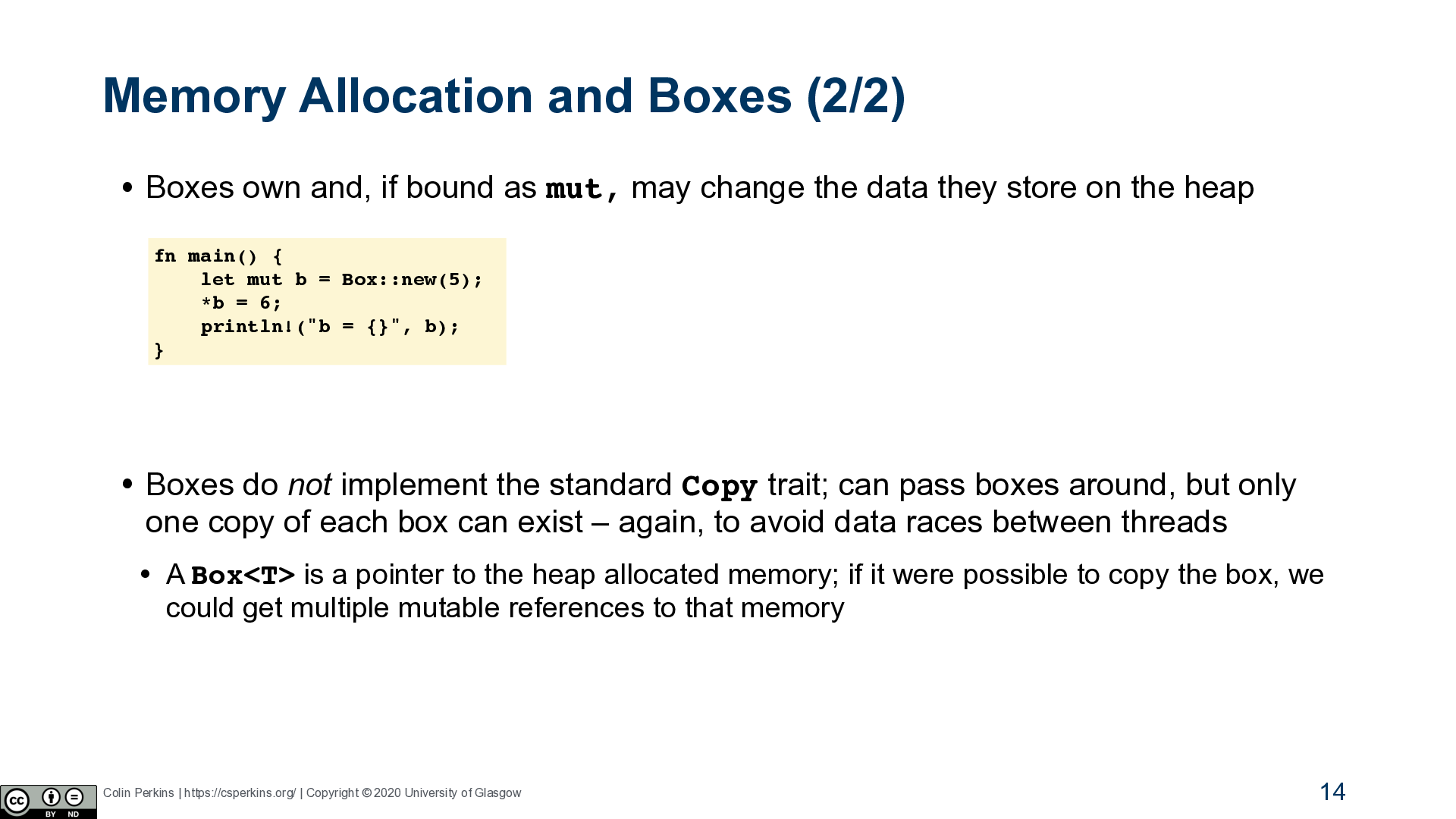
00:10:10.333
Finally, boxes in Rust
00:10:13.000
do not implement the standard copy trait.
00:10:16.834
This means that you can pass boxes around,
00:10:19.542
but you cannot make copies of them.
00:10:23.000
It's guaranteed that only one copy of a box exists.
00:10:29.000
The Box type is a pointer
00:10:31.583
to memory allocated on the heap.
00:10:34.000
If it were possible to make a copy of the box,
00:10:36.792
then it would be possible to create several pointers
00:10:39.000
to the same object.
00:10:41.500
In the same way that Rust prevents you from taking
00:10:43.917
several mutable references to the same object,
00:10:46.917
it also prevents you from creating several pointers to the
00:10:50.417
same object via boxes.
00:10:53.000
And, as with mutable references,
00:10:55.458
this is to prevent data races between threads.
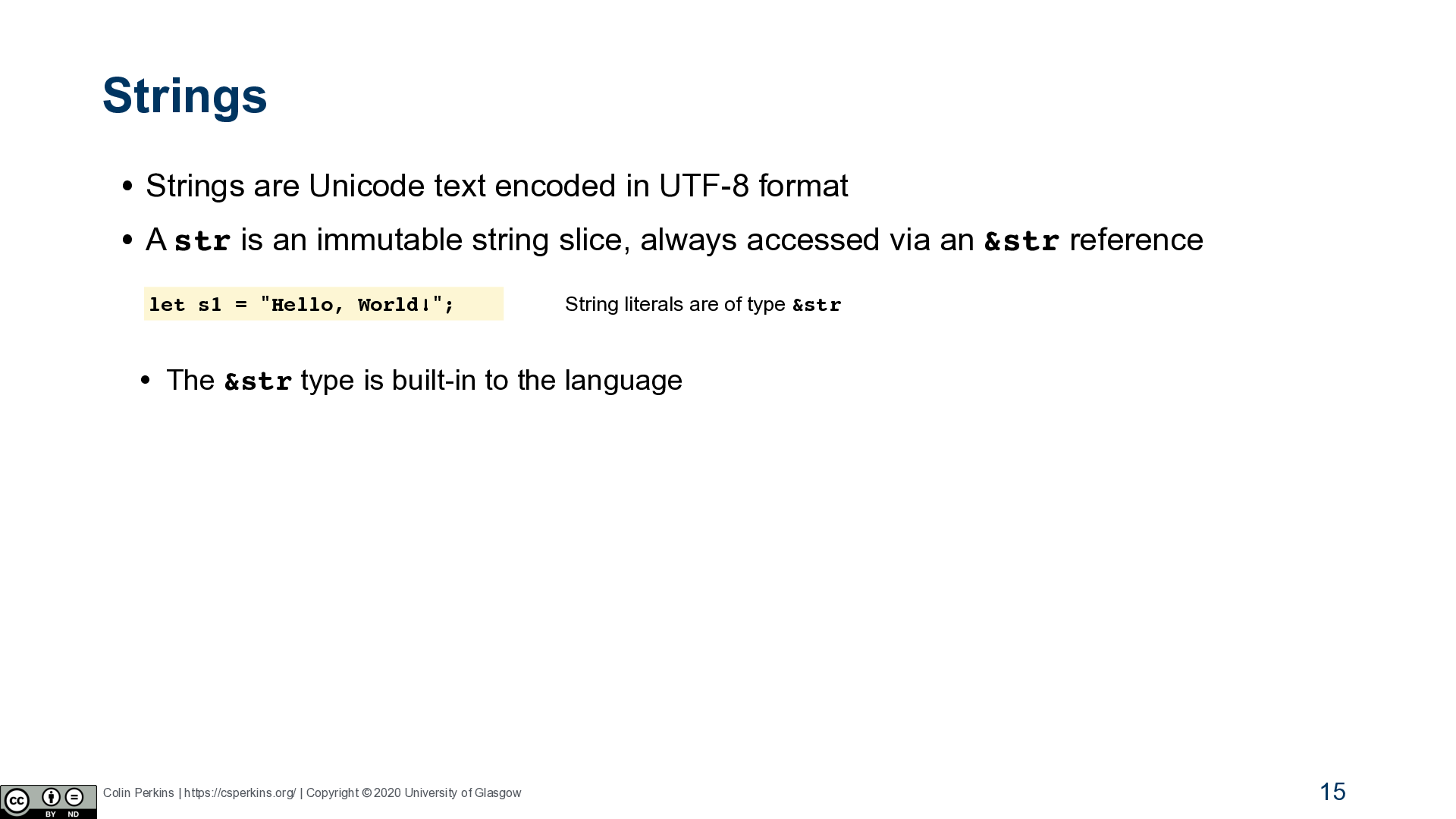
00:11:01.208
Strings in Rust are defined to be unicode text
00:11:04.708
and are encoded in UTF-8 format.
00:11:08.375
This allows them to represent
00:11:10.000
the full range of internationalized text.
00:11:13.208
Somewhat confusingly, there are two string types in Rust.
00:11:18.500
A str is an immutable string slice
00:11:21.875
that's always accessed via an immutable reference as &str.
00:11:27.917
String literals in Rust,
00:11:30.250
as we see on the slide, are of type &str.
00:11:34.917
The &str type is built into the language
00:11:37.959
as a primitive type.
00:11:42.417
In contrast, a string is a mutable string buffer type
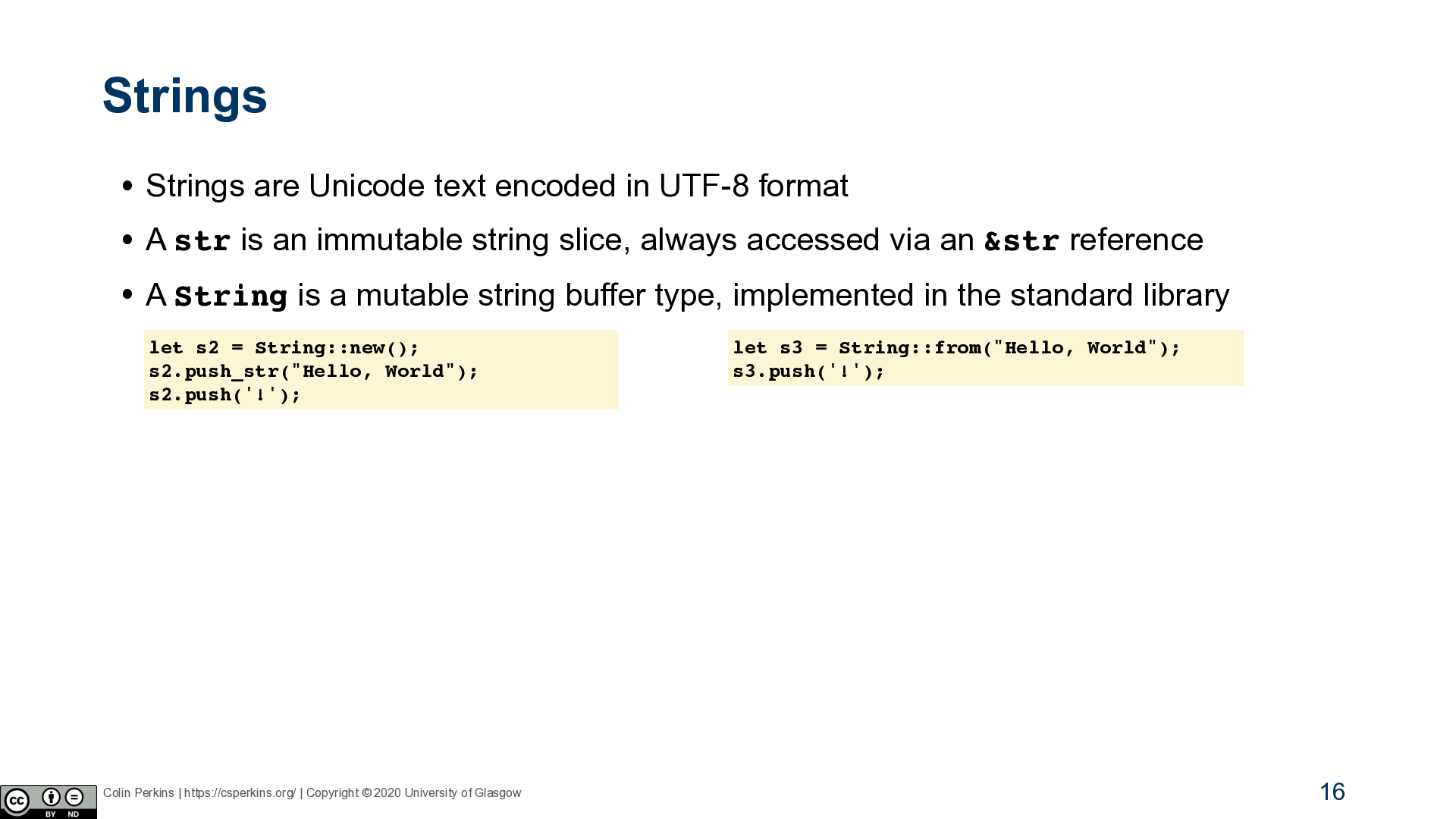
00:11:47.083
implemented in the standard library.
00:11:50.208
Essentially it's a mutable box
00:11:52.667
pointing to an array holding text in UTF-8 format.
00:11:57.959
While the variable of type &str cannot change,
00:12:02.083
a string can be modified, as we see on the slide,
00:12:05.750
and can be created from a string literal.
00:12:10.417
If you're a Java programmer,
00:12:12.250
a string in Rust is equivalent to a string buffer in Java.
00:12:17.333
The &str type in Rust is equivalent to a Java String.
00:12:22.417
The names in Rust are confusing.
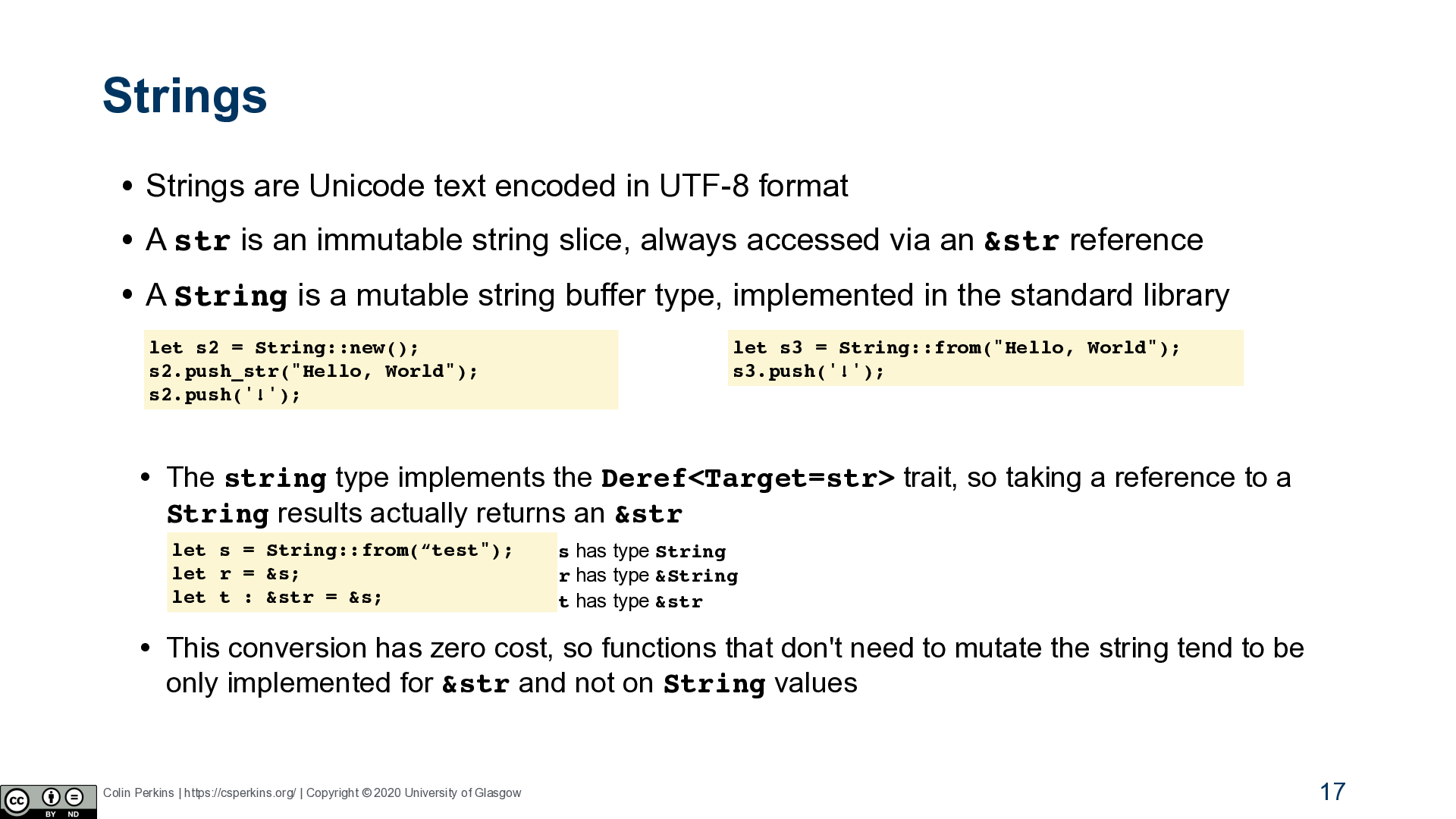
00:12:27.500
Finally, the string type in Rust
00:12:29.834
implements the deref trait from the standard library.
00:12:33.375
This allows the compiler to implement automatic
00:12:36.166
dereferencing for strings.
00:12:39.417
In the example code, the variable s has type String.
00:12:44.083
If we write let r = &s,
00:12:47.583
then we get a reference to that string.
00:12:51.125
The variable, r, has type &String.
00:12:54.375
It's a reference to a String object.
00:12:58.792
If, instead, we take a reference to s
00:13:01.542
and assign it to the variable t,
00:13:03.792
that we've specified as being of type &str,
00:13:07.500
then the compiler uses the implementation of
00:13:09.959
the deref trait to perform the conversion,
00:13:12.834
giving us an &str, an immutable string slice.
00:13:18.917
This type conversion has no runtime cost,
00:13:21.834
since it just involves taking a pointer to the
00:13:24.750
internal mutable buffer of the string type.
00:13:28.208
The usual Rust rules about immutable references
00:13:31.458
mean that the underlying string becomes unchangeable
00:13:34.333
while the &str reference exists.
00:13:38.250
Since this conversion is free,
00:13:40.417
functions that don't need to mutate the string
00:13:43.125
tend to be only implemented for &str
00:13:46.041
and not on string values.
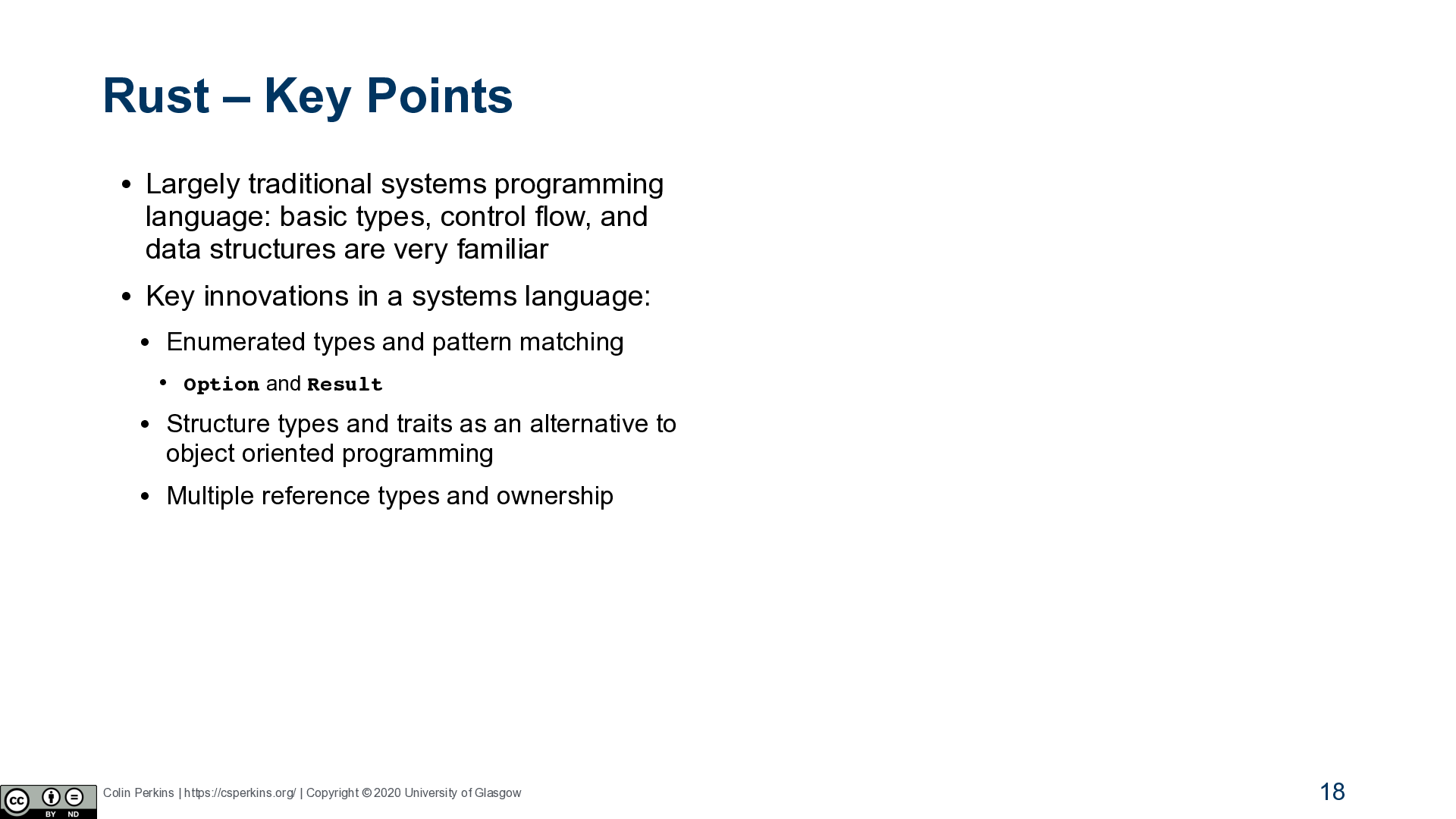
00:13:52.583
That concludes our initial review
00:13:54.667
of the Rust programming language.
00:13:57.500
As should be clear,
00:13:58.959
Rust is largely a traditional systems language.
00:14:02.875
The basic types, control flow, and data structures are very
00:14:07.750
familiar to programmers coming from other languages.
00:14:11.458
But it does make some innovations for systems language.
00:14:16.417
Enumerated types and pattern matching
00:14:19.166
are well known features of functional programming languages.
00:14:22.708
As the Option and Result types.
00:14:25.708
But they've not previously been used in systems programming.
00:14:30.125
Similarly, the use of structures and traits
00:14:33.166
as an alternative to object oriented programming
00:14:35.750
mirrors the use of type classes in Haskell,
00:14:39.125
but it's new in the systems domain.
00:14:43.458
Overall, there's relatively little in Rust
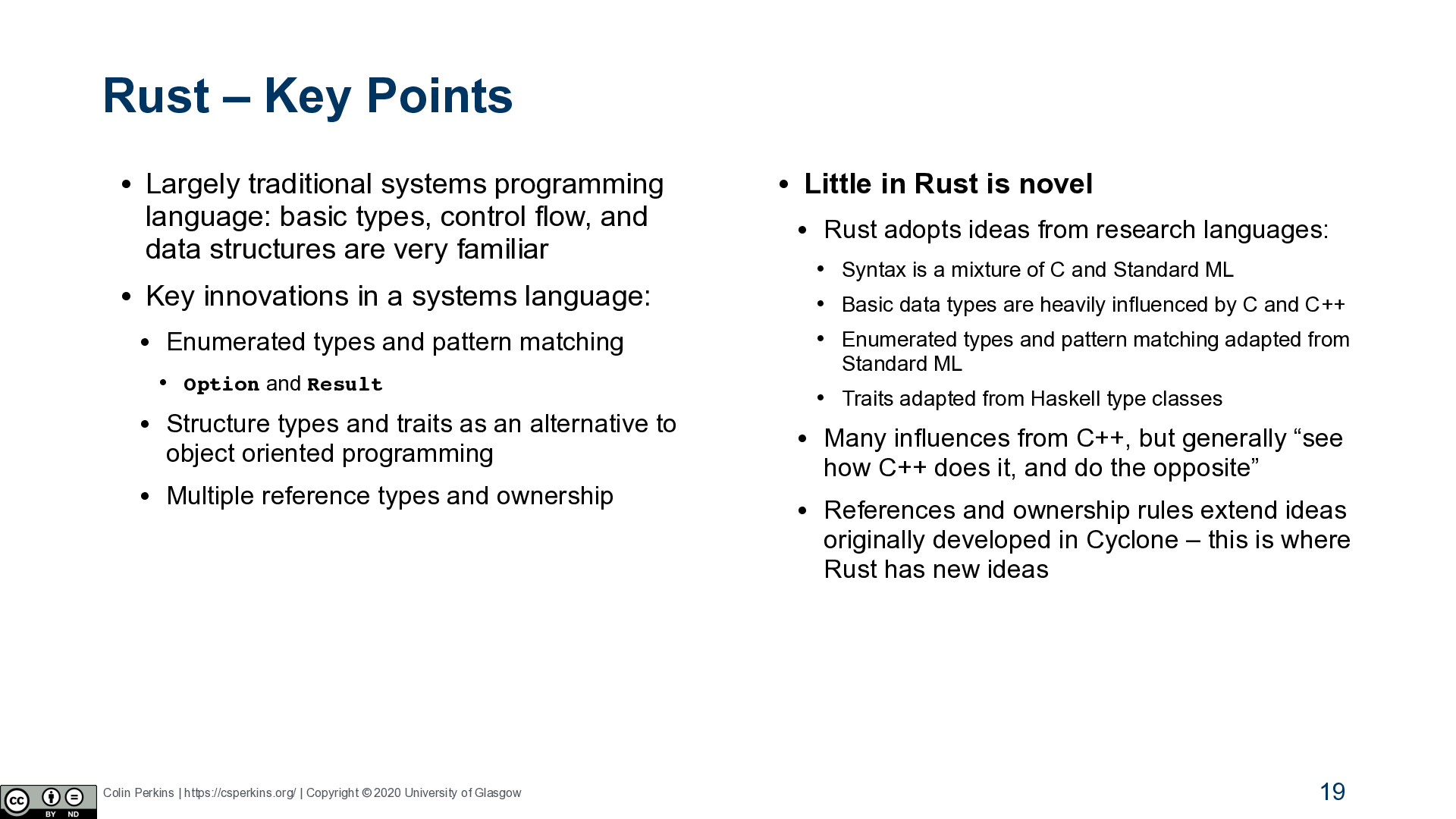
00:14:46.583
that is truly novel.
00:14:49.208
The syntax is a little is a little different from that of C,
00:14:52.750
but where it differs
00:14:54.250
it mostly takes inspiration from Standard ML.
00:14:58.291
The basic data types closely match those of C.
00:15:02.667
Enumerated types and pattern matching
00:15:05.333
come from the Standard ML language.
00:15:07.625
And Standard ML was an influential functional
00:15:10.500
programming language, developed back in the 1980s,
00:15:13.375
that was widely used for teaching functional programming
00:15:16.250
before Haskell was developed,
00:15:17.583
and so was quite familiar to programmers
00:15:20.125
10-20 years ago.
00:15:24.417
Traits are adapted from Haskell type classes,
00:15:27.667
and there are many influences from C++,
00:15:30.583
but these are generally of the form of looking
00:15:33.125
at how C++ solves a problem, and doing the opposite.
00:15:37.834
Rust tends to favor the safe default,
00:15:40.500
while C++ tends to prefer performance,
00:15:43.542
and makes the safe choice an option.
00:15:47.250
The one area where Rust is novel it's memory management.
00:15:51.708
The ideas around references and ownership
00:15:54.250
that we've touched on in this lecture and we'll talk,
00:15:57.125
more about later in the course, are unique to Rust.
00:16:01.458
Although, even here, they're influenced by previous work
00:16:04.542
on a research language known as Cyclone
00:16:07.000
developed by AT&T and Cornell University in the early 2000s.
00:16:15.125
What makes Rust an interesting language?
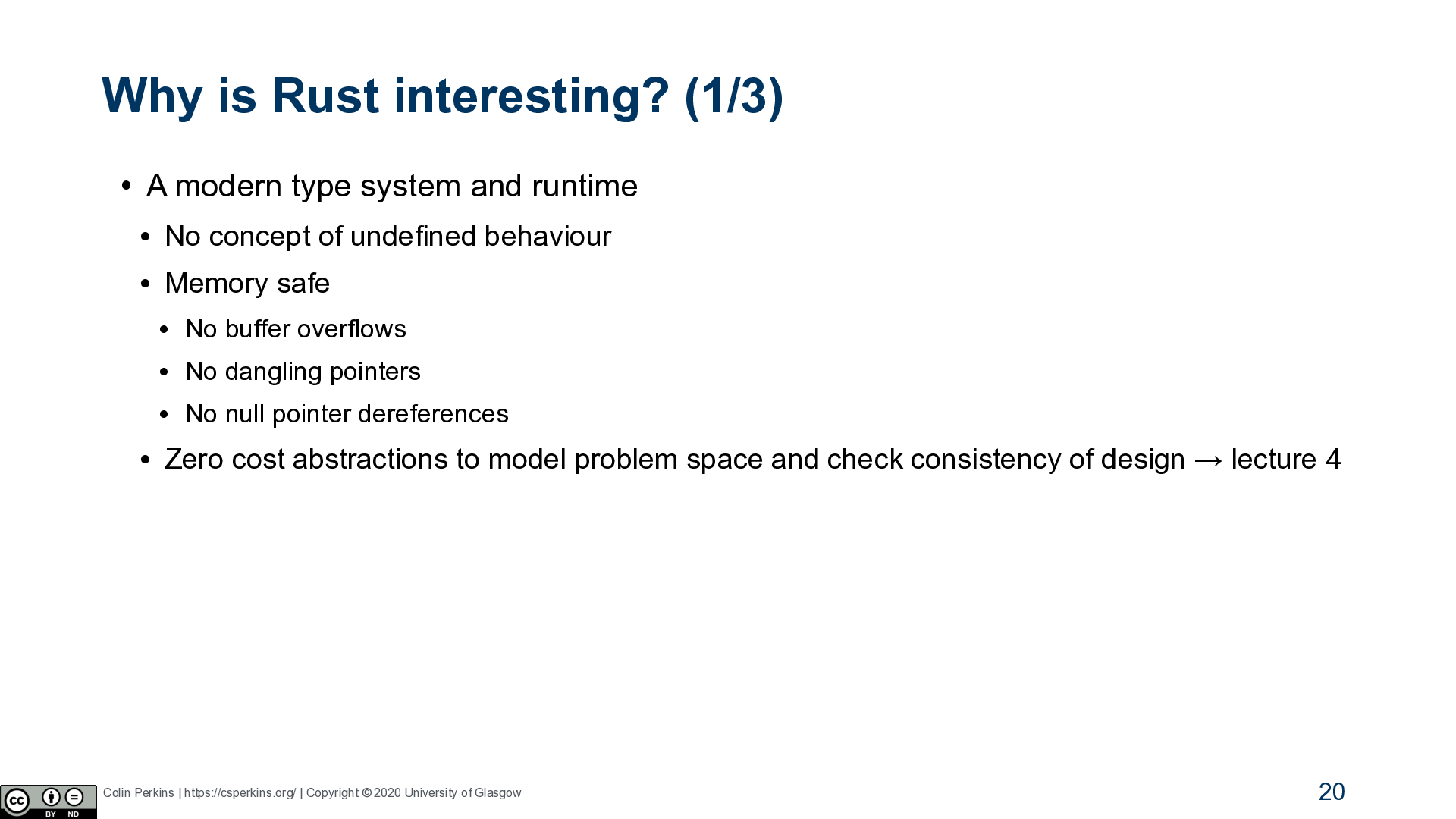
00:16:19.792
Well, it employs a safe, modern type system.
00:16:25.041
It has no concept of undefined behavior.
00:16:28.542
And its memory safe.
00:16:31.208
Rust programs don't suffer from undefined behavior
00:16:33.792
due a buffer overflows,
00:16:35.333
dangling pointers, or null pointer dereferences.
00:16:39.250
And the type system is expressive enough,
00:16:41.792
with enough zero cost abstractions,
00:16:44.333
that it can be used to model the problem space,
00:16:47.125
and check designs for consistency,
00:16:49.542
as we'll discuss in lecture four.
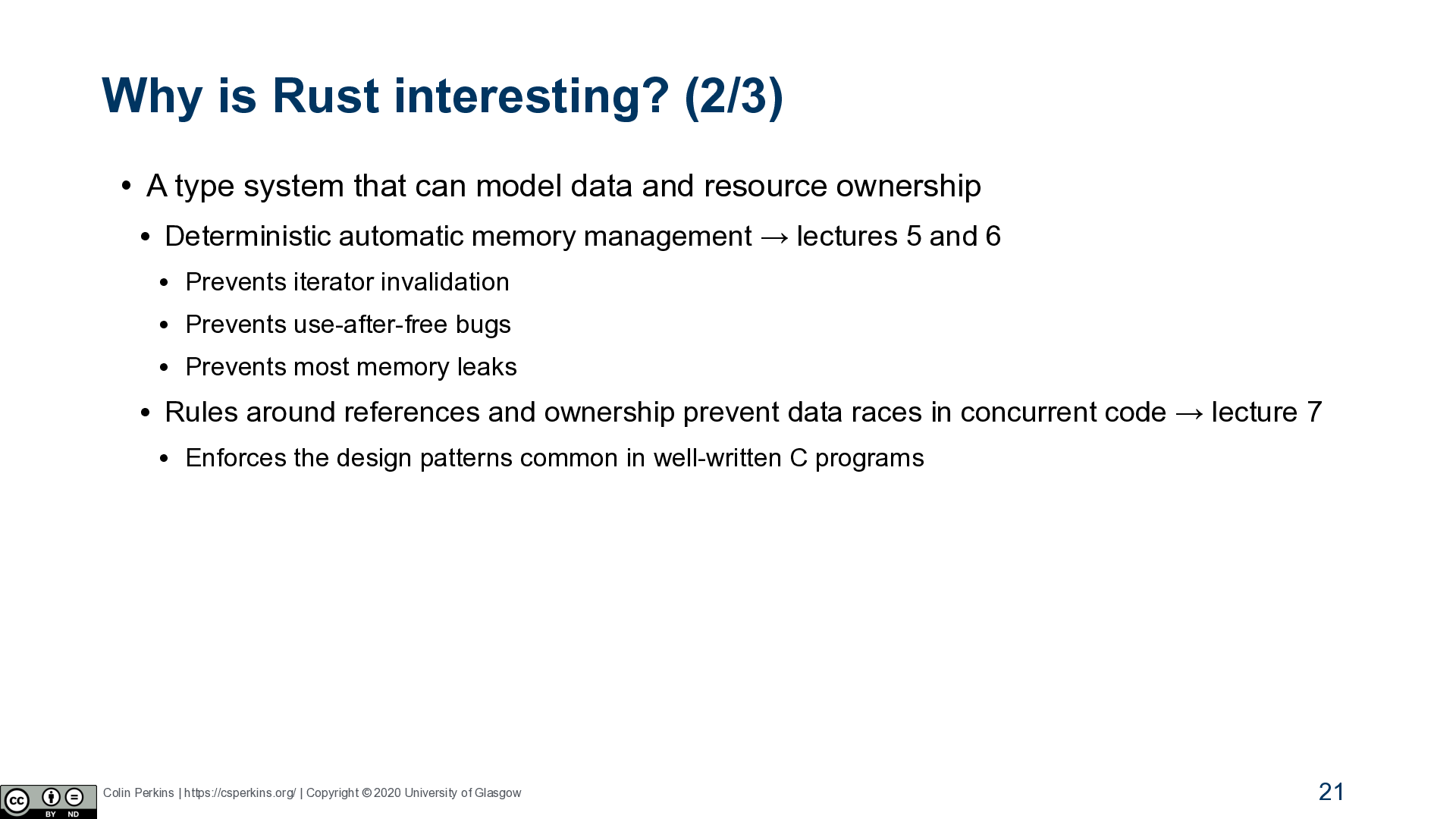
00:16:54.417
Rust is interesting
00:16:56.041
because it has a type system that can model
00:16:58.083
data and resource ownership.
00:17:00.458
It provides deterministic automatic memory management
00:17:03.625
that prevents iterator invalidation,
00:17:05.583
use after free bugs, and most memory leaks.
00:17:09.000
And that lets us model state machines,
00:17:11.417
and resource use in state machines,
00:17:13.750
in a way that makes it easier to validate
00:17:15.750
system designs for correctness.
00:17:18.291
We'll talk more about this in lectures, five and six.
00:17:22.750
And Rust has rules around references and ownership
00:17:25.667
that prevent data races in concurrent code,
00:17:28.417
that enforce the design patterns that are common
00:17:31.375
in well written C programs.
00:17:34.333
We'll talk more about these in lecture seven.
00:17:39.583
And, fundamentally, Rust is a systems programming language
00:17:43.083
that eliminates many classes of bug
00:17:45.417
that are common in C and c++ programs,
00:17:48.583
and makes it easier to write correct software.
00:17:55.959
That concludes this lecture.
00:17:58.250
I've discussed what is a strongly typed language,
00:18:01.125
and hopefully shown you why it's desirable.
00:18:04.166
And I've began to introduce the Rust language,
00:18:06.583
which is one example of a modern,
00:18:08.375
strongly typed, systems programming language.
00:18:11.750
In the next lecture, I'll move on to discuss
00:18:14.333
how we can use typing to help model the problem domain,
00:18:17.417
and write more robust programs.
Discussion
Discussion will include presentation and discussion of the slides you
prepared in lab 2, considering the energy
efficiency of programming languages and their impact on the carbon
footprint of a system, plus the material below.
The lecture focussed on the definition of a type system and of strongly
typed languages. It discussed the benefits of strongly typed languages,
and introduced the Rust programming language as an example of a modern,
strongly typed, systems programming language. Before the discussion
session, review what are type systems and how do they differ between
the various programming languages you have used. Begin to learn about
the Rust language, and what features it has that are familiar and which
are less so.
Think about strongly and weakly typed languages in the context of safe
and unsafe programming. A safe language, whether static or dynamic,
know the types of all the variables and only allows legal operations;
results of a program using only strong types are well-defined. An
unsafe language, on the other hand, allows the types to be circumvented
to perform operations the programmer believes correct, but the type
system can’t prove to be so.
Think about what is the trade-off between safe and unsafe languages
for systems programming? Can systems programs be written entirely
in a safe language, or is some escape hatch into unsafe behaviour
needed?
Lecture 3 focussed on Rust, a modern systems programming language with
a strong static type system. Rust is a largely traditional systems
programming language: the basic types, control flow, and data
structures are very familiar. Its key innovations for a systems
language are enumerated types and pattern matching, the use of
structure types and traits as an alternative to object oriented
programming, and the use of multiple reference types and ownership
tracking for memory management.
From what you have seen so far, does Rust provide the right set of
features for a systems languages? How does it compare with other
languages you've used? Do you have questions about Rust?