Lecture 9: Security Considerations
Lecture 9 discusses security considerations in systems programming.
It discusses the key role memory safety plays in secure software,
and highlights the undefined behaviours that results from lack of
memory safety, and that can lead to security vulnerabilities. The
benefits of programming in a strongly typed, memory safe, language
are highlighted. Later parts of the lecture discuss approaches to
safely handling and parsing data received from the network, and
the possible benefits of type-driven design for security.
Part 1: Memory Safety
The first part of the lecture discusses the importance of memory safety
and discusses how the lack of memory safety frequently leads to security
vulnerabilities.
With reference to the type system of a language, it describes what is
memory safety and introduces the concept of undefined behaviour in
languages that are not memory safe. This is followed by a description
of various types of undefined behaviour, relating to lack of memory
safety, that can occur in C programs. The lecture concludes by
highlighting some statistics around the prevalence of memory safety
related security vulnerabilities in systems code over the years, and
suggests various mitigations and approaches to help move away from
memory unsafe code.
00:00:00.433
In this lecture I want to discuss
00:00:02.333
some security considerations when writing systems programs.
00:00:06.700
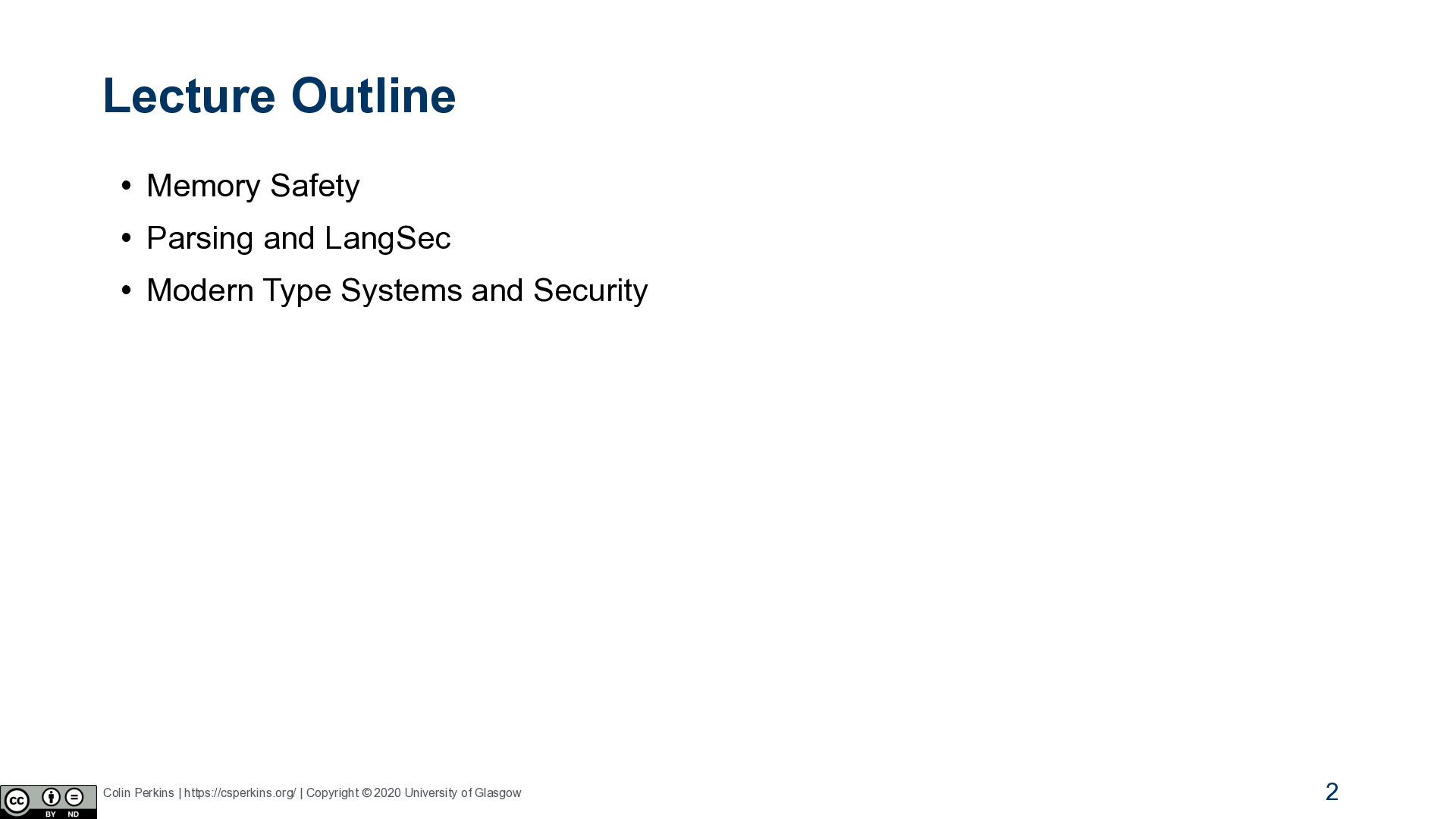
In this part, I’ll start by talking
00:00:08.433
about memory safety, and some of the
00:00:10.066
issues with memory safety, and the lack
00:00:12.566
of memory safety, and how they affect
00:00:15.200
security vulnerabilities.
00:00:16.966
And then, in the later parts,
00:00:18.166
I’ll talk about parsing and some language
00:00:21.100
theoretic approaches to securing parsing. And I’ll
00:00:24.666
talk about the benefits of modern type systems for security.
00:00:30.266
So let's begin by talking about memory safety,
00:00:33.166
and talk a little about what
00:00:34.900
is memory safety, and the types of
00:00:36.966
undefined, memory-unsafe, behaviours you see in C
00:00:40.666
and C++. I’ll talk about the security
00:00:43.833
impact of memory unsafety, and the mitigations
00:00:47.233
that can be applied.
00:00:52.033
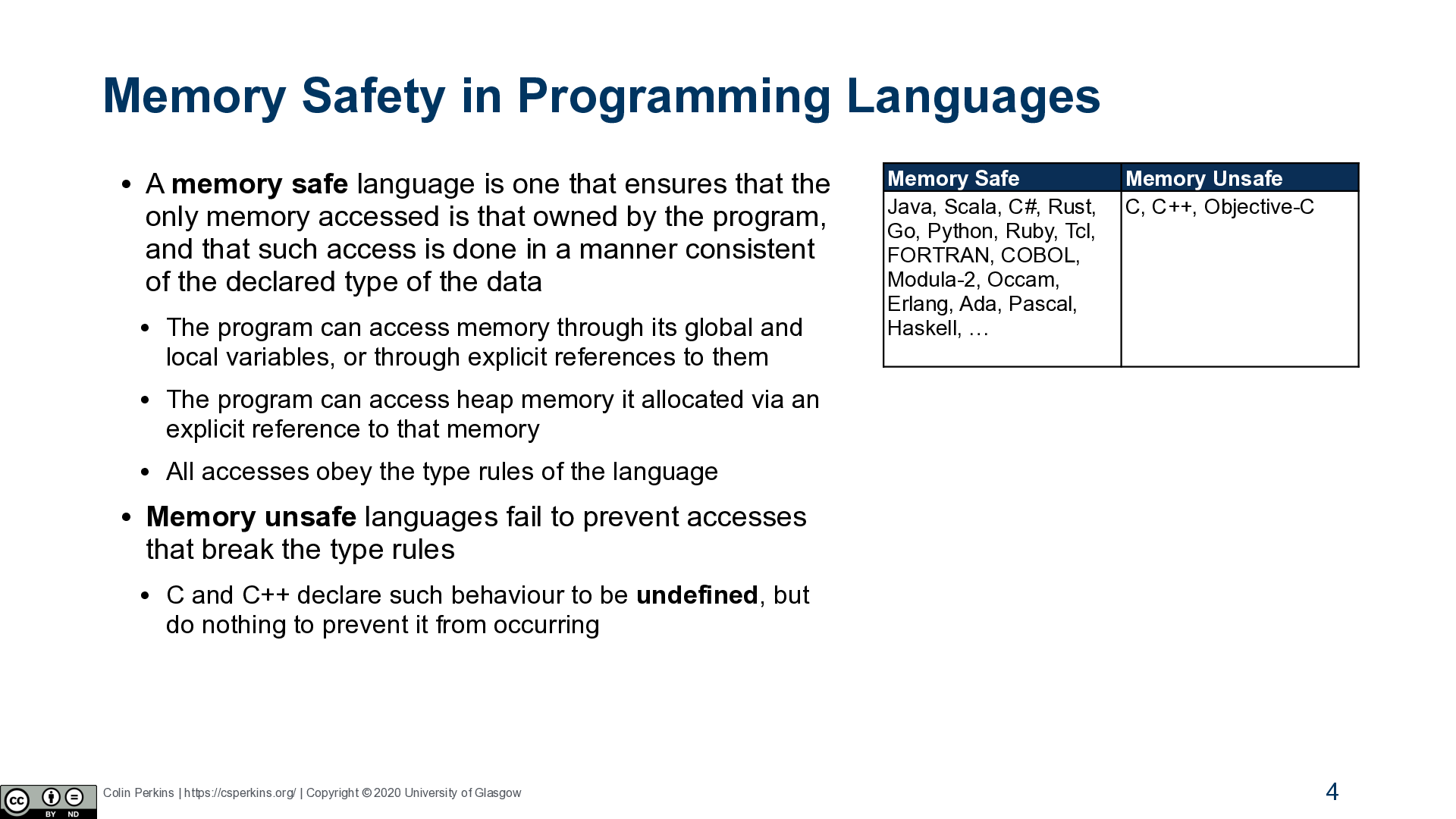
So what is memory safety?
00:00:55.200
Well, a memory safe language is a
00:00:58.500
language that assures that the only memory
00:01:02.366
that can be accessed is that which
00:01:03.733
is owned by the program, and that
00:01:06.000
all access to that memory are done
00:01:08.566
in a manner which is consistent with
00:01:10.333
the types of data.
00:01:13.300
So the program can only access memory
00:01:15.933
through its global variables, through its local
00:01:18.566
variables, or through explicit references from them.
00:01:21.800
It can't access memory which isn't in
00:01:24.066
any of its variables, or isn't referenced
00:01:26.500
from any of those variables.
00:01:28.833
It can only access heap memory if
00:01:30.500
it's got an explicit reference to that
00:01:32.133
memory, and the way in which it
00:01:33.966
accesses memory is consistent with the type
00:01:36.100
of the memory. If the value is
00:01:38.566
written into memory as an integer,
00:01:40.300
it can’t be read back as a
00:01:41.633
floating point value, for example,
00:01:44.033
unless there's an explicit conversion in scope.
00:01:47.866
It can't treat the data inconsistently for different types.
00:01:53.166
A memory unsafe language is a language
00:01:56.333
which fails to prevent accesses which break
00:01:59.100
these typing rules. A memory unsafe language
00:02:02.566
is a language which allows access to
00:02:04.300
memory which the program doesn't explicitly own,
00:02:08.100
or which allows memory to be accessed
00:02:10.100
in a type unsafe way.
00:02:13.200
Now there are many examples of safe
00:02:15.400
languages, memory safe languages:
00:02:17.800
Java, and Scala, and Rust, and Go,
00:02:20.400
and Python, and Ruby, and Tcl,
00:02:22.300
and FORTRAN, and COBOL, and Modula-2,
00:02:24.033
and Occam, Erlang, and Ada, and Pascal,
00:02:26.166
and Haskell and a whole bunch more.
00:02:30.833
The ones which are unsafe are a
00:02:32.866
much smaller set: assembly language. C,
00:02:36.900
C++, and Objective C.
00:02:39.766
As far as I know, that's it.
00:02:43.166
And these languages don't prevent accesses which
00:02:48.266
break the type rules, such that they have.
00:02:51.433
What they do is, rather, declare such
00:02:53.133
behaviour to be undefined.
00:02:55.533
They say “you shouldn't do this”,
00:02:57.600
they say “it's not legal to do
00:02:59.100
this”, but in these cases the program will continue
00:03:03.733
if the undefined accesses are performed,
00:03:06.566
it's just not clear what the behaviour
00:03:08.466
will be. It doesn't specify what the behaviour will be.
00:03:16.000
So what does this mean in practice?
00:03:19.366
When a language defines certain types of
00:03:22.100
behaviour to be undefined, what can happen?
00:03:25.066
What types of behaviour are undefined?
00:03:30.766
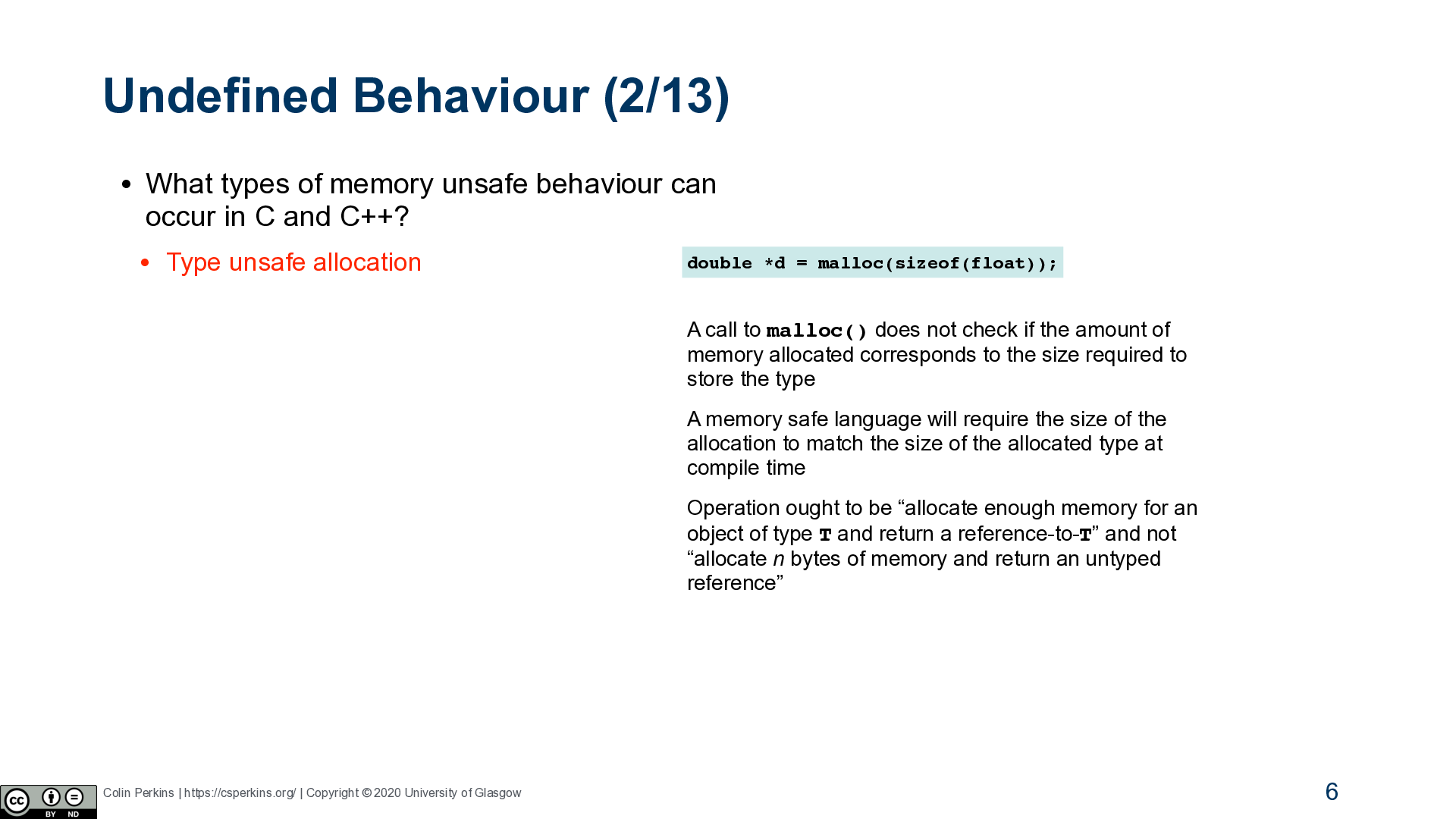
Well, maybe it's a type unsafe allocation.
00:03:35.866
It’s possible to write C code like
00:03:38.166
we see on the slide here,
00:03:39.366
where we allocate memory to hold the
00:03:41.533
size of floating point value, and we
00:03:43.833
reference it as if it was a
00:03:45.966
double precision float.
00:03:48.666
And in this case, what we see
00:03:50.233
is that the call to malloc() does
00:03:52.200
not check if the amount of memory
00:03:53.733
allocated corresponds to the type by which
00:03:57.633
it's being accessed.
00:03:59.400
On a typical 64-bit machine, this is
00:04:03.400
allocating memory for a 32-bit floating point
00:04:07.733
type, and then when it's accessed,
00:04:10.100
it’s accessed as a 64 bit-type,
00:04:12.266
and overflows the space.
00:04:15.800
A memory safe language would require that
00:04:19.366
the size of the allocation match the
00:04:21.700
size of the value which will be stored in it.
00:04:26.066
If you're allocating space for a floating
00:04:28.533
point value, you store floating point values
00:04:31.000
in it. If you try to access
00:04:34.033
to allocate space for a floating point
00:04:35.933
value and access it as a double, it shouldn't compile.
00:04:39.566
So the operation ought to be,
00:04:41.966
allocate enough memory for an object of
00:04:44.366
type T, and return a reference to type T,
00:04:48.400
which can only be assigned to a
00:04:52.400
variable which holds a reference of that type.
00:04:56.866
What we have in C, though, is a
00:04:59.466
function which allocates a certain amount of
00:05:01.700
memory and a returns an untyped reference.
00:05:04.633
And that's where
00:05:06.466
the lack of safety comes in;
00:05:08.100
there's no typing of the allocations.
00:05:10.600
And C doesn't know what's going to
00:05:12.733
be stored in a malloc()-ed value,
00:05:14.366
and therefore it can't check that it's
00:05:16.000
big enough to hold the values that
00:05:17.433
are being stored there.
00:05:21.633
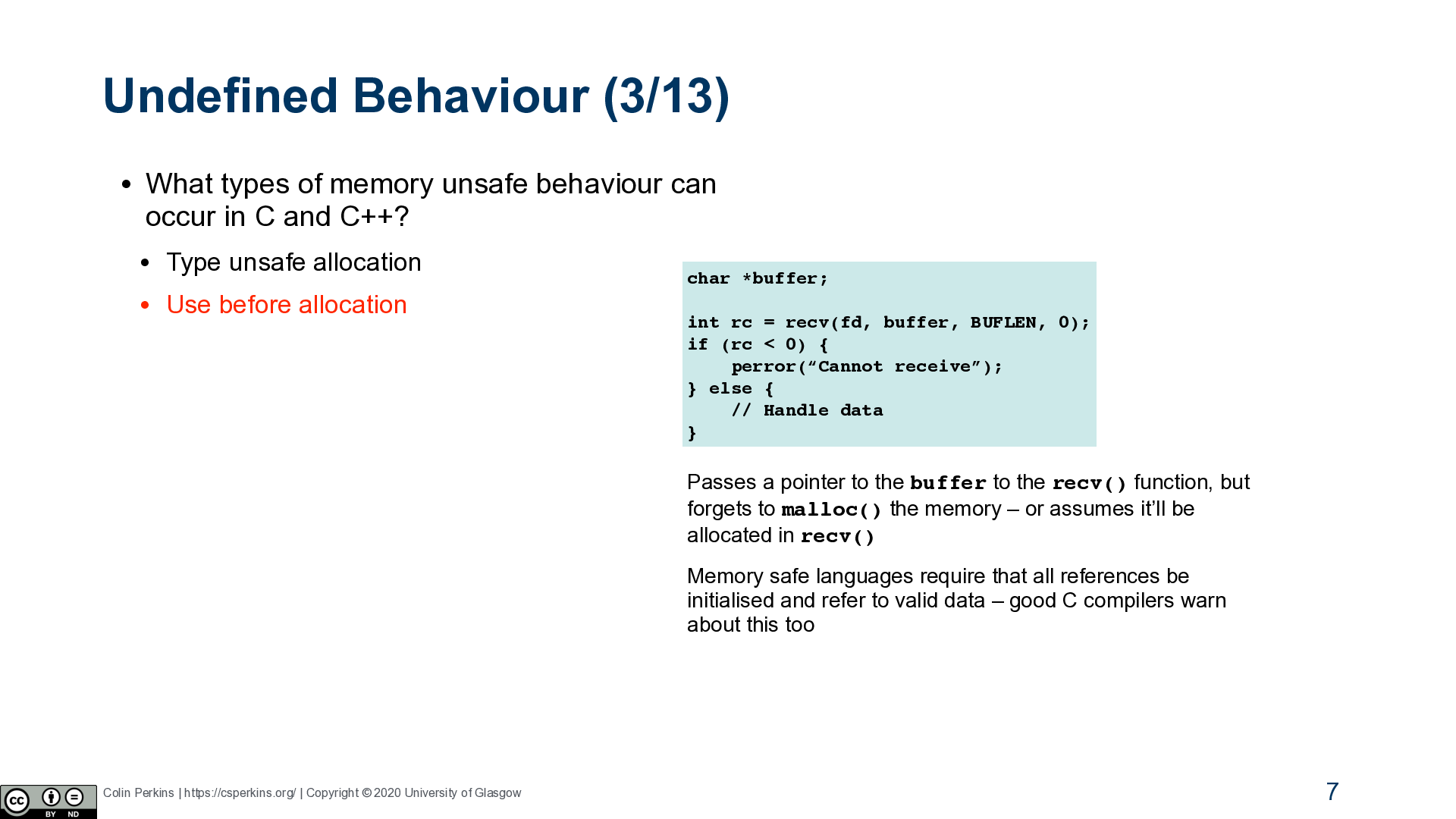
We could be doing a use-before-allocation.
00:05:26.200
In this case, we see code which
00:05:29.666
reads from a file descriptor, for example
00:05:33.266
reading from a network, and it has
00:05:36.266
a char* pointer for a buffer into
00:05:38.733
which it is reading, and it calls
00:05:40.533
the recv() call to read into that
00:05:43.466
buffer, but it never allocates the memory for the buffer.
00:05:47.600
So it passes a pointer to the
00:05:49.800
buffer to the recv() function, but it's
00:05:51.600
forgotten to allocate memory,
00:05:53.400
or the programmer has assumed that the
00:05:55.566
recv() function will do the allocation for
00:05:57.433
them. And the result is that it
00:06:00.233
writes to an arbitrary location, depending on
00:06:02.566
what value happens to be in this uninitialised pointer.
00:06:08.033
A memory-safe language would require that references
00:06:11.400
are initialised, and require that they refer
00:06:14.133
to valid data.
00:06:16.266
So it shouldn't be possible to have
00:06:18.700
an uninitialised reference,
00:06:20.233
a reference that points to nothing.
00:06:25.500
And languages like Rust enforce this.
00:06:28.100
You can't get a reference which is
00:06:30.033
uninitialised in Rust, it always points to
00:06:32.800
a valid value.
00:06:34.466
And, to be fair, good to C
00:06:36.333
compilers will warn about this behaviour.
00:06:38.566
If you turn on the warnings,
00:06:40.333
they’ll warn you, in most cases,
00:06:42.333
that you're accessing an uninitialised pointer.
00:06:45.533
But the C language doesn't require that
00:06:47.733
warning, and allows you to access arbitrary
00:06:50.400
pointers, whether or not they point to valid memory.
00:06:56.233
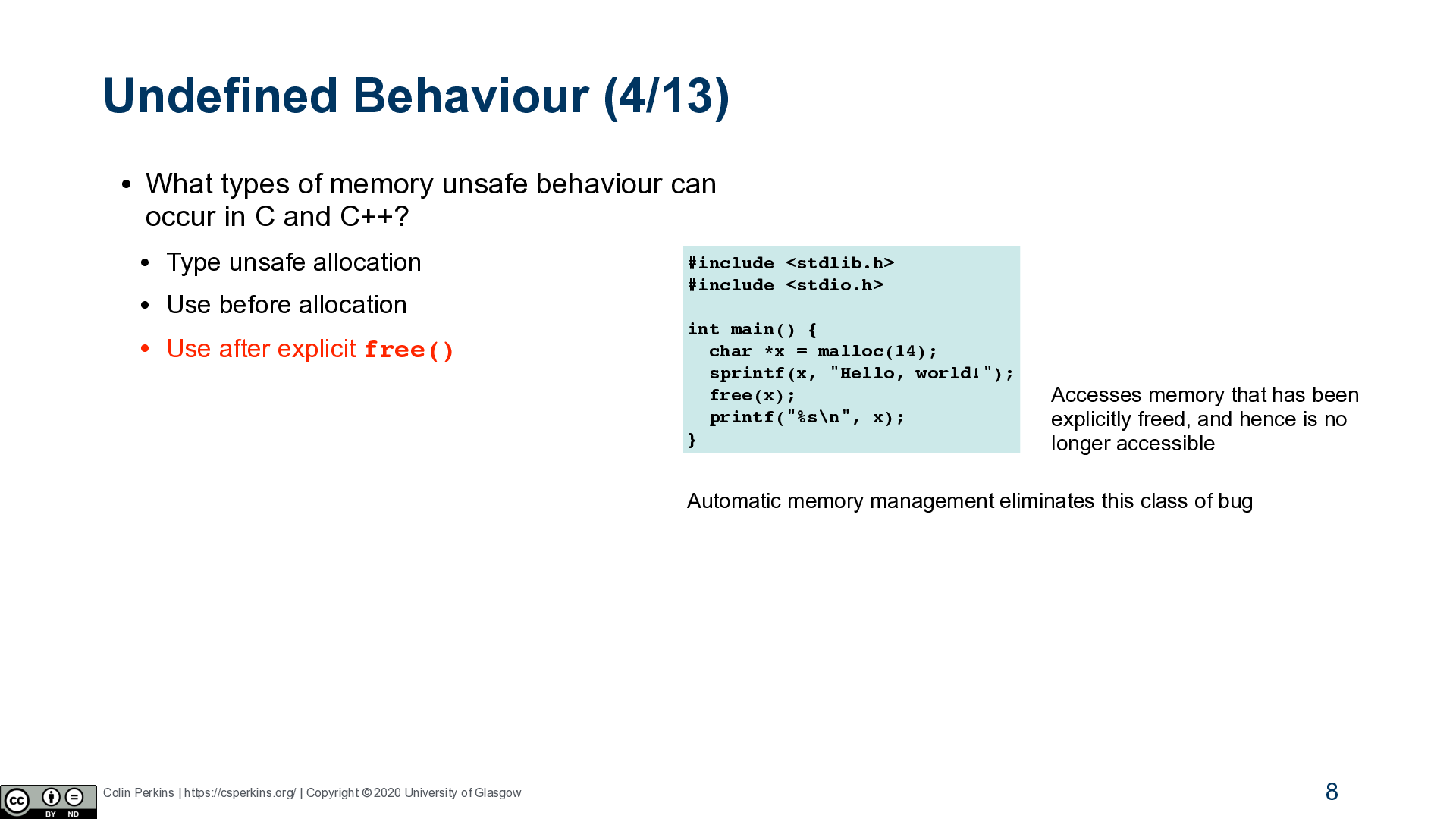
Similarly, C and C++ allow you to
00:07:00.700
use memory after you freed it.
00:07:04.633
And this is a simple example.
00:07:07.233
It allocates 14 bytes of space,
00:07:10.566
writes the string “Hello, world!” into it,
00:07:12.900
frees that memory, and then prints out the value.
00:07:16.933
And, in most cases, this will work,
00:07:20.933
because nothing else is using that memory,
00:07:23.833
because this is only a simple test
00:07:27.000
function with main() in it.
00:07:29.466
But it's this was a larger program
00:07:31.366
with concurrent accesses going on, that memory
00:07:34.500
could have been reused by another thread,
00:07:36.633
and it could print out who knows what.
00:07:40.766
And what happens is entirely undefined.
00:07:45.100
Modern languages, with automatic memory management,
00:07:48.200
avoid this problem.
00:07:50.466
They either fail to compile, or they
00:07:52.500
ensure the memory is held for the
00:07:55.500
appropriate amount of time.
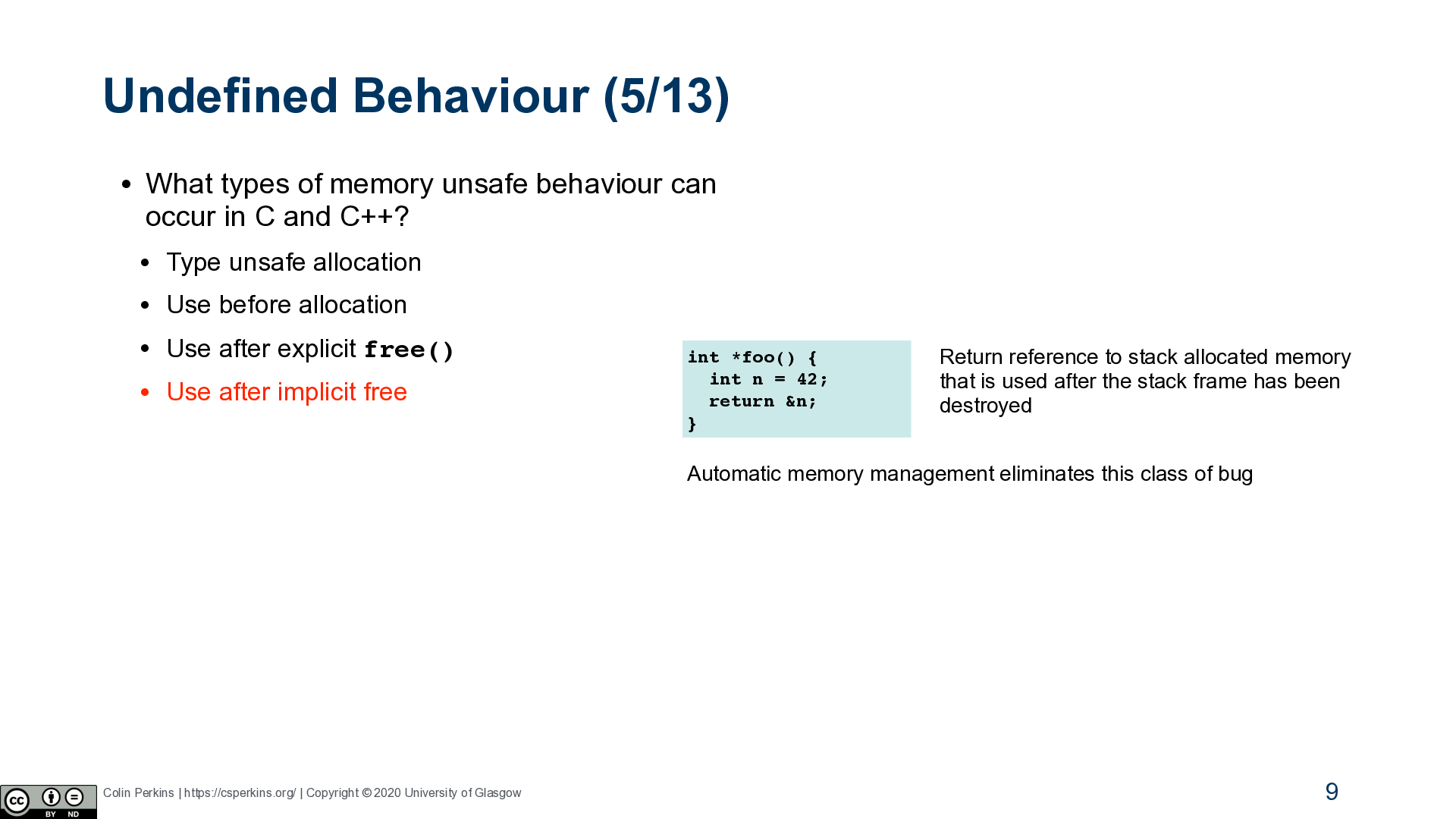
00:07:59.566
Equally, we can access memory implicitly after
00:08:02.833
it’s been freed. The typical example here
00:08:06.033
is a function which returns a reference
00:08:08.733
to stack allocated memory, and once the
00:08:11.500
function returns the stack frame is destroyed,
00:08:13.966
and the reference now points to
00:08:16.433
unallocated memory. And, again, you've got an
00:08:21.433
arbitrary reference, and it's not clear what’s
00:08:24.733
in the memory which is being referred to by that reference.
00:08:29.766
And, again, languages with automatic memory management
00:08:33.100
eliminate this type of bug. Their either
00:08:35.833
hold onto the value so that it
00:08:37.833
can't go away if it's heap allocated,
00:08:41.233
if it's a language with boxed values,
00:08:43.233
or if it's a language like Rust
00:08:45.133
they just won’t compile if you're returning
00:08:47.133
a reference which goes out of scope.
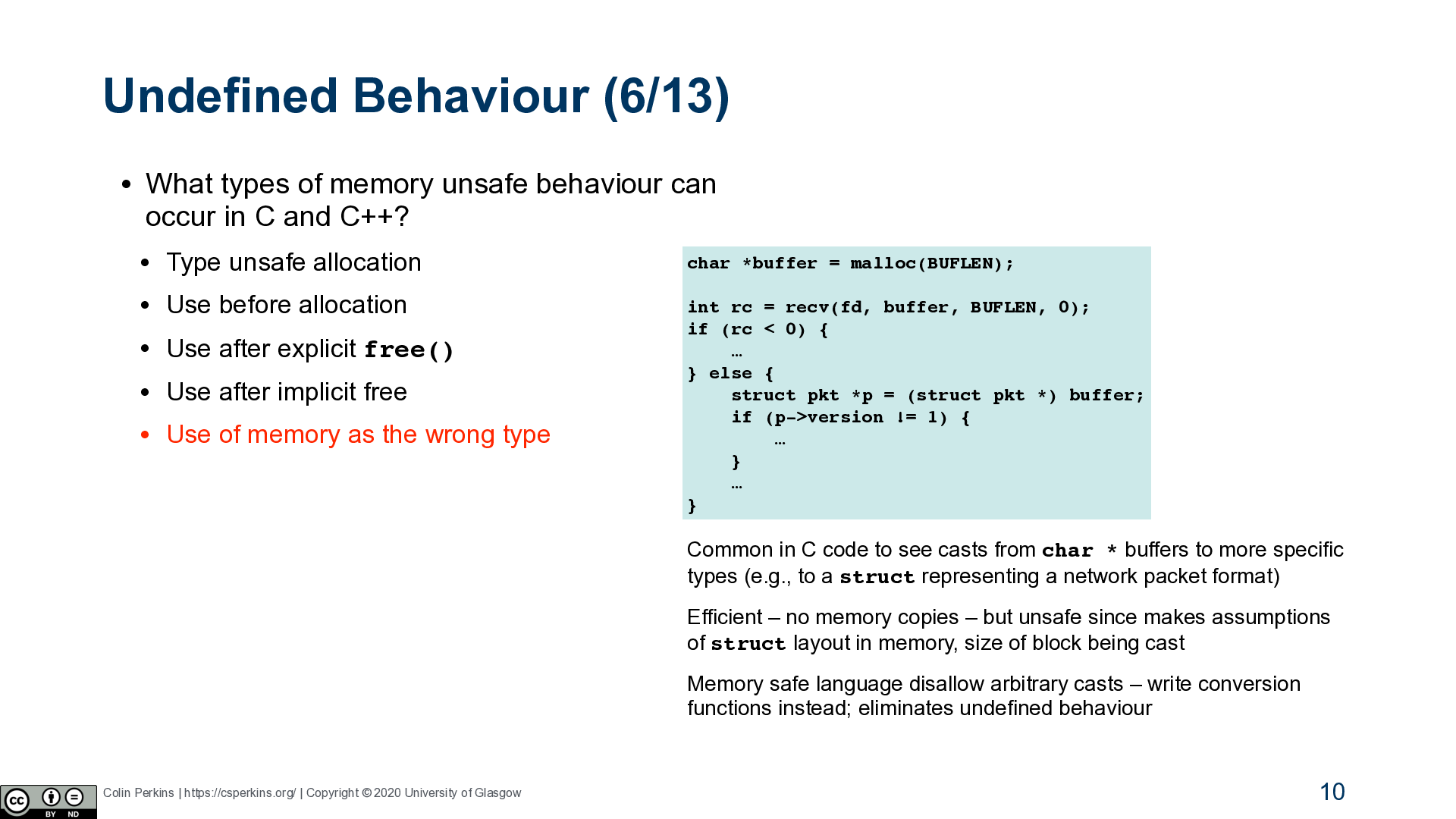
00:08:52.800
Memory unsafe languages can allow memory to
00:08:57.066
be accessed as the wrong type.
00:09:01.033
This is a bit more subtle.
00:09:03.466
The code we have here
00:09:06.633
allocates space for a buffer and reads
00:09:10.566
data into that buffer, for example it
00:09:13.633
could be reading from a socket.
00:09:15.866
And, assuming it successfully reads into that
00:09:17.933
buffer, it then casts the buffer to
00:09:21.300
be a pointer to a different type.
00:09:25.366
And this is quite a common idiom
00:09:27.400
in C code. You see casts from
00:09:29.700
char* pointers representing buffers, to a certain
00:09:33.666
struct, for example, representing a network packet
00:09:37.166
format or representing the header of a file format.
00:09:43.533
And the reason people do this is
00:09:45.500
because it's very efficient. There’s no memory copies.
00:09:49.933
And, assuming that the layout of the struct matches
00:09:53.833
the layout of the data you want,
00:09:55.966
it's a really efficient way of getting
00:09:57.733
a reference to data in the appropriate format.
00:10:03.000
The problem is that it's unsafe.
00:10:05.266
It makes assumptions that the layout of
00:10:08.233
the struct in memory matches the format of the data.
00:10:12.666
And it makes assumptions that the size
00:10:16.533
of the block being cast matches the size of the struct.
00:10:20.900
And these assumptions have a habit of
00:10:24.300
becoming untrue over time.
00:10:28.133
They tend to work at the point
00:10:30.000
the programmer writes the code,
00:10:32.600
otherwise it would it would fail,
00:10:35.400
and wouldn't it wouldn't pass the tests
00:10:37.800
initially. But the problem is that compilers
00:10:40.433
tend to change the way structs are laid out.
00:10:43.966
Changes in the compiler, or changes in
00:10:46.966
the processor, can insert padding between struct elements.
00:10:52.300
And that means that the layout of
00:10:53.766
the struct no longer matches, and the
00:10:55.966
program silently fails and gives unpredictable behaviours.
00:11:00.800
Or, it turns out, the program is
00:11:02.766
run on a big-endian versus a little-endian
00:11:05.633
machine, and silently gives you the wrong values.
00:11:11.200
And, because the type system is being overridden,
00:11:14.900
because the program is essentially saying
00:11:16.666
“trust me, I know what I’m doing”,
00:11:18.466
"pretend this set of bytes is a
00:11:21.233
value of this other type”, such changes
00:11:24.933
in layout, changes in behaviour, tend not
00:11:27.566
to get detected, and the program fails
00:11:29.333
silently when used on a different compiler,
00:11:31.933
or on a different type of machine.
00:11:35.633
And memory safe languages disallow such arbitrary
00:11:38.966
casts. They make you explicitly write the
00:11:42.000
conversion functions, and explicitly parse the buffer
00:11:45.100
into the struct.
00:11:47.166
And this is slightly slower, because you
00:11:49.633
have to explicitly go through and make
00:11:51.466
the copy, but it eliminates the undefined
00:11:54.100
behaviour and it's consistent.
00:11:56.433
It avoids silent failures when something changes.
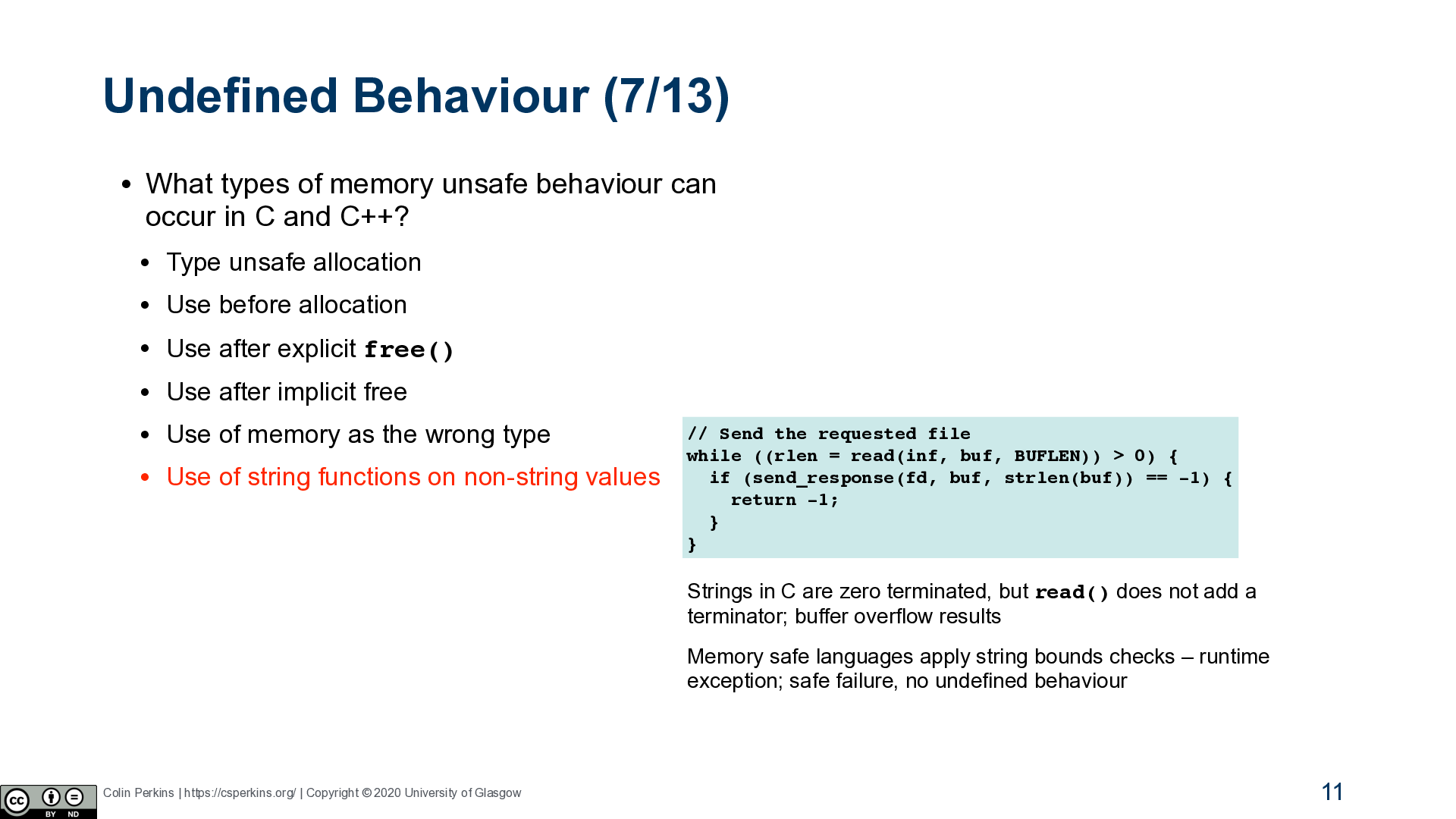
00:12:04.633
Memory unsafe languages allow you to apply
00:12:08.266
string functions on non string values.
00:12:11.533
And this is a really common security
00:12:15.166
vulnerability in C programs,
00:12:18.266
where the C language assumes strings are
00:12:22.666
NUL terminated, there's a terminating zero value
00:12:25.566
at the end of a string,
00:12:27.100
but the recv() function, for reading from
00:12:28.966
a file or reading from the network,
00:12:30.500
doesn't add that terminating zero.
00:12:33.700
So program that's wanting to treat data
00:12:37.200
read from the network, or read from
00:12:39.266
a file, as a string, in C,
00:12:40.933
has to explicitly add a terminating zero
00:12:43.466
on to the end of the values
00:12:45.300
returned by the read() call.
00:12:47.133
And if you forget, and call a
00:12:50.266
string function on that, and in this
00:12:52.166
case we're calling strlen() in such a way,
00:12:55.233
the string length function just keeps reading
00:12:57.400
until it finds the first zero in
00:12:58.966
memory, and who knows what it reads in memory.
00:13:04.166
And, maybe,
00:13:07.033
in the best case that just leaks
00:13:10.033
the contents of memory, maybe exposes some
00:13:13.033
sensitive data. And in the worst case,
00:13:15.066
it keeps going until it runs into
00:13:17.466
some unallocated memory and crashes the program.
00:13:23.166
And memory safe languages apply string bounds checks.
00:13:28.266
They make sure that the types match,
00:13:30.866
they make sure you can't access over
00:13:32.500
the end of the string,
00:13:34.433
and they either succeed or, if they’re
00:13:37.933
going to fail, they fail with a
00:13:39.533
runtime exception which closes the program cleanly
00:13:42.533
without undefined behaviour.
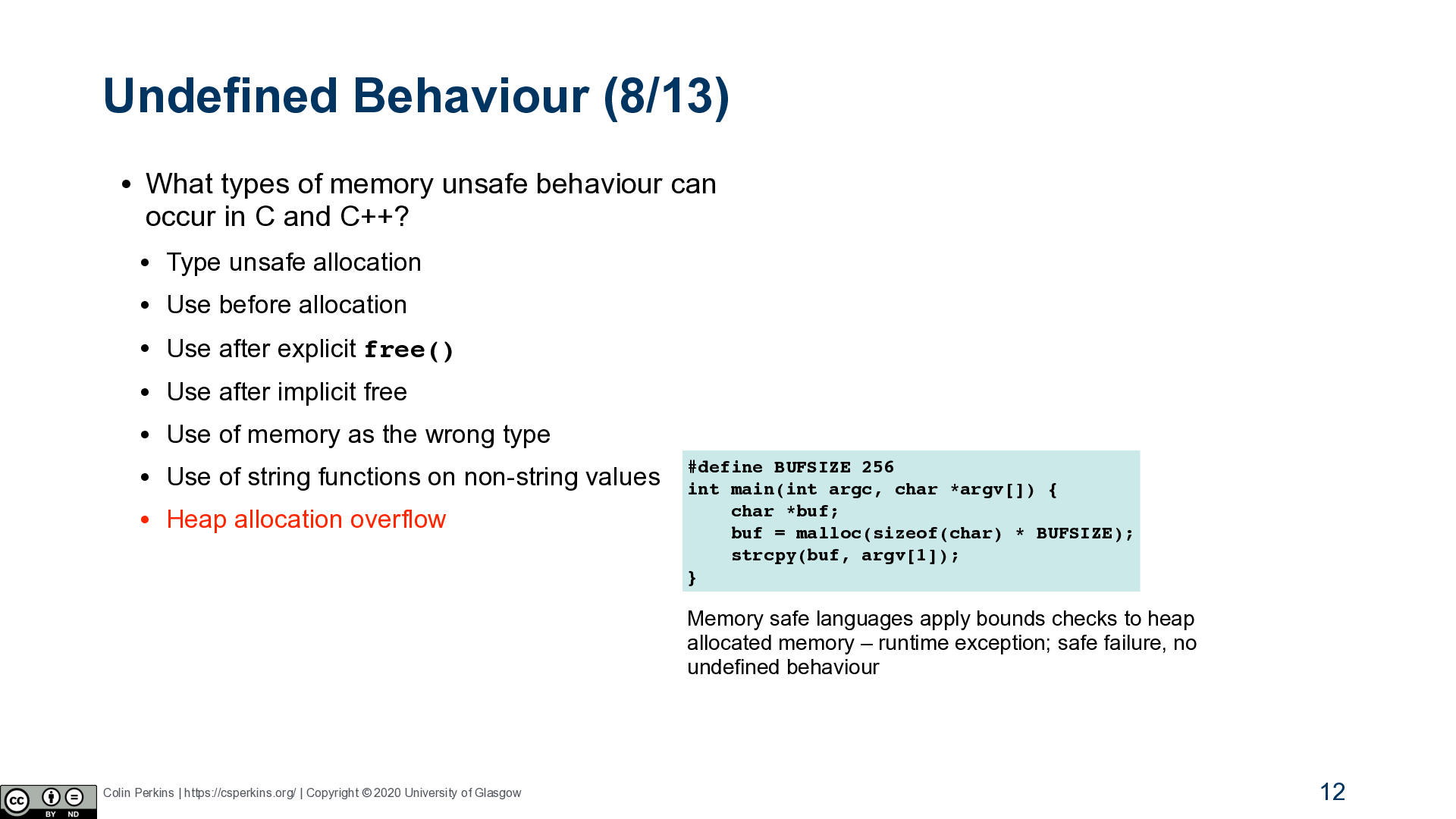
00:13:49.833
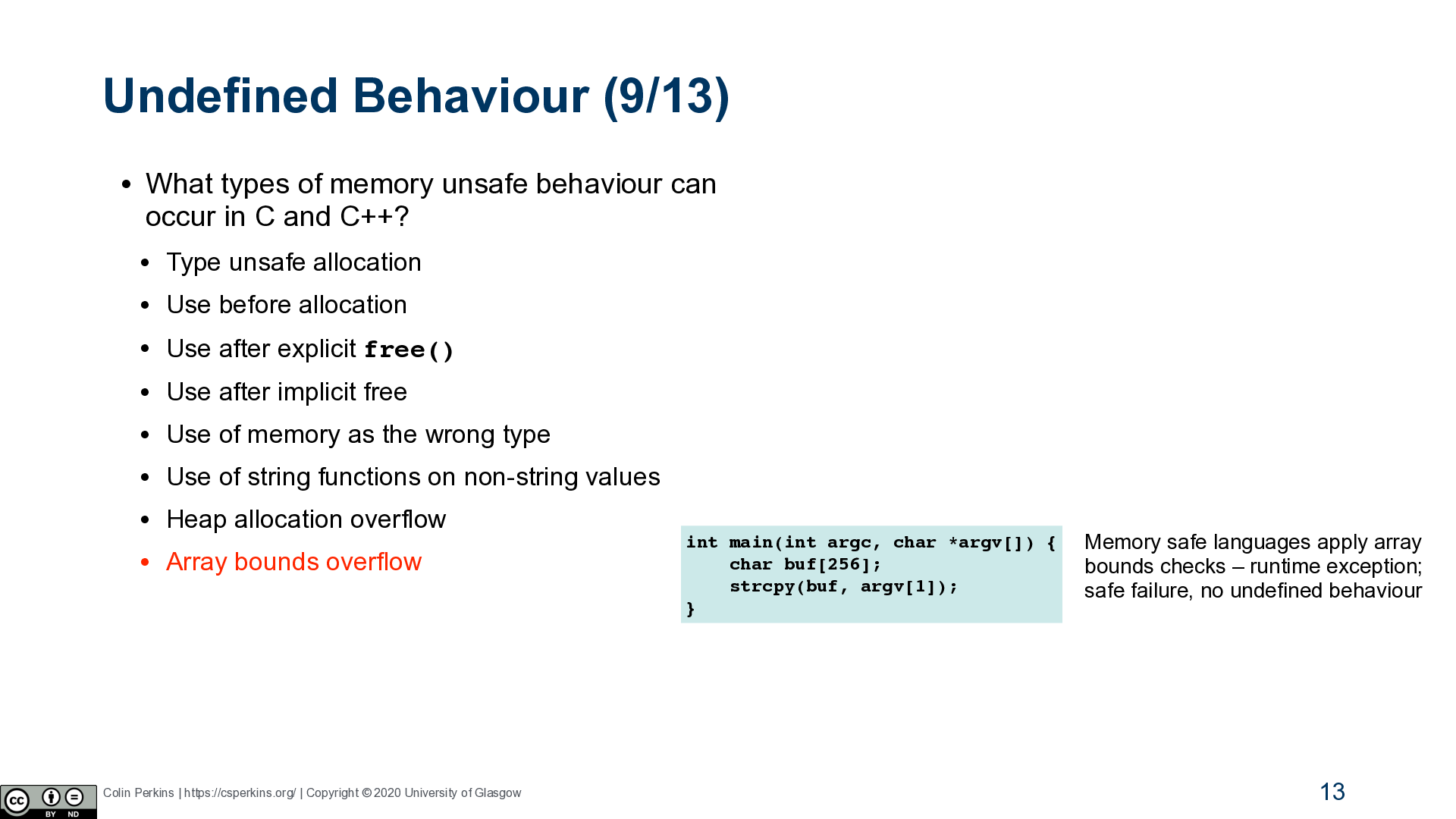
Memory unsafe languages put no requirements that
00:13:55.066
you only access the memory you've allocated.
00:14:01.266
In a memory unsafe language you can
00:14:03.900
allocate, in this case, memory for 256
00:14:09.266
bytes of memory, but copy-in an arbitrary sized buffer.
00:14:14.333
And the language, the strcpy() call,
00:14:17.400
and the way
00:14:19.366
arrays and pointers work in C,
00:14:21.833
means there’s no checks that the value
00:14:24.266
that's being copied into that buffer,
00:14:26.166
fits in within the 256 bytes allocated.
00:14:32.766
And it can overwrite the end of
00:14:34.366
the array, and it can corrupt whatever
00:14:36.000
happens to be in memory next.
00:14:38.900
And memory safe languages apply bounds checks.
00:14:43.700
If you try to overwrite the end
00:14:45.766
of an array in C, it will
00:14:47.433
just corrupt whatever's next memory.
00:14:49.600
If you try to overwrite the end of an array in Java,
00:14:52.966
or in Rust, the program will fail,
00:14:57.000
but it will fail with an exception,
00:14:59.766
or a panic in Rust, which closes
00:15:02.566
down the program cleanly.
00:15:05.966
Which doesn't fail in an undefined way;
00:15:09.200
it has defined failure semantics. It doesn't
00:15:12.766
leak information, it doesn't corrupt the state,
00:15:14.800
it just cleanly shuts the program down.
00:15:18.766
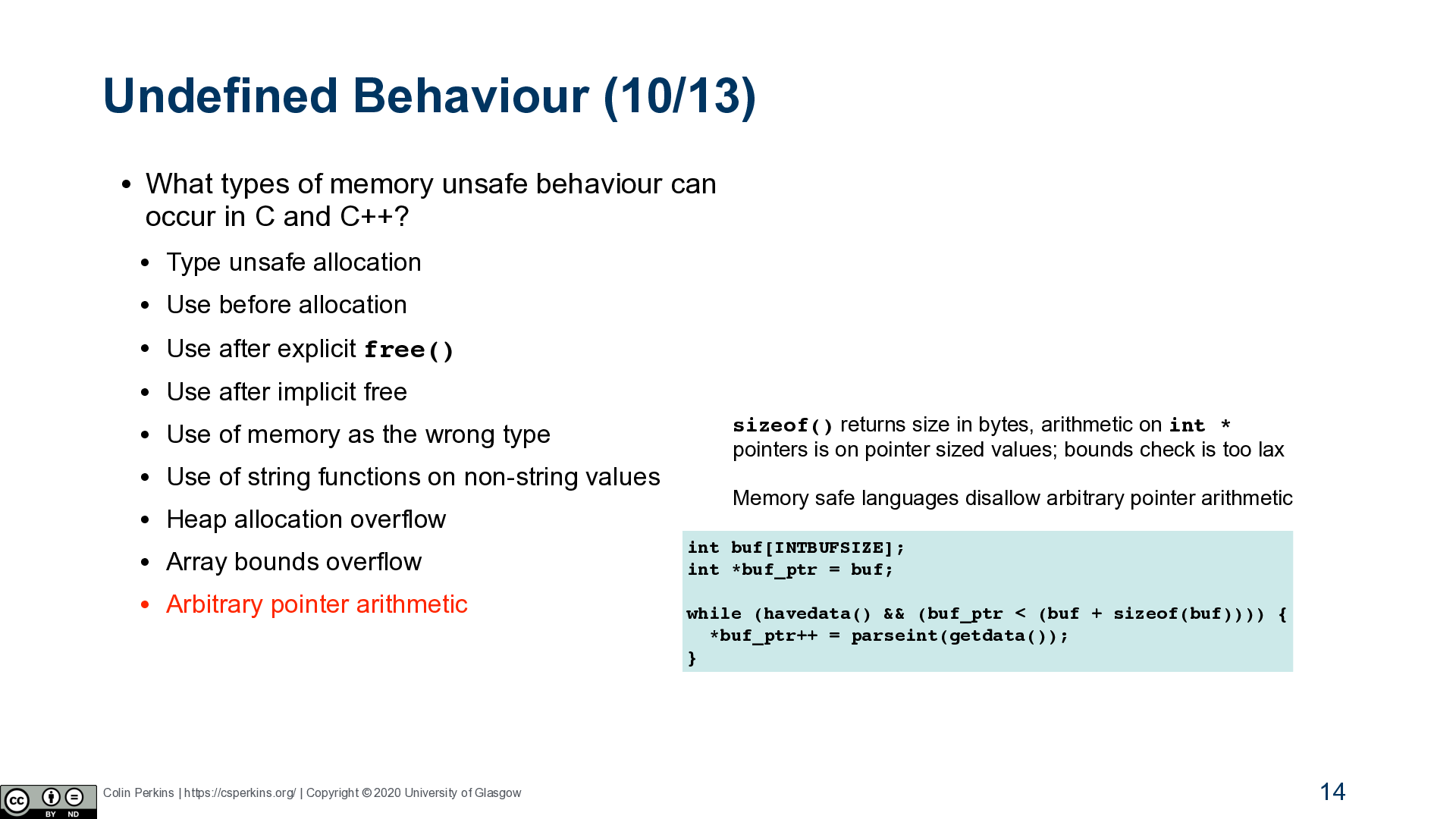
And you can do the same thing with arrays.
00:15:21.566
The memory doesn't have to
00:15:22.900
be allocated on the heap for you
00:15:24.333
to be able to overflow it in
00:15:25.666
C or C++ and, again, there's no
00:15:28.566
bounds checks, whereas in a safe language there should be.
00:15:34.566
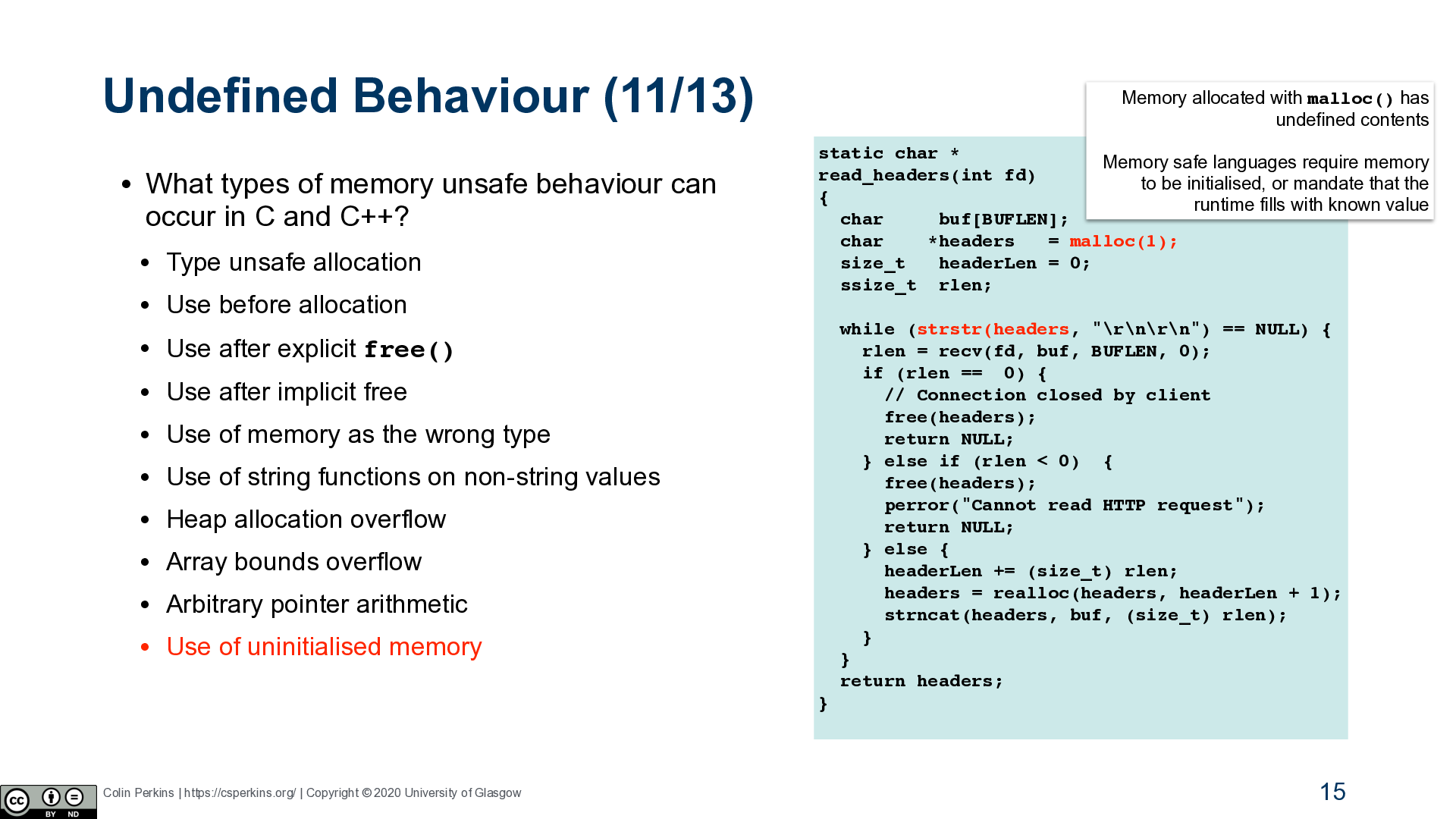
Or you can perform arbitrary pointer arithmetic.
00:15:39.733
This C program
00:15:42.900
is calculating,
00:15:48.566
it's looking at the size of the
00:15:53.066
buffer, so the check for buf_ptr is
00:15:55.466
less than buf+sizeof(buf), looks like it's checking
00:15:59.166
the pointer is within range, it looks
00:16:01.200
like it's manually implemented about a bounds check.
00:16:04.533
But the bug here is that the
00:16:05.866
buf_ptr is a pointer and int,
00:16:08.433
and sizeof() returns a size in bytes,
00:16:13.166
and what this program is doing,
00:16:16.800
when it increments buf_ptr, is incrementing by
00:16:19.866
int sized chunks, rather than byte sized
00:16:22.066
chunks, so the sizes don't match-up.
00:16:26.066
And it ends up with a buffer
00:16:28.533
overflow because it's doing
00:16:31.333
arithmetic on pointers, but it's not doing
00:16:34.533
the arithmetic incorrectly.
00:16:36.333
And, again, the language shouldn't allow
00:16:41.600
accesses where the types don't match up.
00:16:51.366
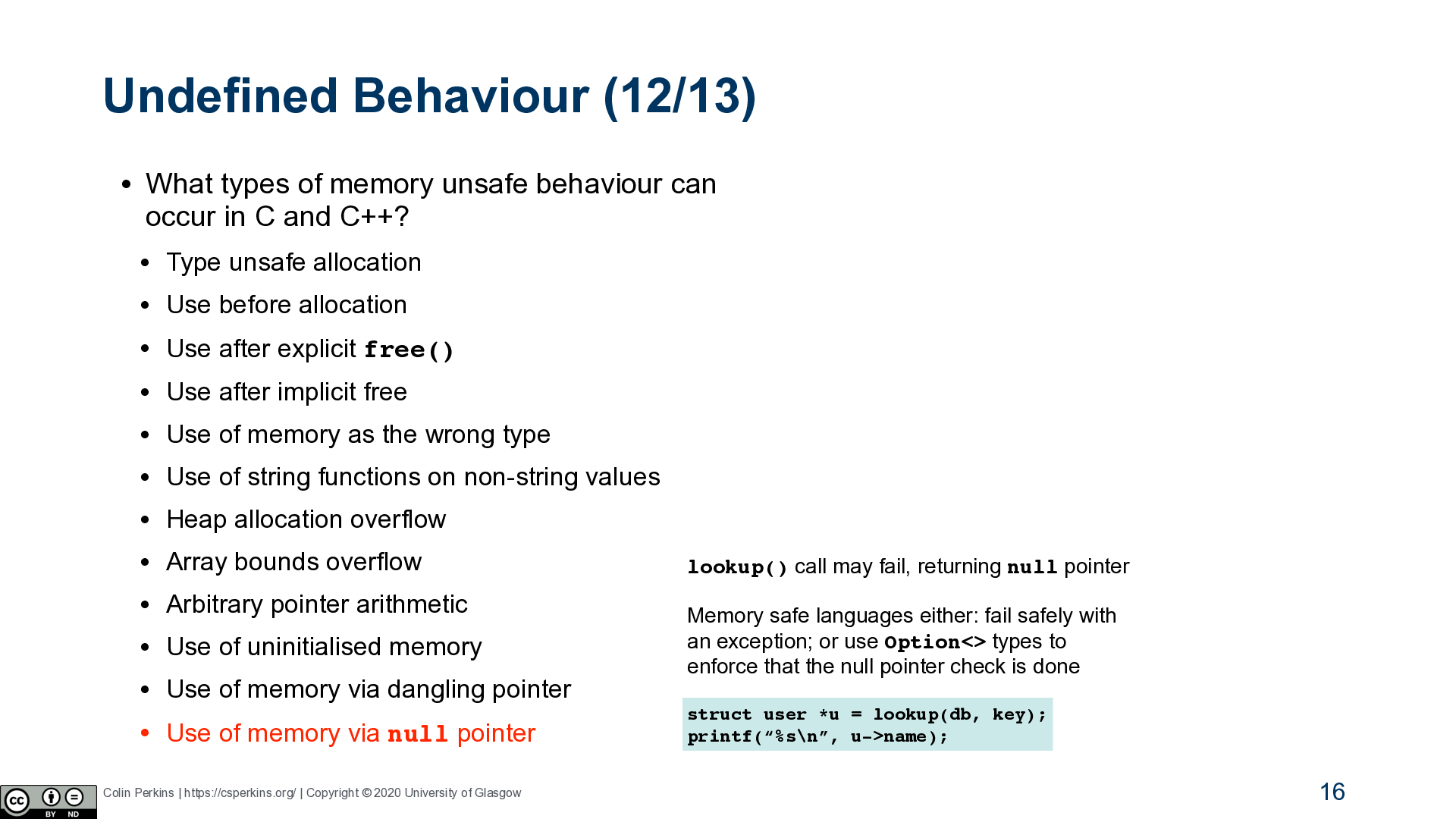
And memory unsafe languages allow uninitialised memory
00:16:55.300
to be accessed.
00:16:58.366
In this example, we're allocating space,
00:17:01.900
allocating one byte of memory to store the headers.
00:17:05.700
And this is an example, it might
00:17:07.933
be reading HTTP headers, and is growing
00:17:10.233
a buffer, and reading the headers in,
00:17:12.633
byte-by-byte, and checking after each read() to
00:17:15.400
see whether it's received the complete set
00:17:17.200
of headers, if they end with a
00:17:19.166
double carriage return newline.
00:17:21.533
The problem is the initial allocation allocation
00:17:23.666
just allocates space one byte, but doesn't fill in
00:17:26.333
that memory.
00:17:27.533
It doesn't have an end-of-string marker there,
00:17:30.000
to say that this is an empty string.
00:17:32.133
So the first strstr() call just
00:17:34.566
runs off the end of the uninitialised
00:17:36.700
memory, and keep searching for the zero.
00:17:40.233
And it's similar to the bug we
00:17:43.100
saw earlier, with strings not being zero
00:17:45.533
terminated, but it happens because the language
00:17:47.900
lets you reference uninitialised memory.
00:17:51.266
The language lets you reference memory that
00:17:53.533
hasn't got a defined value.
00:17:56.433
And a memory safe language would require
00:17:58.866
that all the memory is initialised.
00:18:02.833
It would require that any allocation,
00:18:05.533
any heap allocation, has known contents.
00:18:09.000
Whereas the unsafe languages don't do that,
00:18:11.433
and they let you perform computations on
00:18:14.000
arbitrary, unpredictable, values.
00:18:21.900
And we have languages which allow you to access
00:18:26.566
memory via dangling pointers, via null pointers.
00:18:31.400
which can access values where the pointer points to
00:18:36.166
some unknown, unpredictable, value.
00:18:43.500
And you may get a null pointer
00:18:47.300
returned from lookup(), and try to dereference
00:18:49.566
it, and that will fail. Or you
00:18:52.200
may have a pointer to something which
00:18:54.133
is no longer existing and it may fail.
00:18:59.133
And there are more.
00:19:02.033
That’s a long summary of some of the more
00:19:06.333
common types of memory unsafe behaviour,
00:19:08.666
but the link has many dozens more
00:19:12.966
types of memory unsafe behaviours that can
00:19:15.066
happen in C or C++.
00:19:22.600
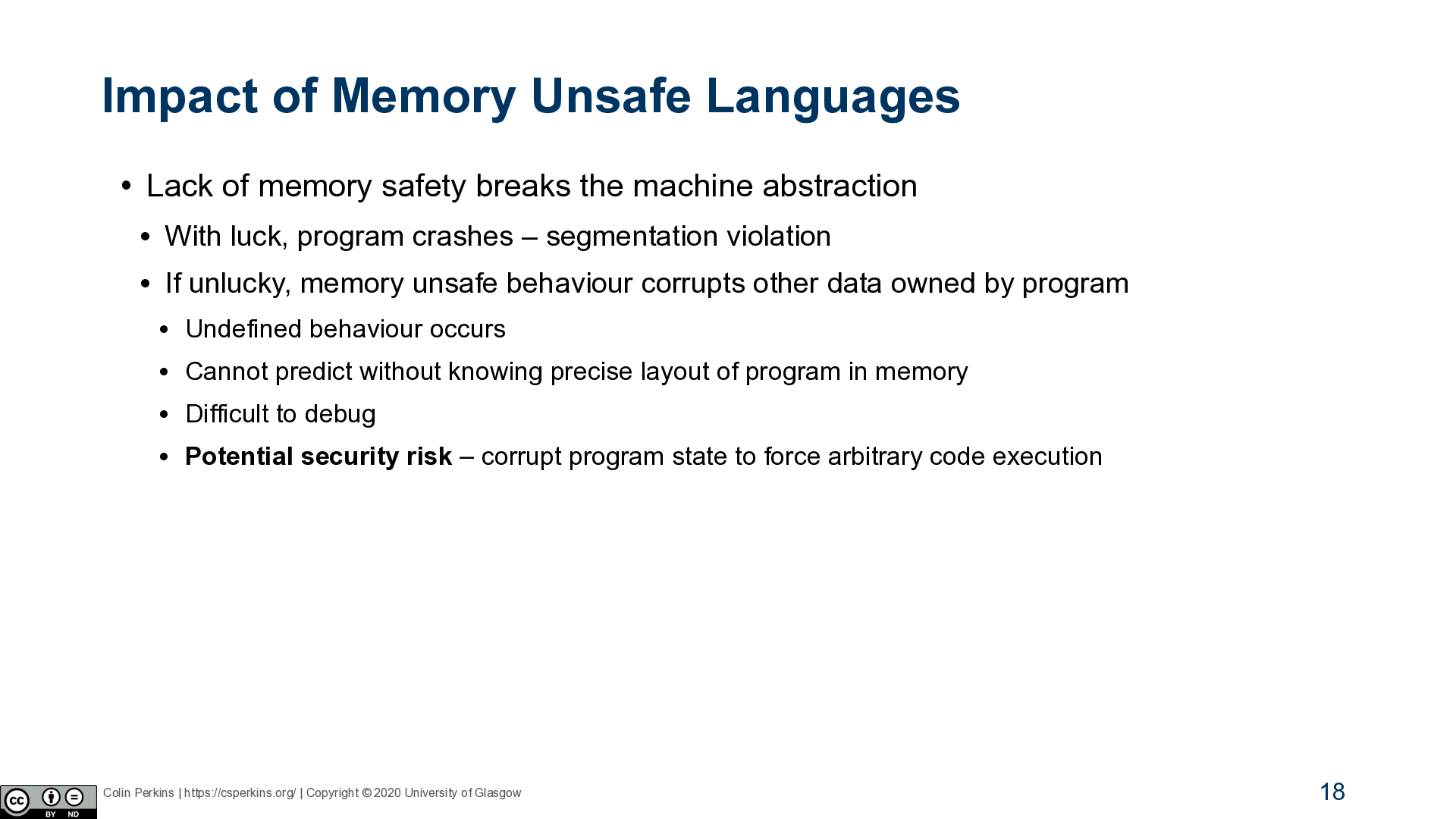
And the issue here is that lack
00:19:25.000
of memory safety breaks the abstractions.
00:19:29.933
It means the program starts doing unpredictable things.
00:19:36.266
And, if you're lucky, the program just
00:19:38.600
crashes, and crashes early and visibly,
00:19:41.433
and you can tell that there's a
00:19:43.400
memory safety bug, and you can fix it.
00:19:47.700
If you're unlucky,
00:19:51.266
the program accesses memory which it doesn't
00:19:54.700
own, or accesses memory in a way
00:19:57.700
that doesn't match the types, and it
00:19:59.866
silently corrupts some other value.
00:20:04.200
It silently corrupts some other value stored in memory.
00:20:09.433
And maybe that's memory which isn't being
00:20:11.300
used, and the corruption has no effect.
00:20:14.133
But maybe it's memory which is being
00:20:16.566
used, and is storing some other value
00:20:18.466
in the program, and you've just silently
00:20:20.866
corrupted the value of another variable,
00:20:24.000
with no way of knowing when,
00:20:26.200
or where, that change happened.
00:20:29.500
And you can't predict what's going to
00:20:31.366
happen without knowing the exact layout of
00:20:33.166
the program in memory. And, if it's
00:20:35.166
a multi-threaded program, knowing the exact order
00:20:37.366
of execution of all the different threads.
00:20:40.833
It’s very difficult to debug such behaviours,
00:20:44.133
and it’s potentially a security risk because
00:20:46.866
by corrupting the program state, an attacker
00:20:50.366
can cause the program
00:20:53.000
to do something which wasn't intended,
00:20:56.533
and potentially force arbitrary code execution.
00:21:04.033
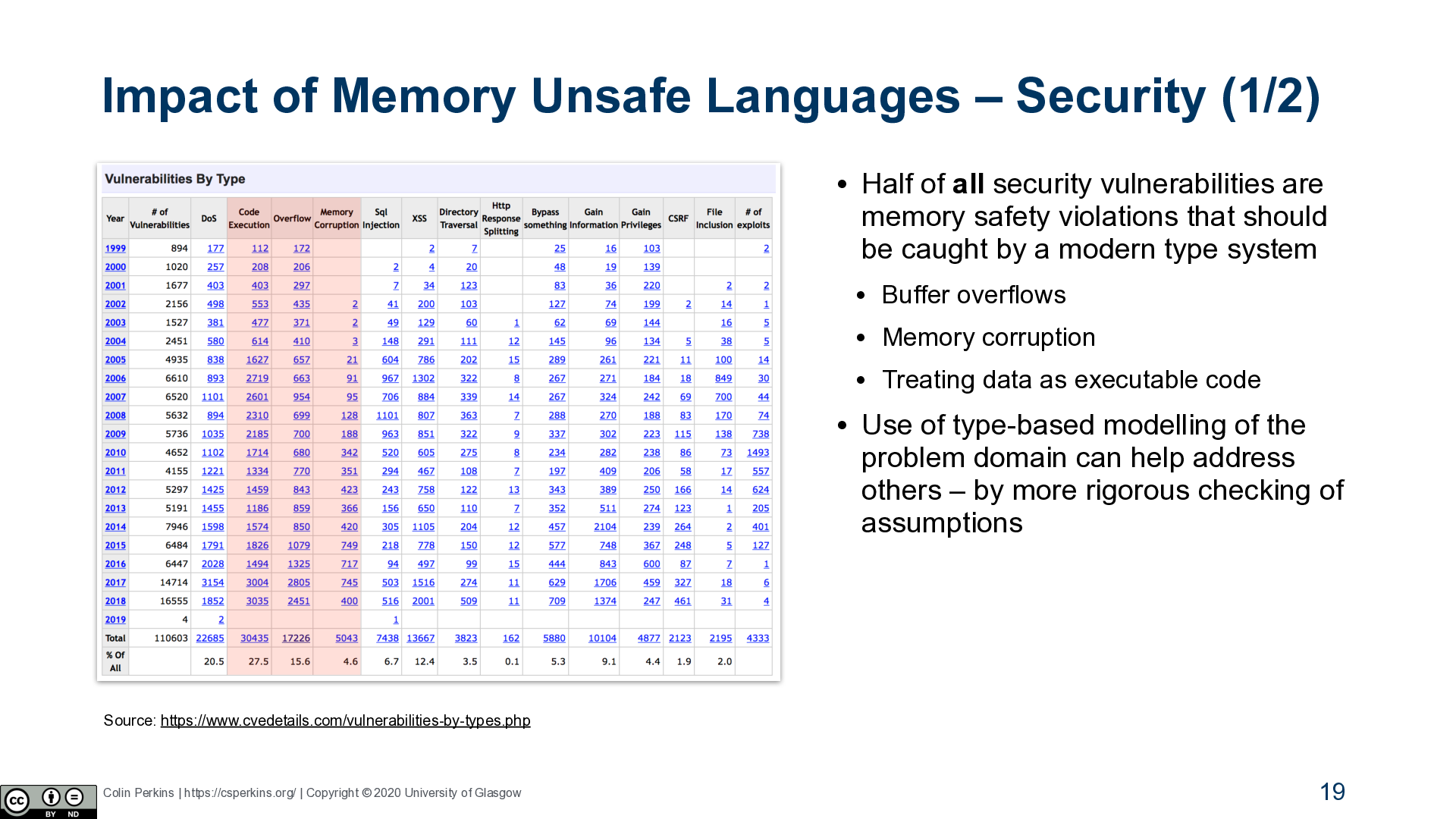
And this is a real problem.
00:21:08.100
The chart we have on the left,
00:21:12.066
which is a little hard to read
00:21:14.166
perhaps, is looking at the number of
00:21:16.433
reported security vulnerabilities, for a 20 year period.
00:21:21.733
And this is
00:21:23.866
a list of all the CVEs,
00:21:27.633
the common vulnerability database, and it's a
00:21:31.966
list of all of the security vulnerabilities
00:21:34.966
reported, in all software, over a 20 year period.
00:21:39.800
And the column highlighted
00:21:42.500
is showing the vulnerabilities which are due
00:21:44.800
to buffer overflows, memory corruption, or treating
00:21:49.233
data as executable code. It’s highlighting vulnerabilities
00:21:53.033
which are due to memory unsafety.
00:21:55.866
If you look at the numbers,
00:21:59.133
we see that about half of all
00:22:01.666
security vulnerabilities
00:22:03.733
are memory unsafety vulnerabilities.
00:22:06.733
They are problems due to lack of
00:22:08.433
memory safety in the language, which should
00:22:10.766
be caught by a modern type system.
00:22:13.066
The compiler should be able to detect these problems.
00:22:19.100
And a lot of the others,
00:22:21.866
I think, by modelling the problem domain
00:22:25.000
in the types, even if they're not
00:22:27.000
directly related to memory unsafety, the compiler
00:22:29.966
can also help check for these types of problems.
00:22:33.566
Things like SQL injection bugs,
00:22:37.833
parsing bugs, the type system can help
00:22:42.133
check for consistency, can help check that
00:22:44.166
these are not happening.
00:22:49.133
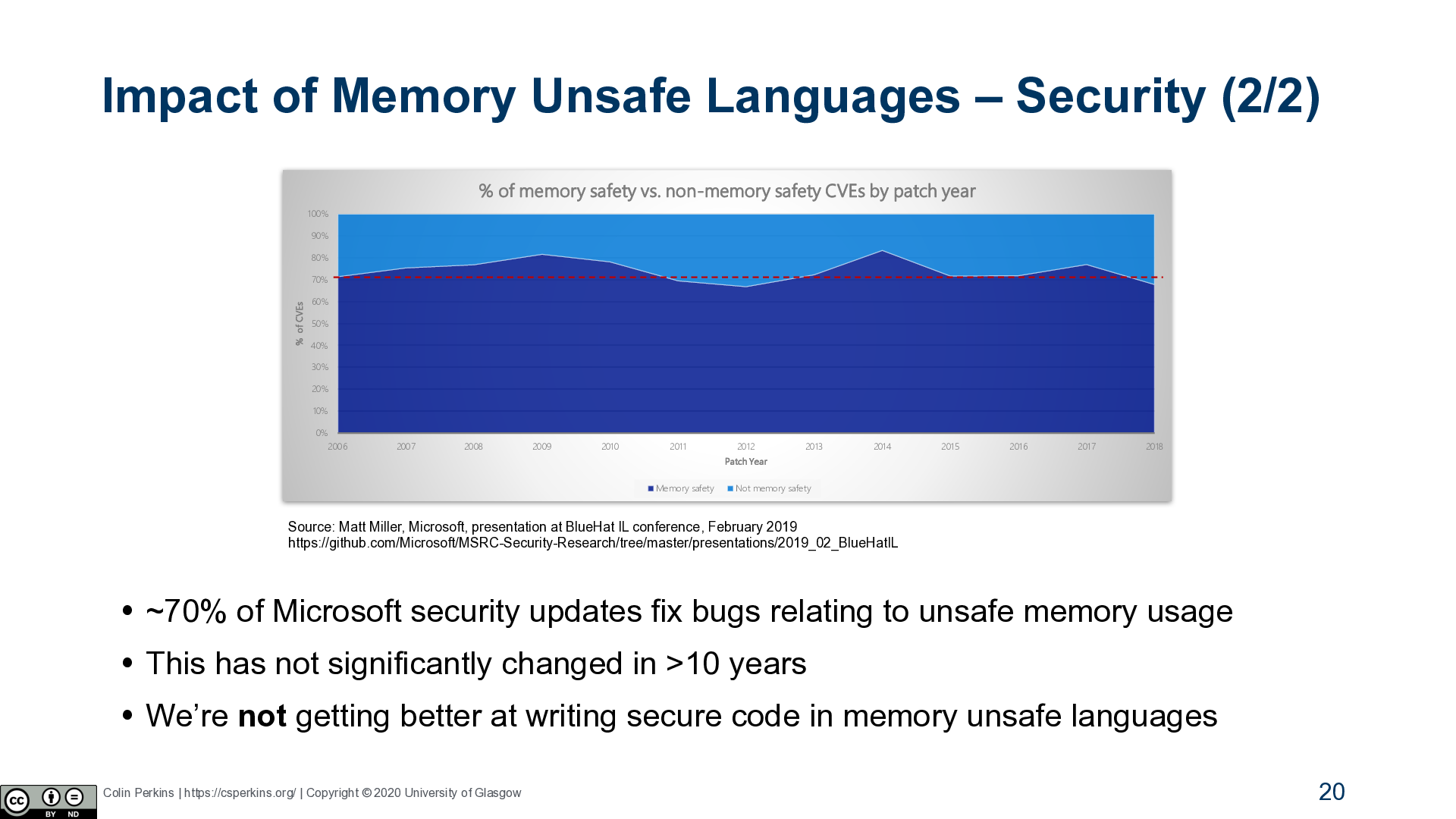
And this is a another graph,
00:22:50.866
this is from a presentation by Microsoft,
00:22:53.633
and it's looking at the type of
00:22:55.533
security vulnerabilities in Microsoft software, again over
00:22:59.900
a 10 year or so period.
00:23:03.366
And, in Microsoft's case,
00:23:06.200
about 70% of their security updates fix
00:23:10.166
bugs relating to unsafe memory usage.
00:23:13.833
And this is perhaps a little higher
00:23:16.566
than the previous graph, because of the
00:23:18.466
type of software that Microsoft develops,
00:23:20.866
which is a lot of systems code,
00:23:22.866
a lot of applications code,
00:23:24.466
whereas the previous graph, the previous table,
00:23:28.400
was looking at all software, including web
00:23:31.233
applications, and so on.
00:23:35.833
I think what's interesting is that we're
00:23:39.300
not getting better at this.
00:23:41.400
We have known that memory safety bugs
00:23:44.766
are a problem for a very,
00:23:46.233
very long time, 10-20 years, and we're
00:23:49.366
not getting better at writing secure code
00:23:51.333
in memory unsafe languages.
00:23:53.300
The number of memory safely bugs isn't
00:23:55.833
going down. And it's not that Microsoft
00:23:58.433
doesn't know that this is a problem.
00:24:00.666
It's just that this is a hard
00:24:02.666
problem, and it's difficult to fix in these languages.
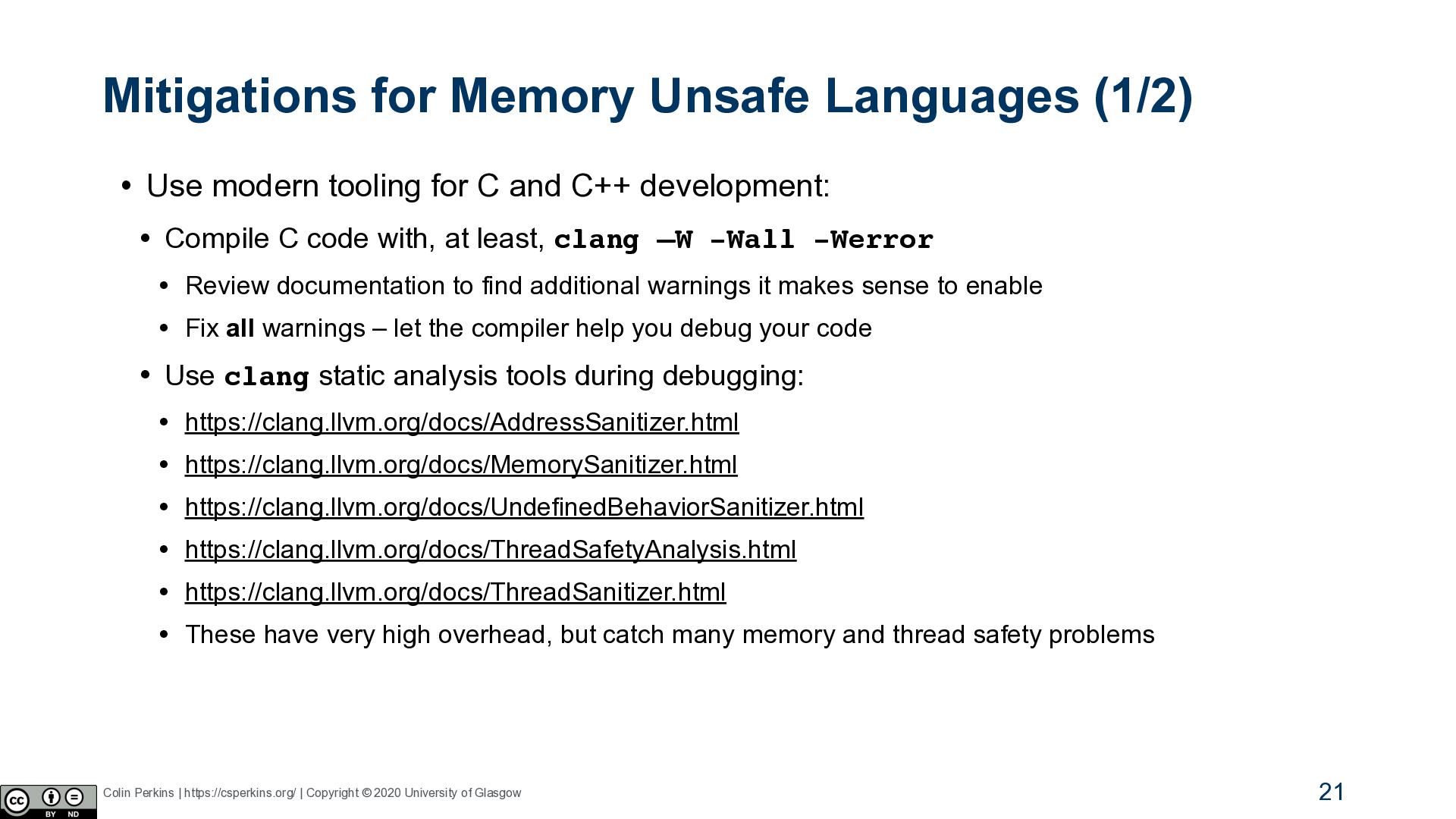
00:24:11.566
What should you do as a systems programmer?
00:24:16.900
If you have to write in a
00:24:19.200
memory unsafe language,
00:24:21.633
use the modern tooling.
00:24:25.800
If you're compiling C code, at the
00:24:28.600
very minimum, turn on all the warnings you can find.
00:24:33.933
The minimum set of flags for compiling
00:24:36.600
C code, if you're using clang,
00:24:38.733
for example, should be -W -Wall -Werror.
00:24:44.566
And you’d think this would turn on
00:24:46.133
all warnings, and make them errors.
00:24:48.333
But, actually what it does, is turn
00:24:50.266
on all warnings that a particular version
00:24:52.766
of GCC had, and make them errors.
00:24:55.466
So look at the documentation, and find
00:24:57.866
the additional warnings, and see if it
00:25:00.000
makes sense to turn them on.
00:25:02.666
Find the warnings which exist in addition
00:25:06.000
to -Wall, and turn them on.
00:25:09.800
Fix all the warnings. When the compiler
00:25:12.633
says there's a warning, treat it as
00:25:14.233
an error; force the compiler to treat
00:25:16.233
it as an error. Let the compiler help you debug your code.
00:25:22.300
And when you're debugging your code,
00:25:24.133
when you're testing your code, use the
00:25:26.500
static analysis tools that exist.
00:25:30.200
And this could be older tools like
00:25:33.200
valgrind, or it could be more modern
00:25:35.266
tools, like the address and the memory
00:25:37.566
sanitisers, or the undefined behaviour sanitisers,
00:25:40.500
the thread sanitisers, built into clang.
00:25:43.233
There's a lot of tools that exist
00:25:45.433
now that perhaps have a very high
00:25:47.266
overhead, perhaps can’t be used in production,
00:25:50.566
but for debugging and testing can help
00:25:52.666
you catch many memory and thread related
00:25:55.933
safety problems.
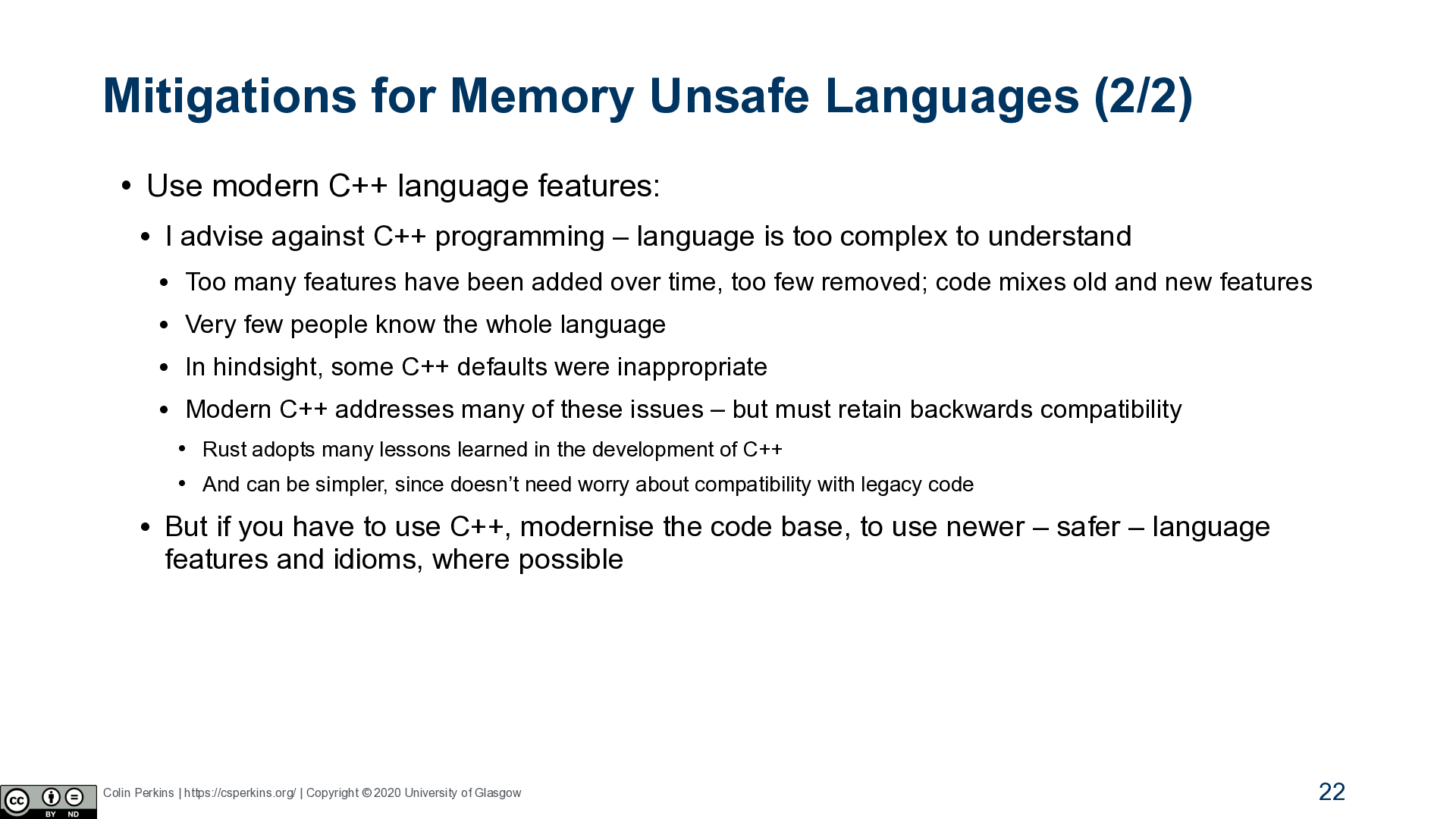
00:26:03.233
If you're using C++, use the modern
00:26:07.933
features of the language.
00:26:10.400
The modern C++ idioms are much safer
00:26:13.600
than the older idioms.
00:26:15.766
Although, in general, I have to say
00:26:18.066
I would advise against C++ programming because
00:26:21.666
it's too complicated. The problem, I think,
00:26:24.266
with C++ is that features keep getting
00:26:26.133
added over time, and features don't get removed.
00:26:29.833
So modern C++ is quite a nice,
00:26:32.333
quite a safe, language, if you can
00:26:34.800
understand it, and if you can make
00:26:36.600
sure that the code doesn't use any
00:26:39.633
of the older, less safe, features.
00:26:44.766
But the problem with C++ is that
00:26:47.533
very few people know the whole language,
00:26:50.000
it made some bad choices in early
00:26:52.300
versions, had some inappropriate defaults,
00:26:57.433
and you just need a lot of
00:26:59.400
knowledge to write C++ code correctly,
00:27:01.666
know which features are safe to use,
00:27:03.733
know in which cases you need to
00:27:06.300
override the defaults.
00:27:08.933
It’s getting better at that, the modern
00:27:11.333
versions solve a lot of these issues,
00:27:13.266
but they have to retain backwards compatibility,
00:27:15.233
so they have to retain all the
00:27:16.733
unsafe features. The means you need to
00:27:18.600
audit all the code
00:27:20.500
to check that they're not being used,
00:27:22.566
and you need to understand all of those features.
00:27:26.233
One of the reasons I think Rust
00:27:29.800
is a good choice for systems programming
00:27:32.100
is that it's learned from this experience,
00:27:34.133
and it's looked at what works in
00:27:36.066
C++ and what, with the benefit of hindsight, doesn't.
00:27:39.466
And, because it's a new language,
00:27:41.266
it doesn't need to be backwards compatible,
00:27:43.266
so it can fix the problems C++ can't fix.
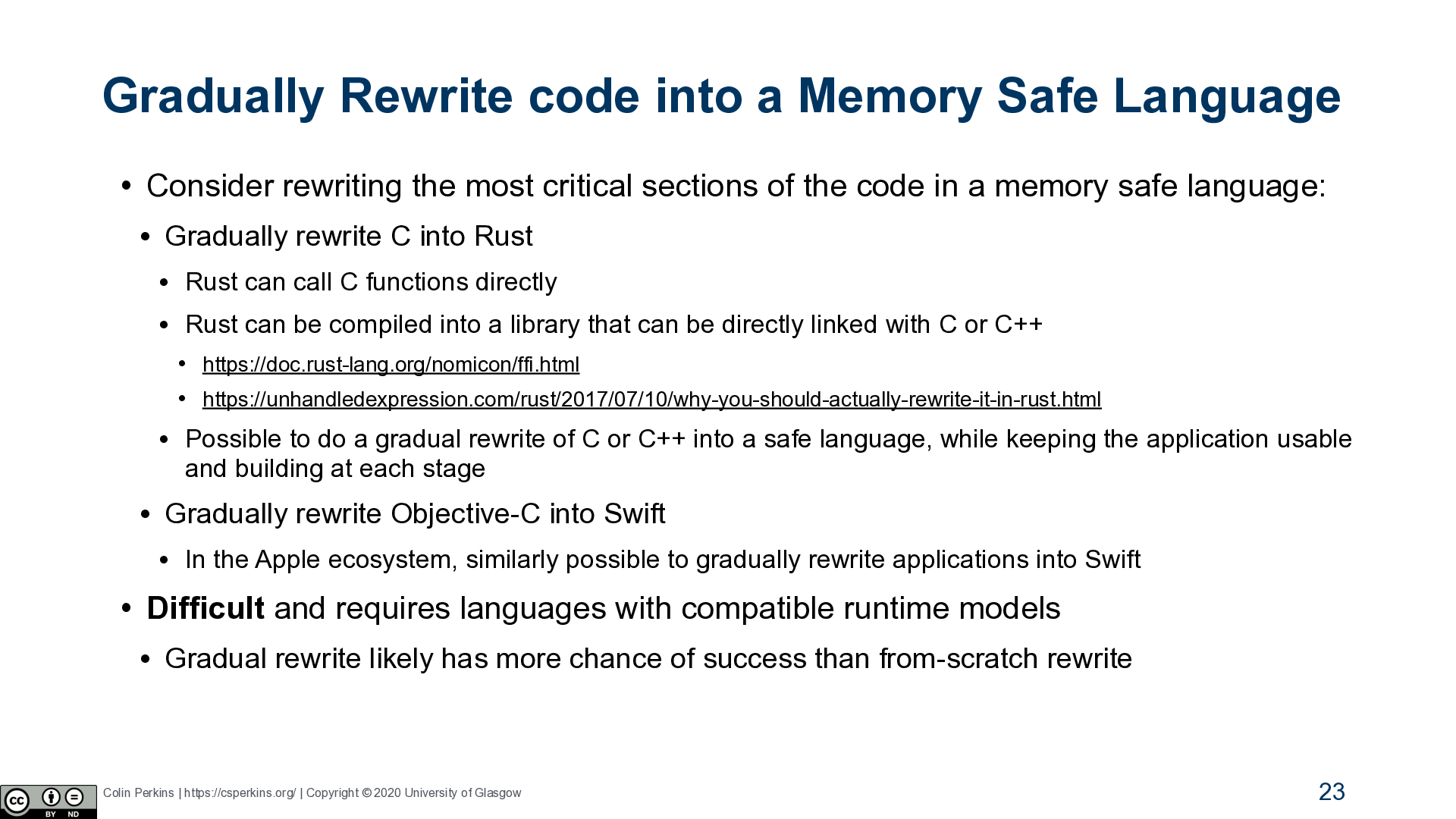
00:27:50.033
Ultimately, I think, if you have a
00:27:52.366
memory unsafe code base, you should be
00:27:54.900
looking to gradually rewrite it, or at
00:27:56.666
least rewrite the critical sections, the input
00:27:59.933
parsing code for example, into a memory safe language.
00:28:05.066
If you have C or C++ code,
00:28:08.000
you can gradually rewrite it into Rust, for example.
00:28:11.966
And one of the nice things about Rust,
00:28:15.766
is that you can compile it in
00:28:17.500
a way that the functions are compatible with C code.
00:28:22.666
So you can rewrite a program function
00:28:25.000
at a time, and link in the
00:28:27.633
Rust code, and gradually convert it over
00:28:29.933
a period of many years, function by
00:28:32.066
function, testing it as you go, and gradually
00:28:35.900
fixing the problems.
00:28:39.533
And the links on the slide point
00:28:44.133
to some blog posts that talk about
00:28:45.666
how to do this. And there’s been
00:28:47.566
a couple of examples of open source
00:28:49.233
projects which have done this, and have
00:28:50.833
gradually transitioned
00:28:52.433
a code base from C to Rust
00:28:54.100
over a five year period, for example,
00:28:58.200
while keeping the API, keeping compatibility.
00:29:02.333
If you're in the Apple world,
00:29:04.666
you can do the same sort of
00:29:06.366
thing, gradually rewriting from Objective C to
00:29:09.066
Swift, for example, and get the safety benefits.
00:29:12.666
But this is difficult. It requires languages
00:29:16.066
that have compatible runtime models, so you
00:29:19.300
can link the code together,
00:29:21.633
and write a program in multiple languages,
00:29:24.433
and it requires that you have programmers
00:29:27.033
who know both languages.
00:29:28.966
But I think this sort of gradual
00:29:30.866
rewrite is the way to go,
00:29:32.733
and has much more chance of success
00:29:34.333
than a from-scratch rewrite, because you can
00:29:37.500
keep testing the program as go,
00:29:39.633
you can keep debugging the program as you go,
00:29:44.733
rather than having to throw it all
00:29:46.733
away, start from scratch,
00:29:48.100
and have to reimplement everything.
00:29:53.766
That’s all I want to say about
00:29:55.800
memory safety. We've seen a small fraction
00:30:00.366
of the long list of undefined behaviours
00:30:02.900
that could happen in C and C++,
00:30:05.266
and hopefully this gives you a flavour
00:30:08.100
of why these languages are dangerous.
00:30:11.233
We spoke about the security impact of
00:30:13.900
memory unsafety, and the way 50-70% of
00:30:19.033
all security vulnerabilities in the code are
00:30:21.500
due to memory unsafety, and this isn't getting better.
00:30:25.600
And I spoke a little bit about
00:30:27.266
the mitigations, the idea that we should
00:30:29.133
be gradually transitioning to memory safe languages,
00:30:32.866
where possible.
00:30:34.633
And I think that the number of
00:30:36.300
security vulnerabilities make it clear that,
00:30:38.733
ultimately, the way forward has to be
00:30:41.700
to transition to memory safe languages.
Part 2: Parsing and Network Security
The second part of the lecture discusses security vulnerabilities in
networked applications. It highlights the problem of how to parse
untrusted input as critical, and discusses some of the implications
of Postel's Law on the security of input parsers. It discusses some
approaches to building safe parsers, and introduces some of the ideas
from the LangSec movement.
00:00:00.033
In this part, I want to talk
00:00:01.866
about parsing and network security.
00:00:04.533
I'll talk about some of the issues
00:00:06.000
with handling untrusted input data, such as
00:00:08.766
the type of input you get from
00:00:10.200
the network. I'll talk about Postel’s law,
00:00:12.600
and I’ll talk about approaches to
00:00:14.066
building more robust parsers.
00:00:18.666
As we saw in the previous part
00:00:20.700
of the lecture, writing safe code in
00:00:24.266
memory unsafe languages is difficult.
00:00:27.200
There's a large number of perhaps somewhat
00:00:30.666
subtle vulnerabilities, somewhat subtle bugs, that can
00:00:34.100
occur, which lead to undefined behaviour,
00:00:36.900
lead to unsafe behaviour, and those bugs
00:00:39.833
can lead to exploitable flaws in the code.
00:00:44.466
And the problem with a lot of
00:00:46.133
this, is that it’s easy to look
00:00:47.866
at each of these individual bugs and rationalise them.
00:00:51.466
It's easy to look at these types
00:00:53.300
of problems, and say “how could anyone
00:00:55.200
possibly write code like that?”
00:00:58.433
And the problem is that a lot
00:01:00.333
of these security vulnerabilities, a lot of
00:01:03.500
the remotely exploitable vulnerabilities we see in
00:01:05.900
network systems, fall under this category.
00:01:09.833
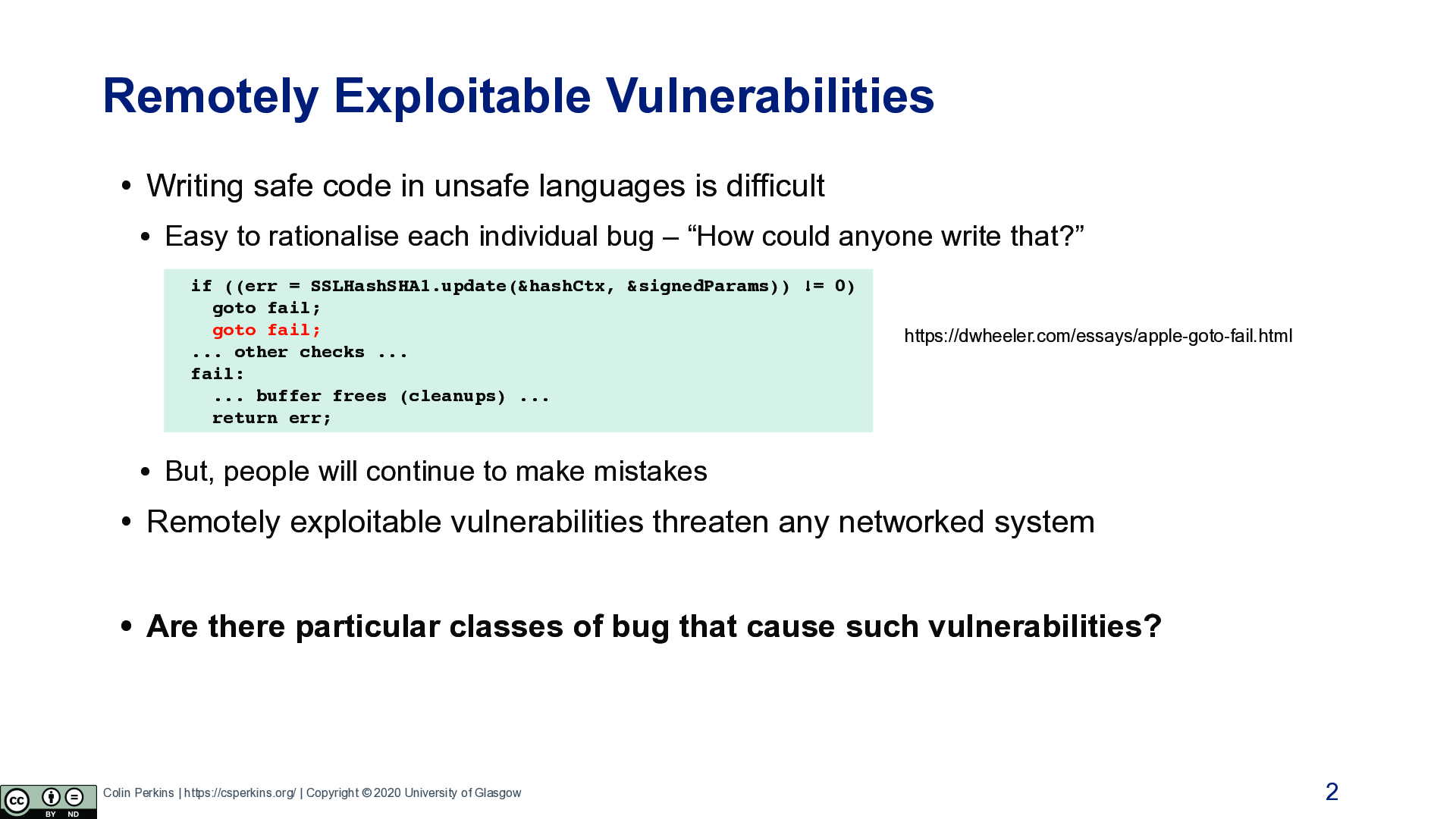
And the example we see on the
00:01:12.000
slide here, is a real security vulnerability
00:01:15.466
from the Apple TLS code.
00:01:21.000
And what's happened here is clearly a
00:01:23.733
mismerge, or misedit, such that a particular
00:01:28.033
line has got duplicated, and the line
00:01:30.633
“goto fail”, has got duplicated.
00:01:33.566
The problem, of course, is that
00:01:36.733
because indentation is not significant in C,
00:01:41.766
what this does is always goes to
00:01:44.533
the failure case, and skips a bunch of checks.
00:01:47.366
And it led to a particular check
00:01:50.200
being skipped, and that led to code
00:01:53.366
that was remote remotely exploitable, because the
00:01:56.866
checks that validated the input were not
00:01:58.700
performed, and that then led to a
00:02:00.266
memory unsafety bug further down the line.
00:02:03.733
And it's easy to look at examples
00:02:05.566
like this, and say “how could anyone write that?”
00:02:09.400
How could the programmer not spot that this was a bug?
00:02:13.266
Of course, for any individual
00:02:16.166
bug you can do that, you can
00:02:18.166
look at it and say, well,
00:02:19.366
of course, you should have seen that.
00:02:21.100
But, the thing is, people keep making mistakes.
00:02:25.866
We’ve ended up in a situation where
00:02:29.966
we're expecting programmers to be perfect.
00:02:32.333
We're expecting programmers to never make mistakes.
00:02:35.366
And not providing the tools to help
00:02:37.400
them, not providing the tools to catch
00:02:39.366
the mistakes when they get made.
00:02:42.633
And the problem is these types of
00:02:44.666
memory unsafety bugs lead to remotely
00:02:46.933
exploitable vulnerabilities. They lead to situations where
00:02:51.033
attackers can use that undefined behaviour,
00:02:54.666
can figure out what happens in particular
00:02:56.733
cases, and can break into systems and
00:02:59.100
run arbitrary code.
00:03:02.333
And this is, of course, a problem.
00:03:06.400
If we want to improve security,
00:03:08.533
I think we need to focus on,
00:03:11.466
as we spoke about last time,
00:03:13.233
we need to focus on getting rid
00:03:14.933
of memory unsafe languages.
00:03:17.500
But obviously this is a long term goal.
00:03:20.333
And it may make sense to think
00:03:21.933
about are there particular types of bug,
00:03:24.200
particular classes of bug, which most cause
00:03:27.166
such vulnerabilities, which we can address in
00:03:29.033
the short term.
00:03:30.633
Where we can expand the effort to
00:03:34.166
proactively move to safer languages, or to
00:03:36.866
proactively use new techniques, or to proactively,
00:03:40.633
at least, review the code carefully.
00:03:46.000
Well, I think there are. And I
00:03:47.466
think one of these areas where
00:03:50.300
we need to proactively spend this effort,
00:03:53.033
is parsing untrusted input. The input from
00:03:56.333
the network to the rest of the
00:03:58.566
program, or the input from a file
00:04:00.833
parser, to the rest of the program.
00:04:04.200
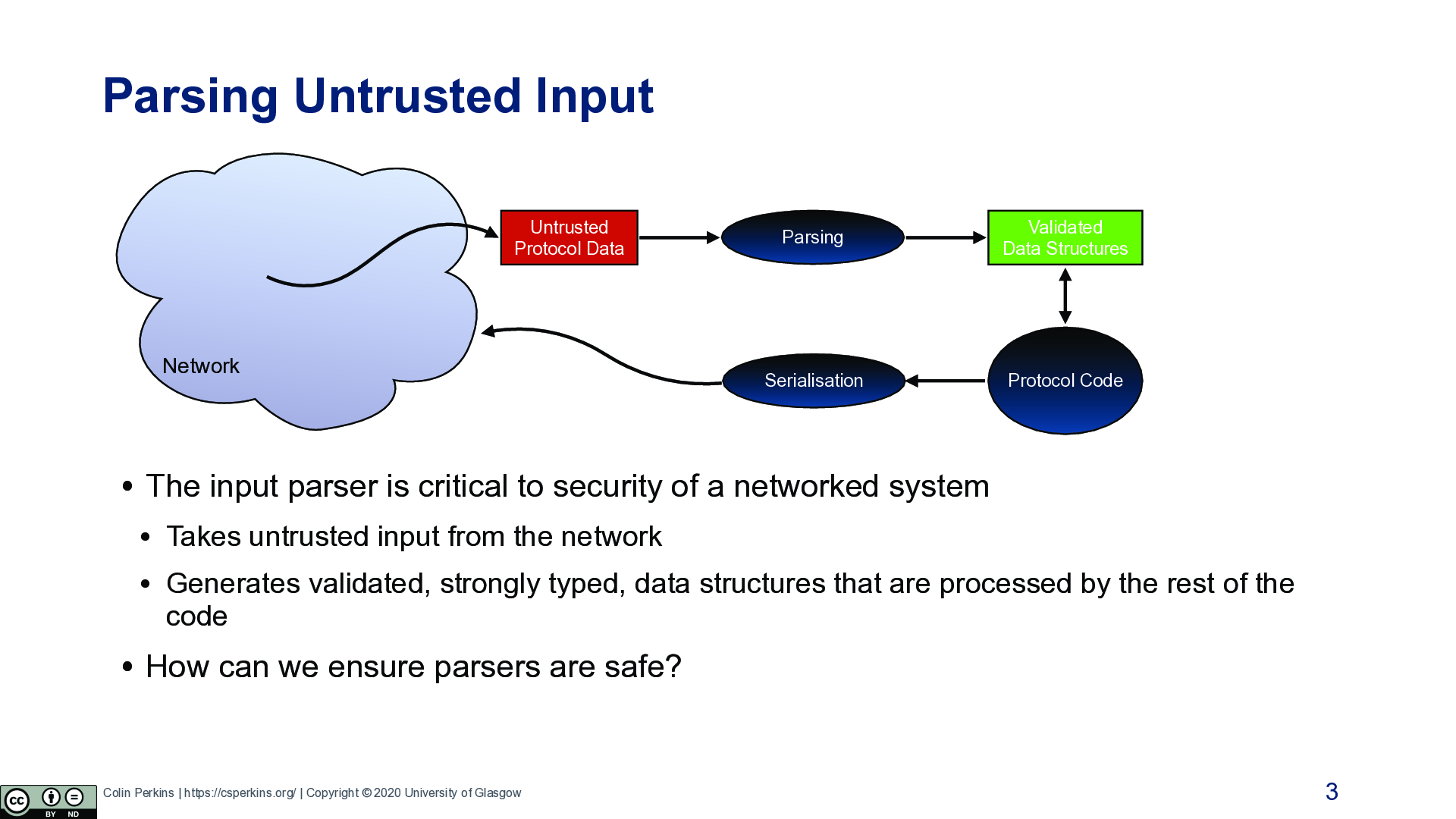
And, if we focus on networked systems,
00:04:06.633
the structure of a networked system,
00:04:08.866
in a very high level terms,
00:04:11.100
is that you get some untrusted protocol
00:04:13.266
data from the network.
00:04:15.266
You need to parse it, take the
00:04:17.600
protocol messages, parse them into some internal
00:04:20.400
data structure.
00:04:23.233
And the protocol code then operates on
00:04:25.200
those data structures, and serialises the results
00:04:28.400
for transmission back out across the network,
00:04:31.133
in response to the request.
00:04:35.000
I think what should be clear,
00:04:36.333
is that the input parser is critical
00:04:38.133
to the security of any networked system.
00:04:41.566
It’s taking untrusted input data from the
00:04:44.100
network, where we know there are people
00:04:46.733
who are maliciously trying to break the systems,
00:04:49.533
and it's trying to generate validated,
00:04:51.900
strongly-typed, data structures that can be processed
00:04:54.233
by the rest of the code.
00:04:57.066
And one of the key challenges is
00:04:59.033
ensuring that the parsers are safe.
00:05:02.766
And ensuring that parsers safe, even if
00:05:05.166
they've written in memory unsafe languages.
00:05:11.066
So how do we build networked systems?
00:05:14.766
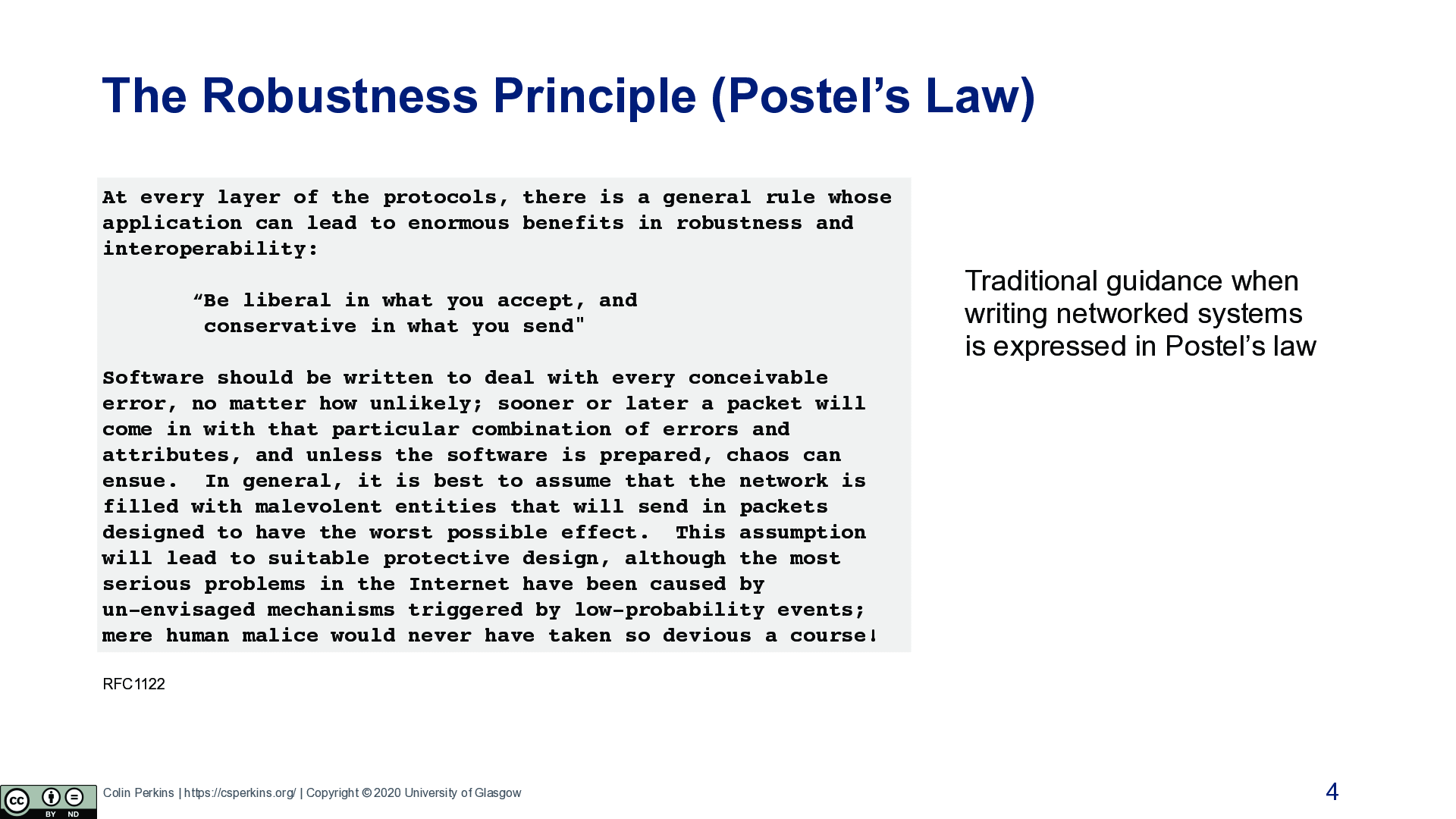
Well, the traditional guidance, when writing networked
00:05:18.400
systems, has been expressed in the form
00:05:20.700
of Postel’s law.
00:05:23.133
And Postel’s law was first described in RFC 1122.
00:05:27.533
And it, it talks about interoperability and
00:05:32.600
robustness of network protocols.
00:05:36.000
And the suggestion is that you should
00:05:37.866
be liberal in what you accept,
00:05:39.633
and conservative in what you send.
00:05:43.100
That is, when generating data, you should
00:05:46.066
try your hardest to make sure the
00:05:48.400
data you generate conforms to the protocol.
00:05:51.366
But when parsing data that you receive
00:05:53.500
from the network, the suggestion from Postel’s
00:05:56.266
law is that you should be forgiving
00:05:58.566
of errors, you should be forgiving of the
00:06:02.500
precise details of the format, providing you
00:06:06.633
can make sense of what you get.
00:06:13.100
The software does need to be rewritten
00:06:16.200
to deal with errors, it does need
00:06:19.466
to cope with the fact that the
00:06:20.933
data is coming in which is malevolent,
00:06:24.866
which is designed to break the system,
00:06:31.200
but if it's too strict, too unforgiving,
00:06:36.466
interoperability suffers.
00:06:38.666
And there's a balance. And Postel’s law
00:06:41.466
is saying, err towards being liberal, towards accepting
00:06:50.066
data which is not necessarily well-formed,
00:06:53.633
to enhance interoperability.
00:06:58.066
I think the question is whether this
00:06:59.833
principle of being liberal in what you
00:07:02.100
accept, conservative in what you send,
00:07:04.133
is still appropriate for today's network,
00:07:06.666
and for today's networked systems?
00:07:10.333
And I think it's not clear that it is.
00:07:12.833
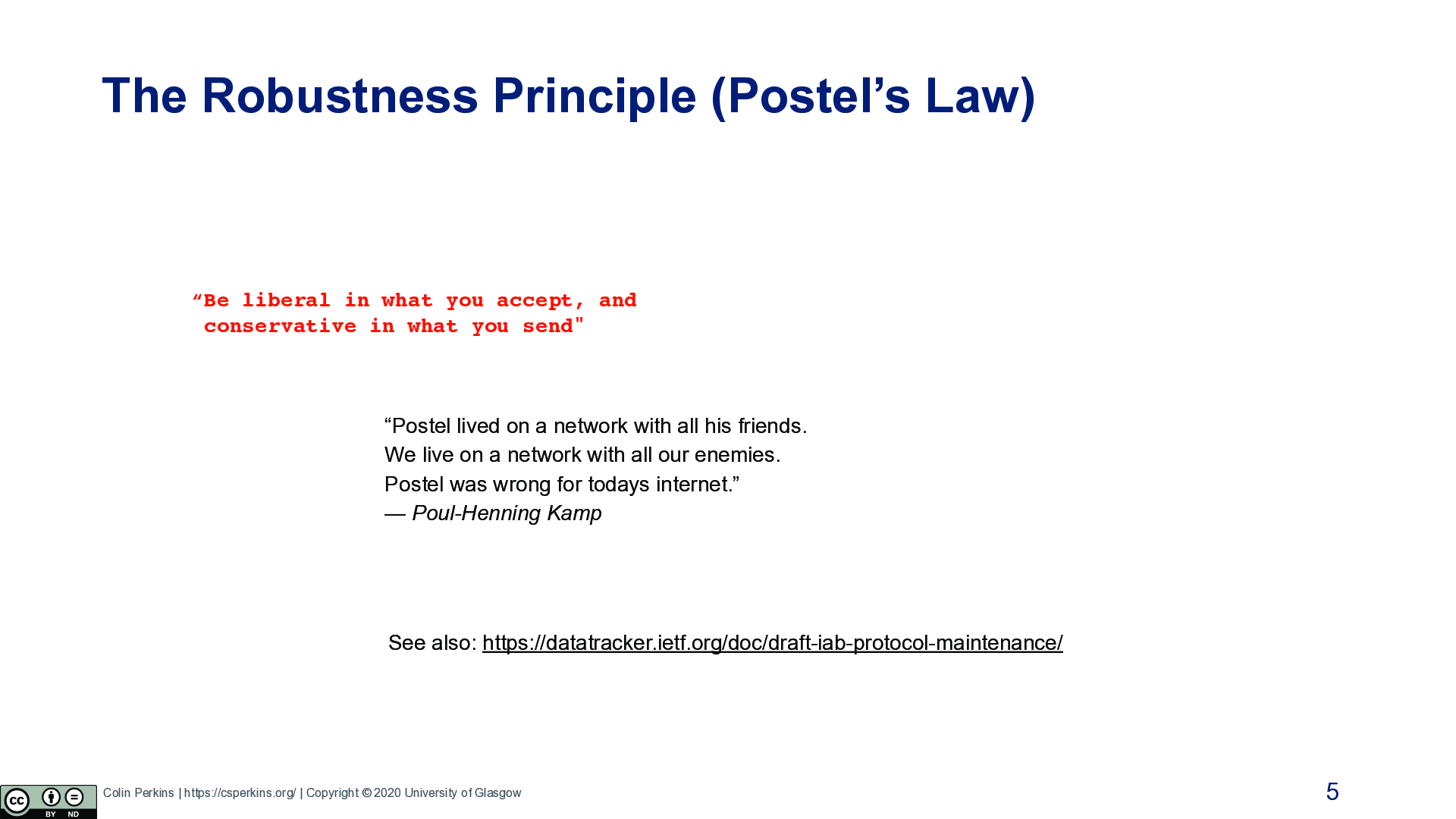
Poul-Henning Kamp, one of the FreeBSD developers,
00:07:17.466
expressed this in the
00:07:19.700
clearest way I’ve seen, when he said
00:07:22.466
that Postel lived on a network with all of his friends,
00:07:25.833
and we today live on a network
00:07:28.366
with our enemies. People are trying to
00:07:31.233
break the systems, people are trying maliciously
00:07:34.800
to break our code, break our applications.
00:07:38.533
Postel’s law, I think, is not appropriate
00:07:41.233
for today's Internet.
00:07:44.366
We should not, perhaps, be so liberal
00:07:46.933
in what we accept. We should clearly
00:07:48.833
specify what is legal. We should clearly
00:07:52.566
specify what the code will accept,
00:07:54.600
and what it won't accept. And we
00:07:56.766
should be strict about that.
00:07:59.766
We should be strict about how, and when, our code fails.
00:08:04.500
Because the consequences of being too liberal
00:08:07.333
is that our systems are exploitable.
00:08:10.000
If we don't precisely specify that behaviour,
00:08:12.466
there are too many corner-cases with undefined behaviour.
00:08:18.333
The Internet Architecture Board, in the IETF,
00:08:20.933
also has some discussion of this,
00:08:23.033
in the draft I’ve linked.
00:08:29.366
When we're building network systems, the approach
00:08:33.566
we should be taking
00:08:35.933
is to clearly specify what is legal,
00:08:39.800
what is not.
00:08:43.433
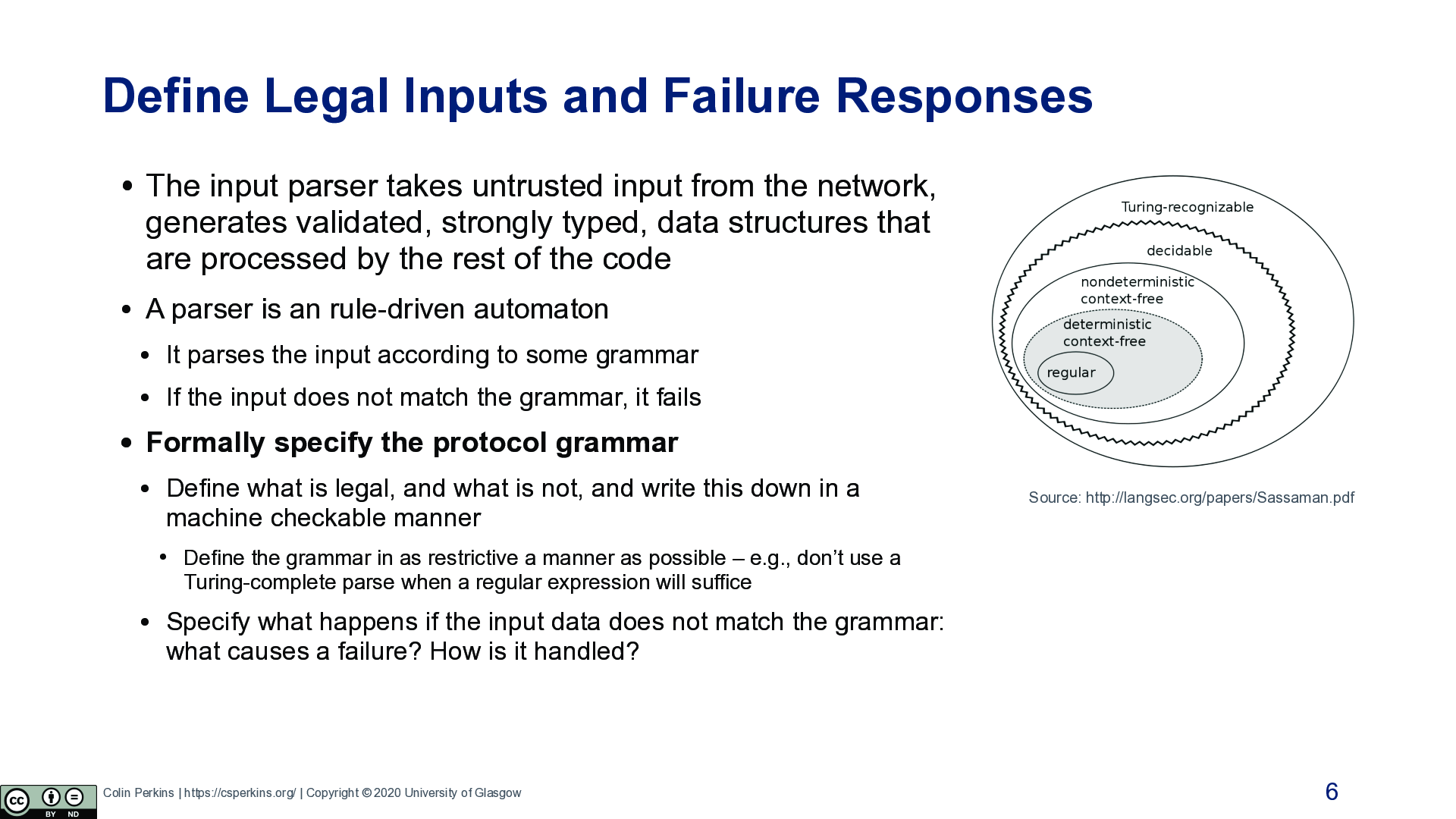
Input parsers are designed to take in
00:08:46.300
untrusted data, validate it, and generate strongly-typed,
00:08:51.233
safe, data which we can then use.
00:08:54.966
They’re taking something which is untrusted and
00:08:57.200
unsafe, and converting it to a form
00:08:59.166
which can be trusted, and which is safe, which is usable.
00:09:04.466
And they do that by parsing the
00:09:06.133
input according to some grammar.
00:09:10.700
And if the input doesn't match the
00:09:12.400
grammar, the parser fails.
00:09:15.533
And the problem, I think, with a
00:09:17.733
lot of traditional protocols, and a lot
00:09:19.966
of traditional parsers, is that it hasn't
00:09:22.033
been clear what that grammar is,
00:09:23.666
and what are the failure conditions.
00:09:26.200
And this is the problem of Postel’s
00:09:28.200
law. It encourages each application to extend
00:09:31.266
the grammar in arbitrary ways, to be
00:09:33.800
a little bit flexible, a little bit
00:09:36.833
forgiving of giving of different inputs,
00:09:39.700
malformed inputs.
00:09:42.400
And that leads to inconsistencies, systems which
00:09:45.733
work in some cases, which
00:09:47.666
don't work in other cases.
00:09:52.066
And those inconsistencies in behaviour leads to
00:09:56.600
gaps, where particular implementations can be exploited.
00:10:02.166
So, we should define what's legal,
00:10:04.100
and what's not, and write this down
00:10:06.100
in a machine readable way.
00:10:07.766
Ideally, we should do this in the
00:10:09.566
protocol specification, the protocol standard, so every
00:10:12.700
implementation can use the exact same grammar,
00:10:16.166
and accepts the exact same inputs,
00:10:18.266
and there's no ambiguity, non inconsistency,
00:10:20.366
in what's acceptable and what isn't.
00:10:23.633
And Ideally, we should do this in
00:10:25.266
as restrictive a manner as possible.
00:10:28.000
The grammar should be as restricted as
00:10:31.766
it's feasible to do so.
00:10:34.166
Because the more expressive power we have,
00:10:36.300
the more likely we are to have risks,
00:10:39.100
the more scope for vulnerabilities, the more
00:10:42.533
scope for ambiguity.
00:10:46.066
And importantly, we should specify what happens
00:10:48.366
if the data doesn't match the grammar.
00:10:50.866
We should specify what causes a failure,
00:10:53.333
and how failures are handled. And,
00:10:55.500
ideally, we should do so in the
00:10:57.000
standard. But if the standard doesn't do
00:10:58.866
this, every implementation has to do it itself.
00:11:02.500
It has to be clear what it's
00:11:04.866
accepting, and what it's not accepting.
00:11:13.566
And once we've done this, we should
00:11:15.733
automatically generate the parsing code.
00:11:20.566
We should automatically generate the parsing code,
00:11:23.233
using the simplest possible parsing technique.
00:11:26.333
If we've got a regular input language,
00:11:28.666
we should use a regular expression.
00:11:30.366
If we've got a context-free grammar we
00:11:32.266
should use a context-free parser.
00:11:34.966
If need be we should use more
00:11:37.166
sophisticated parsing techniques, but we should use
00:11:39.433
those of the minimal computational power to
00:11:41.633
minimise the ambiguity, minimise the risks,
00:11:44.400
if we mess up.
00:11:46.500
And we should generate strongly-typed data structures,
00:11:49.266
with explicit types to identify the different
00:11:51.433
types of data, so we know what
00:11:53.533
has been parsed, we know that it
00:11:55.133
conforms to a particular legal set of values.
00:11:59.466
And we should do this automatically using
00:12:02.166
tools which can be validated.
00:12:05.166
And a lot of the problem here
00:12:06.700
is that people try to write parsers by hand.
00:12:10.400
And manually written, ad-hoc, parsing code is
00:12:13.133
very difficult to reason about.
00:12:16.166
It tends to perform low-level bit manipulation.
00:12:19.600
It tends to perform detailed string parsing.
00:12:22.266
And all of this is hard to get right, hard to structure.
00:12:27.900
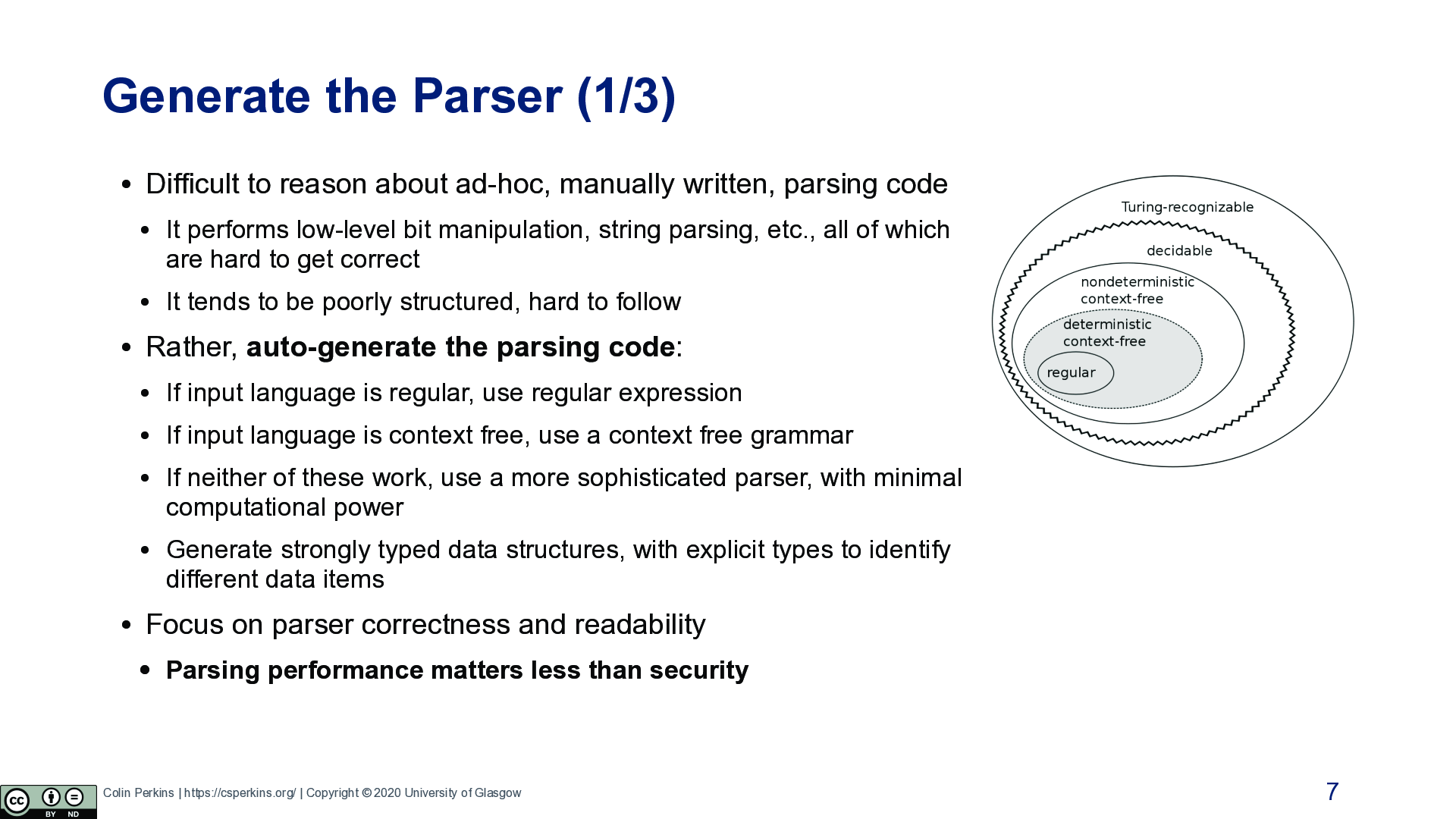
But we know about parsers. There's a
00:12:30.866
whole theory of how to design parsers,
00:12:34.533
and a whole grammar hierarchy, which you see on
00:12:37.333
the right hand side of the slide,
00:12:40.566
which talks about expressivity of the different
00:12:43.300
types of parsers. And there’s a whole
00:12:45.166
bunch of techniques for structuring parsers.
00:12:47.666
So we can write down a grammar,
00:12:50.400
we can formally verify the grammar,
00:12:52.200
we can formally generated a parser automatically
00:12:55.166
from that grammar, and we know that
00:12:56.800
it's consistent, and that it’s correct.
00:13:00.900
And I think the key goal is
00:13:02.300
to focus on parser correctness and readability.
00:13:05.300
Performance matters much less than getting this
00:13:07.466
right, getting this to be secure.
00:13:13.266
One of the key things we can
00:13:15.433
do to improve the security of systems code,
00:13:18.766
is use existing, well-tested, parser libraries.
00:13:23.466
And use them as the input side
00:13:27.533
of our networked applications.
00:13:30.700
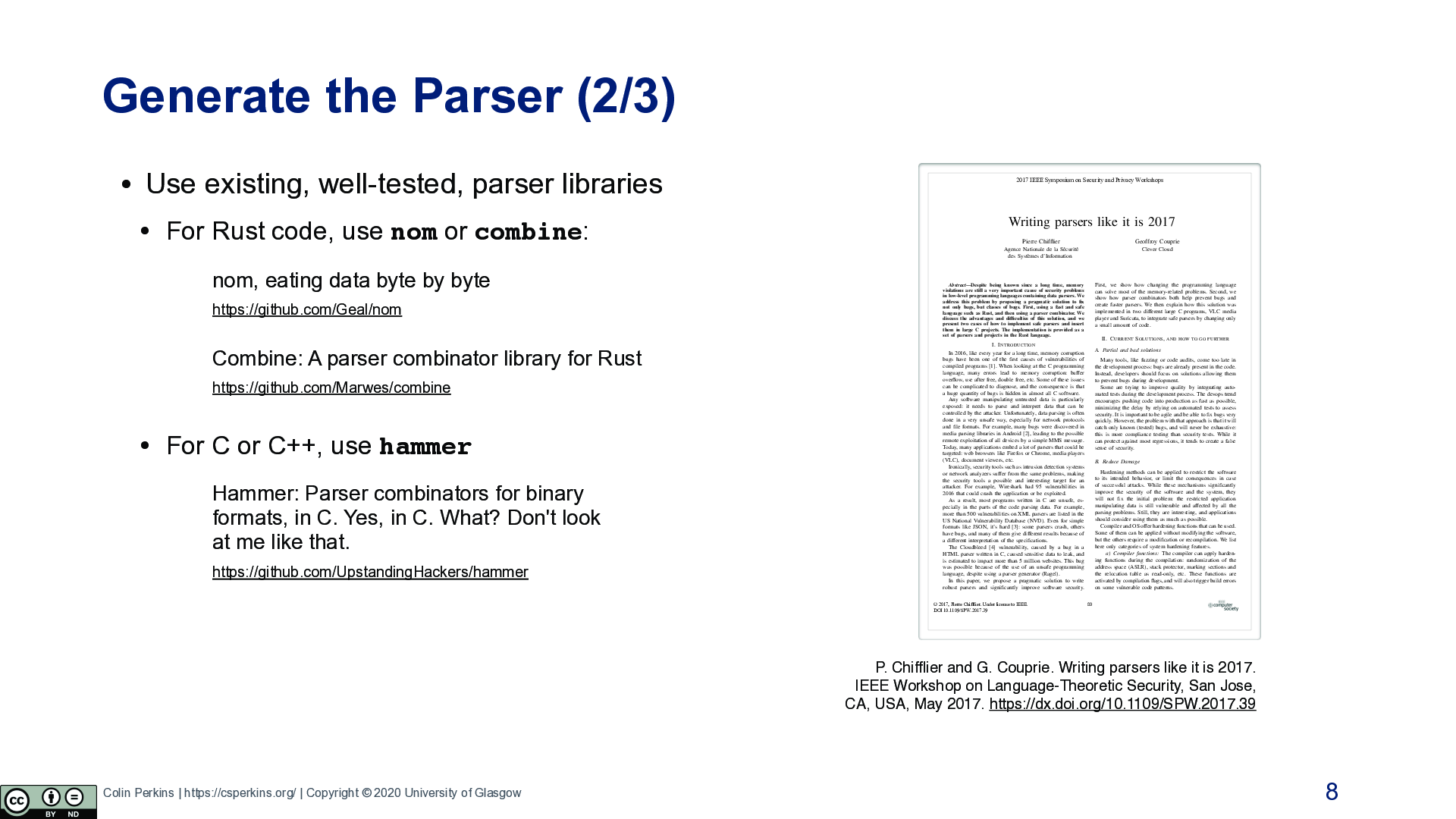
If you're writing Rust code, use something
00:13:33.133
like nom or combine. Well-tested, well-structured,
00:13:37.933
parser combinator libraries, which let you
00:13:41.366
easily specify the grammar, easily specify the
00:13:44.133
parsing rules.
00:13:45.900
If you're using C or C++,
00:13:48.433
use the Hammer parser which, again,
00:13:51.233
is designed to be robust, designed to
00:13:55.266
be testable and to fail in structured,
00:13:58.333
well-defined, ways.
00:14:01.133
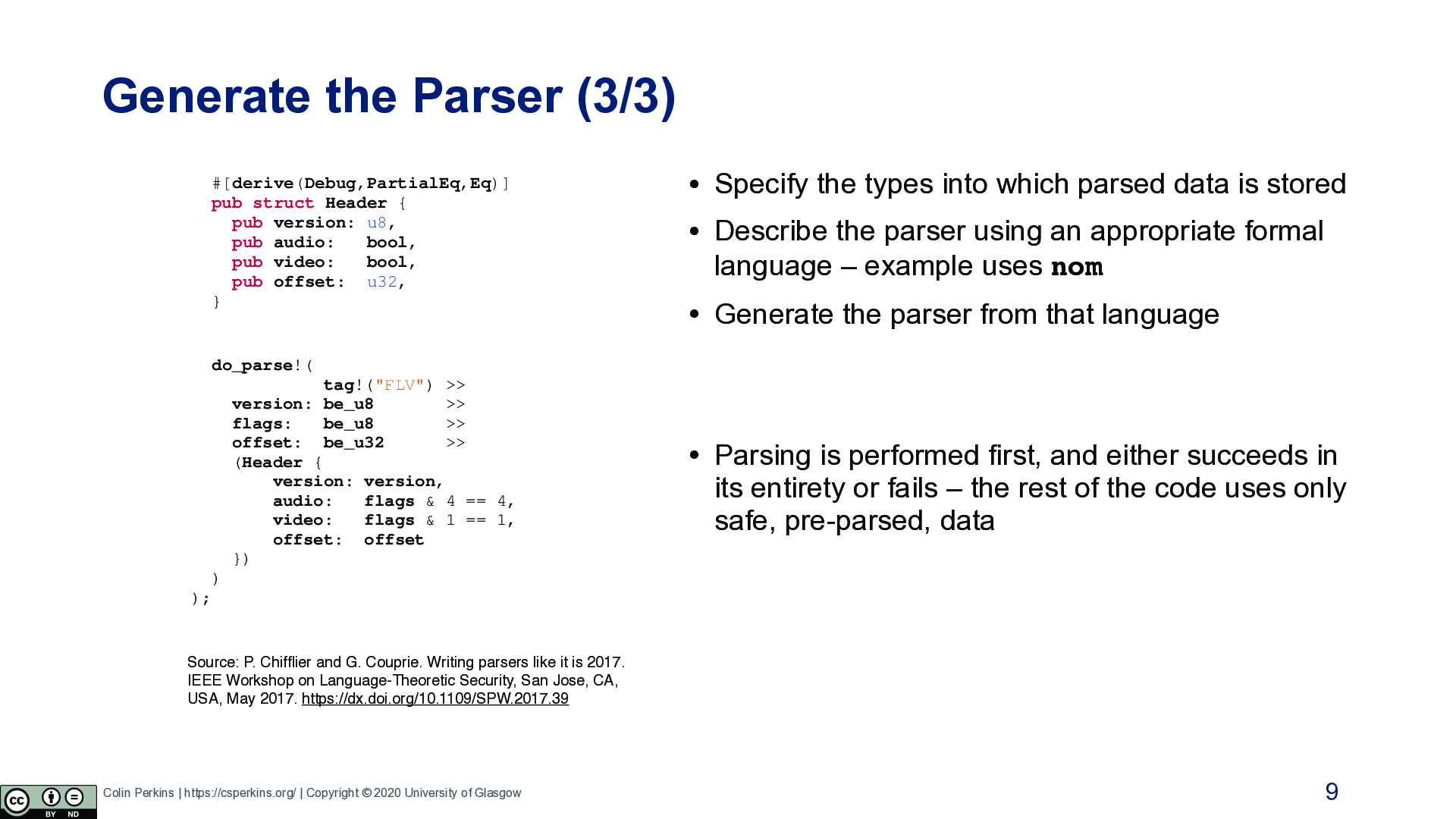
Read this paper, “Writing Parsers like it
00:14:06.966
is 2017”, and this shows how this
00:14:09.733
is not a new idea, which talks
00:14:12.600
about how to make robust parsers.
00:14:17.766
Specify the types into which the data
00:14:20.533
is parsed, describe the parser using a
00:14:22.833
formal language, generate the parser from that language.
00:14:28.000
And ensure that the parsing is performed
00:14:30.633
first, and either succeeds or fails in
00:14:33.000
its entirety. And then, if it succeeds,
00:14:35.500
you have safe, pre-parsed, structured, strongly-typed,
00:14:38.733
data on which to build the rest of the code.
00:14:45.066
Input parsers are difficult.
00:14:48.966
They’re very difficult to get right,
00:14:50.900
if written in an ad-hoc way.
00:14:52.500
And, especially, if written in a low-level
00:14:54.233
memory unsafe language, because they involve lots
00:14:57.066
of bit manipulation, lots of string handling,
00:14:59.166
which are the features which are the
00:15:00.666
hardest in those languages.
00:15:03.000
Yet we have tools, we have parser
00:15:05.366
generator tools, so let's make use of them.
00:15:08.266
Even if we're still using C or
00:15:10.033
C++, we've got tools that can make this safer.
00:15:17.400
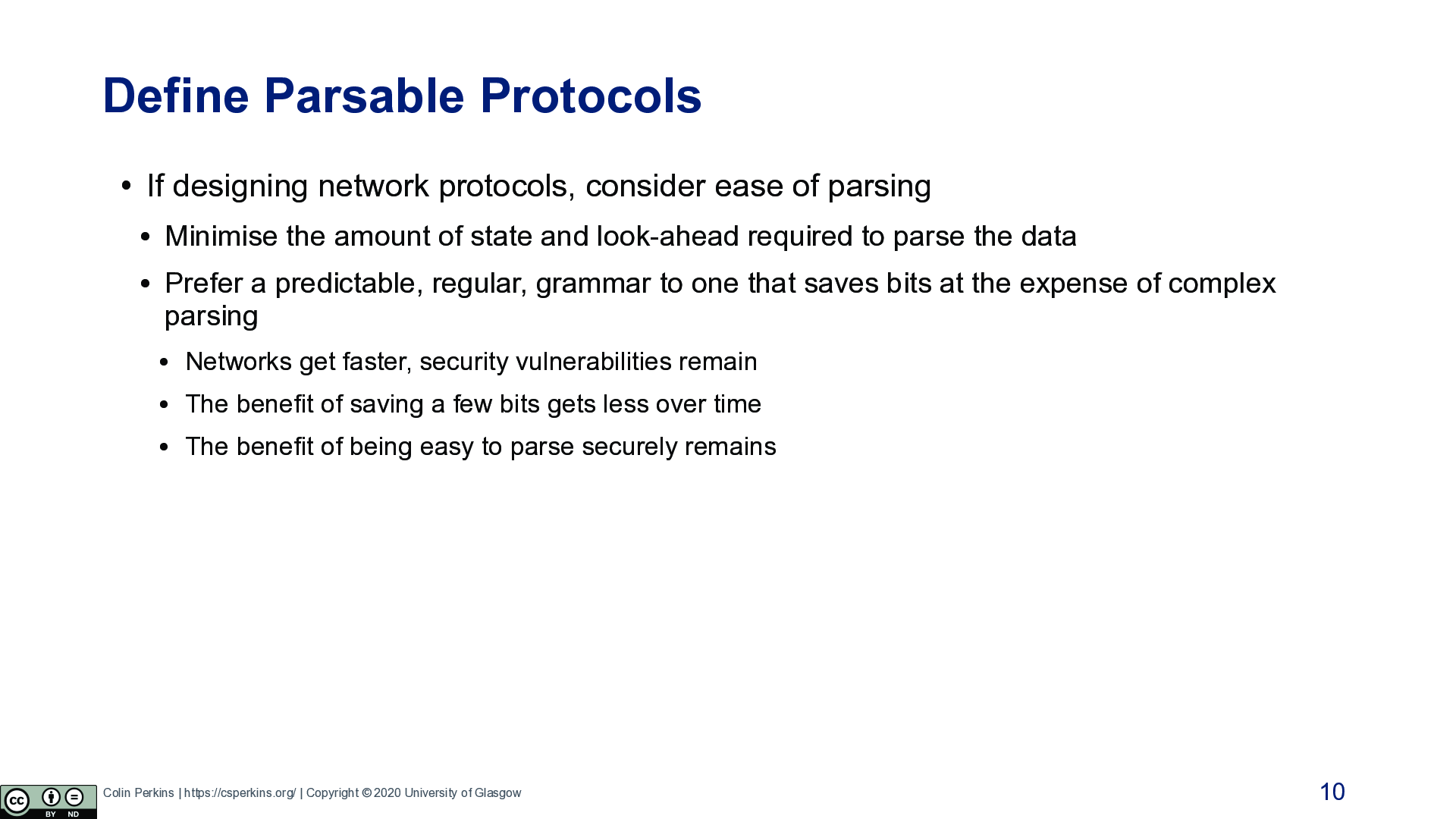
And when we're designing
00:15:19.500
network protocols, we should be thinking about
00:15:22.800
ease of parsing.
00:15:25.266
We should be thinking about minimising the
00:15:27.700
amount of state, the amount of look-ahead
00:15:30.000
required to parse the protocol data.
00:15:32.900
We should be thinking about the complexity
00:15:35.366
of the format, and how easy it
00:15:38.000
is to parse, or not to parse.
00:15:41.633
We should be designing network protocols,
00:15:44.233
such they are predictable, such that they
00:15:46.500
can be parsed using regular expressions,
00:15:49.200
or context free grammars, rather than needing
00:15:51.766
complex, state-dependent parsing, because that allows us
00:15:55.333
to use simpler parser generators, and simpler
00:15:57.900
parsing code, and reduce the chances of there being bugs.
00:16:03.766
The benefit of saving a few bits,
00:16:06.833
by having a more sophisticated, more complex,
00:16:09.866
format goes down over time, because the
00:16:12.400
networks get faster.
00:16:14.333
The security vulnerabilities remain. We should be
00:16:17.200
aiming for simplicity and ease of parsing,
00:16:19.566
and we should be using the best
00:16:21.033
parsing tools we can to get rid
00:16:22.800
of these vulnerabilities.
00:16:28.500
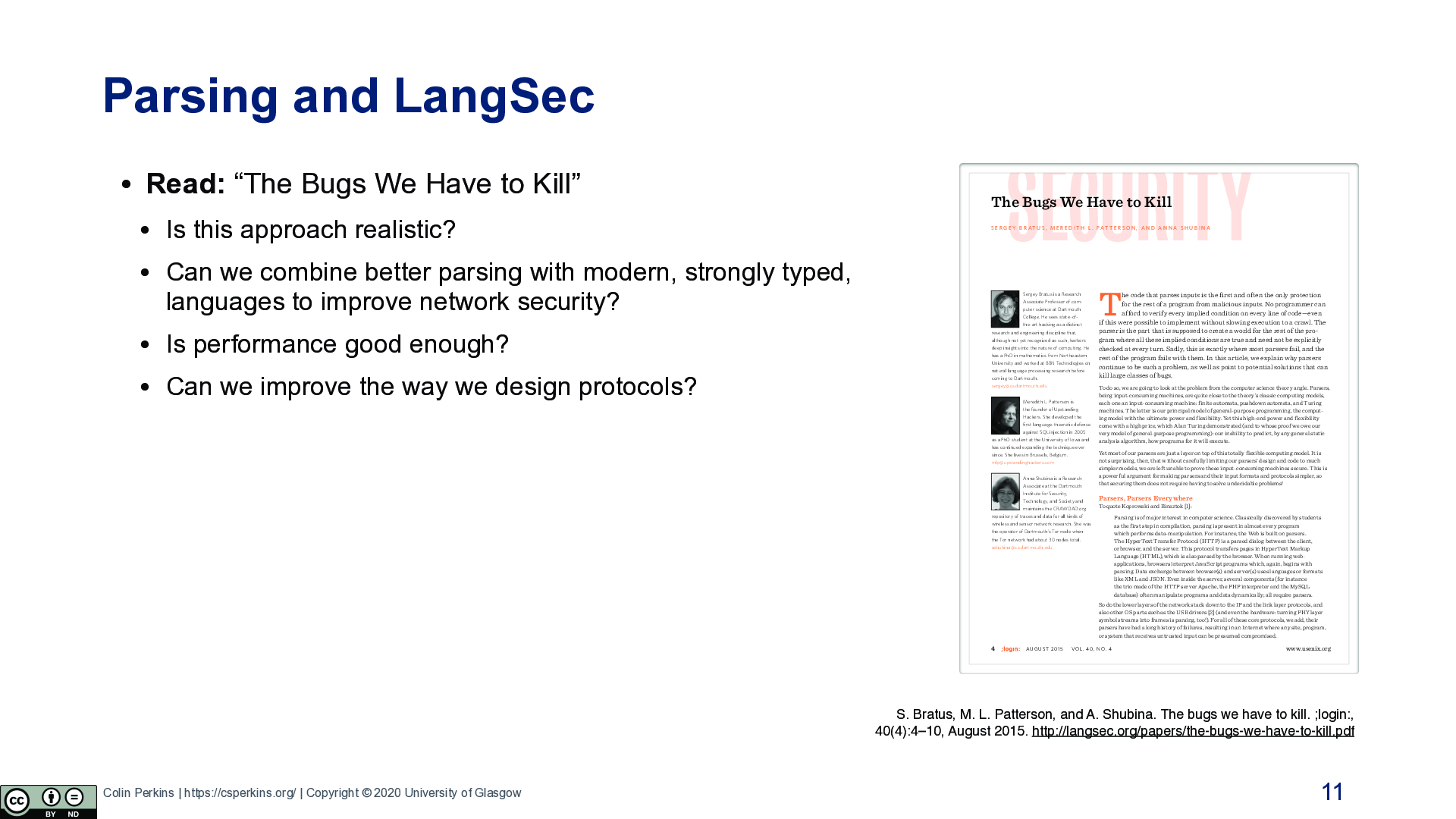
And I would urge you to read
00:16:31.366
this paper, “The Bugs We Have to Kill”,
00:16:36.033
which talks much more in detail about
00:16:39.066
these ideas. It talks about this approach,
00:16:41.866
of using parser generator tools, modern languages,
00:16:45.466
strong type systems.
00:16:47.533
I think we can we can massively
00:16:49.466
improve network security by doing this.
00:16:52.466
We can improve network security by using
00:16:54.966
these techniques, even in unsafe languages.
00:16:58.166
So if you still have to write
00:16:59.733
C or C++ code, think how you
00:17:02.666
write the input parser, think about using a
00:17:05.666
well-tested, well-structured, parsing tool, like Hammer.
00:17:09.466
Write down the grammar, write down the failure conditions.
00:17:13.666
And, ideally, yes, implement this in a
00:17:16.066
safe language, but even if you're not,
00:17:17.866
we have better tools, we just need to use them.
00:17:24.966
That’s all I want to say about parsing.
00:17:27.900
Network security is hard.
00:17:31.033
It is hard to write safe parsers.
00:17:34.966
But we have tools, we have approaches, which can help.
00:17:39.400
I would urge you,
00:17:41.700
whether or not you're using Rust,
00:17:44.300
or C, or C++, or Python,
00:17:46.666
or any other language, write down the
00:17:49.200
grammar which your code is accepting,
00:17:51.966
think about what's legal think, about the
00:17:54.966
failure conditions.
00:17:56.900
Define your parser in a robust, structured, way.
-
M. Thomson and D. Schinazi,
Maintaining Robust Protocols,
Internet Architecture Board, June 2023, RFC 9413.
-
P. Chifflier and G. Couprie,
Writing parsers like it is 2017,
IEEE Workshop on Language-Theoretic Security, San Jose, CA, USA, May 2017.
-
S. Bratus, M. L. Patterson, and A. Shubina,
The bugs we have to kill,
;login:, 40(4):4–10, August 2015.
Part 3: Modern Type Systems and Security
The final part of the lecture discusses some non-memory safety related
causes of security vulnerabilities in networked applications. It notes
that these often result from a failure to make assumptions explicit in
code, allowing an attacker to exploit inconsistent behaviour to cause
a program to do something unexpected. The implications of type-driven
development in strongly typed languages for forcing assumption to be
made explicit, and in checking designs for consistency, is noted, as
a likely driver to reduce the likelihood that vulnerabilities exist.
It's noted that memory safety, the use of strongly typed languages, and
type driven design won't eliminate security vulnerabilities, but they
do have the potential to reduce their prevalence.
00:00:00.500
In this final part of the lecture,
00:00:02.333
I want to look about modern type
00:00:03.833
systems, and how they can help build secure systems.
00:00:08.200
I’ll talk about how modern type systems
00:00:10.066
help us make some of the assumptions
00:00:12.200
in our code explicit, and how they
00:00:14.066
help us eliminate undefined behaviour, and how
00:00:16.733
this can help improve the security of networked systems.
00:00:22.900
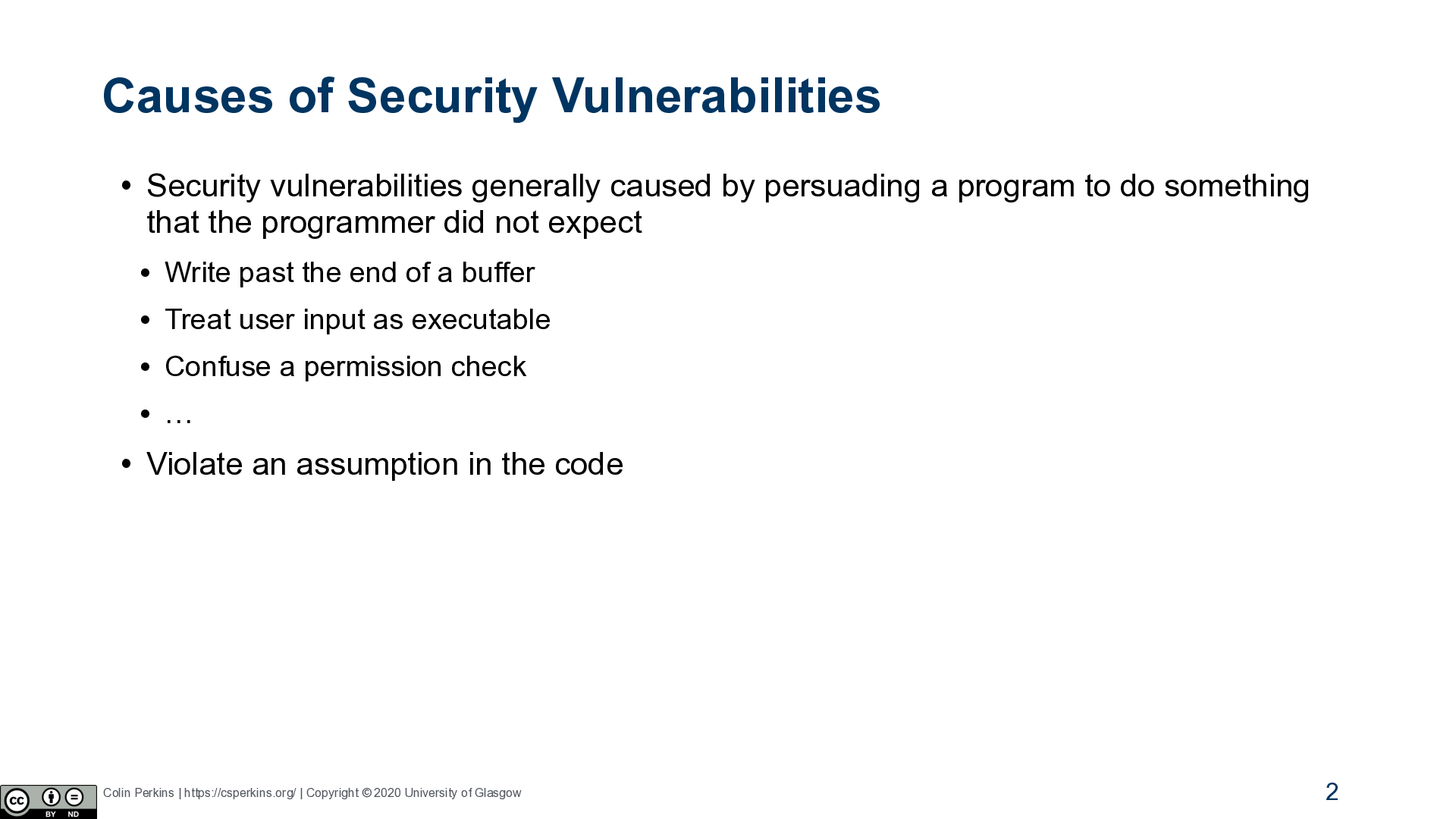
So what causes security vulnerabilities in systems?
00:00:28.900
Well, they tend to be caused by
00:00:34.333
the attacker persuading the program to do
00:00:37.600
something which the programmer didn't expect.
00:00:41.933
Security vulnerabilities occur when the attacker can
00:00:46.633
persuade the program to violate it’s assumptions.
00:00:50.766
If you can persuade the program to
00:00:52.433
write past the end of a buffer,
00:00:53.966
in a memory unsafe language,
00:00:56.466
and corrupt the state, which can then
00:00:59.200
cause it to behave in an unexpected
00:01:01.166
way. If you can persuade the program
00:01:04.066
to treat user input data as executable
00:01:07.233
somehow, by misusing using escape characters for
00:01:10.500
example. If you can confuse a permission
00:01:13.166
check somehow. Or any other type of
00:01:16.366
behaviour which the attacker can force the
00:01:19.766
program to do, which the programmer isn't expecting.
00:01:24.466
Essentially, the goal of an attacker,
00:01:26.833
the goal of someone who is trying
00:01:28.733
to break into a networked system,
00:01:30.366
is to violate the assumptions in the code.
00:01:33.533
To confuse the program into doing something
00:01:36.666
which is not expected to do.
00:01:40.500
A consequence of that, is that anything
00:01:43.533
we can do to make the assumptions
00:01:45.733
explicit, and check those assumptions, helps avoid
00:01:49.766
security vulnerabilities.
00:01:54.833
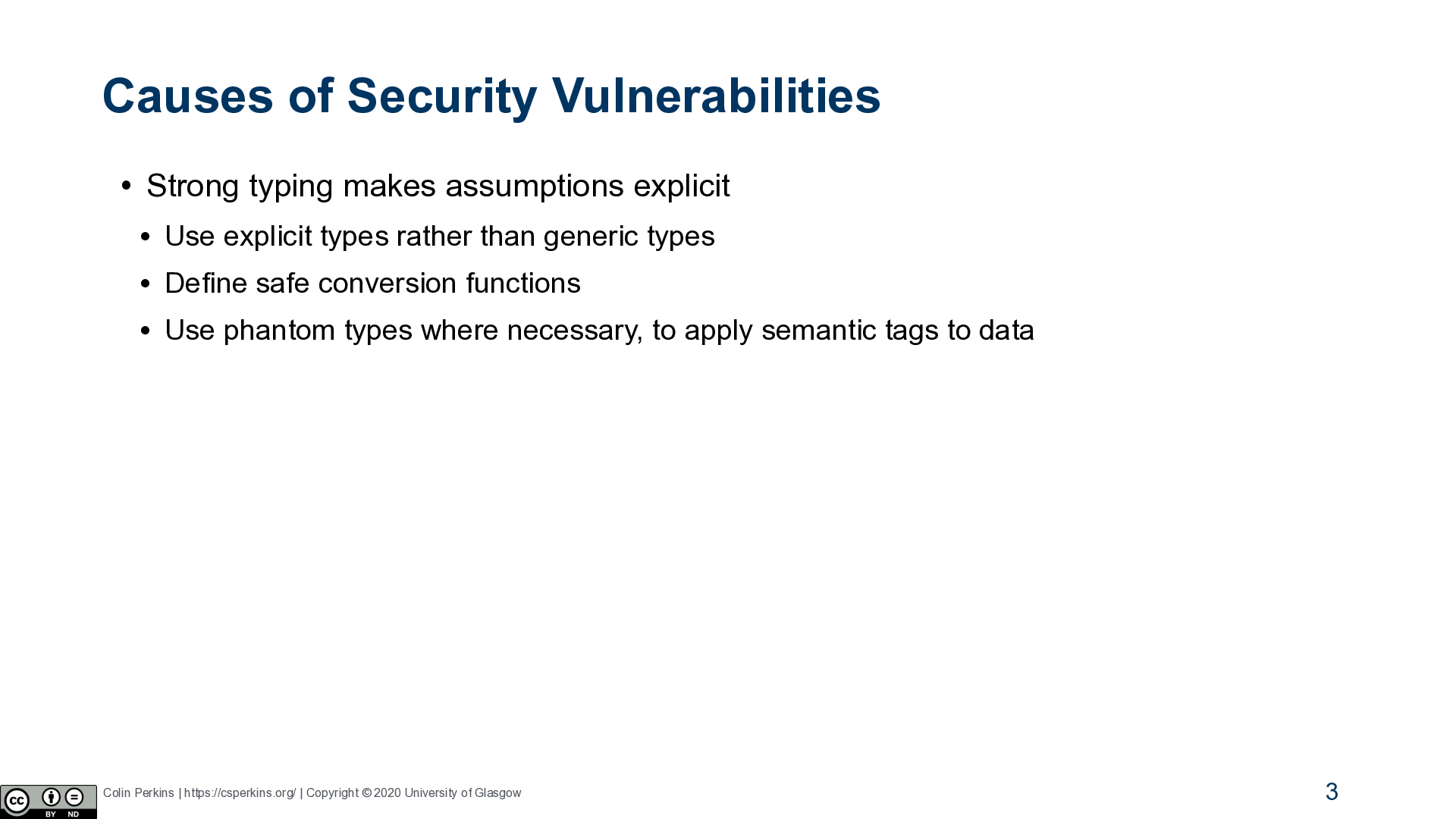
A lot of the reason why I’ve
00:01:57.133
been highlighting, and emphasising, strong typing,
00:02:01.266
is that strong types make the assumptions explicit.
00:02:06.133
They let the compiler check that what
00:02:09.733
we're doing in the program makes sense.
00:02:15.766
And for this reason, I would argue
00:02:19.733
that strong typing helps reduce the security
00:02:22.700
vulnerabilities in code.
00:02:26.266
By using explicit types rather than generic
00:02:29.166
types, by defining conversion functions, by using
00:02:33.500
the type system to add semantic tags
00:02:35.733
to the data to help us understand
00:02:37.633
what it means,
00:02:39.266
we can be clear how the data
00:02:41.466
should be processed. We can be clear
00:02:44.700
what the data is, what has been done to it,
00:02:48.900
and what are the legal operations on
00:02:52.000
that data. And by clearly specifying the
00:02:54.966
legal operations, we can have the compiler
00:02:57.833
help us check that illegal operations are not performed.
00:03:02.866
And this, I think, is key to
00:03:04.833
improving the security of systems.
00:03:07.466
Most security vulnerabilities are not complex.
00:03:11.733
They’re not subtle, magic, misbehaviours.
00:03:16.666
They’re simple things, simple checks which have
00:03:19.466
been forgotten.
00:03:21.633
And the more we can express the
00:03:23.366
desired behaviour in the code, the more
00:03:25.566
the compiler can help us make sure
00:03:27.533
that we don't forget those checks.
00:03:33.966
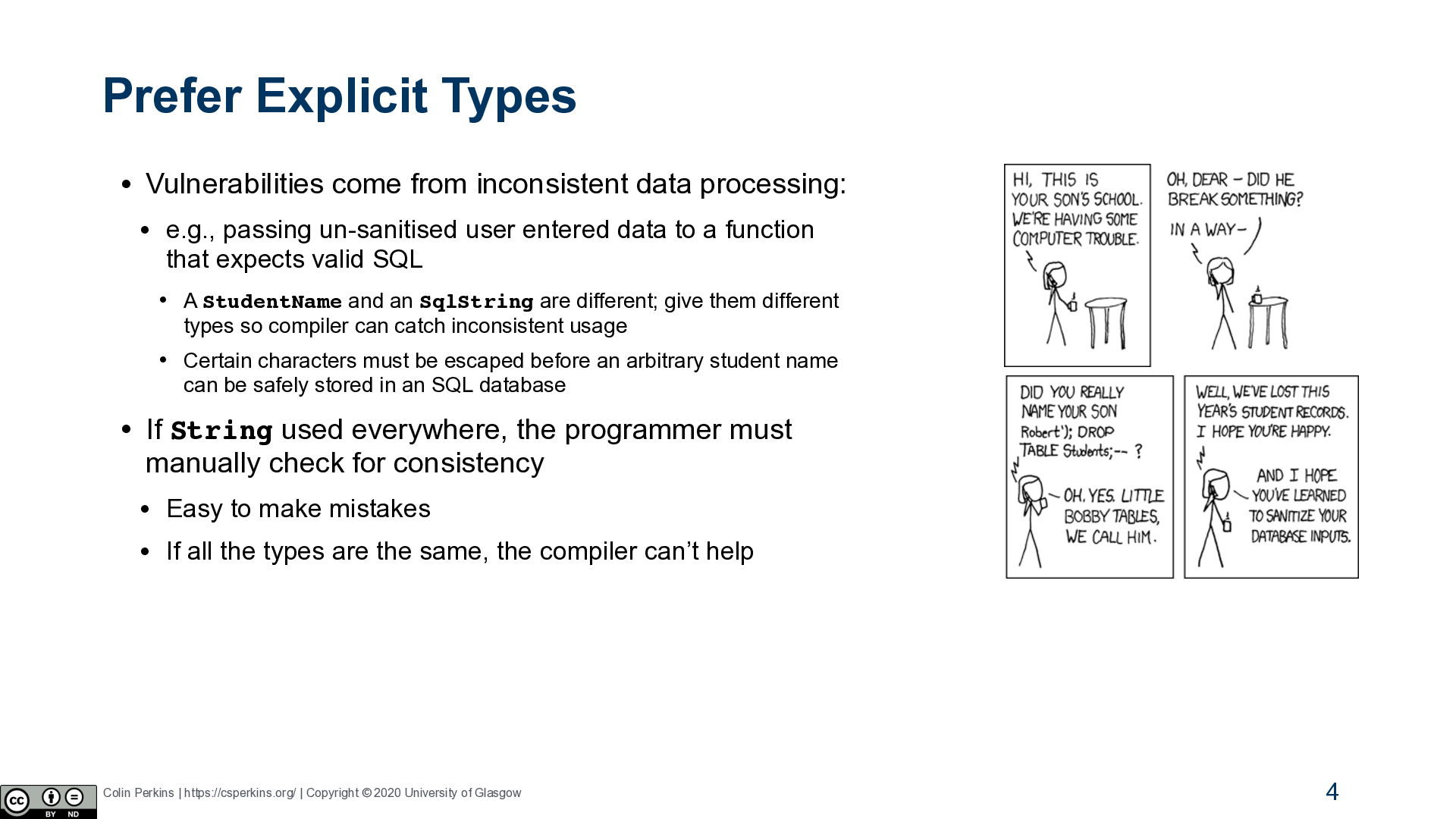
When dealing with data, you should prefer
00:03:36.766
explicit types. A lot of the reason
00:03:39.766
for this, is because vulnerabilities come from
00:03:42.533
inconsistent data processing.
00:03:45.466
It's easy to accidentally take data which
00:03:48.133
arrives off the network,
00:03:49.766
and pass it, un-sanitised, to a function
00:03:53.233
which processes that data and execute that data.
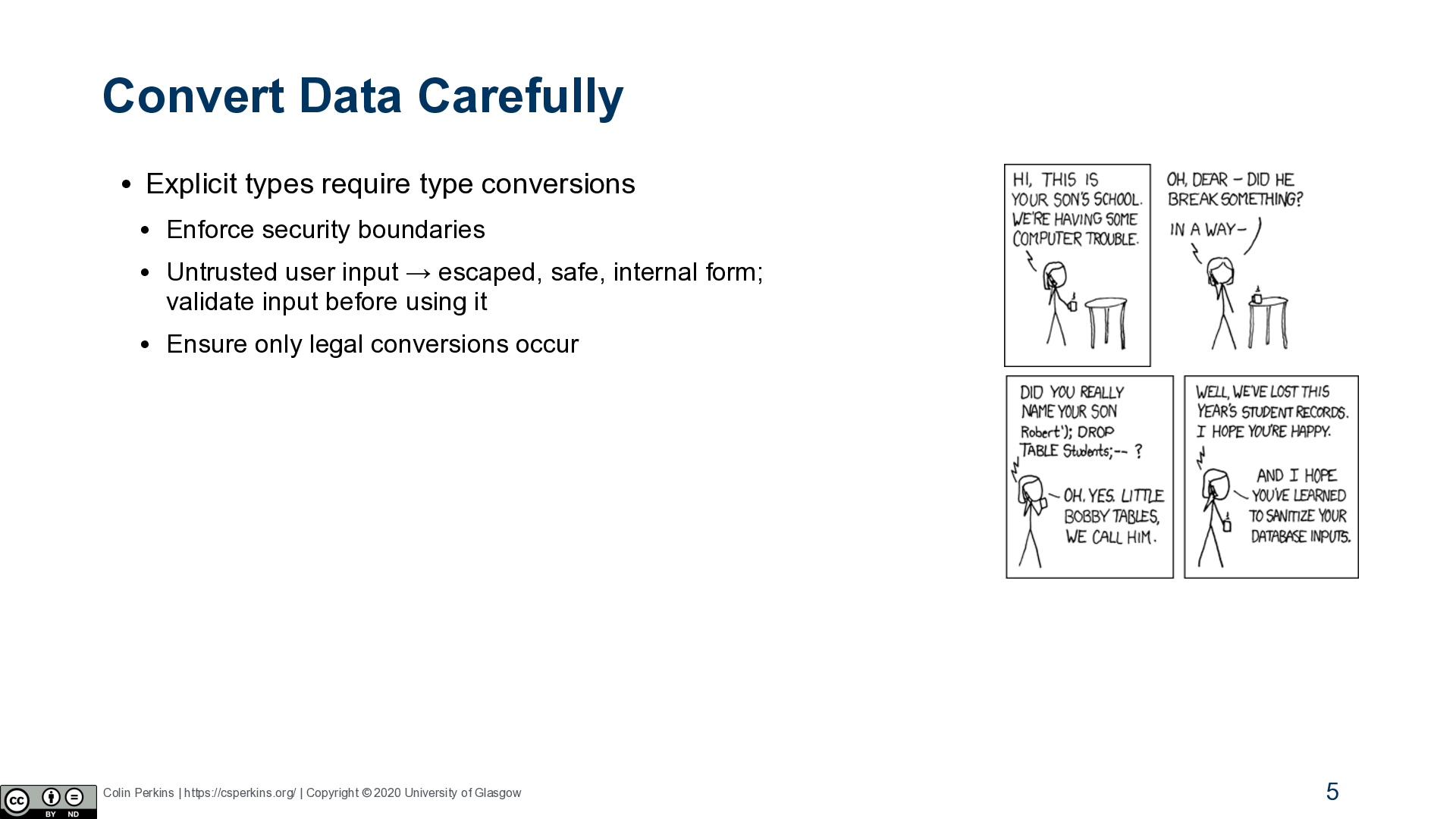
00:03:57.166
The XKCD cartoon, which is pretty well-known,
00:04:03.133
on the slide, is an example of
00:04:05.333
this, where you're taking some input data,
00:04:08.400
in this case the student’s name,
00:04:10.866
and accidentally passing it to a function
00:04:13.200
that expects valid SQL data. And because
00:04:15.766
the student’s name has a valid SQL
00:04:18.233
command embedded within it, it gets executed
00:04:20.833
and corrupts the database.
00:04:23.366
And this type of bug happens,
00:04:25.666
because we're conflating different types of data.
00:04:29.966
Because we're conflating, in this example,
00:04:33.100
a person's name with a set of
00:04:35.700
SQL commands.
00:04:38.733
But student names, and input data,
00:04:41.566
and SQL data, are different types.
00:04:46.066
And it should be possible to write
00:04:48.500
the code in a way that uses
00:04:50.466
one type of value to represent untrusted
00:04:53.766
input data, and another data type to
00:04:56.566
represent SQL commands.
00:05:00.566
And to have a specific conversion function,
00:05:04.533
which converts between the data formats,
00:05:08.200
and validates the data, before making that conversion.
00:05:12.533
And by doing that, by having these
00:05:14.466
different types of data in different types,
00:05:16.333
we can't accidentally pass the data into
00:05:18.333
the wrong function.
00:05:20.500
It stops us accidentally passing untrusted input
00:05:23.933
data as an SQL string.
00:05:27.200
But that only works if we use
00:05:29.233
different types for different things. If we
00:05:31.900
use a string everywhere, then the programmer
00:05:34.800
must keep in their head “is this
00:05:37.700
trusted? Is this untrusted? Has it been
00:05:39.933
validated? Has it been correctly escaped?”
00:05:42.733
And it's easy to make mistakes.
00:05:46.233
If we use the same type everywhere,
00:05:48.566
if we use the same string type
00:05:50.200
to represent input data from the network
00:05:52.766
and student names, as we use to
00:05:55.200
represent the SQL commands, the compiler can't help us.
00:06:00.866
So my first suggestion: to improve the
00:06:04.266
security of your systems, think about what
00:06:07.200
the different types are, and use different
00:06:09.633
types to represent different sorts of data.
00:06:14.033
Use a different type to represent the
00:06:16.400
parsed, validated, trusted, data, from that used
00:06:20.966
to represent the untrusted input data,
00:06:23.400
and carefully convert between them.
00:06:28.000
Make sure when you are converting data,
00:06:30.733
make sure that there are explicit type
00:06:32.500
conversion functions, and use these to enforce
00:06:35.466
the security boundaries.
00:06:40.133
Untrusted input data
00:06:43.566
is one thing, it needs to be
00:06:45.100
handled with care. But we can process
00:06:47.466
it, we can escape it, we can
00:06:49.433
try to convert it to some safe,
00:06:51.333
trusted, internal form,
00:06:53.066
making sure that all of meta characters,
00:06:55.133
the escape sequences, and so on have
00:06:57.100
been correctly handled. We can validate it
00:06:59.733
before we're using it.
00:07:01.800
And we can write explicit conversion functions,
00:07:04.600
to convert between the type representing the
00:07:06.566
input data, and the type representing the
00:07:08.600
data to be processed.
00:07:10.666
And this can ensure that only legal
00:07:12.833
conversions occur, and it can ensure that,
00:07:14.966
in order to convert the data,
00:07:16.566
it has to be validated.
00:07:19.566
And this combination, of using different types
00:07:22.966
for input data and parsed, processed,
00:07:25.566
validated, data, and explicit conversion functions,
00:07:29.933
and making sure the only way to
00:07:31.966
convert between those types is by using
00:07:34.100
a valid, validating, conversion function, makes sure
00:07:37.700
that only legal conversions can happen.
00:07:40.433
And helps make sure that we don't
00:07:42.233
accidentally pass untrusted data
00:07:44.100
somewhere where we shouldn’t.
00:07:47.433
It's a way of enforcing the security
00:07:49.566
boundaries, a way of distinguishing secure and
00:07:52.033
insecure data,
00:07:53.900
and of only allowing conversions between those
00:07:56.633
that validate the data integrity.
00:08:02.366
And we should think about ways of
00:08:05.800
labelling the data, ways of labelling whether
00:08:10.466
data has been checked or not,
00:08:12.833
and ways of tagging it with the
00:08:14.733
assumptions were making about its processing.
00:08:18.933
And in languages like Rust, or many
00:08:22.666
other more modern strongly-typed languages,
00:08:26.333
it's entirely possible to add tags to
00:08:29.800
the types.
00:08:32.833
It's entirely possible in Rust, for example,
00:08:35.666
to define a struct that has no fields.
00:08:38.600
And the result has no size,
00:08:40.533
because it has no content, but it
00:08:42.766
can be used as a parameter,
00:08:44.666
as a type parameter, to add a
00:08:46.500
semantic tags to the data.
00:08:50.233
So in the example we define two
00:08:52.033
structs, UserInput and Sanitised,
00:08:56.133
both of which are empty. They have
00:08:58.166
no size, no fields and therefore no
00:09:00.233
size, but we tag the Html type with a
00:09:05.566
type parameter, which is either UserInput or Sanitised.
00:09:11.500
And we can write a sanitise_html() function,
00:09:14.400
that takes HTML in the form of
00:09:16.633
user input, and returns sanitised HTML,
00:09:20.600
to convert between the two forms,
00:09:23.466
and we can make sure that everything
00:09:25.400
that takes HTML takes one of these two variants.
00:09:28.866
So we can use it to represent
00:09:30.766
whether a particular processing step has been
00:09:33.266
performed. We can use it to represent
00:09:35.800
states in the various state machines that
00:09:37.700
define the behaviour in the system,
00:09:39.566
as we saw earlier in the course.
00:09:43.000
Again, the point is to label the
00:09:45.966
data, to specify what has been done
00:09:48.933
to the data, to make the assumptions explicit.
00:09:53.266
And then the compiler can help us,
00:09:55.433
by checking that the data we're passing
00:09:58.100
around has been correctly tagged
00:10:00.033
as having had the particular
00:10:03.200
sanitising operations performed.
00:10:07.200
It doesn't stop the bugs,
00:10:11.466
it just limits the scope of them.
00:10:14.866
If we mess up, if we
00:10:17.666
write the conversions wrongly, the compiler can
00:10:20.033
detect the problems for us.
00:10:25.866
And, to be clear,
00:10:28.166
the use of memory safe languages,
00:10:30.500
the use of strong typing, the use of
00:10:34.066
explicit types, different types for validated or
00:10:38.366
unvalidated data, conversion functions, semantic tags,
00:10:42.633
all of these things are not going
00:10:44.433
to eliminate security vulnerabilities.
00:10:48.533
The use of memory safe languages is
00:10:50.833
not going to eliminate security vulnerabilities.
00:10:54.600
What they do, though, is eliminate certain
00:10:58.266
classes of vulnerabilities.
00:11:04.066
When we're writing networked code,
00:11:06.433
security critical code in C,
00:11:09.566
we have to be continually on the
00:11:11.766
lookout for buffer overflows, for example.
00:11:16.533
We have to keep debugging code,
00:11:19.866
keep fixing buffer overflows, one at a time.
00:11:24.200
If we write the code in Rust,
00:11:26.900
buffer overflows can't happen.
00:11:30.066
We've eliminated a particular class of vulnerability.
00:11:35.800
This is the benefit of memory safe
00:11:38.966
languages. This is the benefit of strongly-typed
00:11:41.200
languages. It's not that they get rid
00:11:43.500
of security vulnerabilities, it’s that they get
00:11:46.133
rid of particular types of security vulnerability,
00:11:48.733
and let us focus our efforts on the other types.
00:11:53.900
The use of strong typing doesn't get
00:11:56.400
rid of security vulnerabilities, but it lets
00:11:58.833
us make our assumptions clear. It lets
00:12:01.366
us more clearly specify to the compiler
00:12:04.000
what our goal is in writing the
00:12:06.033
code, and the compiler can then help
00:12:08.333
us check that the code meets that goal.
00:12:12.266
And, to the extent that vulnerabilities occur
00:12:15.966
because the attackers have ways of violating
00:12:21.966
those assumptions, spotting the cases we've missed,
00:12:25.500
the more we can specify, so the
00:12:27.633
compiler can help us spot those cases,
00:12:29.966
the less likely it is that these vulnerabilities persist.
00:12:34.700
We're never going to get rid of
00:12:36.400
security vulnerabilities entirely.
00:12:38.333
There's no magic silver bullet here.
00:12:41.900
But we can eliminate certain types of
00:12:44.866
vulnerability. And we can make vulnerabilities in
00:12:48.800
the code which does exist less likely
00:12:51.700
by clearly specifying the assumptions.
00:12:59.966
And, as programmers, we need to start
00:13:03.733
thinking about how we write code.
00:13:11.600
If you look up, for example,
00:13:13.366
the ACM code of ethics,
00:13:16.900
one of the key
00:13:20.000
things every engineer has to do,
00:13:22.566
is avoid causing harm.
00:13:26.566
When we're building systems, whether they're software
00:13:30.166
systems, or bridges, or any other type of engineering,
00:13:35.533
we have to avoid causing harm.
00:13:39.966
And for the Civil Engineers, that means
00:13:42.033
using appropriate techniques to build the bridges
00:13:44.500
such that they don't fall down.
00:13:47.200
For the software engineers, it means using
00:13:50.033
appropriate techniques to make sure our software
00:13:52.266
doesn't cause harm.
00:13:55.766
And, unfortunately, security vulnerabilities,
00:13:58.566
and software failures, do routinely cause harm.
00:14:06.466
And I think the question I want
00:14:08.300
you to think about, is whether you
00:14:11.666
are following best practices to avoid that harm.
00:14:16.800
If you're writing a networked system in C,
00:14:20.400
can you actually claim you're following best
00:14:24.200
practices to avoid harm,
00:14:27.433
when we know that a memory unsafe language
00:14:31.000
is likely to suffer from buffer overflows,
00:14:35.033
use after free bugs, race conditions,
00:14:37.733
and so on, which cause security vulnerabilities.
00:14:42.433
Can you justify your professional practice?
00:14:48.100
And I think, we are rapidly getting
00:14:50.800
to the stage where,
00:14:54.700
some sort of software failure or security
00:14:58.633
vulnerability is going to cause significant harm.
00:15:02.066
And that is going to result in a lawsuit.
00:15:06.033
And some software engineer, somewhere, is going
00:15:08.700
to be up in court, and will
00:15:10.766
be asked to justify their processes,
00:15:15.233
and will be asked to justify did
00:15:17.700
you follow best practices?
00:15:21.033
And we all know that people are
00:15:22.666
not perfect, we all know that mistakes happen.
00:15:26.666
And the issue is not making sure
00:15:28.500
that no-one ever makes a mistake.
00:15:31.166
The issue is making sure people follow
00:15:32.966
best practices, to mitigate human errors,
00:15:37.633
and to mitigate risk.
00:15:42.200
And I would argue that the best practice today
00:15:46.433
is using memory safe languages, is using
00:15:49.800
strong type systems, is using structured methodologies
00:15:53.233
for defining our software.
00:15:59.866
And it's not clear that we're necessarily always doing that.
00:16:03.600
But as a community, I think we want to shift
00:16:06.566
towards building software in a in a more structured,
00:16:10.066
more well-defined, more secure, way,
00:16:13.200
before we are forced to, by threat of lawsuit.
00:16:21.133
And that's what I want to say about security.
00:16:24.533
I’ve spoken about memory safety, I’ve talked about how
00:16:28.466
memory unsafe languages have a large number
00:16:31.300
of undefined behaviours, which tend to lead
00:16:34.000
to exploitable vulnerabilities.
00:16:36.833
I spoke a little bit about parsing,
00:16:39.166
the problems of parsing unstructured data,
00:16:44.466
and suggested we need
00:16:47.600
formalised parsing libraries, formal definitions of the
00:16:52.600
input grammar, such that we can be
00:16:54.900
sure what is accepted, and what is
00:16:57.700
not, by our systems, and to reduce
00:16:59.900
some of the risks in parsing untrusted data.
00:17:03.266
And I said a little bit about
00:17:05.033
how by carefully structuring our code,
00:17:07.933
and documenting the assumptions using modern type
00:17:10.966
systems, we can reduce the risks that
00:17:13.700
the system has inconsistencies and unexplainable behaviours.
00:17:21.200
As professional engineers, we need to build
00:17:24.000
systems which are secure and fit for purpose.
00:17:27.966
By gradually moving to
00:17:33.133
memory safe languages, to languages which have
00:17:36.566
stronger type systems, that allow us to
00:17:39.100
formally specify their behaviours,
00:17:41.233
and that help us by checking those
00:17:43.433
behaviours, I think we can start to
00:17:46.433
avoid some of the problems inherent
00:17:49.200
in a lot of code. And I
00:17:52.566
think as professional, ethical, engineers it behooves
00:17:55.566
us to do that.
Discussion
Lecture 9 discussed some security considerations when writing system
programs. It noted the risks due to lack of of memory safety in
programming languages, and how this can lead to undefined behaviour.
And it highlighted some of the types of undefined behaviour that are
possible in C and C++ programs. It outlined how such undefined
behaviour can lead to security vulnerabilities, and presented
statistics showing that more than half of all security problems in
software are due to memory safety issues. It highlighted some of the
tools that are available to help mitigate these problems in C and C++,
and suggested a gradual rewrite of memory unsafe systems into safe
languages.
Part 2 noted that parsing network data is a frequent source of
vulnerabilities, and suggested that parsers can be improved. It
noted that ad-hoc, hand-written, parsing code is commonly not safe or
robust, and suggested the use of formal grammars and parser generator
systems to produce robust input parsers. It noted the limitations of
Postel's law for modern systems, and suggested that robust protocol
implementations, when the protocol is seeing broad deployment, need
to have both a well-defined input grammar but also well-defined failure
modes, if they are to be consistent, robust, and secure.
Finally, part 3 noted that security vulnerabilities are often caused
by adversaries finding a way to exploit inconsistencies and mistaken
assumptions about the way data is processed in a system. It noted that,
while there is no silver bullet, strongly typed languages can help a
programmer to express the constraints and assumptions inherent in a
design, helping the compiler to check the code for consistently. This
can help reduce the risk of security vulnerabilities. The benefits of
strongly typed languages in avoiding common bugs were also noted.
The lecture concluded by discussing the ACM code of ethics, and the
requirement for professional engineers to build systems that do no
harm. It suggested that memory unsafe, weakly typed, systems can no
longer be regarded as best current practice for building many types
of system.
Discussion will focus on the types of undefined behaviour present in
C programs and how they lead to security vulnerabilities. On the
limitations of Postel's law and on the appropriate way to parse data
in networked systems. And on the supposed benefits of strongly typed
languages for security.